
You've found a used golf push cart for sale that looks like a bargain. The photos show a clean frame, the seller says it “works perfectly,” and the price is low enough to make you want to arrange pickup immediately. That's exactly when patience matters. A cart can look fine while hiding a loose wheel, a weak brake, a troublesome folding joint, or a frame that won't accept the upgrade you may want later.
The right purchase isn't the cheapest cart you can find. It's a cart that fits your bag, folds reliably, stops securely, travels easily in your car, and leaves you with sensible options if pushing becomes harder in the future.
Finding Your Perfect Used Golf Push Cart
Start by treating the listing as a screening tool, not proof of condition. Facebook Marketplace can offer convenient local collection and a chance to inspect before paying. SidelineSwap and similar online marketplaces make comparison easier and may show more specialized models, but shipping can make a mediocre deal less attractive. A golf club pro shop or local golf retailer may charge more, yet staff may know the cart's history and can sometimes identify replacement parts.
The market gives buyers plenty of choice. The global golf push and pull cart market is projected to grow at a 9.67% CAGR and reach USD 0.65 billion by 2035, according to Business Research Insights' golf push and pull cart market forecast. That projected expansion supports a healthy secondary market, but it also means you don't need to rush the first acceptable listing.
Read the listing like a mechanic
Look for photographs of the wheel hubs, brake, folding joints, bag supports, handle, and underside of the frame. A listing that only shows a clean side profile tells you very little. Ask the seller:
- Bag fit: What type and size of bag did you use, and did the lower support cradle it securely?
- Folding action: Can you send a short video showing the cart folding and locking?
- Wheel condition: Do the wheels spin freely without wobble, cracking, or scraping?
- Brake performance: Does the brake hold the cart on a slope?
- Included equipment: Are the cup holder, storage pouch, umbrella holder, straps, and other accessories included?
- Upgrade history: Has the frame been modified, drilled, repaired, or fitted with an add-on motor?
A vague answer isn't automatically proof of a bad cart, but it does justify caution. Be wary of missing close-up photographs, unexplained rust, phrases such as “probably fits any bag,” and sellers who won't demonstrate the fold or brake.
Your own needs should narrow the search before you compare prices. This guide to choosing a golf push cart can help you think through wheel layout, storage, bag compatibility, and folding requirements. Three-wheel carts generally turn tightly and weigh less, while four-wheel designs usually sit flatter when parked and offer more confidence on side-hills. Neither layout wins every course, so match the design to the terrain you walk.
Practical rule: If the seller can't answer basic questions about fit, folding, and braking, don't spend your time negotiating the cart. Keep searching.
The Essential On-Site Inspection Checklist
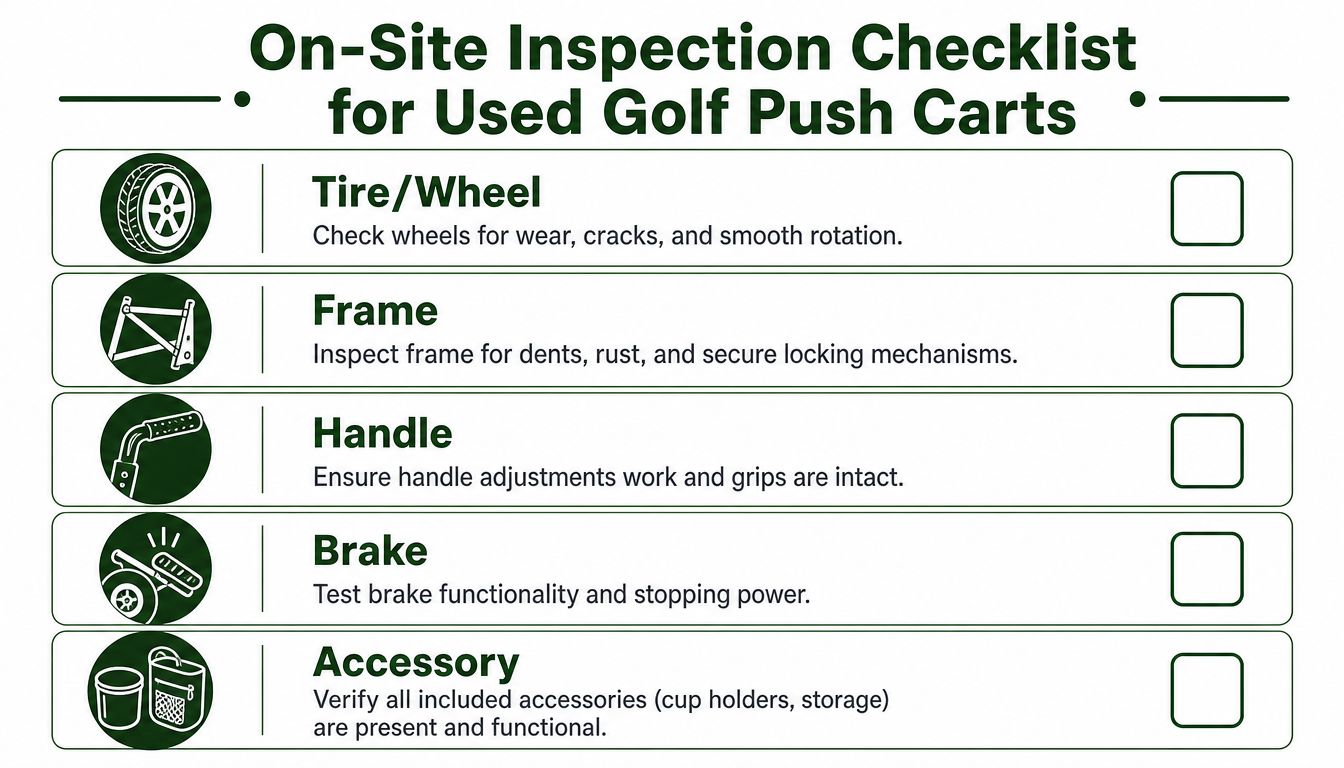
An in-person inspection should take place before payment, even if the cart looks excellent online. Cosmetic cleanliness matters less than how the cart carries weight, folds, rolls, and stops. Bring your own golf bag if possible, because an empty cart can hide a poor fit.
A sound inspection follows four functional checkpoints: bag compatibility, fold and unfold repeatability, brake holding power on an incline, and trunk fit. This practical golf push cart testing guide emphasizes those checks because they affect every round more directly than scratches or faded plastic.
Start with the bag and frame
Place your bag on the lower support and secure the upper strap. Check whether the bag sits centrally or twists toward one side. A stand bag and a cart bag can behave differently, so don't accept “fits all bags” without testing your own equipment.
Inspect the frame from front to back. Look for bent tubing, corrosion around fasteners, cracked plastic at joints, and locking mechanisms that feel loose. Flex the handle gently, but don't force it. A frame that shifts under light pressure may become unstable once loaded.
Examine wheels, bearings, and brake parts
Spin each wheel slowly. It should rotate smoothly, without side-to-side movement, grinding, or a visibly uneven tire. Look closely for cuts, flattened areas, deep tread wear, and cracks in the wheel material. On pneumatic tires, check the valve and ask whether the tire holds air. On solid or airless wheels, focus on tread condition and hub play.
Move the cart over a short distance with the bag loaded. Listen for clicking and observe whether it tracks straight. A cart that pulls sharply may have a damaged wheel, bent axle, or uneven adjustment.
Test the brake on an incline. Engage it fully, place the loaded cart on the slope, and confirm that it stays put. If the seller won't allow this test, treat the brake as unverified and price the cart accordingly.
Fold it more than once
Fold and unfold the cart twice, then repeat the motion with the bag removed and attached again. The mechanism should lock without excessive force, hesitation, or grinding. Check whether the folded cart fits your trunk without removing necessary wheels or accessories.
| Inspection area | What good condition looks like | Warning sign |
|---|---|---|
| Bag cradle | Your bag sits securely and remains centered | Strap slips or bag leans |
| Frame | Rigid, aligned, and free of structural damage | Bends, cracks, or loose joints |
| Wheels | Smooth rotation with controlled tracking | Wobble, scraping, or severe wear |
| Brake | Holds a loaded cart on an incline | Cart creeps or lever feels weak |
| Fold mechanism | Locks consistently with modest effort | Sticking, looseness, or incomplete lock |
Ask the seller to identify every accessory included in the price. Missing parts can turn a cheap cart into an inconvenient one, especially when replacement mounts or straps are difficult to locate. For electric models, inspect the motor, battery housing, charger, wiring, and warranty paperwork separately. Battery condition can matter more than surface wear, and this practical guide to testing battery capacity provides useful background for evaluating powered equipment.
How to Future-Proof Your Push Cart Purchase
A used cart should solve today's walking problem without creating tomorrow's upgrade problem. Many listings say nothing about compatibility with add-on motors, even though golfers may later want to reduce physical strain. This used cart listing example illustrates why frame adaptability deserves attention before purchase.
You don't need to predict every future need. You do need to avoid a frame that leaves no practical way to attach an assist system, secure a battery, or maintain stable steering.
Check the frame before the finish
Use this inspection sequence while the cart is empty, then repeat the key checks with your bag attached:
- Study the rear axle and wheel spacing. Look for a solid, accessible structure around the rear wheel rather than a fragile assembly that flexes under load. An add-on wheel needs a stable mounting area and enough clearance from the tire, frame, and bag.
- Inspect the lower bag rest. The support should hold the bag without blocking the area where an attachment bracket might sit. A very narrow or unusually enclosed lower cradle may limit future options.
- Look for clean, unobstructed tubing. Avoid frames with crushed sections, improvised clamps, welded repairs, or heavy accessories already competing for mounting space. Straight, sound tubing gives you more flexibility.
- Check steering and front-wheel alignment. An electric assist can't compensate for a cart that already pulls to one side. A straight frame and correctly aligned front wheel are more valuable than a decorative accessory.
- Ask for model information. Record the brand and model, then check whether replacement straps, wheels, brake parts, and accessory mounts are still available. A familiar, modular design is usually easier to maintain than an anonymous frame with no parts trail.
Caddie Wheel is one example of a drop-on electric assist designed for standard golf push carts. It uses a snap-in bracket, variable-speed remote control, forward and reverse operation, braking control, and a battery designed to support up to 36 holes per charge. Compatibility still needs to be confirmed for the specific cart, so use the Caddie Wheel electric golf push cart conversion kit information as a starting point rather than assuming every used frame will work.
A future upgrade is only useful if the cart remains stable, aligned, and structurally sound before the motor is attached.
Avoid buying a damaged cart because you believe an electric assist will hide its faults. Motorized assistance adds convenience, but it doesn't repair a bent axle, weak brake, slipping bag strap, or folding mechanism that fails under load. Future-proofing starts with a dependable manual cart.
Determining a Fair Price and Negotiating the Deal
A fair price reflects condition, completeness, functionality, brand, and future repairability. Don't let a recognizable logo distract you from a damaged frame, and don't assume a generic cart is poor value if it rolls smoothly, folds securely, and includes the parts you need.
Used carts can sell at substantial discounts. SidelineSwap reports that list-price savings commonly range from 30% to 70%, with active examples priced around $43, $51, and $90 on its push cart marketplace. Those figures show a wide resale spread, not a universal price guide, so compare the actual cart in front of you with similar listings rather than anchoring to the cheapest result.
Build your comparison before making an offer
Search for the same model first. If you can't find an exact match, compare carts with similar wheel layouts, folding systems, condition, and included accessories. Separate the asking price from the delivered price, since shipping or travel can erase an apparent bargain.
The inspection gives you respectful negotiating advantage:
- Strong mechanical condition: The cart folds, rolls, and brakes correctly, so the seller has a reasonable basis for the asking price.
- Minor consumable wear: Worn grips, tired straps, or aging tires support a modest reduction because you'll need to refresh them.
- Missing accessories: Deduct value for absent cup holders, storage, umbrella mounts, or proprietary hardware.
- Unverified function: If the seller can't demonstrate the brake or folding action, treat that uncertainty as a cost.
- Structural damage: Walk away from a bent frame or questionable repair unless you fully understand the repair and its implications.
A simple offer sounds better than an aggressive one: “I like the cart, but the rear wheel has noticeable play and the storage pouch is missing. Would you take my offer based on those repairs?” That approach connects the number to an observable issue and gives the seller a chance to respond.
The same comparison discipline helps with other golf equipment purchases. If you're researching larger recreational purchases, compare UK golf simulator price points to see how equipment costs vary by configuration and included features. The principle is identical: compare complete setups, not headline prices.
Walk away when the seller won't permit a basic test, the cart has structural damage, or the total cost approaches a dependable new alternative without offering better construction or features. A low sticker price isn't a saving if the cart becomes unusable after the first few rounds.
Post-Purchase Care for Your Used Cart
The first cleaning should happen before the cart goes into regular service. Remove grass, sand, and mud from the wheels, hubs, lower bag rest, and folding joints. Use water and a mild cleaner where appropriate, then dry the cart thoroughly so moisture doesn't remain around fasteners or brake components.
Avoid blasting high-pressure water directly into bearings or joints. Wipe those areas instead, and use a lubricant only where the manufacturer permits it. Excess lubricant can attract grit, especially around folding mechanisms and wheel hubs.
Use a simple maintenance rhythm
After a wet or muddy round, clean the wheels and inspect the brake contact points. Before the next round, confirm that the bag straps still hold firmly and that every folding lock is fully engaged.
At regular intervals, check:
- Wheel movement: Spin each wheel and watch for wobble, scraping, or roughness.
- Frame fasteners: Look for loose bolts, missing hardware, or new movement at joints.
- Handle controls: Confirm that height adjustments lock and the grip remains secure.
- Brake action: Test the brake with the cart loaded, especially before a hilly course.
- Storage condition: Keep the cart indoors or in a dry, protected area rather than leaving it exposed to weather.
If the cart uses pneumatic tires, check the pressure according to the tire or manufacturer guidance. If it uses airless wheels, inspect tread and hub condition instead. Replace small worn parts before they create stress elsewhere. A tired strap is cheaper and easier to address than a bag that shifts into the wheel during a round.
Maintenance also protects resale value. The broader used golf cart market was estimated at USD 2.0 billion in 2024 and is projected to reach USD 3.457 billion by 2035, according to Global Growth Insights' used golf cart market overview. That market includes ride-on carts rather than only manual push carts, but it demonstrates the scale of the wider secondhand golf mobility ecosystem. Clean records, working accessories, and a cart that folds properly make your equipment easier to sell when your needs change.
Your Smart Buyer's Summary
A smart used golf push cart purchase follows a clear order. Find several candidates, question the listing, inspect the actual cart, test it with your bag, and calculate the complete cost before you negotiate. Cosmetic condition comes after mechanical confidence.
Keep these decisions in front of you:
- Choose for your course. Three wheels can provide lighter handling and tighter turning, while four wheels can offer a flatter parked stance and more stability on side-hills.
- Test the four essentials. Your bag must fit, the cart must fold repeatedly, the brake must hold on an incline, and the folded footprint must fit your vehicle.
- Think beyond today. Inspect the axle, lower bag rest, frame tubing, and alignment if you may want electric assistance later.
- Price the cart you're buying. Include missing accessories, worn wheels, replacement parts, travel, and shipping in your judgment.
- Maintain it immediately. Clean the wheels, dry the frame, check fasteners, protect the folding joints, and store the cart away from weather.
That process works for more than golf equipment. Buyers evaluating walking aids, mobility accessories, and other practical gear can also benefit from guidance on finding the right mobility equipment, especially when comfort, fit, durability, and future use matter as much as price.
You're not looking for the oldest cart at the lowest price. You're looking for a sound frame with dependable movement, secure braking, a sensible folded size, and enough adaptability to remain useful as your walking needs evolve.
Caddie Wheel offers a drop-on electric power assist for compatible standard three-wheel and four-wheel golf push carts, with a snap-in bracket, variable-speed remote, forward, reverse, and braking control, and a battery designed for up to 36 holes per charge. Visit Caddie Wheel to check the conversion option before you finalize your used cart purchase.
Share:
Motorized Push Cart for Sale: A Smart Buyer's Guide
Cart Golf Push Guide to Smarter Walking Rounds