
You're standing on the first tee for the second round, legs a little flat, hands already slightly sticky from the heat, and the question isn't whether you can get through the day. It's whether you can still make good swings when the last nine holes start asking for more than your first 18 did. That's the test in 36 holes of golf in one day, especially if you're walking.
What 36 Holes Really Demands When You Walk
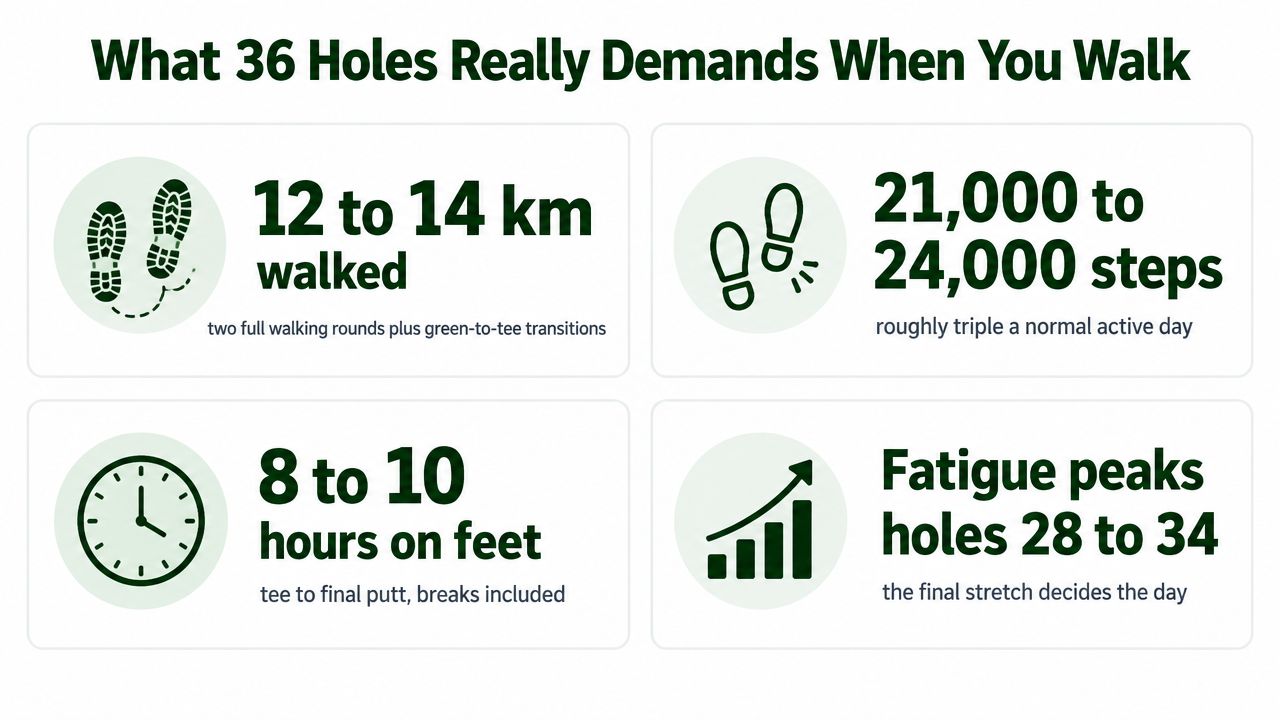
A walking golfer can handle one 18-hole round like a long morning. Two rounds in a day ask for something different. Independent golf-health references commonly put a walking 18 at about 4 to 6 miles, with published estimates often landing near 4.6 miles or roughly 9,200 steps on an average course, and hilly layouts can push a single round closer to 6 miles or more (sportsmonkie.com). A full day can easily become 9 to 12 miles on foot, before you count the extra walking from green to tee, around hazards, and out to practice areas.
That is why 36 holes does not feel like “double 18.” The first round gets you moving. The second round asks whether your pace, fueling, and walking pattern hold up after the body has already started to cash the check. The late-day drop usually shows up first in stride length, then in focus, then in the small choices that keep a round under control. On foot, the test is not a hot start. It is whether your walk, thoughts, and contact stay clean after hour six or seven.
Practical rule: judge the day by the last third, not the first nine. The first round tells you whether you are warm. The second round tells you whether your system works.
Time matters just as much as distance. Independent golf references commonly estimate that one walking 18 takes about 3.5 to 4.5 hours, so a full 36-hole day usually runs 8 to 10 hours with a short break in between (caddietap.golf). That is why the day can feel like an endurance effort rather than a long recreational outing.
The best mental model is simple. You are not trying to survive 36 holes. You are trying to keep enough energy in reserve that holes 28 to 34 still look like golf, not damage control. That is where walking-specific planning matters more than grit. A useful walking guide for golfers is available in this practical course-walking resource, and it matches the same basic truth, the less waste you create early, the more game you have late.
Building Your 36 Hole Schedule and Pace Plan
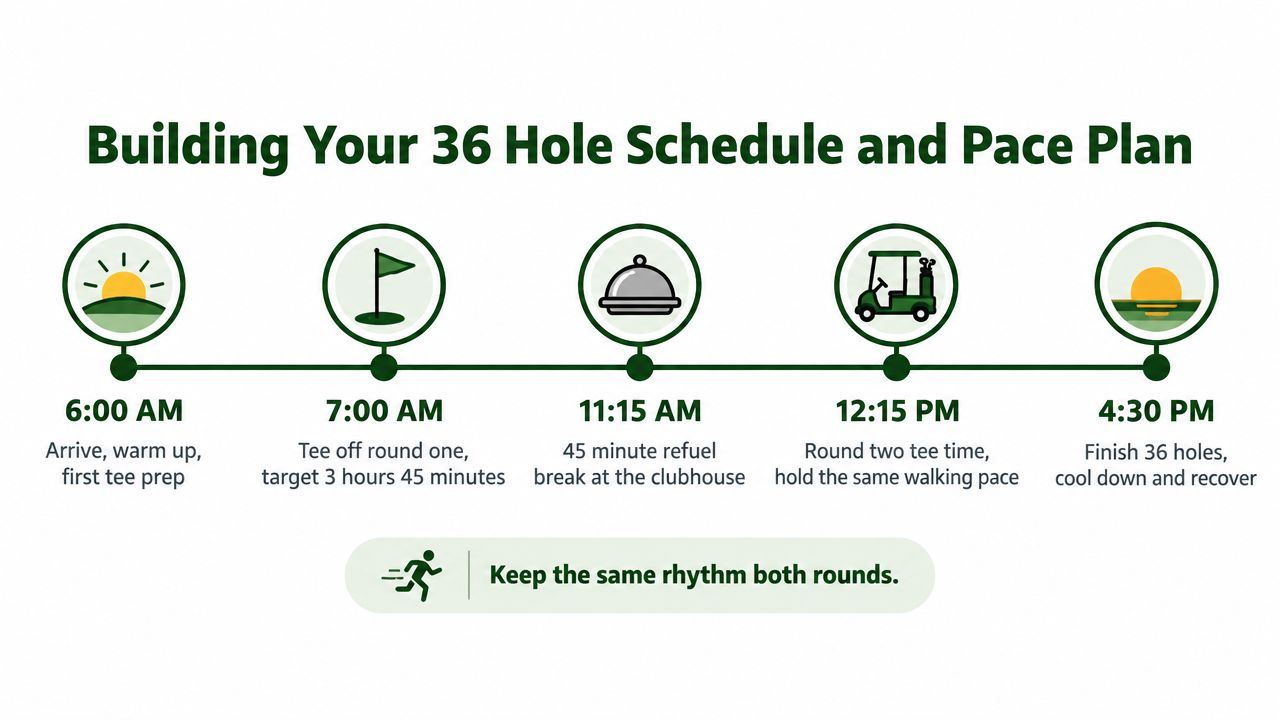
The easiest way to lose a 36-hole day is to treat the second tee time like it will sort itself out. It won't. A standard 18-hole round gives the best planning baseline, and one independent directory estimates a typical round at about 4 hours and 15 minutes. With that pace, a 7 a.m. first tee can still put you near the second round around noon if the turn stays tight and deliberate (southwestfloridagolf.com).
Start with the tee-time gap, not the wish list
If the first round is on foot, build in a reset that is short and useful. A 36-hole walking day usually takes about 8 to 10 hours total, and one guide places a recreational version around 9 hours including the break (caddietap.golf). The turn is not a long lunch. It is a working recovery window, and the difference shows up late in the day.
The pace-of-play side matters too. The R&A Pace of Play Manual says that in two-balls an interval of at least 8 minutes is recommended, and in three-balls at least 10 minutes. It also notes that when 36 holes are played in one day, it is customary not to change hole positions between rounds, although that is not prohibited. That keeps the day predictable, and predictability saves energy because you spend less of it waiting, wondering, or resetting your rhythm.
Use a simple dawn-to-afternoon timeline
A workable day can look like this:
- 6:00 a.m. arrive, loosen up, get ready.
- 7:00 a.m. tee off the first round.
- Late morning finish the first 18, then eat and reset.
- Around noon start the second round without stretching the break.
- Late afternoon finish, cool down, and leave time to recover.
That structure works because it respects pace without forcing the front nine. A lot of golfers waste energy by hurrying early, then cool down too much between rounds and feel flat again on the first few holes. Keep the transition efficient, keep your shoes on, and keep moving lightly so the second tee time does not feel like starting over.
Pace check: if your group is walking and you are waiting on every shot, you are not getting a rest. You are just collecting standing time.
If you are building the day around a cart or electric assist, the same timeline still applies, but the break becomes more about food, hydration, and battery management than leg recovery. For a more equipment-focused setup, see this cart-assist planning guide before you book the day.
Training and Pacing Strategies That Save Your Second Round
A fit golfer can usually finish 36. The harder part is whether the last 9 to 12 holes still look like golf when fatigue starts speaking louder than intention. A competitive golf study found that perceived physical fatigue rose significantly in the 25 to 30 and 31 to 36 hole segments, and mental fatigue worsened near the end as well. A 2025 systematic review also confirmed that mental fatigue increases across a continuous 36-hole day (pgedf.ufpr.br).
Train for the back half, not just the start
The best prep for a 36-hole day is a short buildup that includes walking, hills, and recovery between efforts. Walking with a push cart is a different load than riding, and the difference shows up late. If you only practice one round at a time, the second round will not feel familiar when the body is tired. The body keeps score.
I've found the most common mistake is going out too hard on climbs. On a hilly course, the goal is not to attack every rise. It is to keep the effort even enough that your breathing settles after the next shot. That matters more than stride length, more than bravado, and more than trying to save time with a rushed walk from green to tee.
Use visible fatigue cues, not pride
A useful self-check is simple. Ask whether your pre-shot routine still feels organized, whether club selection is still calm, and whether your first move over the ball still looks repeatable. When those things start falling apart, the problem is not just tired legs. It is compound fatigue.
The best second-round players do not try to feel fresh. They try to stay functional.
- Keep climbs steady: take hills at a sustainable pace instead of spiking effort and paying for it later.
- Shorten wasted steps: walk directly between shots and avoid unnecessary detours around the group.
- Reset between holes: a minute of easy breathing beats a rushed mental spiral after a bad swing.
- Protect decision quality: if a target or club choice feels forced, slow down and commit only when it is clear.
A pre-round warm-up should be light and repeatable, not long and draining. Between rounds, do the opposite of stiffness. Walk a little, sip something, eat something, and avoid sinking into a chair for too long. A short, deliberate reset keeps the second nine from feeling like a restart.
For golfers who use assist devices, the same pacing logic still applies. One useful resource is this long-distance walking guide, which fits the same idea, save energy early so the last stretch still belongs to you.
Fueling Hydration and Recovery for a Full Day Walking
A full walking day asks more of your fuel plan than a normal round. One golf calorie calculator says a 36-hole day can burn over 2,500 calories for a 70 kg person, and another places the total time demand at roughly 450 to 600 minutes (caloburner.app). That is a long stretch to stay clear-headed, so the smarter move is a timed routine, not a loose plan to “eat better.”
Build the day around steady intake
The most reliable pattern is plain, and that is the point. Eat before the first tee, then keep taking in small amounts of food and fluid every few holes. Golf-nutrition coverage has pushed this approach for a reason, because energy use in golf varies and hydration needs shift with heat and sweat rate instead of a fixed bottle count. Waiting until thirst shows up is too late on a long walking day (pgedf.ufpr.br).
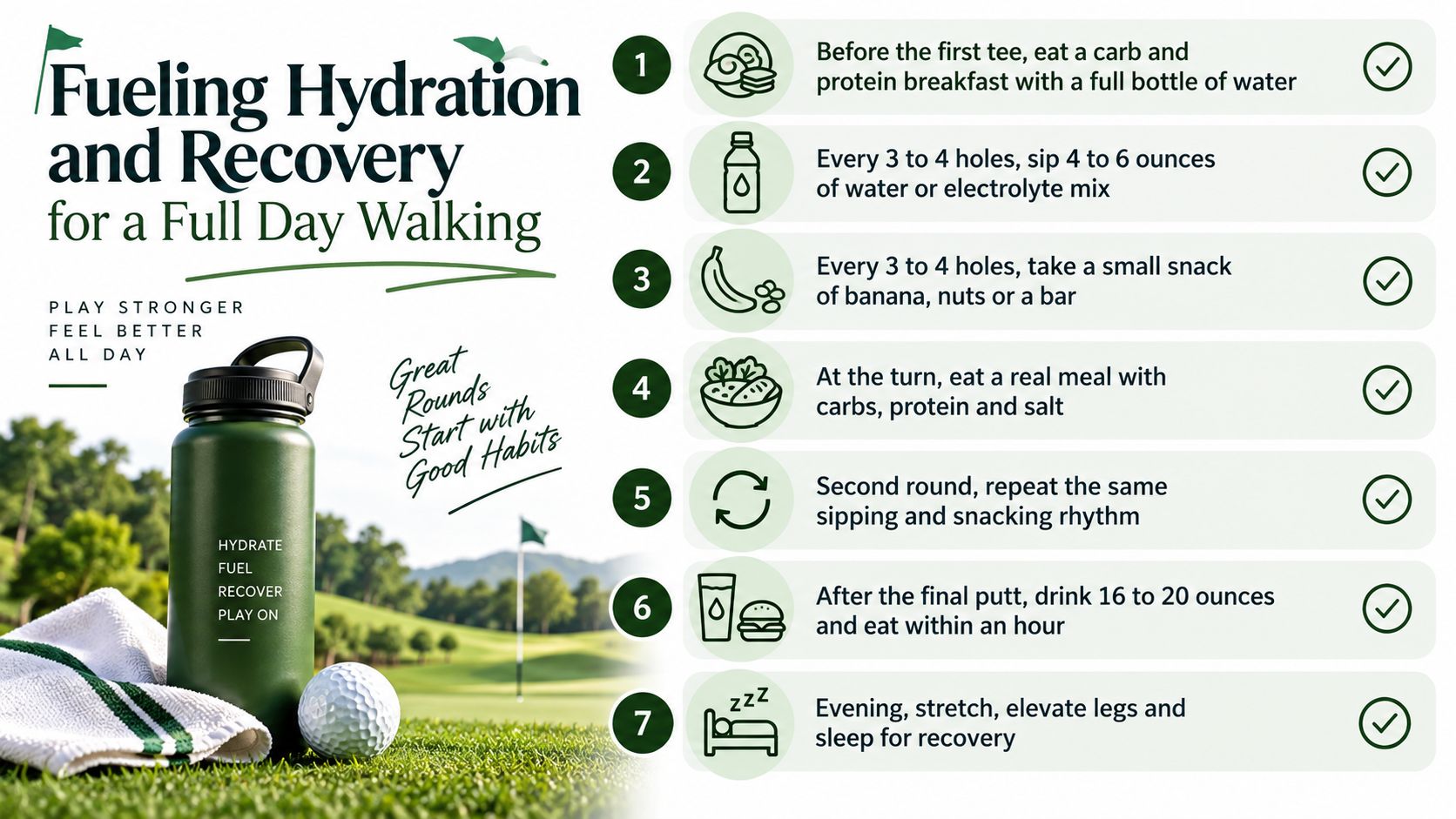
A simple rhythm works better than a complicated one:
- Before the first tee: eat a breakfast with carbs and protein, and start the day well hydrated.
- Every 3 to 4 holes: sip water or an electrolyte drink.
- Every 3 to 4 holes: take a small snack like a banana, nuts, or a bar.
- At the turn: eat a real meal with carbs, protein, and some salt.
- Second round: keep the same sipping and snacking pattern.
- After the final putt: drink and eat again within the hour.
- Evening: stretch, get your legs moving a little, and go to sleep on time.
The point is to stay ahead of the slide. If the second round already feels heavy, you are catching up too late. For golfers who want to compare advanced hydration fuel options, that guide is a useful place to sort through the category without turning the round into a science project.
Avoid the mistakes that make the back nine drag
Big meals at the turn can backfire. So can sugar spikes, especially if they are followed by a long wait between holes. A 36-hole day is one of the few golf situations where small, regular intake is easier to manage than one big lunch. Your stomach does not need a feast. Your muscles need a steady supply, and your brain needs stable focus.
The simplest recovery signal is also the easiest to miss. If your hands start to feel dead, your stride gets sloppy, or your patience drops fast, you are behind on food or fluid. Fix that before the next tee shot, not after the next bad one.
Gear Checklist and Electric Assist Setup for Walking More Holes
The wrong gear does not just feel awkward, it drains energy hole by hole. Shoes that rub, socks that hold moisture, and a cart that pulls poorly on slopes all add up to extra effort you pay for later, usually in the last 9 to 12 holes when the round starts to bite. On a 36-hole walking day, the aim is a setup that removes friction and keeps your legs and focus available for golf.
Keep the bag simple and the contact points clean
Start with the items that affect how you feel after a few hours on your feet. Wear shoes you trust on a tired walk, choose socks that stay dry and do not bunch, and pack sun protection, a rain layer if the forecast can shift, plus the basics you use, tees, balls, a glove backup, and a towel. That kind of kit is not flashy, but it saves more energy than carrying one extra item you might never touch.
An electric-assist push cart changes the load in a useful way. It takes strain off the walk itself, which matters most late in the second round and on courses with slopes. If you are comparing setup ideas, these electric golf trolley options help you match the cart to your course, not just to a brochure.
Match the assist to the course, not the brochure
Three-wheel and four-wheel push carts can both work with assist systems if the attachment and balance are right. The real test is whether the cart tracks straight, brakes in a way you can predict, and stays easy to turn when the ground tilts. A motor that feels fine on flat paths can feel heavy on side slopes, so a short test roll before the round is worth more than guessing after the first tee.
Battery planning belongs in the same conversation. A long day needs a setup you can trust to hold up to the end, especially if you are trying to protect your walking legs for the final stretch. The best setup is the one that matches your route, your cart, and how much of the day you want to save for the swings.
Do a pre-departure check that takes minutes, not hope
Before you leave, check that the attachment is secure, the wheel turns freely, and the speed control responds the way you expect. If the cart feels slow or awkward, look first at weight distribution, wheel pressure, and whether the load is uneven. Most mid-round problems start with small mistakes at home.
A short checklist keeps things simple:
- Shoes and socks: start with comfort and friction control.
- Layers: pack for sun, wind, and a possible shower.
- Cart setup: confirm the assist is mounted, charged, and test rolled.
- Carry items: water, snacks, glove backup, towel, and range essentials.
- Battery routine: charge ahead of time and do not guess at runtime.
If you want a closer look at the cart-assist side, the overview at Caddie Wheel's electric golf walking carts guide is a practical companion for this kind of day. The point is not gadget obsession. It is lowering the load that steals good swings before the round is over.
Final Checks and Smart Ways to Finish Strong
The last decision before a 36-hole day is straightforward. Are you set up to finish well, or just get through it? If the answer is the second one, adjust before the first tee instead of hoping the round fixes itself later. Heat, hills, age, mobility limits, and back-to-back days all make that call more important.
A quick go-or-no-go check keeps the day honest. Start if your shoes are broken in, your food and water are packed, your tee-time gap is realistic, and your cart or assist setup has already been tested. Cut the day short, or add more support, if the course is especially hilly, the weather looks punishing, or the walking load will leave you flat for tomorrow. The goal is steady golf, not proving anything.
The finish is where pacing matters most. The last 9 to 12 holes often decide whether a long day feels controlled or like a slow collapse, especially when the first 27 felt manageable. Keep the tempo calm, keep eating and drinking on schedule, and do not spend extra energy chasing lost shots.
When the round ends, keep moving a little. Drink, eat, and get out of the posture you have held for hours. A sensible evening routine makes the next day possible, especially if you want to repeat a walking-heavy schedule instead of limping through it.
If you are planning a walking-heavy 36-hole day and want less strain on the hills, Caddie Wheel is built for that job with electric assist for standard push carts. Visit Caddie Wheel to see how its drop-on wheel, variable-speed control, and long-day battery support can fit into a round like this.
Partager:
36 Holes of Golf How Long It Takes and How to Walk It
Golf Cart Attachment Guide to Upgrade Your Push Cart