
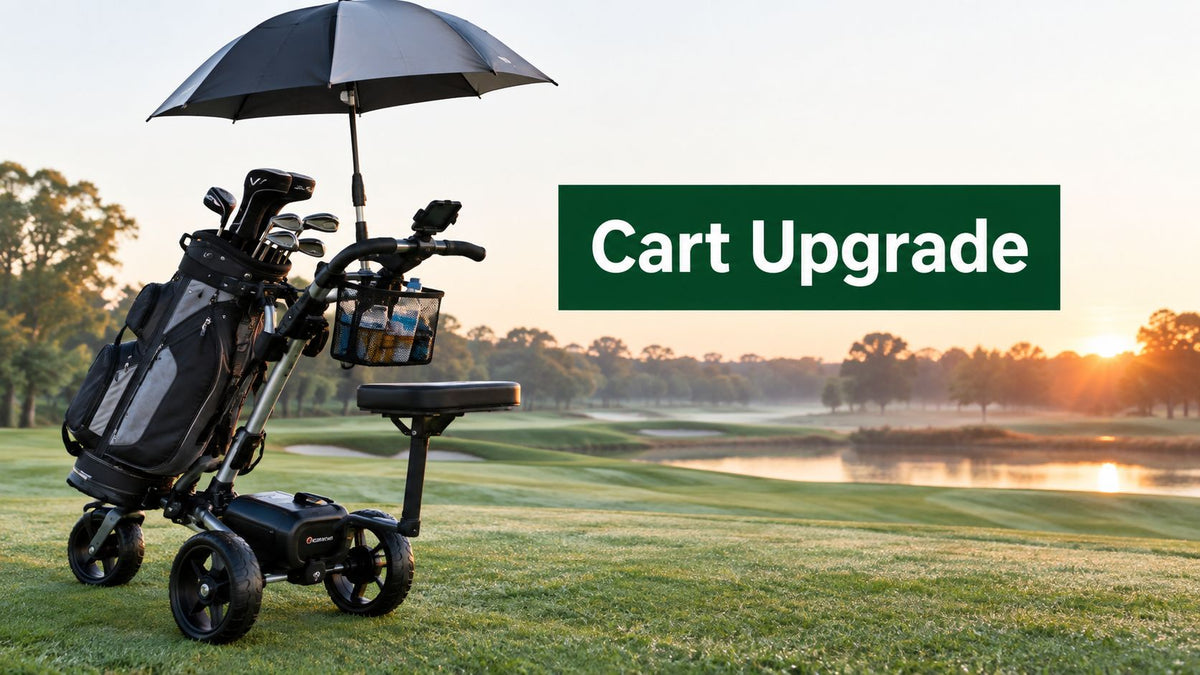
You've reached the back nine, your shoulders are tired, and the push cart that felt effortless on the first tee now seems to resist every slope. Your clubs, water, rain gear, and personal items still need to come along, but the energy you'd rather spend reading greens is going into moving equipment.
A golf cart attachment can solve that problem without asking you to replace the push cart you already know. Some attachments add propulsion, while others improve storage, comfort, weather protection, or access to your phone and GPS. The right choice depends less on having the most accessories and more on matching one attachment to the specific nuisance that keeps appearing during your rounds.
Introduction to Golf Cart Attachments and Why They Matter
A walking golfer may start a round with a simple goal, keep the bag moving and stay focused on the next shot. Then the course adds its usual complications. A steep approach makes pushing harder, a loose strap lets the bag twist, and a drink or phone has nowhere convenient to go. None of these problems requires a new golf cart. They call for a smarter connection between the cart and the golfer.
That's the useful way to think about attachments. A push cart provides the frame, wheels, and basic support. A golf cart attachment modifies that foundation for a particular job. A motorized wheel reduces manual pushing, an umbrella holder handles changing weather, and an organizer keeps frequently used items within reach. The cart remains familiar, but its workload changes.
The practical reason to add one
The strongest case for an attachment is repeated friction. If you struggle only once with a wet round, an umbrella holder may be enough. If every hilly course leaves your arms and shoulders tired, an electric-assist wheel deserves closer attention. If your bag shifts over bumps, a better stabilization method may matter more than any powered upgrade.
A controlled golf transportation study found that pushing a cart lowered metabolic cost compared with carrying a bag by 10.4% in VO2 terms (controlled golf transportation study). That result doesn't mean every golfer needs motor assistance. It does show why moving equipment efficiently matters over a full walking round.
Practical rule: Start with the task that drains your attention or energy most often, then choose the attachment that addresses that task directly.
This guide moves from the history and major attachment families to fit, installation, stability, and electric-assist trade-offs. By the end, you should be able to inspect your existing push cart, reject incompatible options, and choose an upgrade that feels like part of the setup rather than an awkward add-on.
How Push Cart Attachments Evolved Into Modern Upgrades
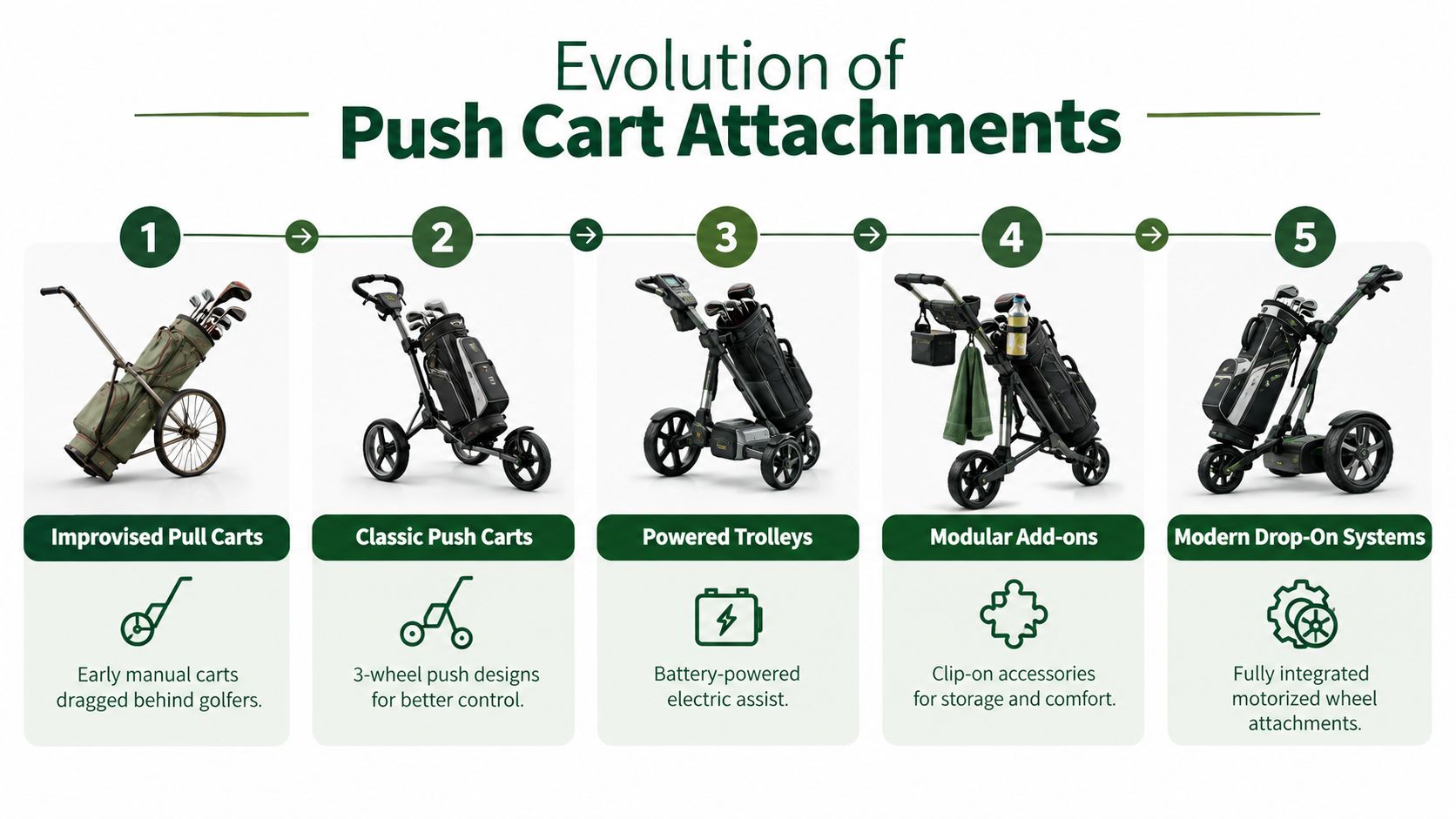
Golf mobility has never developed as a single leap from manual walking to powered travel. Golfers and manufacturers have added one improvement at a time, much like a cyclist upgrades a familiar bicycle with lights, racks, or clip-on storage instead of discarding the frame.
Electric course mobility was tested before it became a commercial category. J.K. Wadley experimented with electric carts on Los Angeles golf courses in the late 1930s, and Merle Williams and Marketeer produced the first commercial electric golf cart designed specifically for golf-course use in 1951, a milestone described in golf cart history coverage. The technology changed, but the underlying question stayed familiar: how can golfers move equipment with less effort while remaining involved in the walking experience?
Push-cart development followed its own practical path. Golf Canada describes the first Bag Boy pull cart as having been assembled from aluminum tubing, springs, and lawnmower wheels, an example of golfers solving a straightforward problem with available materials. By 1983, Joe Catford had introduced electric golf trolleys into the United Kingdom through Powakaddy, helping establish powered walking aids as a recognizable part of golf equipment.
Why modular design makes sense
A modern attachment works because the push cart already provides a standardized platform. The frame carries the bag, the wheels establish direction, and the handle gives the golfer control. An add-on can focus on one missing function instead of recreating the entire cart.
That modular approach also protects the value of an existing purchase. A golfer who likes a cart's folding action or bag cradle doesn't have to abandon those qualities because hills have become more demanding. The upgrade can be narrower, easier to store, and more targeted than a complete replacement.
Market forecasts reinforce that add-ons are no longer just novelty items. One independent study values the golf cart accessories market at USD 428.7 million in 2025 and projects USD 884.4 million by 2035, with a 7.5% compound annual growth rate (golf accessories market study). Another report estimates the broader category at USD 1.3 billion in 2025 and USD 2.5 billion by 2034 (electric golf caddy market coverage). Different market boundaries explain the different totals, but both point toward sustained interest in upgradeable cart systems.
Types of Golf Cart Attachments Explained
The easiest way to sort attachments is by the job they perform. Ask whether you want to move the cart, carry more, rest, handle weather, or reach information without digging through a pocket.
Propulsion attachments
A motorized wheel assist changes the cart's primary workload. Instead of pushing every foot of the course, the golfer controls powered movement through the attachment. This option suits long walks, hills, or golfers who want to conserve upper-body energy while continuing to walk.
A drop-on system is especially different from buying a complete powered trolley. The cart stays in place, while the motorized wheel connects through a compatible bracket. Caddie Wheel describes its unit as a drop-on motorized wheel that attaches in minutes, with a handheld remote controlling forward, reverse, and brake functions (Caddie Wheel motor and remote explanation). That directional control matters because a powered cart still needs to behave predictably beside you, at a stop, and while being repositioned.
Organization and carrying capacity
Storage attachments solve a different problem. Cooler bags, cargo racks, and organizer units give bulky or frequently used items a defined place. They're useful when a cart's existing console forces you to choose between water, clothing, accessories, and personal belongings.
The best storage add-on doesn't merely create more room. It keeps weight low and centered, leaves the bag pockets accessible, and avoids interfering with folding. A cargo rack that holds equipment but blocks the brake or catches on the bag creates a new inconvenience.
Rest and weather protection
A foldable seat attachment adds a place to sit between holes or while waiting. It can help golfers who need regular breaks, but it also introduces extra weight and a larger folded profile. Check whether the seat remains stable when the cart is stationary and whether it changes the way you lift or store the frame.
An umbrella holder has a narrower purpose, but it can earn its place quickly in bright sun or rain. Look for adjustable positioning and a secure clamp. An umbrella mounted too high or too loosely can shift the cart's balance, especially when wind catches it.
Accessory mounts
Phone, GPS, and drink holders improve access rather than propulsion. They work best when they sit within reach without forcing the golfer to look away from the path for long. A device mount should hold the equipment firmly over bumps, while a drink holder should accommodate the container you use.
Avoid buying several attachments that perform the same job. A practical setup might combine one propulsion upgrade with one storage solution, while another golfer may need only an umbrella holder and a better organizer. The goal is a balanced cart, not a crowded one.
Compatibility and Fit Considerations Before You Buy
An attachment can be well made and still be wrong for your push cart. Compatibility comes first because the frame, wheel arrangement, and mounting points determine whether the add-on will sit squarely and stay secure.
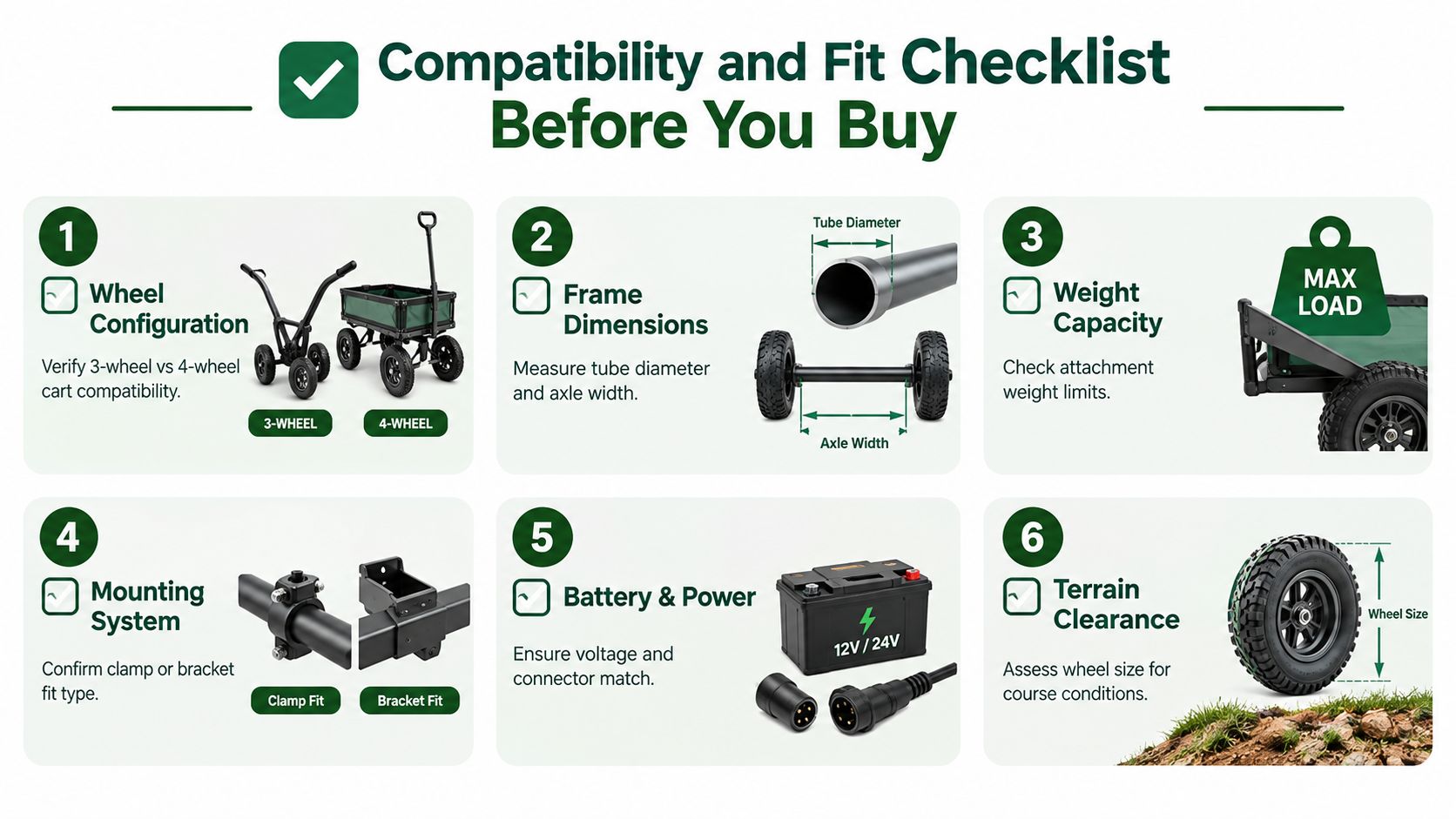
Start with the wheel configuration. A three-wheel cart and a four-wheel cart distribute weight differently, and their brackets may not place an attachment in the same position. If a product claims broad compatibility, confirm what that means. It may fit several frame styles with separate brackets, or it may only fit carts with a particular axle shape.
The pre-purchase inspection
Measure before ordering. Note the frame tube diameter, axle width, available clearance, and the distance between the mounting points. Also check how the cart folds. An attachment that fits while open but must be removed every time the cart folds may not suit your routine.
Use this filter:
- Wheel layout: Confirm whether the attachment supports your three-wheel or four-wheel design.
- Frame geometry: Compare tube dimensions, axle width, and bracket shape with the manufacturer's specification.
- Weight and balance: Check the attachment's limits and consider how its weight will affect a loaded bag on slopes.
- Mounting method: Identify whether the system uses a clamp, bracket, strap, clip, or another connection.
- Power connection: For an electric unit, verify the battery and connector requirements rather than assuming similar plugs are interchangeable.
- Ground clearance: Consider the wheel's position and size against uneven paths, grass, and transitions between surfaces.
If the fit looks close
“Universal” shouldn't mean “measure nothing.” If the frame dimensions fall outside the published range, contact the manufacturer before purchase. If the cart uses an unusual folding mechanism, ask whether the attachment must be removed for storage. If the added component sits behind the axle, inspect how it may change turning and hill behavior.
For a structured way to organize those questions, use this golf cart compatibility test guide. A few minutes with a tape measure can prevent wobble, blocked folding joints, and an expensive return.
Installation Overview and Troubleshooting Common Issues
Installation should end with a test, not with the moment the attachment appears to fit. The most reliable approach is to install slowly, secure each connection, and then recreate the bumps and turns the cart will experience on the course.
For a drop-on motorized wheel, begin with the compatible bracket kit. Secure the bracket to the cart frame according to the manufacturer's directions, then check that the bracket sits straight before adding the wheel. A crooked bracket can make the cart pull to one side even when the motor is working correctly.
A simple installation sequence
- Prepare the cart: Remove loose equipment and place the cart on a stable surface.
- Secure the bracket: Tighten the clamp or fasteners evenly so the bracket doesn't rotate.
- Inspect the contact points: Make sure clips, zip ties, or Velcro straps sit where intended and don't touch moving parts.
- Drop on the wheel: Set the motorized unit onto the bracket and confirm that it snaps fully into place.
- Check the controls: Test forward, reverse, and braking with the cart unloaded before trying it on a course.
- Load the bag: Add the bag, accessories, and battery, then repeat the control test at low speed.
The golf cart bracket installation guide can help you understand how the bracket, clips, zip ties, and Velcro straps work together on compatible setups.
Fixing the common stability problems
A golf bag that shifts usually needs better sequencing, not more force. Place the lower strap first and secure the base of the bag against the cart. Then attach the upper strap so it controls the bag's upper movement without crushing pockets or restricting access.
Run a stability test before the round. Gently rock the cart, roll it over a small uneven section, and check whether the bag twists, slides, or contacts the wheel. Independent golf bag attachment guidance recommends rechecking after uneven ground because straps can settle once the cart begins moving.
Stability check: The bag should stay aligned during movement without straps being tightened so aggressively that they distort the bag or block its pockets.
If the motorized cart pulls sideways, inspect wheel alignment and bracket position before adjusting the remote. If the remote responds inconsistently, check the battery, control range, and physical connections. If the cart feels top-heavy, remove unnecessary accessories and move heavy items lower in the storage area.
How to Choose the Right Electric Assist Attachment
Electric assist sits between two familiar options, carrying or manually pushing on one side and riding in a powered cart on the other. It changes the effort profile without removing the walking element. Research comparing golf movement modes reported average energy expenditure of 211 kcal/hr for motorized cart play, 236 kcal/hr for electric trolley use, and 288 kcal/hr for push-cart play (golf movement energy comparison). Those figures provide context, not a promise about an individual round, because terrain, pace, equipment, and personal effort all vary.
The features that matter on the course
Power and torque matter most on hills and soft ground. Variable speed matters when you're walking beside the cart, approaching a tee, or moving through a narrow path. Braking matters whenever the cart stops on an incline, and reverse control helps with positioning in tight spaces.
Battery information should be equally concrete. Independent review coverage for a comparable electric push-cart class describes a battery designed for about 36 holes per charge, with full recharge taking roughly 6 to 7 hours, depending on the model (electric push-cart battery and recharge review). Treat those figures as a reference point for planning, not as a universal specification for every attachment.
A neutral review also reported that its remote didn't require pairing with the cart and that remote mode allowed steering (electric push-cart remote-control review). That distinction is useful. A remote may handle more than start and stop, so test whether its controls feel natural while you're walking and watching the path.
| Feature | What to Look For | Why It Matters |
|---|---|---|
| Power and torque | Output suited to your course's slopes | Helps the cart maintain movement where manual pushing becomes tiring |
| Speed control | Smooth adjustment rather than one fixed pace | Keeps the cart near you instead of surging ahead |
| Braking and reverse | Dedicated, predictable controls | Improves positioning and confidence on inclines |
| Battery | Published runtime and recharge guidance | Helps you plan rounds and storage |
| Portability | A manageable wheel, bracket, and battery setup | Determines whether you'll actually use the attachment |
| Remote ergonomics | Buttons you can identify while walking | Reduces fumbling and distraction |
For a closer look at the form factor, review this electric assist wheel overview. Caddie Wheel is one example of a drop-on motorized wheel for compatible standard push carts, using a snap-in bracket, handheld variable-speed remote, and a battery rated for up to 36 holes per charge. Its advertised warranty is 12 months, while manufacturer warranty pages show 24 months as a common warranty length for carts and lithium batteries (golf cart warranty comparison). Warranty duration should be compared alongside support, replacement parts, and the exact components covered.
Making Your Push Cart Work Smarter for More Enjoyable Rounds
A useful upgrade starts with an honest diagnosis. If your arms tire on hills, propulsion is the priority. If your bag twists, fix the straps and mounting points before adding more equipment. If your phone, drink, or rain gear keeps disappearing into the bag, organization or weather protection may deliver more value than a motor.
Before buying, run through this short checklist:
- Name the recurring problem: Choose the inconvenience that appears on most rounds.
- Measure the cart: Confirm wheel layout, frame dimensions, axle width, and clearance.
- Protect balance: Place heavier additions low and avoid stacking weight behind one side.
- Test the controls: For powered systems, verify forward, reverse, speed adjustment, and braking.
- Check the routine: Make sure the attachment still allows folding, transport, charging, and storage.
- Review protection: Compare warranty coverage and understand what happens if a bracket or battery needs replacement.
The best golf cart attachment is the one you can install securely, operate without thought, and trust over changing ground. It should preserve the parts of your push cart that already work while reducing the effort or inconvenience that keeps interrupting your walk. A successful first round feels simple: the bag stays put, the cart follows your pace, and more of your energy remains available for the swing.
If your existing push cart needs lighter, more controlled movement, visit Caddie Wheel to review its drop-on motorized wheel, snap-in bracket system, remote forward, reverse, and braking controls, battery information, compatibility details, and warranty. Compare those details with your cart measurements before choosing the upgrade that fits your course and walking routine.
Partager:
36 Holes of Golf in One Day How to Walk It Well
Portable Charger Long Lasting: How to Pick the Best One