
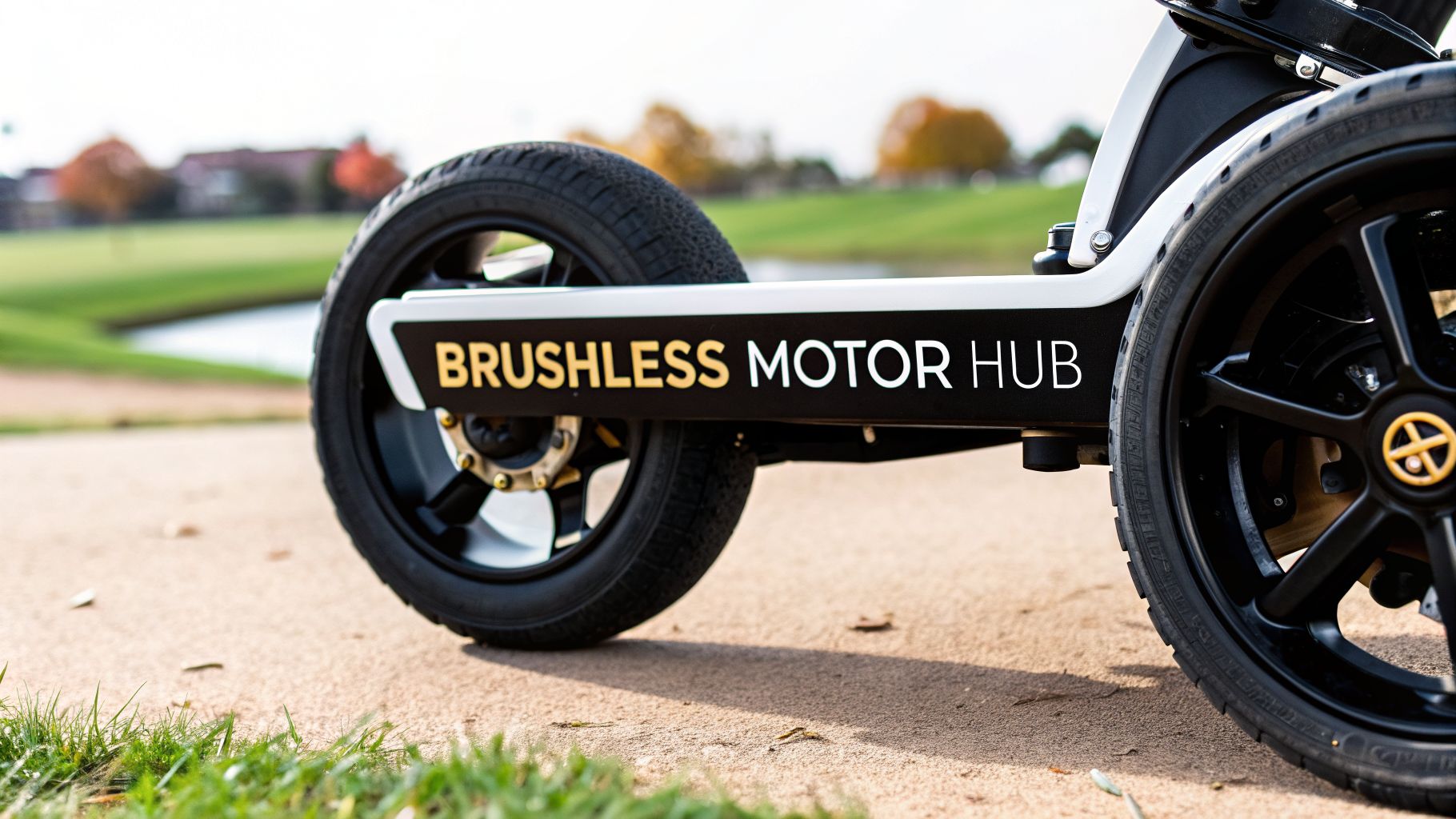
At the heart of today's best electric golf carts is a simple yet powerful piece of tech: the brushless motor hub. This is the engine that makes modern e-mobility possible, neatly integrating a motor right into the center of a wheel. This clever design gets rid of the need for clunky belts, chains, or gears, delivering smooth and silent power for everything from e-bikes to electric golf carts.
The Secret Behind Effortless Golf Rounds
We’ve all been there. You’re heading into the back nine on a beautiful, hilly course, but your focus is shot. Your arms ache, your legs are tired, and your swing is suffering. That’s the reality for many golfers who manually push a heavy cart, especially on undulating terrain. Pushing a 40-pound cart up a steep fairway isn't just a workout; it's a distraction that pulls you out of the game.
But what if you could walk the course and arrive at the 18th green feeling as fresh as you did on the first tee? That’s not a gimmick—it’s the promise of the brushless motor hub. This technology is changing how golfers experience the game, replacing the physical toll of pushing with the effortless glide of a motorized caddy.
From Manual Labor to Motorized Luxury
The brushless motor hub offers a truly elegant solution to this age-old problem. By building the motor directly into the wheel, it delivers power exactly when and where you need it. It feels completely natural. Instead of wrestling with your cart against gravity, you’re simply guiding it along, saving your energy for what really counts: your next shot.
This simple shift completely transforms the golfing experience in a few key ways:
- Reduced Physical Strain: It turns what was a strenuous trek into a pleasant walk, freeing you up to focus on course strategy and shot-making instead of muscle fatigue.
- Consistent Energy Levels: By conserving energy, you maintain better concentration from start to finish, helping you stay sharp and enjoy the entire round.
- Enhanced Enjoyment: Walking the course becomes one of the best parts of the day again. You can take in the scenery and enjoy the social side of the game without the physical burden.
The true advantage of a brushless motor hub isn't just the power it provides, but the energy it saves. It transforms the golf course from an obstacle to be overcome into an environment to be enjoyed.
Products like the Caddie Wheel are built around this technology, allowing you to upgrade your favorite push cart into a fully electric one. It’s a smart, cost-effective way to get all the benefits of an electric caddy, with options for an electric golf push cart with remote for ultimate hands-free convenience. In the end, the brushless motor hub is the unsung hero behind a more enjoyable, less exhausting, and better-performing round of golf.
How a Brushless Motor Hub Actually Works
To really get what makes a brushless motor hub tick, it helps to look at what it replaced: the old-school brushed motor. Imagine a clunky rotary phone—it worked, but it relied on physical, grinding parts that wore out over time. That’s a brushed motor. A brushless motor, on the other hand, is like a smartphone: sleek, digital, and incredibly reliable.
At its heart, a brushless motor hub gets rid of the physical "brushes" that caused friction and wear in older designs. If you want to go a little deeper on the tech, it's worth understanding brushless motors and why they’ve become the standard in everything from power tools to electric vehicles.
This simple diagram shows how a brushless hub motor turns a tough walk into an effortless round of golf.

It perfectly captures the leap from manual labor to smart, motorized assistance, which is what this technology is all about.
The Stator and Rotor Partnership
Inside every brushless hub motor, two key players work together: the stator and the rotor. Think of it as a magnetic dance.
- The Stator: This is the part that stays put. It's lined with tightly wound copper coils. A smart little computer, called an Electronic Speed Controller (ESC), zaps these coils with perfectly timed electricity, creating a magnetic field that spins.
- The Rotor: This is the part that moves. It has powerful permanent magnets attached to it. As the stator's magnetic field rotates, it grabs onto these magnets and pulls them along for the ride. That's what makes your wheel spin.
This whole process is almost magical in its efficiency. There's no physical contact, no grinding, and no friction—just a silent, powerful interaction between magnetic forces. Because nothing is rubbing together, efficiency jumps to an incredible 85-90%, and the motor’s lifespan is dramatically longer.
A brushless motor hub uses smart electronics to create a spinning magnetic field in the stationary stator. This field pulls the rotor’s permanent magnets, making the wheel turn. It’s pure magnetic force, with no parts grinding against each other.
This technology isn't brand new, but it's been perfected over time. The concept was first introduced way back in 1962 by T.G. Wilson and P.H. Trickey. Their "DC motor with solid-state commutation" was a major breakthrough, replacing mechanical parts with electronics to slash friction and boost reliability. It paved the way for the powerful, compact motors we use today.
For golfers, this maintenance-free design is a huge win. Our guide on hub motor kits dives into how this translates to a better ownership experience. You get smooth, consistent power, round after round, without ever having to worry about replacing worn-out parts.
Why Motor Efficiency Translates to More Holes Per Charge
For any walking golfer, the most important question about a motorized cart is always the same: “Will it last the entire round?” Battery life is everything. This is where the design of a brushless motor hub makes a huge difference, and its incredible efficiency is the secret to playing more golf on a single charge.
This isn't just a small upgrade; it’s a completely different level of performance. Efficiency is simply how much electrical energy from your battery gets turned into useful motion versus how much is wasted as heat. Old-school brushed motors typically run at about 75-80% efficiency. That means for every bit of power pulled from your battery, 20-25% of it is lost forever as useless heat.
The Power of High Efficiency
A modern brushless motor hub, on the other hand, operates at an impressive 85-90% efficiency. That extra 10-15% might not sound like a lot on paper, but on the golf course, it’s the difference between your cart dying on the 16th hole or cruising confidently through a full 36.
This is the key advantage of a brushless hub, delivering more power where every watt counts. Unlike brushed DC motors, these motors get rid of the friction-heavy brushes that waste so much energy. This smart design allows high-capacity batteries to last significantly longer, powering everything from e-bikes to the Caddie Wheel for up to 36 holes with ease. If you're curious about the nitty-gritty, you can explore more about the principles of brushless DC electric motors on Wikipedia.
The table below really drives home why this matters for your game.
Brushed vs. Brushless Motor Efficiency Comparison
When you look at the numbers, it becomes clear why modern electric caddies have moved to brushless technology. This comparison shows the practical differences you'll feel on the course.
| Feature | Brushed Motor | Brushless Motor Hub |
|---|---|---|
| Typical Efficiency | 75-80% | 85-90% |
| Primary Energy Loss | Friction and Heat | Minimal Heat |
| Practical Impact | Shorter battery life, heavier batteries needed | Longer range, lighter battery packs |
| Reliability | Brushes wear out and require maintenance | Virtually maintenance-free |
As you can see, the brushless motor hub isn't just a minor improvement—it’s a smarter, more reliable, and more efficient system from the ground up.
Real-World Benefits on the Course
This leap in efficiency has practical benefits you'll notice right away. Because a brushless motor hub wastes less energy, it doesn't need a huge, heavy battery to give you the same range. This means the Caddie Wheel can offer an extended range without adding a bunch of weight to your push cart, keeping it light and easy to handle.
The efficiency of a brushless motor hub directly translates into more playing time. Less energy wasted as heat means more power is dedicated to moving your cart, giving you the confidence to tackle 18, 27, or even 36 holes without range anxiety.
In the end, this better engineering means you spend less time worrying about your battery and more time focused on your next shot. For those who like to crunch the numbers, you can check out our guide on how to calculate power consumption the right way to get a better handle on your gear's energy needs.
Key Motor Specs That Matter on the Course
 When you're looking at a motorized caddy, it’s easy to get lost in marketing fluff. But if you want to know how it’ll actually perform on the course, you need to look at the numbers. Translating tech specs into real-world benefits can feel like a chore, but a few key metrics tell you everything you need to know.
This is your no-nonsense guide to the specs that make a difference. We’ll break down what really matters for climbing hills, playing in all weather, and finding that perfect balance between power and weight. Understanding these numbers shows you exactly how a brushless motor hub is built for a great day on the links.
Torque: The Secret to Hill-Climbing Power
Think of torque as pure muscle. It's the raw twisting force that gets your cart moving, especially from a dead stop on an incline. It’s not about speed—it’s about the grunt work.
A brushless motor hub with high torque will make that monster hill on the 12th hole feel like a flat fairway. A low-torque motor? It'll struggle, slow to a crawl, or just give up. For a golf caddy, torque is arguably the most important number on the spec sheet, as it translates directly to a smooth and steady walking pace, no matter the terrain.
This is why the Caddie Wheel is optimized for high torque at low speeds. It ensures your cart keeps up with you, even when the course gets tough.
Waterproofing and Durability
Let's be real—golf isn't always a sunny-day sport. You’ve got morning dew, unexpected downpours, and those sneaky sprinkler systems to deal with. That’s why a motor’s Ingress Protection (IP) rating is so critical.
A higher IP rating means the brushless motor hub is better sealed against water and dust getting inside and causing problems. It's the difference between a motor that dies after one rainy round and one that lasts for years. A solid IP rating means a sudden shower won't short-circuit your investment.
The robust sealing on the Caddie Wheel’s motor is designed for exactly these real-world conditions, giving you peace of mind to play through whatever the weather throws at you.
A motor's specs are its resume. High torque shows it can handle the tough jobs, like steep hills, while a strong IP rating proves it’s reliable enough to work in any weather.
This same principle applies across other electric vehicles. When you compare electric mountain bike specs, you see how motor wattage and battery size directly impact climbing ability and range—it's all about matching the power to the task.
The Balance of Power and Weight
Finally, you need a system that adds power without wrecking your push cart's feel and balance. This is where the integrated design of a brushless motor hub really shines. Because the motor is built right into the wheel, it keeps the center of gravity low and stable.
A clunky, poorly-placed motor can make a cart top-heavy and a pain to steer. The goal is to hit that sweet spot: enough power to conquer any hill, but not so much weight that it feels like you're wrestling a tank around the greens.
The Caddie Wheel nails this balance. It adds serious assistance while preserving the lightweight, easy-to-push feel that you want from a push cart. It’s an upgrade that enhances your cart, not complicates it.
How Caddie Wheel Perfects This Technology for Golfers
Having a powerful brushless motor is a great start, but it’s really only half the battle. The real magic happens when that power is thoughtfully integrated into the user experience. This is where Caddie Wheel truly sets itself apart. It wasn't just built by grabbing an off-the-shelf motor; it was engineered from the ground up as a complete system designed for real golfers.
That golfer-first approach is obvious in every detail, from the ridiculously simple installation to the intuitive controls you can master in seconds. The entire system is built to solve problems on the course, not create new ones.
Built by Golfers for Golfers
The Caddie Wheel story started right where it belongs: on the golf course. It was created by a couple of avid players who were just plain tired of the grind of pushing a cart up and down hilly fairways. Their mission was simple—design an affordable, rock-solid power-assist system that works with the push carts golfers already own and love.
This mission led to some key design choices that put simplicity and performance first:
- Simple Drop-On Installation: You don’t need a toolbox or a YouTube tutorial. Caddie Wheel is designed to attach to your existing push cart in minutes, with no complex wiring or modifications needed.
- Secure Snap-In Bracket: The mounting system is tough and reliable, locking the wheel firmly in place. You can walk with confidence, knowing it won't budge, even on the bumpiest cart paths.
- Intuitive Remote Control: The lightweight, pocket-sized remote puts you in command. It has straightforward buttons for forward, reverse, and braking—everything you need and nothing you don’t.
Caddie Wheel was engineered to be an upgrade, not an overhaul. It enhances the cart you already have, adding powerful assistance without sacrificing the balance, feel, or simplicity of your original setup.
Powering a Growing Market
The technology driving Caddie Wheel is at the heart of a massive trend. The global hub motor market was valued at USD 12.82 billion in 2024 and is expected to soar to USD 19.55 billion by 2033. This incredible growth is powered by the same superior brushless DC technology that Caddie Wheel uses, which replaces old-school mechanical parts with smart electronics to eliminate wear and extend the product’s life.
For golfers—whether you’re a senior player, a fitness walker, or just someone looking for great value—this means you get a rugged, lightweight wheel that snaps onto your cart and powers you through 36 holes. You get variable speed and braking right at your fingertips. If you're curious about the industry trends, you can learn more about the hub motor market's rapid growth on straitsresearch.com.
Ultimately, Caddie Wheel delivers on the promise of the brushless motor hub by focusing on what truly matters on the course. It’s all about providing robust, reliable power in a package so simple and intuitive that it just fades into the background, letting you focus on your next shot.
Installation, Maintenance, and Real-World Performance
 Technical specs are one thing, but what really matters is how a brushless motor hub performs out on the course. It all comes down to the everyday experience—from the first time you set it up to how it handles that monster hill on the 14th hole. The Caddie Wheel was built from the ground up to make every part of that experience effortless.
The installation is refreshingly straightforward. Thanks to a secure snap-in bracket and an intuitive drop-on design, you can have your push cart motorized in minutes. There's no need to mess with complex wiring or dig through a toolbox. It’s a true plug-and-play design that gets you out on the course, not stuck in the garage.
Maintenance and Real-World Expectations
One of the best things about a brushless motor is that it’s practically maintenance-free. Older motors relied on brushes that would wear out over time, making them the most common point of failure. Brushless technology completely does away with that problem, giving you incredible reliability day in and day out.
Your part in its upkeep is simple:
- Keep It Clean: Give the wheel and motor a quick wipe-down after your round to keep grass and dirt from building up.
- Check Connections: Every so often, just make sure the power connections are still snug and secure.
- Charge Properly: Follow the battery instructions to get the most life out of every charge and the battery itself.
With a brushless motor hub, you can stop worrying about replacing worn-out parts. The entire system is built for long-term, dependable performance, so you can focus on your game instead of your gear.
When you hit the course, you’ll immediately feel the difference. That notoriously steep fairway that used to wind you? The Caddie Wheel’s high-torque motor will cruise right up it without skipping a beat. And thanks to its high-efficiency design, you can confidently play a full 18 holes—or even 36—on just a single charge.
This is the kind of reliable performance that takes all the guesswork out of your round. You’ll know your cart can handle whatever the course throws at it.
Common Questions About Brushless Motor Hubs
Making the switch to a motorized cart is a big step, so it's normal to have some questions. A brushless motor hub is a serious upgrade in both performance and convenience.
Let’s tackle a few of the most common things golfers wonder about before they motorize their push cart. This way, you can feel totally confident you're making the right move.
Is a Brushless Motor Powerful Enough for Hilly Courses?
This is probably the number one question we get, and the answer is an enthusiastic yes. Golfers want to know if a brushless system can really handle the beast of a hill on the back nine, and it absolutely can.
Brushless motor hubs are specifically engineered for a high torque-to-weight ratio. In simple terms, this means they pack a serious punch for climbing hills without weighing down your cart. The Caddie Wheel, for instance, is tuned to deliver plenty of torque to glide up steep inclines, letting you save your energy for your swing, not for a wrestling match with your gear.
Another frequent concern is durability. Just how long will this kind of motor last?
Because there are no brushes inside creating friction and wearing out, a brushless motor hub gets rid of the main reason older motors fail. The result is an incredibly durable motor that will give you years of reliable performance on the course.
Finally, golfers often ask what happens if the battery dies mid-round. Will the cart become impossible to push? A well-designed brushless hub is built exactly for this scenario.
- Minimal Internal Resistance: Quality systems like the Caddie Wheel are designed with very little internal drag.
- Effortless Free-Wheeling: When the motor is off, the wheels spin freely with almost no resistance.
- No Compromise: You can push it manually just as easily as you did before the motor was installed. You get power when you want it and effortless manual control when you don’t.
Partager:
The Modern Golfer's Guide to the Golf Cart Buggy
How to Test a Golf Cart Motor A Complete DIY Guide