
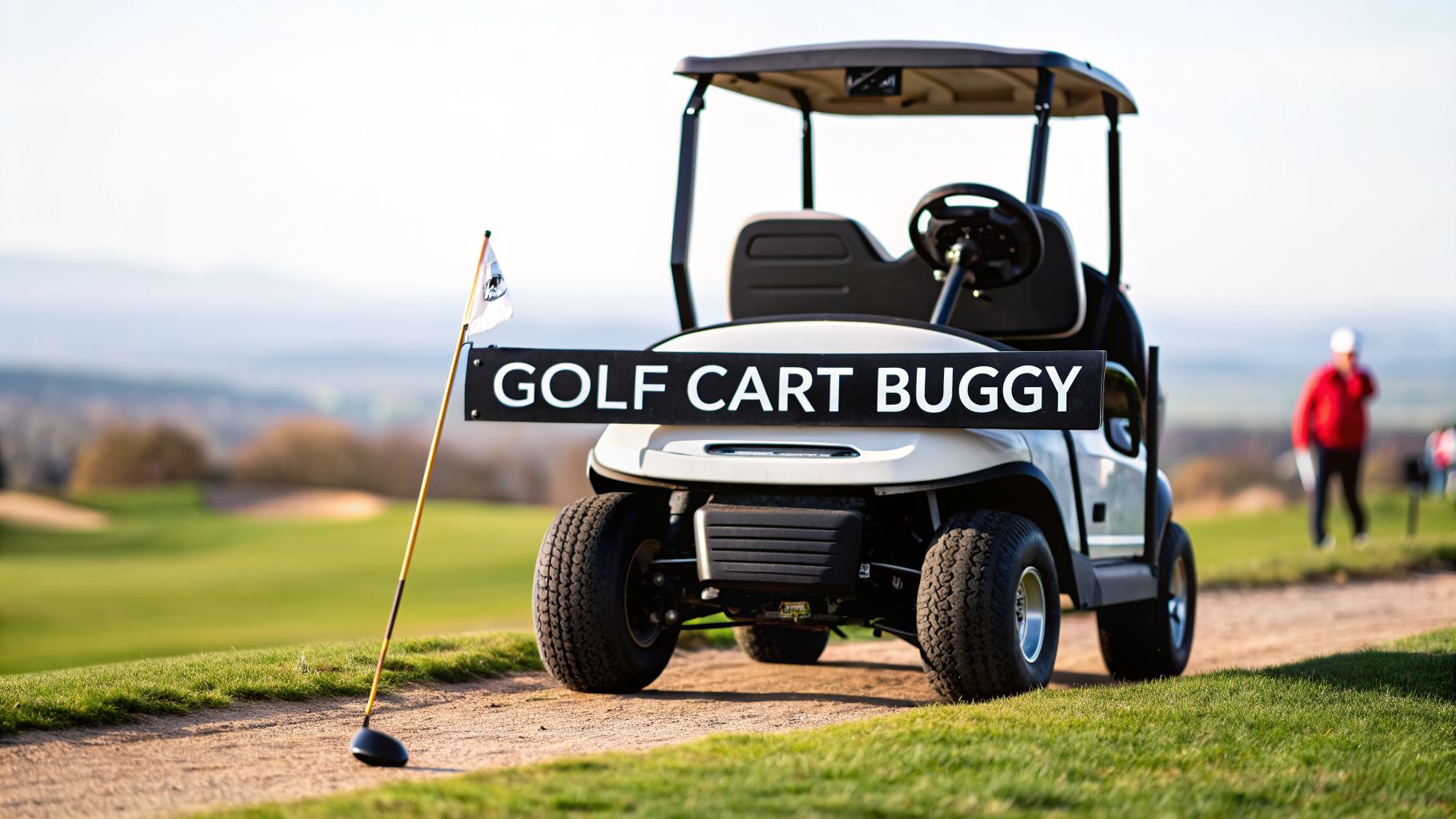
Let's settle a debate that’s probably as old as the sand wedge. The term golf cart buggy is a perfect example of how golfers have their own language—one that can mean a dozen different things depending on who you ask and where you're playing.
You'll hear "cart," "buggy," and "trolley" thrown around to describe everything from a full-sized riding cart to a simple push trolley. It's a casual, catch-all phrase that works fine on the course but causes real confusion when you're trying to buy the right gear.
Think of "golf cart buggy" as a broad category, not a specific product. It’s a bit like the word "bike." Are we talking about a sleek road bike, a rugged mountain bike, or a kid's tricycle? They all have wheels and handlebars, but their purpose is completely different. The same logic applies on the golf course.

Where Did All These Names Come From?
The journey from a caddie hauling your bag to you cruising in a high-tech electric cart didn't happen overnight. Believe it or not, the first "golf cart" was a far cry from what we zip around in today. The whole idea was born out of a need for accessibility.
Back in 1932, a Florida golfer named Lyman Beecher, who had trouble walking the course, invented the first version—essentially a rickshaw pulled by two caddies. It was a simple solution to a real problem.
By 1935, he’d upgraded to a motorized model powered by six huge car batteries. This was a game-changer, paving the way for players who might have otherwise had to quit the sport. While the idea caught on slowly at first, its popularity exploded after the war. In 1955, only 40% of U.S. courses offered carts for rent. Just over a decade later, by 1967, that number had shot up to an incredible 92%.
This history helps explain the jumbled terminology. In the early days, any device that helped carry clubs was a massive improvement, and the names just stuck.
Decoding Golf Transportation Terms
To make sense of it all, it helps to have a clear guide to what these terms usually mean today. While your local club might have its own slang ("buggy" is more common in Australia and the UK, for instance), this table breaks down the most common uses you'll encounter.
| Term | Common Meaning | Primary Use Case |
|---|---|---|
| Golf Cart | A motorized, sit-down vehicle for 2-4 passengers and their bags. | Riding the course instead of walking. Standard at most U.S. clubs. |
| Buggy | Often used interchangeably with "golf cart," especially outside North America. Can sometimes refer to electric push carts. | Riding or, in some regions, walking with an electric trolley. |
| Push Cart / Trolley | A non-motorized, three- or four-wheeled frame that you push your bag on. | Walking the course without carrying your bag. |
| Electric Push Cart | A push cart with a motor and battery to propel it forward, often with a remote. | Walking the course effortlessly, without pushing. |
| Pull Cart | An older, two-wheeled style of cart that you pull behind you. | A basic, inexpensive way to walk without carrying. |
This table should clear up most of the confusion, but the real takeaway is that you need to think beyond the labels.
The key is to move past the vague "golf cart buggy" term and ask yourself one simple question: Do I want to ride, or do I want to walk with some help? Answering that is the first step to finding the perfect solution for your game.
Understanding these differences is crucial. An automatic golf buggy, for example, typically means an electric push cart with remote-control or follow features—a world away from a classic riding cart. This guide will help you pinpoint exactly which type of "buggy" fits your playing style, fitness goals, and budget.
Understanding the Different Types of Golf Buggies
Now that we're on the same page with the terminology, let's look at the actual equipment. The phrase “golf cart buggy” is a huge umbrella, covering everything from resort-style vehicles to simple, human-powered push carts. Think of it as a spectrum, with each option designed for a totally different on-course experience.
Figuring out where you fit on this spectrum is the secret to finding what you really need. It’s not about finding the "best" buggy, but the best one for your body, your home course, and how you love to play the game.
For the Riding Golfer: The Traditional Golf Cart
This is the classic machine you’ll find at most country clubs and resort courses. It’s the two or four-seater vehicle that lets you ride between shots, saving your legs completely. These are the workhorses of the golf world, perfect for players with mobility issues, those playing in extreme heat, or on courses with huge distances between holes.
But the decision doesn't stop at just riding. The power source is a big deal.
- Gas-Powered Carts: These beasts offer more power and a longer range, making them ideal for hilly courses or heavy commercial use. They refuel in minutes, but they're also noisier, produce emissions, and need more engine maintenance.
- Electric-Powered Carts: Much quieter and eco-friendly, electric carts are a fantastic choice for community use and most standard courses. Their main drawback is the downtime for recharging, which can take hours, and keeping the batteries in good shape is crucial for their lifespan.
While riding carts deliver comfort and speed, they do take away the health benefits of walking and can disconnect you from the feeling of strolling the fairway. For some, that's a fine trade-off. But for the walking golfer, the real action is happening somewhere else entirely.
For the Walking Golfer: Push and Electric Carts
For those of us who believe golf is a game best played on foot, the "golf cart buggy" conversation takes a sharp turn. The goal here isn’t to skip the walk, but to make it better by getting the weight of that bag off your shoulders. This corner of the market has seen some of the most exciting innovations in years.
The modern walking golfer isn't just surviving the walk; they're optimizing it. The focus has shifted from simply carrying clubs to conserving energy for what matters most—the swing.
This shift has driven a clear evolution in walking cart tech, moving from basic manual tools to smart, automated assistance.
Manual Push Carts
This is where most walking golfers start. It’s a simple, non-motorized frame with three or four wheels that lets you push your bag instead of carrying it. They’re affordable (usually between $150 and $400), lightweight, and need almost no maintenance. They give you the core benefit of walking—great exercise—without the back and shoulder pain of hauling a 30-pound bag for five miles.
Electric Push Carts and Trolleys
This is where the term "golf buggy" gets really interesting. These are push carts that come with their own integrated motor and battery. Instead of you doing the pushing, you just guide the cart as it moves itself forward. The benefits are massive, especially on hilly courses. You get all the health perks of walking without the exhaustion of shoving your gear up every incline.
Prices for these dedicated electric caddies jump significantly, ranging from $800 to over $3,000. They also come loaded with different features:
- Follow Mode: High-end models have sensors that allow the cart to follow you around the course automatically.
- Remote Control: Most come with a remote so you can steer the cart from a few yards away.
- Advanced Braking: A downhill assist feature keeps the cart from running away from you on steep slopes.
These dedicated electric units are a major investment. They’re also often heavier and bulkier than a standard push cart, which has opened the door for a more flexible and affordable solution—one that bridges the gap between a simple push cart and a full-blown electric caddy.
How to Choose the Right Golf Buggy for You
Making sense of all the golf buggies out there can feel like you’re standing over a tough chip with five different wedges in your hand. How do you know which one is right for the shot? When it comes to carts, the secret isn't about chasing the fanciest model or the biggest brand name.
It’s all about finding the right fit for your game, your body, and your home course. A quick, honest look at how you play will make the perfect choice surprisingly clear.
Assess Your Course and Your Game
First things first: think about where you play most often. The layout of your local course is probably the single biggest factor in this decision.
Is your course a flat, easy walk? Or does it have hills that leave you gasping for air by the 12th hole? A manual push cart can handle flat ground just fine, but even a few moderate inclines can turn a pleasant round into a serious workout. This is where an electric-assist model really proves its worth, making those climbs feel like a stroll.
Next, get real about your fitness and what you want out of a round. Are you walking to get your steps in, or are you trying to save every last drop of energy for your swing?
- If you’re walking for the workout: A simple manual push cart is a great, low-cost choice. It keeps you moving and your heart rate up.
- If you’re walking for performance: Do you notice your swing getting sloppy on the back nine? An electric buggy is a game-changer. It takes the strain off your body, so you can stay fresh from the first tee to the 18th green.
For instance, a senior golfer playing a hilly course a couple of times a week will find an electric cart helps them walk the course for years longer. On the other hand, a young, fit golfer on a flat 9-hole executive course might be perfectly happy with a standard push cart.
This flowchart can help you visualize which path makes the most sense for you.

As you can see, the moment you decide between riding and walking, your options narrow down fast, pointing you toward a solution built for your style of play.
Weighing Your Investment and Logistics
Once you know what you need on the course, it’s time to line it up with your budget and a few practical details. Let's be honest—the price difference between these options is huge.
A solid manual push cart might set you back around $300. A dedicated electric caddy, however, can cost anywhere from $800 to over $3,000. That massive jump is a tough pill to swallow for many golfers who want electric assistance without the sky-high price tag.
This leads to a big question for walking golfers: do you spend a fortune on a brand-new electric buggy, or is there a smarter way to upgrade?
The big debate for many is whether to replace their trusted push cart with an expensive electric caddy or find a way to add power to the equipment they already own and love.
This is where a brilliant middle-ground solution comes in: the push cart conversion kit. These kits are designed to motorize the manual cart you already have, giving you the best of both worlds. They’re a budget-friendly alternative that delivers the power you need without forcing you to shell out for a whole new system.
To help you decide, here's a quick breakdown of your main options:
Riding Cart vs Electric Caddy vs Push Cart Conversion
| Consideration | Riding Golf Cart | Dedicated Electric Caddy | Push Cart Conversion Kit |
|---|---|---|---|
| Upfront Cost | Highest ($5,000+) | High ($800 - $3,000+) | Low to Moderate ($500 - $800) |
| Fitness Benefit | None | High (walking) | High (walking) |
| Energy Saved | Maximum | High (no pushing) | High (no pushing) |
| Pace of Play | Generally Faster | Golfer's walking pace | Golfer's walking pace |
| Storage & Transport | Needs garage/trailer | Bulky, needs trunk space | Compact, minimal extra space |
| Course Access | Restricted to cart paths | Allowed on most greens/tees | Allowed on most greens/tees |
This table makes it clear that if walking the course is your goal, a conversion kit offers nearly all the benefits of a dedicated electric caddy at a fraction of the price.
Don't forget to think about the day-to-day practicalities, either. Where will you store it? How will you get it to the course?
- Storage Space: A dedicated electric caddy is almost always heavier and bulkier than its manual cousin.
- Transportation: Make sure your choice fits easily in your trunk. A conversion kit adds almost no bulk to the cart you already transport.
In the end, choosing the right golf buggy is about an honest look at your course, your body, your budget, and your trunk space. When you think through these factors, you can cut through the noise and pick a solution that actually makes you enjoy the game more. For many, a conversion kit hits that perfect sweet spot.
The Smart Upgrade Your Push Cart's Electric Future

For any passionate walking golfer, giving up the stroll for a riding cart is out of the question. It’s just not the same. But let's be honest—the appeal of a little electric help is hard to ignore, especially when you’re staring down that brutal uphill climb on the 17th hole.
This is where a modern solution is really starting to make sense for a lot of players: the electric conversion kit.
Imagine a simple, motorized wheel that turns your favorite push cart into a powerful electric caddy. We're not talking about replacing your trusted gear; we're talking about upgrading it. This approach offers a smart middle ground for golfers who want the perks of a motorized golf cart buggy without the massive price tag or the commitment to a brand-new, bulky system.
The core advantages are simple: cost, convenience, and familiarity. You get to keep the lightweight, easy-to-fold push cart you already know and love. You just add the power.
Meet Bob The Walking Golfer
Let’s put this in perspective with a story about a golfer we’ll call Bob. At 58, Bob loves the game and walks his hilly home course twice a week. For years, his trusty three-wheel push cart has been his reliable partner on the links.
Lately, though, the back nine has become a real grind. The fatigue from muscling his cart up one too many slopes starts creeping into his swing. His focus slips, and his scores on the closing holes are starting to show it. He knows he needs some help, but the options feel a bit extreme.
Bob strolls through the pro shop and eyes the high-end electric trolleys, complete with follow-me tech and price tags north of $2,000. It feels like overkill. He doesn’t need a robot caddie; he just wants to make it up the hills without feeling gassed. This is the exact dilemma that leads many golfers like Bob to discover the simple brilliance of a conversion kit.
The Conversion Kit Solution
A conversion kit is designed for a situation exactly like Bob's. Instead of shelling out for a whole new dedicated electric caddy, he can simply motorize the cart he already owns and trusts. The best kits are designed for incredibly easy installation, often involving little more than a snap-in bracket and a drop-on motorized wheel.
Within minutes, Bob's manual cart becomes a remote-controlled powerhouse. This isn't some complicated weekend project; it’s more like attaching a new accessory. Suddenly, his push cart has features he thought were only for the most expensive models:
- Remote Control: He can send his cart ahead to the next tee or navigate it around a bunker from 20 yards away, all with a simple remote.
- Variable Speed: He can perfectly match the cart's pace to his own, whether he’s taking a slow walk up the fairway or hustling to find a ball.
- Impressive Battery Life: A good battery can easily last 36 holes, so he never has to stress about running out of power during a long day of golf.
By choosing a conversion, Bob gets 90% of the benefits of a premium electric trolley for about 30% of the cost. He saves money, saves his energy, and keeps the cart he's comfortable with.
For any golfer looking to improve their walking experience, learning how to convert a push cart to electric can be a true game-changer. This approach delivers the power you need without forcing you to abandon perfectly good equipment. It’s the smart, practical, and affordable future for any walking golfer feeling the strain of the push.
Taking Care of Your Gear and the Course

Owning any kind of golf buggy—whether it's a full-on riding cart or a simple push cart with an electric wheel—comes with a couple of responsibilities. You’ve got to take care of your gear, and you’ve got to know how to use it without getting sideways looks from the group behind you.
Think of it this way: a well-maintained cart is your reliable partner on the course, but good etiquette is what makes you a welcome playing partner. One without the other can lead to a dead battery on the 10th hole or an angry glare from the course marshal.
Essential Maintenance and Upkeep
The upkeep your golf buggy needs really depends on what you're using. A traditional gas or electric riding cart is a lot like a car, requiring regular checks on batteries, fluid levels, and brakes.
But for an electric push caddy or a conversion kit like the Caddie Wheel, maintenance is a whole lot simpler. It really just boils down to battery health and a quick cleanup.
- Battery Care is King: For any electric model, the battery is its heart. The golden rule is to always follow the manufacturer's charging instructions. Get in the habit of fully charging it after every round and try to avoid letting it die completely, as that can shorten its lifespan over time.
- Keep It Clean: After a round, especially a wet or muddy one, just take a minute to wipe down the frame and wheels. A little bit of caked-on mud and grass can work its way into moving parts and cause unnecessary wear.
- Check Tires and Connections: Give the tire pressure a quick check every now and then (if you have air-filled tires). More importantly, make sure all connections for batteries and motorized wheels are snug. A loose cable is often the culprit behind frustrating power issues.
If you want to dive deeper into extending the life of your equipment, our guide on 6 essential golf cart maintenance tips has you covered.
The beauty of a modern conversion kit is its "snap-in and go" simplicity. Installation often takes minutes with no special tools, and upkeep is minimal, focusing almost entirely on charging the self-contained battery.
On-Course Rules and Etiquette
Knowing how to operate your golf cart buggy is just as crucial as keeping it running. Every course has rules designed for two simple reasons: to protect the turf and to keep the pace of play moving. Breaking them isn't just bad form—it can do real damage to the fairways and greens that superintendents work so hard to perfect.
Make sure you're familiar with these common rules:
- Understand 'Cart Path Only' Days: When the course is soaked, you'll be told to keep your riding cart on the designated path, no exceptions. This prevents the wheels from creating deep, muddy ruts in the fairway. Walkers and push carts are usually still allowed on the grass.
- Respect the 90-Degree Rule: On most days, you can drive your riding cart onto the fairway. The rule is simple: stay on the cart path until you're level with your ball, make a 90-degree turn onto the grass to drive straight to it, and head directly back to the path after your shot.
- Know the No-Go Zones: Never, ever take any kind of golf buggy—riding or walking—onto a putting green, its collar, or a tee box. Keep your wheels several yards away to protect these delicate areas. The same goes for the edges of bunkers, where a cart's weight can cause the fragile lips to collapse.
Follow these simple guidelines, and you’ll be a responsible course citizen who respects the game, the grounds, and your fellow players.
Your Questions About Golf Cart Buggies Answered
Even after you've explored the world of golf buggies, a few questions almost always linger. That's completely normal—you're looking at a decision that's going to affect your comfort, your game, and your wallet.
We've pulled together the most common questions we hear from golfers. Think of this as your final checklist to clear up any doubts and help you choose with total confidence.
How Much Does a Good Electric Golf Buggy Cost?
This is usually the first thing on every golfer's mind, and the truth is, the price can vary—a lot. The cost really depends on the type of electric buggy and what it can do, so let's break down what you can expect to pay.
A brand-new, top-of-the-line electric caddy from a premium brand can be a serious purchase. These are the models packed with all the bells and whistles, like "follow-me" tech and GPS, and they typically run from $1,500 to over $3,000. They offer an incredible experience, but the price tag reflects that.
If you're looking for something a bit more budget-friendly, there are plenty of quality mid-range electric trolleys. These give you solid remote-control functions and reliable batteries, with prices usually sitting between $800 and $1,500. They're a fantastic option but still a big jump in cost from a standard push cart.
This is exactly where conversion kits shine. They give you the premium features you want—remote control, different speeds, and long battery life—for a fraction of the cost. By adding a motor to the push cart you already have, you get the full electric experience at a much more approachable price, making it a go-to for smart, savvy golfers.
Is Converting My Push Cart to Electric Difficult?
This is a common worry that stops a lot of golfers from making the switch, but with today's tech, it's a fear you can put to rest. The idea of a complex DIY project can be daunting, but modern conversion kits are built from the ground up to be simple. Forget needing a garage full of tools or an engineering degree.
The best systems out there use a simple snap-in bracket and a drop-on motorized wheel. The whole installation usually takes just a few minutes, with no special tools or technical know-how required.
Think of it less like a mechanical overhaul and more like attaching a new accessory. It’s a welcome change from older, clunky kits that had you drilling holes and messing with wires.
This kind of user-friendly design means any golfer can motorize their own push cart and be ready to hit the links in no time. It completely removes the barrier of a tricky setup and makes electric assistance available to everyone.
Does Electric Assist Defeat the Purpose of Walking?
This is a huge misconception, but the answer is a firm no. Using an electric-assist golf buggy doesn't cancel out the health benefits of walking the course—it actually enhances the experience and makes it more sustainable. You're still walking the entire four to six miles of an 18-hole round.
The real difference is you're no longer wrestling with 30 to 40 pounds of clubs and gear, especially up and down hills. That simple change has some massive benefits:
- Saves Energy for Your Swing: All the energy you’re not spending on pushing can go straight into your performance. You'll feel much fresher on the back nine, which helps you keep your focus sharp and your swing consistent.
- Lowers Your Risk of Injury: Shoving a heavy cart around, especially on uneven ground, puts a ton of strain on your back, shoulders, and knees. An electric assist takes that load off, cutting down the risk of aches, pains, and fatigue-related injuries.
- Makes the Game More Accessible: For older golfers or anyone with minor mobility challenges, an electric buggy can be the key to walking the course instead of being stuck in a riding cart. It keeps you in the game, enjoying the walk, for years to come.
At the end of the day, an electric assist helps you enjoy the walk more and play better golf. It’s not about taking a shortcut; it’s about walking smarter.
What Is the Battery Life on These Electric Carts?
Battery performance is non-negotiable—nobody wants their cart dying halfway through the 14th hole. The battery life you can expect from an electric golf buggy varies based on the model, the battery's capacity, and how hilly your home course is.
Most standard electric caddies and older models will comfortably last for 18 holes, with some able to push through to 27 holes on a single charge. That’s usually plenty for an average weekend round. But for golfers who love playing 36 holes in a day or just want the peace of mind of having extra power, better options are available.
Today's top-tier conversion kits and premium caddies are now packed with high-capacity lithium-ion batteries that can easily power you through 36 holes on one charge. This ensures you’ve got more than enough juice for even the longest days on the course. You should also look at charging times; most modern batteries can get back to full power in just a few hours.
To get the most out of your battery, always follow the manufacturer's charging instructions. Simple habits, like charging it fully after every round and storing it somewhere with a stable temperature, can make a huge difference in its lifespan.
Ready to transform your walk? The Caddie Wheel delivers powerful, remote-controlled electric assistance that snaps onto your existing push cart in minutes. Stop pushing and start playing. Learn more and upgrade your game today at caddiewheel.com.
Partager:
Your Guide to Buying a Used Golf Cart Battery
What Is a Brushless Motor Hub?