
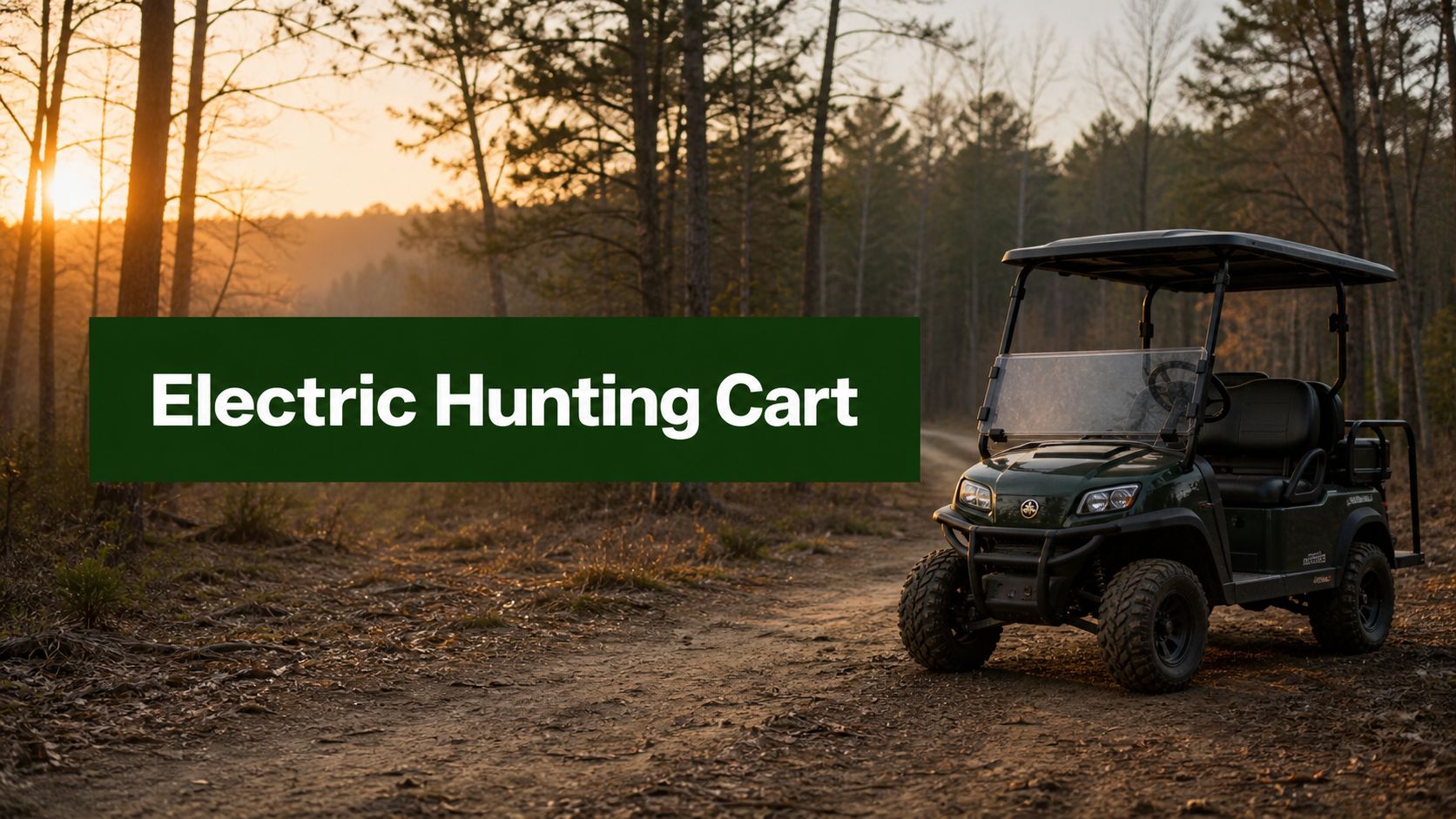
You're loading the truck before daylight, checking a wind shift, and trying to keep noise down because the woods are already alive. That's exactly where an electric golf cart for hunting starts making sense. It gets you and your gear to the stand without the engine note, fuel smell, and constant maintenance headaches that come with gas machines.
For private land, food plots, and trail networks that don't need highway speed, the electric platform has moved from novelty to a serious field tool. The question isn't whether it's quiet. It's whether the cart has enough gradeability, the right chassis geometry, and enough usable range to work when the ground turns rough and the load gets heavy.
Why Hunters Are Switching to Electric Golf Carts
A cart matters most before sunrise, when you are easing toward a stand with a rifle case, a pack, and maybe a cooler in the bed. Every extra sound carries farther than you want it to, and every unnecessary stop can cost you the morning. Electric carts earn attention here because near-silent travel changes how you cross the property, and that matters more than chrome, paint, or fairway styling. A 2026 hunting cart guide says electric carts are near-silent, while gas carts are only moderate in noise, and notes that the quieter approach can help reduce the chance of spooking game. It also says electric carts typically deliver 25 to 45 miles per charge, while gas models reach 100 to 120 miles, with a 4 to 8 hour lithium charge time and about 2 minutes to fuel gas (hunting/off-road golf cart guide).
Quiet travel changes the hunt
Most hunting pressure comes from noise that could have been avoided. A gas cart's idle, exhaust, and stop-start routine can announce your route long before you are visible. Electric drive does not make you invisible, but it removes one of the biggest signals.
The same guide puts electric fuel cost at roughly $0.02 per mile, compared with $0.08 to $0.12 per mile for gas (hunting/off-road golf cart guide). Over a season of feeder runs, stand checks, and short hauls back to camp, that gap matters without adding much planning overhead. The cart ends up cheaper to keep ready and easier to justify for regular use.
electric golf cart off-road guide
Practical rule: if you can hear your vehicle before you can see your stand, you are giving away your approach.
Private land is where electric carts fit best
Electric carts fit best on private land with marked trails, gates, food plots, and stands you revisit often. The guide above says a lithium electric cart with 35 to 45 miles of range can handle a full day of trips on land under 500 acres (hunting/off-road golf cart guide). That will not match every property, but it fits the way many hunters move, in short runs, repeated loops, and quick trips between camp and the field.
Reduced maintenance matters too, even if it gets less attention than quiet operation. Electric carts skip the fuel system work that gas machines bring, and that means fewer small failures to sort out before a weekend hunt. If you are weighing battery setups for a field cart, it helps to compare lithium vs lead-acid RV batteries, because the battery choice changes weight, charging habits, and how much usable range you keep once the cart is loaded. When the machine starts with a charge instead of a choke routine, you spend less time wrenching and more time glassing.
Critical Specifications for Hunting Performance
A hunting cart earns its place in the field when it holds speed on a grade, carries gear without sagging, and turns through a narrow trail without hanging a frame rail on a rut. Motor power, voltage, gradeability, and chassis geometry matter more than badge names or fairway styling. On paper, hunting-cart specs often show 5 kW AC motors with 48V or 72V systems, 20% to 30% gradeability, and 80 to 100 km range, and one example lists a 5 kW motor, 48V 150Ah lithium battery, 30% slope-climbing capacity, and 30 km/h top speed (5 kW hunting cart spec).
Power and voltage under load
For a field cart, 5 kW AC is a useful benchmark because it points to a drivetrain built to move a full load instead of just a driver on flat ground. Higher-voltage systems, especially 48V and 72V, usually give stronger torque when the cart is climbing, starting on soft ground, or pushing through a loaded lane. Low-voltage, lead-acid setups can feel fine in a driveway and weak on an access road.
Gradeability is the number that tells you whether the cart can keep moving when the trail pitches up. If you hunt hilly property, carry two people, or pull gear on a muddy incline, a higher gradeability rating is the field-use spec that matters most. Speed looks good on paper, but low-speed torque is what keeps the cart from bogging down.
A cart that climbs slowly and steadily is more useful than one that sprints on flat dirt and quits on the first rise.
Geometry beats styling when trails get tight
Ground clearance, wheelbase, and turning radius decide whether the cart fits your property or fights it. Published hunting-cart specs commonly show 200 mm ground clearance, 3.5 to 3.87 m turning radius, 80 to 100 km range, and hydraulic braking, while one 4x4 cart pairs front and rear motors for traction on loose ground (chassis spec reference). Shorter, tighter carts are easier to live with in blinds, between trees, and around pinch points.
Battery weight changes how a cart handles under load, not just how long it runs. If you want a direct comparison before you commit, compare lithium vs lead-acid RV batteries is the most useful outside read because the chemistry choice affects weight, charging habits, and how much usable range stays left once the cart is loaded.
| Specification | Minimum for Hunting | Optimal Range | Why It Matters |
|---|---|---|---|
| Motor output | 5 kW class | 5 kW AC or stronger | Holds speed under load and on grades |
| System voltage | 48V | 48V to 72V | Helps torque delivery and hill performance |
| Gradeability | 20% | 20% to 30% | Tells you whether the cart can climb with gear |
| Ground clearance | 200 mm | Around 200 mm or more | Helps avoid bottoming out in ruts and brush |
| Turning radius | Tight enough for narrow trails | 3.5 to 3.87 m | Makes it easier to maneuver in woods and blinds |
| Range | 35 miles usable | 35 to 45 miles or more | Covers a day of typical hunting runs |
Matching Your Cart to Terrain and Hunting Style
A cart that feels fine on a gravel lane can become a liability on wet clay, steep creek crossings, or broken two-track. Start with the ground, because terrain decides whether you need traction, clearance, braking, or just a simpler build that stays light and easy to control.

Read the property before you buy
Soft ground puts a premium on tire footprint and weight management. On steep property, the cart needs torque, braking, and a chassis that stays settled when the load shifts. Thick brush changes the equation again, because low clearance and exposed parts get punished fast.
A four-wheel-drive layout or dual-motor setup helps most where traction is inconsistent and the cart has to claw through loose soil or uneven crossings. On flatter property, that extra hardware can add weight and complexity without giving back much in real use. A lighter 2WD cart with the right tires often makes more sense if the route stays on established trails and short cut-throughs.
Chassis geometry matters more than many buyers expect. A short wheelbase turns easier in timber and around blind access points, while a longer stance can feel steadier on open ground and with a loaded rear bed. The trade-off is simple, tighter carts are easier to place, but stretched carts usually carry weight better.
Match the cart to the way you hunt
Stand hunters usually make repeated runs on the same trails. For that style, usable range, cargo space, and a smooth ride matter more than hard acceleration. The cart has to carry decoys, coolers, or gear without sagging in the back or wasting energy every time the load shifts.
Spot-and-stalk hunting asks for a different setup. Tight turning, quick repositioning, and a cart that does not hang up on brush or dig into soft edges matter more than comfort features. If the route changes often, a cart that is easy to thread through cover will save more time than one with extra speed on paper.
Tires change the whole feel of the machine. Aggressive tread helps in mud and loose dirt, but it brings more noise and can ride rougher on hard ground. Lifted suspensions help clear roots, rocks, and ruts, but a lift alone does not fix weak torque, poor balance, or a cart that carries too much weight high in the chassis.
For accessory choices, a practical electric golf cart mod guide from Caddie Wheel helps separate useful changes from cosmetic ones before money goes into the wrong parts. A good EVChargers.eu EV accessory list makes the same point from another angle, choose parts that solve field problems, not parts that only look ready for the woods.
If the trail is already there and the cart only needs to reach known stands, keep the setup simple. If you are crossing rough ground, spend on clearance and traction first.
Essential Modifications and Accessories
The wrong accessories are easy to buy because they look tough in photos. The right ones solve field problems. For hunting, the useful upgrades are the parts that keep gear secure, protect the cart from terrain, and improve visibility without spending money on trim pieces that do nothing in the woods.
A practical electric cart accessory list helps sort real field value from cosmetic additions. That matters because every extra part changes weight, and weight affects range, hill climbing, and how the cart settles on uneven ground. A hunting build should make the cart easier to use in rough country, not just more convincing in a driveway.
Upgrades that earn their place
A lift kit helps when the cart needs more clearance over ruts, rocks, and low crossings. It does not fix weak torque or poor weight balance, so the chassis still has to be matched to the terrain. All-terrain tires matter when the property shifts from hardpack to mud or gravel, because tread affects both bite and ride quality.
A gun rack keeps firearms stable on rough ground, which is safer than leaning a case against a seat back. Cargo systems deserve more attention than they usually get. A cart that carries a cooler, game bags, and decoys without upsetting balance is more useful than one with a flashy roof or extra trim. Lighting is another practical upgrade, especially if you're entering or leaving before dawn, but it should be aimed and controlled so it does not create unnecessary glare or give away your position.
Add-ons that sound better than they are
Camouflage wraps help visually, but they do not improve traction, clearance, or braking. They are fine if you want the cart to blend in with other gear, but they are not a performance upgrade. Sound systems fall into the same category, useful around camp, irrelevant once the hunt starts.
For broader modification ideas, the internal guide at electric golf cart mods is a useful reminder that every added part changes weight and sometimes range. That trade-off matters more on a hunting cart than on a neighborhood cruiser, because field use exposes weak suspension geometry, poor tire choice, and sloppy cargo placement fast.
Range Planning and Maintenance Realities
Range anxiety is real in the field because a dead cart is not a small inconvenience, it becomes a retrieval problem. The common mistake is to read a quoted range and assume it still holds once you add gear, hills, cold air, and stop-start driving. That is not how batteries behave in the woods.
A better way to think about range is to treat the published number as a starting point, then cut it back for the way you hunt. If you want a broader battery reference, the internal guide at battery golf cart is a useful place to compare battery types and maintenance basics. The practical lesson is simple. Keep a reserve, because the last mile home matters more than the first mile out.
Build a range plan from your actual route
Count the round trip to the stand, then add the extra movement that always happens. You end up checking a gate, rerouting around mud, or hauling a deer back, and each of those runs pulls more from the pack. Weight and terrain matter more than many owners expect, because battery draw rises fast when the cart is loaded and climbing. Cold weather adds another layer, since batteries do not give their best output early in the morning.
Charging setup should match how often you hunt. A basic outlet works if the cart returns after each outing and has time overnight, while a faster charging setup gives more flexibility for repeated use. The key question is not the plug itself, it is whether your routine leaves the cart full before every trip.
Maintenance is simpler, but not optional
Electric carts still need attention. Battery health, tire pressure, brake condition, and controller behavior all deserve regular checks, especially before season and after long storage. If the cart sits unused, store it charged according to the battery maker's guidance, then inspect it again before the first hard drive of spring.
The battery is the heart of the system, and it deserves the same care you give the rest of your field gear. A neglected pack, loose terminal, or low tire pressure shows up quickly once the cart is loaded and off pavement.
Do not plan a hunt around the absolute maximum range. Plan it around the range you still have when the load is heavy and the trail gets ugly.
Making Your Decision Is an Electric Hunting Cart Right for You
The cleanest way to decide is to look at your property, not the catalog. If you hunt a smaller or mid-sized property with established trails, want stealth at dawn and dusk, and can charge at home or camp, an electric cart fits naturally. If your land is extremely large, rutted, or too remote for charging, gas or an ATV may still make more sense.
The strongest electric case is simple. Quiet movement, low running cost, and easy daily use line up with private-land hunting better than expected. The weak spots are just as clear, though, because limited range, charging time, and cold-weather sensitivity can become real problems if you ignore them.
Use this checklist before you buy
- Property size and trail quality: If your routes are short and predictable, electric fits better.
- Terrain and slope: If the land has steep climbs, prioritize gradeability and voltage.
- Cargo needs: If you haul a lot of gear, pay attention to payload balance and braking.
- Access to charging: If you can't plug in reliably, don't force an electric build.
- Hunting style: If you move often and without noise, electric has a real advantage.
The trade-off is not subtle. Electric carts reward planning, while gas carts reward extended runtime. For many hunters, that makes the electric cart the more practical tool, not just the quieter one.
Caddie Wheel builds a motorized wheel attachment that turns a compatible push cart into a remote-controlled electric cart with forward, reverse, brake, and variable-speed control, so the same basic idea of quiet electric assistance carries over to ground that demands less strain. If you're looking at electric mobility tools for the field and want a simple place to start, visit Caddie Wheel and see how its approach fits the way you already move gear.
Partager:
Club Brush Golf: Clean Grooves for Better Spin
Electric Golf Board Guide: How They Work and Who They Suit