
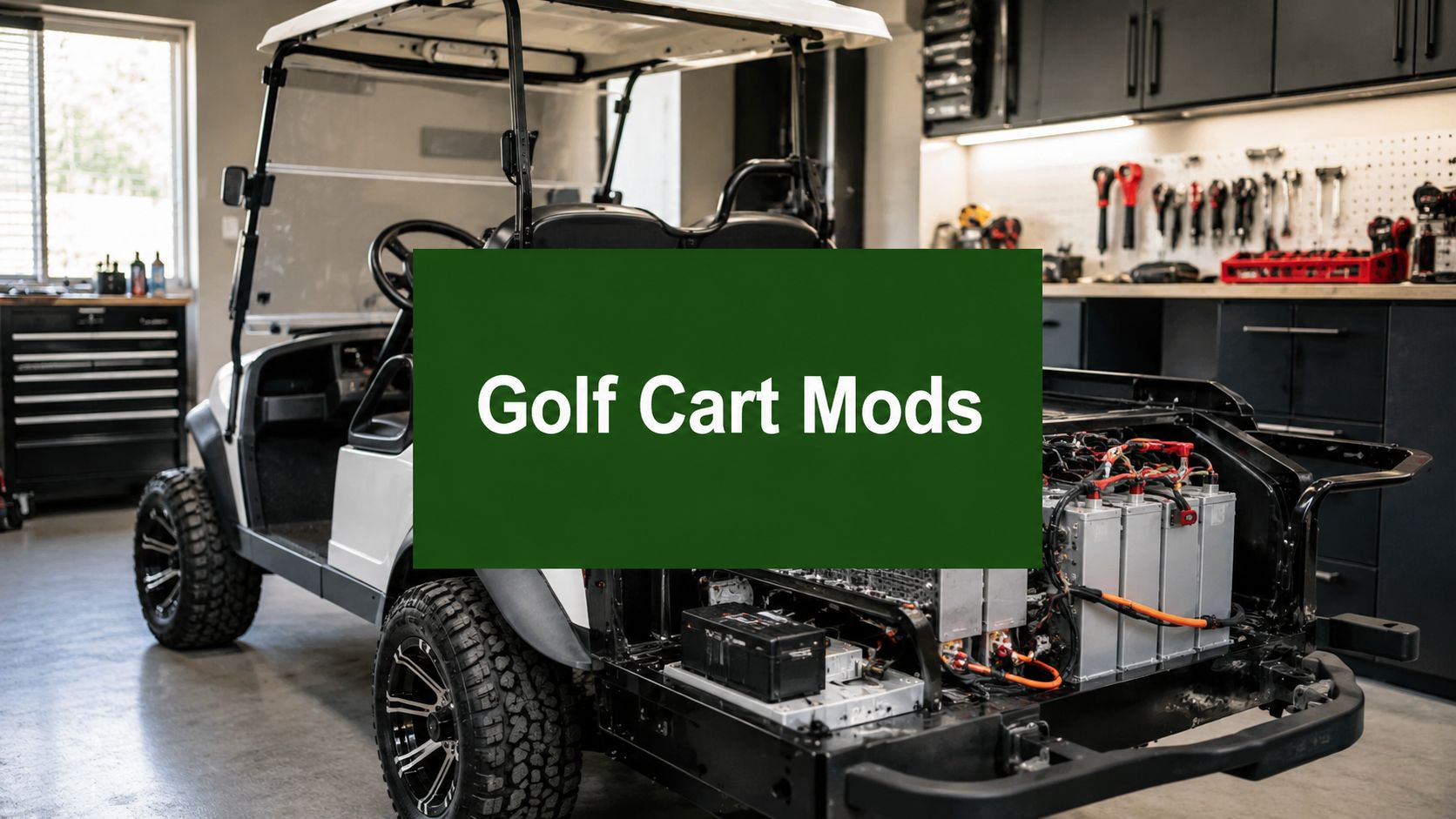
You're staring at a cart that should feel sharper than it does. It's a little sluggish on the hill by the clubhouse, the batteries take longer than they should to recover, and every forum thread seems to promise a different fix, usually starting with speed and ending with regret.
That's the trap with electric golf cart mods. The flashy parts get attention, but the upgrades that matter most are the ones that improve range, charging, weight, reliability, and legal status without creating a new problem in the process. In 2026, that matters more because the category is no longer a niche hobby. The global golf cart market is projected at USD 2.41 billion in 2026 and forecast to reach USD 3.86 billion by 2036 (Future Market Insights), while a related electric golf cart market estimate puts the segment at USD 1.4 billion in 2025, USD 1.7 billion in 2026, and USD 3.3 billion by 2035 at a 7.9% CAGR (Future Market Insights). Electric carts already dominate the category, with one 2026 analysis stating they held 81.81% market share in 2025 and were projected to reach 85% in 2026 (Future Market Insights).

Why Electric Golf Cart Mods Matter in 2026
A lot of owners start with the same complaint. The cart feels fine on flat ground, then the first long climb exposes weak batteries, soft acceleration, or a controller that was never meant to do more than move the vehicle around a course at a conservative pace. At that point, “faster” stops being the right question. The core issue is whether the cart can carry you farther, charge more cleanly, and survive repeated use without turning into a maintenance project.
The market changed before the parts did
The upgrade conversation changed because the installed base changed. As the market data shows, golf carts are now part of a broad, mainstream electrification trend, not a fringe hobby (Future Market Insights). That means more carts on courses, in resorts, in private communities, and in personal garages, all of them aging into the point where owners want better range, better comfort, or better performance instead of a full replacement.
That's why the strongest mods are usually the ones that improve the cart's daily use, not the ones that merely make it sound more aggressive. A battery swap that improves charging behavior and reduces weight does more for most owners than a cosmetic package ever will.
What actually moved from novelty to standard
Modern battery upgrades are the clearest example. One 2026 guide says lithium-ion batteries can weigh about half as much as lead-acid batteries, charge in 2 to 4 hours instead of 8 to 12 hours, last 2,000 to 5,000 cycles instead of 300 to 500 cycles, and provide 20 to 50% more range, with some carts reaching up to 60 miles per charge (Intermountain Golf Cars). A separate trend report says over 80% of new golf carts in 2026 feature advanced lithium-ion batteries and that they provide roughly 50% more range than traditional lead-acid systems (Intermountain Golf Cars).
Practical rule: if a mod doesn't improve range, reliability, or charging convenience, it usually isn't the first dollar to spend.

Battery Upgrades That Transform Performance
Battery work is where most serious builds begin because the battery pack shapes how a cart behaves under load, on hills, and after repeated rounds. A weak pack makes every other upgrade feel underpowered. A strong pack makes the whole cart feel more settled, more responsive, and less temperamental.
Lithium beats lead-acid for real use, not just spec sheets
Lead-acid still shows up because it's familiar and often cheaper up front, but lithium changes the day-to-day ownership equation. The lighter pack reduces vehicle weight, which helps acceleration and range. Faster charging also changes how you use the cart because overnight recovery stops being mandatory for every outing.
If you want a deeper technical comparison of pack architecture and system design, the industrial energy storage solutions guide from E & I Sales is a useful background read because it frames battery choices around system compatibility instead of marketing labels. That mindset matters for cart builds too, especially if you are comparing chemistry, charger behavior, and long-term replacement costs. For a more cart-specific overview, the Caddie Wheel lithium overview is a practical reference point.
A few practical signs point toward lithium:
- You use the cart often: Fewer charging delays matter more than the old lead-acid routine.
- You drive hilly terrain: Weight reduction and steadier voltage under load both help.
- You want longer service life: Fewer replacement cycles reduce long-term hassle.
- You care about usable range: More consistent voltage means the cart feels more predictable late in the round.
Install in the right order or you can damage expensive parts
The safest speed-oriented sequence is simple, and it matters more than most owners realize. First, verify the motor and controller can handle the new voltage. Second, replace the charger so it matches the new battery pack. Third, disconnect the batteries before installation. That order helps avoid controller damage and charging mismatches, which are the expensive mistakes I see most often in higher-voltage builds (YouTube speed-mod guidance).
The controller is usually the first component that gets overloaded when someone installs a battery pack without checking compatibility.
That's why battery conversions deserve more respect than decorative upgrades. They affect range, charging, load behavior, and component life all at once, and the wrong chemistry can create a cheaper purchase with a higher total cost of ownership.
A good reference build can be seen in the Caddie Wheel lithium overview, which is useful as a reminder that battery strategy should match the vehicle's actual workload, not just the owner's wish list.
Motor and Controller Upgrades for Real Speed Gains
A cart that feels lazy off the line, climbs poorly, or runs hot under a normal round usually has a control problem before it has a speed problem. Motor and controller work decides how much current reaches the drivetrain, how long the cart can hold that output, and whether the rest of the electrical system can keep up. I see a lot of owners chase top speed first, then discover the issue is heat, wiring quality, or a mismatched battery pack.
Voltage, amperage, and compatibility decide the outcome
A 400 to 600 amp programmable controller is a common benchmark because it can open up more current flow to the motor and improve overall performance (Golf Cart Garage). A 36V to 48V conversion is also described as a meaningful power boost when the cart is built for it (Golf Cart Garage). Compatibility is the part people skip, and that is where expensive mistakes start. If the motor, controller, wiring, and charger do not match the new pack, the upgrade can run hotter and wear parts out faster instead of giving you the cleaner drive you wanted.
The simplest way to judge the setup is straight through the whole system.
- Voltage sets the system's performance ceiling.
- Amperage decides how much punch the motor gets.
- Controller programming shapes how the cart behaves under load.
If one of those pieces is off, the cart may feel louder, run warmer, or become less reliable even if the headline parts look better on paper.
What to watch before you buy parts
The warning signs show up before installation. Weak wiring, unknown controller specs, and a motor that comes back warm after short runs all point to a cart that needs restraint, not a bigger parts order. A larger controller can raise output, but it can also push a tired motor into a shorter service life if the rest of the build was never meant to handle it.
The electric golf cart fast guide lays out the basic upgrade logic well, but the practical takeaway is simpler. Buy for the full electrical system, not for one headline component.
Installer's rule: if the charger and controller do not agree with the battery chemistry, the build is not finished, it is waiting to fail.
That is why speed-only mod kits disappoint so many owners. They sell a top-end feel while ignoring heat, cable quality, and the cart's real duty cycle.
Suspension, Tires, and Accessories That Improve Ride Quality
Ride quality is where a lot of “performance” discussions get lazy. A cart that's quick but chatters over every seam and pounds the batteries on rough paths isn't a better cart, it's just a faster annoyance. Suspension, tire choice, and practical accessories can matter as much as raw speed.
Bigger tires help, but they're not free speed
Larger tires can raise top speed slightly because they cover more ground per rotation, but they also change how the cart loads the motor. That can reduce acceleration if the rest of the system wasn't upgraded with them. Aggressive tread patterns improve traction on grass or dirt, but they add rolling resistance on pavement and can make the cart feel heavier than it really is.
A lift kit is only worth it when it supports the tire and terrain package you need. If the cart lives on flat paths, a lift may just add complexity and cost. If it spends time on uneven routes, clearance can prevent scuffing and suspension travel problems.
Accessories should solve a real use problem
Lighting helps more than vanity buyers admit. If you sometimes finish late, better illumination extends the cart's usable hours without asking the drivetrain to do anything different. Seats, mirrors, and utility add-ons can be worth it too, but each accessory should earn its place by adding function rather than clutter.
For owners looking at smaller, more focused mobility options, the golf cart wheels guide is relevant because it shows how a single-wheel assist can bridge the gap between manual pushing and full cart ownership. Caddie Wheel itself is a single-wheel electric assist for standard push carts, so it sits in the same broader conversation about practical modification, even though it's a different use case from a full golf cart build.
A simple comparison helps:
| Upgrade | Best for | Trade-off |
|---|---|---|
| Larger tires | Mixed terrain | More load on drivetrain |
| Lift kit | Clearance and fitment | Added complexity |
| Lighting | Late rounds | More wiring |
| Assist wheel solution | Walking golfers | Not a full-cart conversion |
Legal Compliance and Liability Issues Most Guides Ignore
A lot of mod content treats legality like a footnote. That's backwards. Once a cart crosses certain speed thresholds, it may no longer be treated as a golf cart under local rules, and the consequences can include registration, insurance, and equipment requirements that owners didn't budget for.

Federal classification is not optional reading
Under U.S. federal vehicle classification rules, low-speed vehicles are defined as four-wheeled motor vehicles with a top speed of more than 20 mph but not more than 25 mph, and they must meet specified Federal Motor Vehicle Safety Standards such as headlamps, turn signals, reflex reflectors, mirrors, a parking brake, a windshield, seat belts, and a VIN (Federal Register). That doesn't automatically tell you what your state or city requires, but it does tell you the line where the vehicle category starts changing.
Speed chips, limiter bypasses, and oversized controller setups become liability questions, not just performance questions. A cart that's fine on a private course may be out of compliance on a public road, and that gap can matter a lot after an accident.
Treat documentation like part of the upgrade
Before any major mod, keep records of the battery type, controller settings, charger compatibility, and installed safety equipment. If a cart is moved between private property, a gated community, and public roads, the paperwork matters because the legal standard may change with the location.
Practical rule: if the cart can travel faster, it should also be able to stop, signal, and legally belong where you plan to drive it.
That legal filter should come before the excitement of any build. Warranties can be voided, but that's not the biggest risk. The bigger problem is discovering after the fact that the cart was no longer legal for the place it was being used.
Building Your Upgrade Strategy Based on Real Needs
The right build depends on the actual job the cart has to do. A private-course cruiser, a neighborhood cart, and a hilly-property workhorse do not need the same package, even if all three start from the same chassis. The best money usually goes to the upgrade that removes the biggest daily frustration first.
Match the mod to the workload
If range is the main complaint, battery chemistry comes first. If the cart feels weak on hills, controller and motor compatibility deserve attention. If the ride is harsh, tires and suspension should lead the list. Cosmetic work only earns a place after the functional problems are solved.
A practical prioritization looks like this:
- Range and uptime issue: Focus on battery replacement and charger matching.
- Weak acceleration issue: Check controller capacity and motor health.
- Poor ride quality issue: Review tire size, pressure, and suspension geometry.
- Legal uncertainty issue: Sort classification and equipment requirements before spending more.
The budget path is usually the smartest first step
A modest build that corrects battery weakness and cleans up basic compatibility often feels more impactful than a scattered parts list. A premium build makes sense when the cart sees heavy use, steep terrain, or frequent multi-round days. The middle ground, which I recommend often, is to solve one major problem well instead of chasing every possible mod at once.

A cart that's built around real use is cheaper to own and easier to live with. That's the upgrade path that tends to hold up after the first season, not the one that looked best in a parts catalog.
Maintenance Routines and Troubleshooting Modified Carts
Modified carts need a tighter maintenance rhythm than stock ones because every upgrade adds another point where heat, wear, or a mismatch can show up. That matters more once you move beyond basic bolt-ons. A lifted cart with a stronger controller, larger tires, or a chemistry swap can run well for a long time, then fail in a way that looks sudden only because nobody was watching the warning signs.
The first thing I tell owners is to treat the cart like a system, not a pile of parts. Battery chemistry, charger profile, controller settings, wiring quality, and tire load all interact. If one piece is out of spec, the cart can feel inconsistent long before anything quits outright.
Keep a simple inspection routine
Check battery connections for looseness, corrosion, or heat marks before and after heavy use. Confirm that the charger still matches the pack chemistry, especially after any battery change. If you have added a controller or motor, listen for unusual noise, smell for overheated insulation, and watch for range that drops suddenly instead of fading over time.
Moisture and road grime shorten the life of modified carts fast, especially if they are stored in damp conditions or hauled through wet grass and salted paths. The how to protect car from rust guide from APEX NANO - Titan Coatings is a practical external reference for the kind of care that helps keep metal parts from aging early. The core habit is simple, keep moisture, grime, and salt off the parts that corrode first.
Troubleshoot in the right order
Start with the simplest failure point. A cart that sounds dead is often dealing with a battery connection, charger, or fuse problem before it is dealing with a motor problem. A cart that runs but feels weak is often carrying an incompatibility or load issue before it is facing a full component failure.
Use this order:
- Check power delivery through the battery pack and connections.
- Confirm charger behavior and charge completion.
- Inspect controller response for heat or error behavior.
- Evaluate motor load only after the earlier steps look normal.
If a new setup is losing performance fast, write down the symptoms, the last change made, and any heat or charging irregularities. That record saves time when you need warranty support or a professional diagnosis. It also helps you separate a real hardware fault from a bad setup choice, which is one of the most common mistakes I see after aggressive upgrades.
A modified cart is easier to keep reliable when the owner tracks battery health, charger match, and thermal behavior instead of chasing speed alone. That same mindset matters in other equipment, too. It is the difference between a setup that stays useful and one that turns into repeat shop visits and avoidable parts replacement.
Caddie Wheel helps golfers who want electric assist without turning a push cart into a complicated project. If you are comparing upgrade paths and want a simple, practical way to reduce pushing strain, visit Caddie Wheel and see how its drop-on wheel system fits the same real-world need for easier rounds and less fatigue.
Share:
Tony Romo Golf Handicap: What Is It Really?
Wedding Golf Buggy Guide: Rent, Style, and Run It Right