
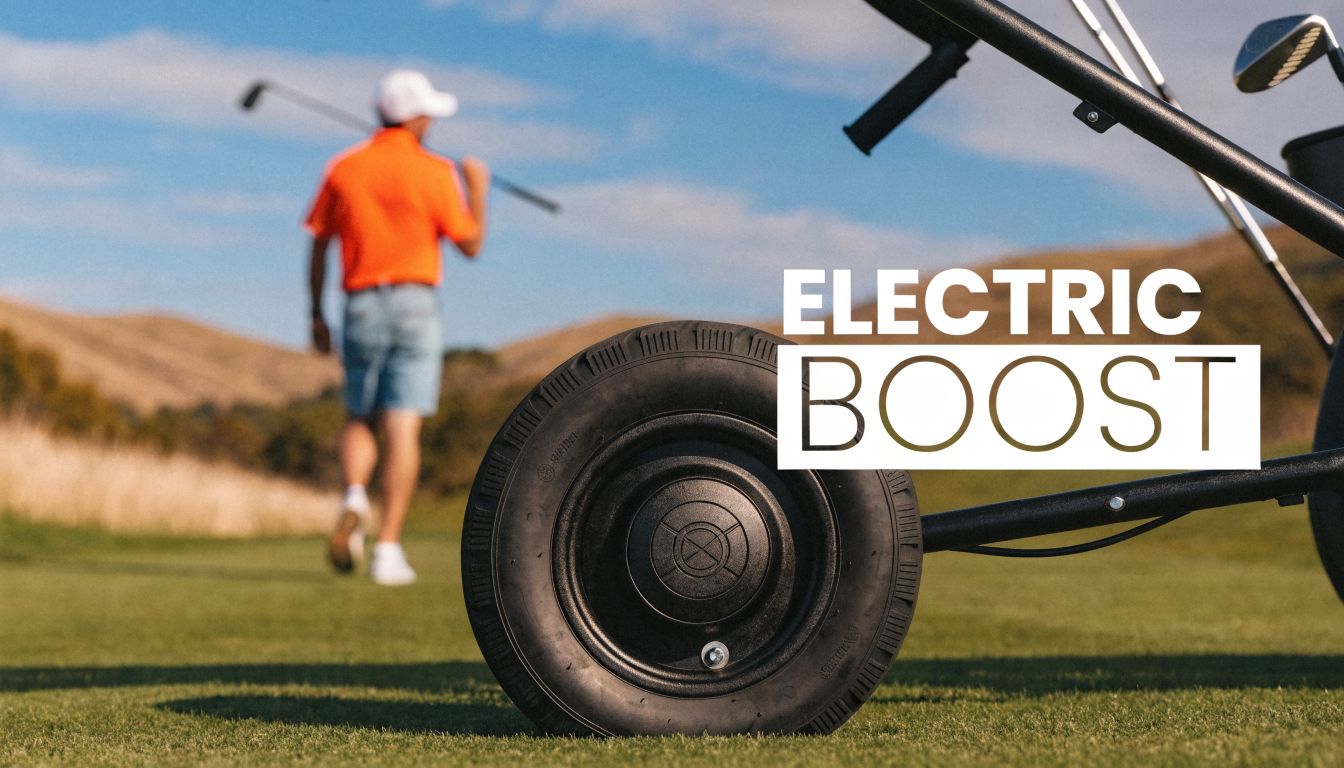
If you already walk with a push cart, you've probably had the same thought on a long uphill hole: the bag feels heavier, your hands get tighter on the handle, and by the time you reach the ball you're a little less fresh than you'd like to be. That matters more than most golfers admit. Fatigue doesn't just affect your legs. It affects decisions, tempo, and patience.
That's where an electric push cart attachment makes sense. Not as a luxury. Not as a compromise. As an upgrade. Instead of replacing a push cart you already know and like, you add motorized help to the setup you already own and keep the part that still works.
For most golfers, that's the smarter path. You keep walking. You save energy. You avoid the cost and storage hassle of a whole new electric cart. And you make the last few holes feel a lot more like the first few.
The Modern Golfer's Upgrade from Push to Power
A familiar round goes like this. You enjoy walking, you already own a push cart that folds well and fits your bag, and you have no interest in filling the garage with another full-size piece of equipment. What you want is simpler. You want the walk without spending extra energy pushing 25 to 35 pounds of clubs up every incline.
That is why this upgrade has caught on. An electric push cart attachment lets you keep the cart you already know, then add motorized help only where the effort shows up. For many golfers, that is the smartest use of money because it improves the part of the experience that feels tiring without replacing gear that still does its job.

You can see the shift in how often golfers now consider powered walking help. Attachments are no longer a fringe idea or a tinkerer's project. They fit a very practical buyer mindset. Upgrade the working cart. Skip the larger purchase unless you need a whole new platform.
Why this upgrade fits real golfers
A good manual push cart does not become obsolete because you got tired on the sixth fairway. If the frame rolls straight, folds easily, and holds your bag the way you like, replacing the entire cart often solves a bigger problem than you have.
An attachment solves the specific problem. It handles the effort of moving the load.
That distinction matters. It is the same logic as adding power steering to a machine you already trust. The frame, storage, and feel stay familiar. The strain drops.
Here is where the upgrade usually makes the most sense:
- Your current push cart still works well: If you like how it folds, steers, and fits in your trunk, keeping it is often the sensible move.
- You walk for exercise but dislike the push: The goal is still to walk the course. You are just removing the repeated effort of driving your clubs forward every step.
- You care about cost and storage: An attachment usually takes less room and asks for less money than buying a separate electric cart.
- You want to preserve your routine: Your bag setup, accessories, and habits often stay almost the same.
Practical rule: If your cart is fine and your complaint is the pushing, start by looking at an attachment before you shop for a full electric cart.
Why it changes the round
The benefit shows up slowly, then all at once. On the first few holes, the difference may feel small. By the turn, especially on a hilly course or in summer heat, you notice your hands, shoulders, and legs have done less background work.
That saved energy has a golf benefit, not just a comfort benefit. You get to your ball a little less rushed. Club selection feels calmer. Late-round swings are less likely to come from a body that has spent four hours doing extra labor between shots.
For golfers who already own a manual cart, that is the primary appeal of moving from push to power. It is an upgrade decision, not a surrender to more gear. You keep the walking experience and improve the part that wears you down.
What Exactly Is an Electric Push Cart Attachment
Electric push cart attachments function similarly to e-bike conversion kits. You begin with equipment you already own and trust, then install a motor system that transforms how it operates.
In golf, that usually means attaching a motorized wheel or drive unit, a battery, and a control system to your existing push cart. Your cart remains the frame. The attachment adds the power.

The core parts in plain English
Most systems include the same basic pieces:
- Motorized drive unit: This is the part that moves the cart. Some systems replace wheels. Others add a powered wheel to the frame.
- Rechargeable lithium battery: This supplies the power without making the setup overly bulky.
- Bracket or mount: This connects the powered unit to your existing cart.
- Remote or control buttons: This lets you send the cart forward, slow it down, reverse it, or brake.
The easiest setups are the ones that don't ask you to become a mechanic. A drop-on style system is appealing because the idea is simple: mount the bracket, connect the drive unit, and go play.
Two common attachment styles
There are two broad styles golfers usually run into.
The first replaces part of the cart's existing wheel setup. These systems can feel integrated, but they may require model-specific mounting points.
The second is the simpler add-on style. That's where products such as Caddie Wheel come into the conversation. It uses a drop-on motorized wheel approach with a snap-in bracket, which makes the conversion feel more like adding an accessory than rebuilding the cart.
A good attachment should feel like a clean upgrade to your push cart, not a weekend workshop project.
For golfers who want to see the concept in motion, this walkthrough helps make the parts and controls easier to visualize.
How the technology helps on the course
The confusing part for many golfers is this question: if the cart is powered, what keeps it from wandering on hills or running away downhill?
That's where better systems separate themselves. High-end attachments can handle inclines up to 30 degrees, and some use 6-axis gyroscopes that sample terrain data every 10 milliseconds to adjust torque and help keep the cart tracking straight on sidehills, based on Club Booster V2 specifications.
A simple analogy helps. Think of the gyroscope as the cart's balance sense. When the course tilts, the system notices it and adjusts before the cart drifts too far off line.
That doesn't mean every attachment performs the same way. But the basic idea is straightforward. The motor moves the cart. The battery feeds the motor. The bracket holds everything in place. The control system helps you stay in charge.
Key Benefits of Upgrading Your Existing Cart
The biggest benefit isn't novelty. It's how much better a round feels when you aren't spending steady effort pushing a loaded cart for several miles.
You still get the health value of walking. You just remove the part that wears you down most. That difference shows up in your body first, then in your focus.
Better energy where it counts
A walking round asks for more than many players realize. Even on flatter courses, you're guiding a bag, managing slopes, crossing rough ground, and dealing with heat. On hilly courses, the push itself becomes its own workout.
That's why user feedback around these systems is so consistent. According to user surveys, 93% of golfers who motorize their push carts say they are “very or quite satisfied,” they report 60 to 70% less physical exertion, and 46% say they play more rounds as a result, according to Cart Tek's 2025 electric golf cart buying guide.
That tracks with what many golfers feel in real play. When you arrive at your ball less winded, it's easier to commit to the next shot.
Why reduced effort can improve the whole day
The advantage isn't only about score. It's also about enjoyment.
- Late-round focus: You're less drained on the closing holes.
- Hilly-course confidence: Courses that used to feel like a grind become more playable on foot.
- Less strain on hands, shoulders, and back: You still walk, but the cart does the hauling.
- More willingness to walk regularly: That can change your routine over a season.
Walking with power assist feels a bit like using a riding cart for your clubs, while your body still gets the benefit of the walk.
If you're comparing different powered walking options, this guide to electric push carts for golf is a useful next read because it broadens the picture beyond one style of setup.
The money side is hard to ignore
There's also a practical financial case. If you already own a solid push cart, upgrading it is often easier to justify than replacing it.
You're not paying for a new frame, new folding system, and all the other pieces you already have. You're paying to solve one problem: manual effort. That makes an attachment appealing for budget-conscious golfers who still want the main benefit of motorized walking.
Attachment vs Full Electric Cart A Comparison
A full electric cart and an attachment solve the same problem in different ways. One replaces the whole machine. The other adds a motor to a cart you already trust.
That makes this section less about philosophy and more about fit. If you already walk with a push cart, the primary question is how the two options differ once you look at cost, setup, storage, and day-to-day use.

Cost is usually the first practical filter
Price is a primary filter in this decision.
An attachment usually costs much less than buying a complete electric cart because you are not paying for another frame, another handle, another folding system, and another set of wheels. You are paying for the part that changes the experience most: powered movement.
If your current push cart already rolls straight, folds well, and fits your trunk, a full replacement can feel a bit like replacing an entire bicycle when all you wanted was pedal assist.
Side-by-side comparison
| Criteria | Electric Push Cart Attachment | Full Electric Cart |
|---|---|---|
| Upfront cost | Lower cost if you already own a push cart | Higher total purchase price |
| Frame and folding system | Keeps the frame you already know | Requires learning a new cart design |
| Initial setup | Needs mounting and basic adjustment | Arrives as a dedicated unit |
| Storage and transport | Often easier to judge because you already know how your cart fits in the car | Can take more trial and error depending on size and fold pattern |
| Controls and features | Usually focused on motor assist and core controls | Often includes more built-in features from the start |
| Repair or replacement path | Motor system and cart are separate pieces | Everything is tied into one platform |
| Best fit | Golfers happy with their current cart who want power | Golfers starting from zero or wanting an all-in-one package |
One detail golfers often overlook is familiarity. With an attachment, your bag straps, handle height, fold routine, and trunk setup usually stay close to what you already use. That lowers the learning curve in a way spec sheets rarely show.
Where a full electric cart has an edge
A purpose-built electric cart can be cleaner out of the box. The battery, controls, frame, and motor are designed as one unit, so there is less for the owner to assemble or match up.
Some golfers want exactly that. If you are buying your first walking cart and prefer a dedicated electric platform from day one, a full cart can be the simpler purchase.
Where attachments often win in real use
Attachments do well in the parts of ownership that happen every week, not just on purchase day. You keep the cart that already fits your car. You keep the handle and fold you already know. If the motor unit comes off easily, storage can stay simple too.
That is why many golfers find the upgrade route more practical than it first appears. It is not a stripped-down version of a full cart. It is a modular approach, much like adding a reliable motor to a hand truck instead of buying an entirely new one.
If you want to compare mounting styles and conversion approaches in more detail, this guide to a golf push cart electric conversion kit helps clarify the differences.
The same logic shows up in other gear categories where wheel size, portability, and terrain matter. A practical example is selecting the best wagon for outdoor adventures, where the smartest choice often comes down to how the equipment will be used and stored, not just which model has more features.
What to Look For When Choosing an Attachment
Not every electric push cart attachment fits every golfer. A smart purchase starts with one question: will this work cleanly with the cart and courses you already use?
That sounds obvious, but it's where many buyers get tangled up. They compare speed settings and battery details before confirming whether the unit mounts easily to their cart in the first place.

Start with compatibility
Check how the attachment connects. Some use universal brackets. Others work best with specific cart designs. The simpler the mount, the fewer headaches you'll have before a round.
Look closely at:
- Axle fit: Make sure the bracket matches your cart's structure.
- Wheel layout: Three-wheel and four-wheel carts can mount differently.
- Removal and storage: If you often load your cart in and out of the car, easy detachment matters.
If you want a more detailed walkthrough of brackets, battery choices, and conversion styles, this guide to a golf push cart electric conversion kit is a helpful reference.
Battery and control features matter more than flashy add-ons
The practical questions are simple. Can it finish your round? Can you control it easily? Can you push manually if you want to?
Most modern attachments use lightweight lithium batteries that provide up to 36 holes on a single 4 to 6 hour charge. They're commonly controlled by a remote with a 50-yard range, and many offer free-wheel modes for manual pushing on flat sections, according to Alphard's Club Booster V2 product specifications.
That gives you a useful checklist:
- Battery range: If you play back-to-back rounds or long hilly courses, more endurance matters.
- Remote simplicity: Forward, reverse, and braking should be easy to learn without staring at buttons.
- Free-wheel mode: This is handy when you want to conserve battery or move through a tight area manually.
Buying shortcut: Prioritize fit, battery life, and control feel before you worry about extra features.
Don't ignore transport weight and terrain needs
Some golfers focus only on course performance and forget the parking lot test. You still have to lift the cart into your trunk and store it at home. A unit that feels good on the fairway but awkward in the garage can get old fast.
Terrain matters too. If you regularly play soft ground, larger wheels and stable traction become more important. That same logic shows up outside golf. When people are selecting the best wagon for outdoor adventures, they also focus on wheel size, surface handling, and how the load moves over uneven ground. Golf carts aren't identical, but the buying mindset is similar.
Choose for your real course, not an idealized one. If your home track has hills, side slopes, and rough paths from green to tee, buy for that reality.
Installation Maintenance and Common Questions
Most golfers are relieved when they realize this isn't a major build. In many cases, installation is a straightforward home job. You mount the bracket, attach the powered unit, connect the battery, and test the controls before heading to the course.
If you want a more detailed walkthrough, this DIY guide on how to convert a push cart to electric shows the basic process in a practical way.
A few habits that keep things running well
Maintenance is usually simple if you stay consistent.
- Charge the battery after use: Don't wait until the next tee time to discover it's empty.
- Wipe down the unit: Grass, sand, and moisture build up around wheels and mounts.
- Check the bracket and fasteners: A quick inspection helps catch looseness before it becomes annoying on the course.
- Store it sensibly: Dry storage is always the safer choice for electronics and batteries.
Common questions golfers ask
Will it really help on hills?
Yes, that's one of the main reasons golfers buy one. Performance still depends on the specific system and your course, but powered assistance is most noticeable on climbs and uneven ground.
Can I still walk naturally with it?
Absolutely. The point is to remove the pushing load, not the walk itself.
Is it difficult to learn?
Usually not. Most golfers adapt quickly because the core controls are simple: move, slow, stop, and reverse.
If a product makes setup or control feel complicated in the first week, you probably won't love it in month six.
What about wet conditions?
Use common sense. Morning dew and light moisture are different from exposing electronics to conditions the manufacturer doesn't recommend. Always check the product guidance for weather use and cleaning.
An electric push cart attachment works best when it fades into the background. You walk, your clubs move with less effort, and your attention stays where it belongs.
If you're ready to upgrade the push cart you already own, Caddie Wheel offers a simple power-assist option built around a drop-on motorized wheel, snap-in bracket, and remote control for forward, reverse, and braking. It's designed for golfers who want to keep walking, save energy on the course, and convert a standard push cart without replacing their whole setup.
Partager:
Golf Push Cart Straps: A Complete Guide to Securing Your Bag
How Much Does a Golf Cart Battery Weigh? 2026 Guide