
Picture this: you're trudging up the steep hill on the 16th fairway, your shoulders aching from shoving that heavy golf bag. By the time you reach your ball, you're gassed. That kind of fatigue doesn’t just wear you out; it can wreck your focus and mess with your swing on the holes that matter most.
This exact scenario is why electric push carts for golf are quickly becoming a must-have for players who love to walk the course. They're no longer just a luxury item.
Why Electric Carts Are Changing How We Walk the Course
Walking the course is one of golf's simple pleasures. You get some exercise, enjoy the fresh air, and really connect with the layout of each hole. But let's be honest, pushing a 30-pound bag for four hours can suck the fun right out of it and tank your performance.
An electric push cart takes that entire burden away.
It's like having a personal caddie who does nothing but carry your bag. The cart's motor handles all the heavy lifting, letting you stroll the fairway and save your energy for what counts: the next shot. This one simple change makes a huge difference in your stamina, especially on the back nine when the grind really starts to set in.
The True Benefits of Effortless Walking
The perks of using an electric cart go way beyond just making life easier. Golfers of every age and fitness level are seeing real, tangible improvements in their game and how much they enjoy a round.
- Sustained Energy and Focus: When you're not wrestling with your bag, you arrive at each shot feeling fresher. That means you're more mentally dialed-in to pull off the swing you want.
- Reduced Physical Strain: For anyone dealing with a bad back, shoulder, or knee, an electric cart is a game-changer. It lets you keep walking the course without aggravating old injuries.
- Improved Pace of Play: The cart moves at a steady walking pace, helping you keep a good rhythm without getting winded on hills or long walks between holes.
A golfer can easily walk four to five miles during a round. When you stop pushing and pulling a heavy cart for that entire distance, you save a ton of energy—and that saved energy often shows up directly on the scorecard.
A Modern Solution for Every Golfer
The great news is that this technology is more accessible than ever. You don't have to buy a massive, all-in-one system anymore. Smart solutions like the Caddie Wheel actually let you convert the manual push cart you already own into a motorized one in just a few minutes. It makes getting started both affordable and incredibly practical.
If you want to dive deeper, you can learn more about the 5 benefits of electric push carts for golfers right here.
At the end of the day, an electric push cart is all about making the walk you already love even better. It’s about enjoying the stroll, staying sharp for every shot, and finishing 18 holes feeling just as strong as you did on the first tee. Of course, even with the cart doing the work, proper hydration for athletes is still key to playing your best.
How Electric Push Carts Actually Work
At first glance, an electric push cart can look a little intimidating, but the concept behind it is surprisingly simple. The easiest way to think about it is like a personal e-bike built specifically for your golf bag. It combines a lightweight motor, a long-lasting battery, and an intuitive control system to do all the heavy lifting for you.
This technology transforms what used to be a muscle-powered chore into an effortless stroll. Instead of you pushing the weight, the cart propels itself. Suddenly, steep hills feel as level as the practice green, and the long walk up the 18th fairway feels just as easy as the first. The whole system is designed to work in sync to move your clubs, leaving you to do one thing: walk.
The Three Core Components
Every electric push cart out there—no matter the brand or design—is built on three fundamental components working together. Once you understand what each part does, the magic behind these machines becomes crystal clear.
-
The Motor: This is the engine of the whole operation. Modern electric push carts for golf use quiet, lightweight brushless DC motors that are powerful enough to tackle heavy bags and hilly courses without adding a ton of bulk. The motor is usually integrated right into the axle or wheel hub, giving you direct and efficient power where you need it most.
-
The Battery: Think of the battery as the fuel tank. Today’s carts almost exclusively run on rechargeable lithium-ion batteries—the same tech powering your smartphone and EV. They offer the best mix of high energy density (more power, less size), lighter weight, and a long lifespan. A good one will easily last for 36 holes on a single charge.
-
The Control System: This is how you tell the cart what to do. The controls can be as straightforward as a dial on the handle or as slick as a wireless remote you keep in your pocket. This system is the brain, telling the motor how fast to go, when to stop, and which way to turn, giving you total command over your gear.
It’s a beautifully simple system built for one purpose: to carry your bag so you don't have to. The remote sends a signal to the controller, the controller draws power from the battery, and the battery feeds the motor to turn the wheels.
Two Paths to Power: Integrated Carts vs. Conversion Kits
When you start shopping for electric push carts for golf, you’ll quickly find they fall into two main camps. Each gets you to the same place—an easier walk on the course—but they take different routes to get there. The right choice for you often comes down to whether you already have a push cart you love.
Fully Integrated Electric Carts
These are all-in-one units where the motor, battery, and frame are designed from the ground up to work as a single product. The components are often seamlessly built into the chassis for a sleek, unified look.
Electric Conversion Kits
This is a more flexible—and often more affordable—path. A conversion kit, like the Caddie Wheel, is an add-on system that motorizes a standard manual push cart you already own. These kits typically come with a motorized wheel, a battery pack, and a remote control.
| Feature | Integrated Electric Cart | Conversion Kit (like Caddie Wheel) |
|---|---|---|
| Initial Cost | Higher, since you're buying a complete system. | Lower, since you use your existing cart frame. |
| Convenience | Components are built-in and always ready to go. | Can be attached or detached in minutes. |
| Compatibility | Limited to the single unit you buy. | Often compatible with a wide range of popular push carts. |
| Upgradability | Difficult; you’d have to buy a whole new cart. | Easy; you can move the kit to a new push cart if you upgrade. |
Ultimately, both integrated systems and conversion kits give you the powered assistance you're looking for. The real difference is how you get there: either by buying a purpose-built machine from scratch or by giving the trusty manual cart in your garage a serious upgrade.
Essential Features to Compare Before You Buy
Picking out the right electric push cart is a lot like choosing a new driver—the best one for you comes down to your game, your home course, and what you personally prefer. To make a smart choice, you have to break down the key features that separate a good cart from a great one. This isn't just about bells and whistles; it's about matching the tech to the real-world demands of your golf rounds.
By taking a close look at the core components—the battery, motor, controls, and more—you can find a system that doesn't just carry your bag but actually makes your time on the course better. Let's dive into the essential features you need to compare before you pull the trigger.
Battery Life and Why 36 Holes is the Gold Standard
The battery is the heart of any electric push cart. Think of it as the cart's stamina; if it runs out of juice, you're back to pushing a heavy, now-motorized cart for the rest of your round. That’s why battery capacity isn't just a number on a spec sheet—it's a direct measure of reliability and peace of mind.
While many entry-level models offer enough power for a standard 18-hole round, a 36-hole battery capacity has become the gold standard for serious golfers. Why is this so important?
- Back-to-Back Rounds: It gives you the freedom to play a second round on the same day without needing to recharge.
- Tournament Play: Long tournament days, often with delays, can push an 18-hole battery to its limit. A 36-hole capacity ensures you're covered.
- Battery Longevity: A battery that isn't constantly drained to empty will maintain its health and last longer over its lifespan.
- Hilly Courses: Demanding terrain drains power faster. A larger battery provides a crucial buffer, so you never have to worry.
A 36-hole battery isn't a luxury; it's a practical feature that removes all anxiety about running out of power. It lets you focus completely on your game, knowing your cart can handle whatever the day throws at it.
Motor Power for Hilly Courses
Not all golf courses are created equal. A flat, links-style course needs far less power than a mountainous track with dramatic elevation changes. This is where the motor becomes a critical factor. A weak motor will struggle on steep inclines, forcing you to help it along—which completely defeats the purpose of having an electric cart.
When you're looking at motor power, think about the terrain of the courses you play most often. If you regularly face steep hills, you need a motor with enough torque to pull a fully loaded bag without slowing down. Brushless DC motors, which are common in quality electric push carts for golf, are known for being efficient and surprisingly quiet.
To learn more about how a motor's strength can impact your game, check out our guide on how motor power affects your game efficiently.
This handy flowchart can help you decide whether a conversion kit or a fully integrated cart is the right place to start.
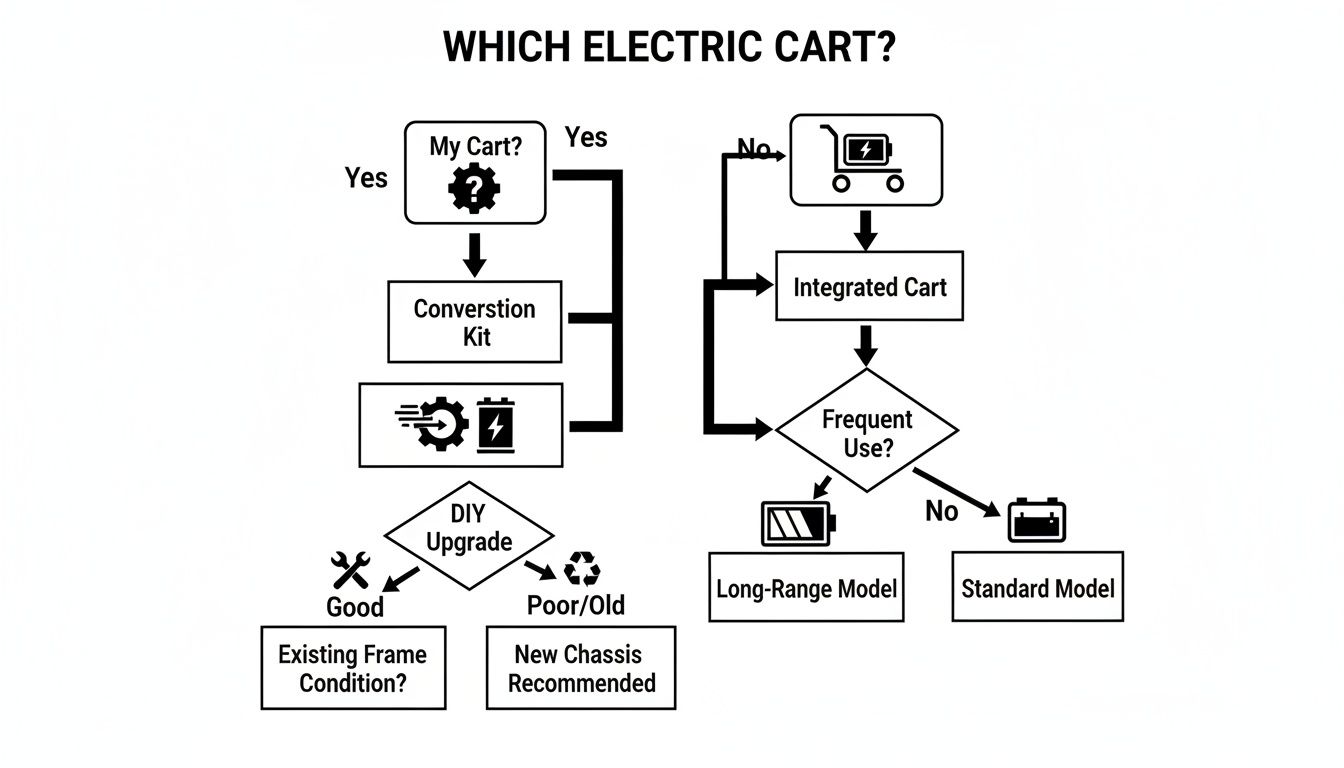
The flowchart simplifies the main decision: if you already own and like your manual push cart, a conversion kit gives you a direct and cost-effective upgrade.
Handlebar Controls vs. Wireless Remotes
How you command your cart is a huge part of the experience. The two main options are handlebar-mounted controls and a handheld wireless remote. Handlebar controls are simple and intuitive—usually just a dial or button to adjust speed. They are fixed to the cart, so you're always steering from behind.
A wireless remote, on the other hand, offers a completely different level of freedom. It lets you operate the cart from a distance, sending it ahead to the next tee box or across the fairway while you walk separately. This untethered control is a huge advantage, letting you move at your own pace. High-quality remotes, like the one with the Caddie Wheel, put variable speed, forward, reverse, and braking functions right at your fingertips.
The growing demand for features like these is reflected in the market's rapid expansion. The electric golf trolley market was valued at USD 704.6 million in 2024, with projections soaring to USD 1.5 billion by 2035. This growth is fueled by golfers looking for convenient, powerful solutions.
Comparing Electric Push Cart Solutions
To help you decide, here's a quick look at how integrated electric carts and conversion kits stack up against each other.
| Feature | Integrated Electric Cart | Conversion Kit (e.g., Caddie Wheel) |
|---|---|---|
| Initial Cost | Higher upfront investment for an all-in-one unit. | More affordable; motorizes a cart you already own. |
| Portability | Can be heavier and bulkier, even when folded. | Adds minimal weight to your existing cart setup. |
| Installation | No installation needed—ready to go out of the box. | Simple, often tool-free installation in minutes. |
| Compatibility | Not applicable; it's a self-contained unit. | Must be compatible with your specific push cart model. |
| Familiarity | Requires getting used to a completely new cart. | You keep the cart and its features you already know. |
| Repair | If the frame breaks, the whole unit is often useless. | If your cart breaks, you can just move the kit to a new one. |
Ultimately, an integrated cart is a great choice if you're starting from scratch. But if you love your current push cart, a conversion kit like Caddie Wheel offers an unbeatable blend of convenience and value.
Weight and Portability
Your electric push cart is only useful if you can easily get it to and from the course. Weight and portability are practical details that many buyers forget to consider. Before you buy, think about your routine:
- Lifting: Can you lift the cart into your car trunk without straining yourself?
- Storage: Does it fold down into a compact size that fits in your vehicle and garage?
- Assembly: How quick and easy is it to set up and break down before and after a round?
Integrated carts can sometimes be bulky, while conversion kits often add minimal weight to your existing, familiar setup. Look for designs that prioritize lightweight materials without skimping on durability.
Cart Compatibility for Conversion Kits
Finally, if you're leaning towards a conversion kit, compatibility is the single most important feature. These kits are designed to work with a wide range of popular three- and four-wheel push carts, but they are not one-size-fits-all.
Before buying, always check the manufacturer's compatibility list to make sure the kit will fit your specific cart model. A great conversion kit should feature a simple installation process—like a snap-in bracket—that lets you motorize your cart in just a few minutes, turning the equipment you already trust into a powerful electric caddie.
How to Install and Maintain Your Electric Cart
One of the best things about modern electric push carts for golf, especially the conversion kits, is just how simple they are to set up and look after. The days of wrestling with complicated wiring or needing a garage full of tools are long gone. Today’s systems are designed for the average golfer, letting you get from the box to the first tee in no time.
This practical, no-fuss approach doesn't stop after setup. With just a bit of routine care, your electric cart will be a reliable partner for hundreds of rounds. Let's walk through just how easy it is to get started and the simple habits that will keep your cart rolling smoothly, season after season.
The Five-Minute Installation
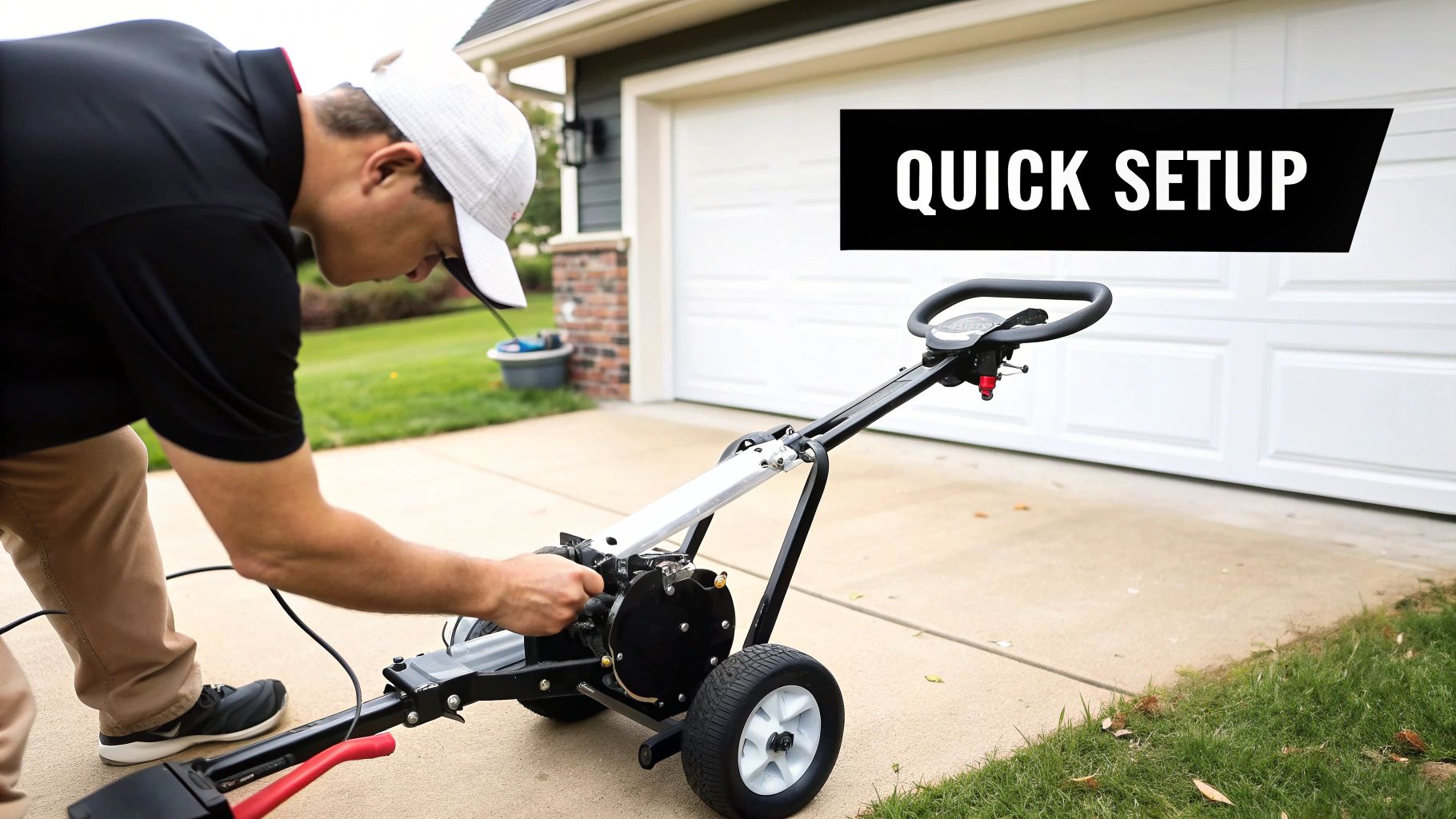
For a system like the Caddie Wheel, the installation is designed to be almost effortless. You don’t need to be a gearhead; if you can attach a wheel to your cart, you’ve got this. The whole process really just boils down to a few clicks and straps.
- Attach the Bracket: The first step is securing the universal mounting bracket right onto your cart's axle. This is the foundation of the whole system, and it’s usually designed for a snug, solid fit on most popular push cart models out there.
- Slide on the Motorized Wheel: Once that bracket is locked in, the motorized wheel unit just slides right on. Good systems will have a locking mechanism that gives you a satisfying click, so you know it’s secure.
- Mount the Battery: Find a good spot on your cart’s frame to strap on the battery pack. Most people put it on the main vertical tube for easy access and good weight balance.
- Sync the Remote: The final touch is pairing the remote control to the motor. This is usually a simple one-button press—hit a button on the motor, a button on the remote, and you're connected.
And that’s it. Seriously. In less time than it takes to hit a small bucket on the range, your trusty manual push cart is now a fully functional electric caddie. For a more detailed walkthrough, check out our complete DIY guide to convert your push cart to electric.
Essential Maintenance for Longevity
Keeping your electric cart system in top shape is just as easy as setting it up. A few simple habits will guarantee its performance and extend its life, protecting your investment for years of great golf.
- Battery Care is Paramount: The battery is the heart of your system. Always give it a full charge after each round and try not to leave it completely dead for long stretches. During the off-season, store it somewhere cool and dry.
- Keep It Clean: After a round, take a minute to wipe down the motor housing and wheels with a damp cloth. Getting rid of mud, grass, and sand prevents gunk from building up and causing problems down the line.
- Check Connections Periodically: Before you head out, give it a quick once-over. Make sure the wheel is firmly attached to the bracket and the battery strap is tight. This little pre-round check can save you a lot of headaches on the course.
Think of it like cleaning your clubs after a round. It’s a small, quick routine that pays huge dividends in performance and longevity. A well-cared-for system is a reliable system.
Troubleshooting Common Issues
Even the most dependable gear can have an off day. The good news is that most common hiccups with electric push carts have simple fixes you can handle yourself in a minute or two.
| Issue | Potential Cause | Quick Fix |
|---|---|---|
| Cart Won't Respond | Remote isn't synced or its battery is low. | Re-sync the remote to the motor. If that doesn't work, pop in a new battery for the remote control. |
| Loss of Power on Hills | The main battery is running low on juice. | Make sure the battery is fully charged before you play. A 36-hole battery gives you a great safety buffer. |
| Squeaking or Grinding | Debris is caught in the wheel or axle. | Disconnect the motor and give the wheel hub and axle area a thorough cleaning to remove any dirt or tiny stones. |
For those who brave the cold for a round, understanding a bit about proper electric vehicle operation in winter can also help you get the best performance out of your cart. By following these straightforward setup and maintenance steps, you can be confident that your electric push cart will be an easy-to-manage and dependable asset for your game.
Your Ultimate Electric Push Cart Buying Checklist
Alright, let's bring it all home. We've covered a lot of ground, but choosing the right electric push cart really boils down to asking a few smart questions before you buy. Think of this as your final pre-flight check.
To make sure the cart you pick is a perfect match for you, your gear, and your home course, run through this quick list. A few minutes here will give you the confidence that you're investing in a piece of equipment that will genuinely make your rounds more enjoyable for years to come.
Compatibility and Fit
First things first: does it actually work with what you already own? This is the most critical step, especially for conversion kits. A system that doesn’t fit your gear is useless before you even get it out of the box.
- Will it fit my current push cart? (For conversion kits) Don't just guess. Check the manufacturer's compatibility list. Does your cart, like a Clicgear or Sun Mountain, need a special adapter?
- Will it hold my golf bag securely? Whether it's an integrated cart or your own, make sure the bag supports are solid. You want something that can lock your bag in place without it twisting or sliding around on side hills.
Seriously, don't assume it will work. A quick look at a compatibility chart can save you the massive headache of a return. This is the single most important check for anyone buying a conversion kit.
Performance on the Course
Next, let's think about how this thing will perform in the real world—your real world. A cart that’s a dream on a flat Florida course might completely bog down on the hills of Pennsylvania.
- Is the motor strong enough for my home course? If your regular track has any serious hills, a powerful motor isn't a perk; it's a must-have.
- Does the battery life genuinely cover 36 holes? If you ever play in tournaments or enjoy a 36-hole day, don't settle for an 18-hole battery. A true 36-hole capacity gives you a crucial buffer and total peace of mind.
- How intuitive is the remote control? Can you easily adjust speed, stop, and reverse without having to stare down at it? A simple, ergonomic remote you can operate by feel makes a huge difference.
Practicality and Logistics
Finally, think about everything that happens off the course. A great cart needs to be just as convenient to transport and store as it is to use during your round.
- Can I easily lift it into my car? Check the total weight—that’s your cart plus the motor and battery. Be honest with yourself about whether it's a weight you can handle over and over again.
- Does it fold down easily? Look for a simple, quick folding mechanism. The goal is a compact shape that fits neatly in your trunk or garage without a fight.
By running through this checklist, you can cut through the marketing hype and focus on what really matters. It's the best way to ensure you buy a system that delivers on its promise, letting you walk the course with less effort and a lot more enjoyment.
Got Questions About Electric Push Carts? We’ve Got Answers.
Jumping into new golf tech is exciting, but it’s smart to have a few questions before you commit. While electric push carts are pretty straightforward, knowing the practical details can help you pull the trigger with confidence.
Here are some of the most common questions we hear from golfers, with clear, no-nonsense answers.
Can I Use an Electric Push Cart in the Rain?
Absolutely. Any quality electric push cart for golf worth its salt is built with water-resistant parts. We're talking sealed battery compartments and protected motor housings that can easily handle a surprise shower or a soggy morning round.
That said, they aren't fully waterproof. You'll want to avoid driving through deep puddles and give the unit a quick wipe-down after a wet day on the course. Think of it like a good rain jacket—it’ll keep you dry in a downpour, but you wouldn’t go for a swim in it.
How Much Weight Does a Conversion Kit Add?
Great question, because nobody wants to wrestle a heavy cart into their car. Modern conversion kits are surprisingly light. A full system, including the motorized wheel and the battery, typically adds just 10 to 15 pounds to your cart.
This minimal addition means your cart is still easy to lift and transport. The whole point is to add power on the course without creating a headache in the parking lot.
Are Electric Push Carts Allowed in Tournaments?
Yes, and their popularity in competitive play is exploding. A huge turning point came in May 2025 when the United States Golf Association officially approved electric-assist push carts for all of its sanctioned competitions. That ruling has helped fuel the market’s growth, which is expected to climb by over USD 204.3 million by 2029. You can learn more from this golf push and pull cart market analysis.
This official stamp of approval really levels the playing field. It allows more golfers to walk during tournaments without physical fatigue becoming a competitive disadvantage, cementing the electric push cart's spot as a legitimate piece of golf gear.
What Happens if the Battery Dies Mid-Round?
You won’t be stranded, so don't sweat it. If your battery runs out of juice unexpectedly, the motorized wheel simply disengages or spins freely. Your high-tech cart just turns back into a regular old manual push cart.
You’ll have to finish the round with your own muscle, but you will finish the round. This is exactly why a system with a reliable 36-hole battery is such a smart investment—it gives you the peace of mind that you’ll probably never have to worry about this scenario.
Ready to make walking the course feel effortless? The Caddie Wheel turns your favorite push cart into a powerful electric caddie in just a few minutes. Explore Caddie Wheel and enjoy the walk.
Share:
The Ultimate Guide to Golf Cart Cell Phone Holders
Choosing Your Perfect Three Wheel Cart A Golfer's Guide