
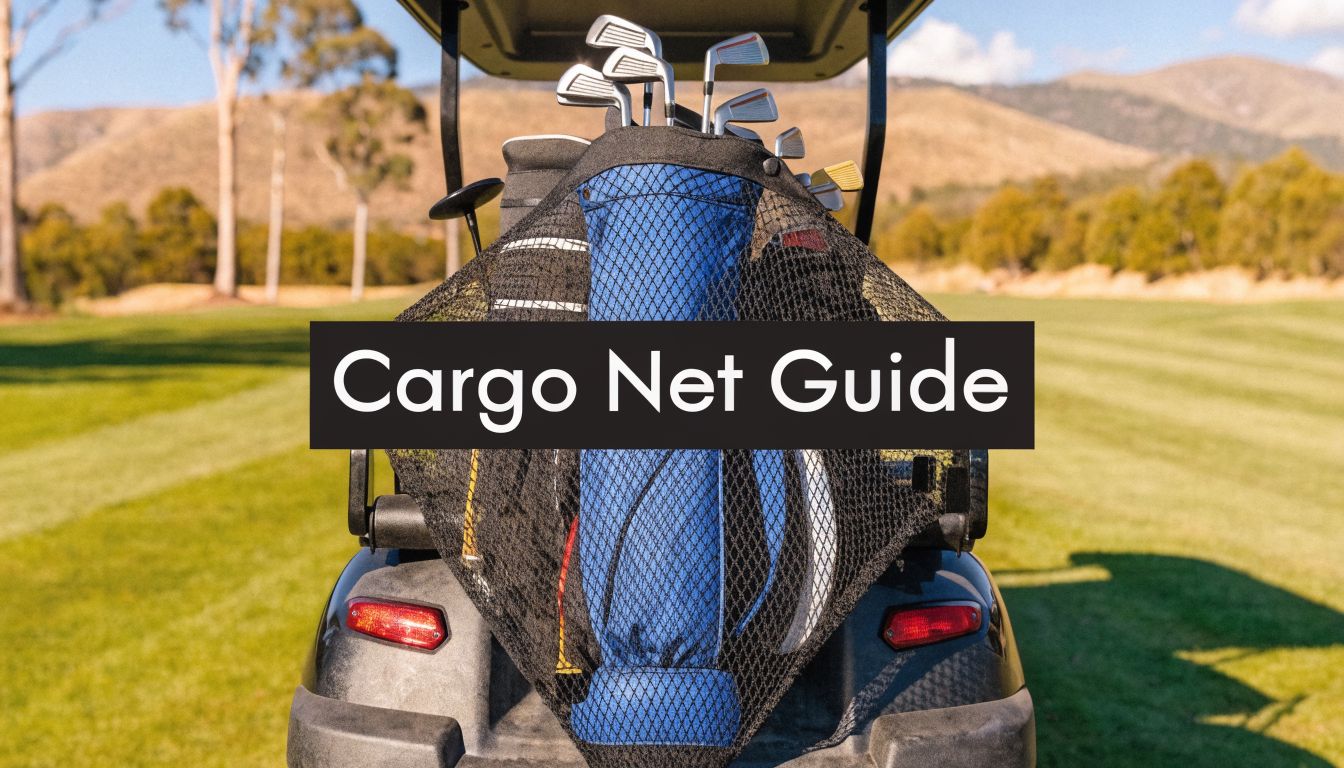
You notice the problem when the cart starts moving. A rangefinder shifts sideways in the basket. A pullover slides off the back. A water bottle rolls underfoot. None of it feels dramatic until you hit a bump and something ends up on the path behind you.
That's why a golf cart cargo net earns its place so quickly. It doesn't add flashy tech or change how the cart drives. It keeps your gear where you put it, clears visual clutter, and saves you from the constant mid-round check of “did that fall out two holes ago?”
Why Secure Gear Matters on the Course
A messy cart affects more than convenience. When loose gear starts shifting around, you spend the round guarding your stuff instead of thinking about the next shot. Jackets, towels, snacks, rain layers, and small accessories all seem manageable until they're stacked in an open basket with no restraint.
I've always found that the most annoying equipment issues in golf are the small ones. Not a broken club. Not a dead battery. The little distractions that pile up. Reaching back for a towel and finding it gone. Hearing something rattle every time the cart turns. Watching items pile on top of each other because the storage area has no structure.
What a loose-load cart usually looks like
- Small valuables shift first. Rangefinders, phones, wallets, and keys are the easiest to lose track of.
- Soft items slide out. Pullovers, rain tops, and seat covers don't stay put in an open rear area.
- Round-day extras create clutter. Balls, sunscreen, gloves, drinks, and snacks all compete for the same space.
Practical rule: If you have to mentally track your gear while driving or walking, your setup isn't organized enough.
For valuables you don't want visible at all, a cargo net isn't the answer. In that case, separate storage makes more sense, especially trusted lock boxes for peace of mind when you need actual theft protection rather than simple retention. A net solves movement and organization. A lock box solves security.
If you use a push cart, this same issue shows up in a different way. Gear shifts, straps loosen, and the whole setup starts feeling improvised. A good primer on that side of the equation is how golfers secure equipment on a push cart. The common thread is simple. Secured gear is calmer gear, and a calmer setup makes for a better round.
Understanding Golf Cart Cargo Nets
A golf cart cargo net earns its keep the first time the path gets rough and your extra layer, snacks, and small accessories stay put instead of sliding into a pile. On a standard cart, that means less clutter. On a cart fitted with a motorized push-cart conversion kit like the Caddie Wheel, it also helps keep carried weight from shifting side to side, which is a bigger deal for balance than many golfers realize.
A golf cart cargo net is a stretchable barrier that closes off an open storage area so loose items stay contained instead of bouncing, sliding, or spilling out. It turns open space into practical storage without adding a hard box, extra bulk, or much installation complexity.
Most golfers notice cargo nets on carts with rear seat kits, but that is only one use case. Any open carry zone can benefit, especially if you want quick access without leaving gear exposed or loose.

What separates a cargo net from a makeshift fix
A cargo net controls a group of items at once. That is the fundamental difference.
Bungee cords are fine for pinning down one awkward item, but they do little for smaller gear that shifts independently. A towel draped over clubs or jackets does not provide retention. An open rear basket helps with capacity, but without restraint, gear still hops around on turns, slopes, and uneven cart paths.
A purpose-built net handles three jobs at once:
- Retention: keeps gear inside the storage area
- Compression: holds soft items like pullovers, towels, or rain gear against the cart
- Access: lets you reach in quickly without unstrapping half your setup
Universal nets also tend to follow a common design. The market is full of rectangular mesh nets with corner hooks or straps sized to fit rear cargo spaces across major cart brands. You can see that pattern across current aftermarket options from large golf cart parts retailers such as Golf Cart King, which is why many nets can be adapted to Club Car, E-Z-GO, Yamaha, and similar frames with minor adjustment rather than brand-specific hardware.
That flexibility matters even more if your setup includes add-ons. A rear basket, cooler rack, or conversion system changes how weight sits on the cart. A net does not add much weight itself, but it helps keep the load centered and compressed, which is useful on motor-assisted setups where a shifting bag of gear can subtly affect tracking and feel.
Why this accessory exists at all
Cargo management on golf carts has been part of the category for decades. The need goes back to the 1960s, when Club Car built early utility-focused vehicles that carried cargo as well as passengers, as noted in this history of Club Car.
That history explains why a cargo net feels so natural on a modern cart. Golf carts have long served as utility vehicles on courses, around facilities, and in neighborhoods. Once the cart is carrying more than people, some form of load control becomes part of the setup.
For golfers comparing storage upgrades, a net works best as part of a system. A basket for a golf cart adds structure. A net adds restraint. Used together, they do a better job of keeping weight low, contained, and predictable, which is especially helpful on carts using Caddie Wheel-style motorized assistance.
Some owners also expand upward rather than outward. If that is on your list, it helps to review practical trade-offs before adding a roof rack to Solana carts, since overhead storage changes access and weight placement very differently than a rear cargo net.
A cargo net is a simple piece of gear, but it solves a real problem cleanly and with far less fuss than loose bins, towels, or improvised straps.
How to Choose the Perfect Cargo Net for Your Cart
A cargo net looks simple until you load the cart for a round, hit a few slopes, and realize the gear shifts every time you stop or turn. The right net fixes that. The wrong one turns storage into constant readjustment.

Buying the right net comes down to three things. Material, fit, and attachment style. Ignore one, and the whole setup usually feels compromised.
Start with material, not brand
Material decides how the net behaves after a few months of real use. High-density polypropylene and double-layer nylon are the two constructions worth checking first because they hold up better than thin elastic mesh and are commonly used in golf cart nets rated for everyday cargo loads, according to this product specification reference.
Here is the trade-off in plain terms:
| Material | What it does well | What to watch for |
|---|---|---|
| Nylon mesh | Flexible, easy to load, conforms around odd-shaped gear | Can sag more if the net is oversized or stretched too far |
| Polypropylene | Better resistance to moisture and sun exposure | Often feels stiffer, especially when new |
For rain gear, towels, and light extras, nylon usually feels easier to live with. For carts stored outside or used beyond the course, polypropylene tends to age better.
Fit matters more than maximum stretch
A net should match the opening it covers. If it is too small, hooks sit under constant tension. If it is too large, the middle droops and gear settles low, which defeats the point.
Measure before you buy:
- Opening width
- Usable height
- Actual anchor-point locations
- Your normal load, not your occasional oversized load
Universal nets are fine, but universal only means they can be made to work on a lot of carts. It does not mean they will hold your gear neatly or sit at the right height. That matters even more if the cart already has rear accessories, seat kits, or other storage changes. Golfers considering broader cargo upgrades sometimes also look at adding a roof rack to Solana carts, and that comparison is useful because every storage add-on changes access, weight placement, and balance.
The detail generic guides miss on motorized push-cart conversions
This is the part I would not skip on a Caddie Wheel-style setup.
On a standard golf cart, a loose net is mostly an annoyance. On a cart using a motorized push-cart conversion kit, the same poor fit can put weight too high, too far back, or off to one side. You feel that in tracking, steering correction, and battery use. A conversion kit does its best work when the load stays centered and close to the cart's natural balance point.
That is why smaller often works better. Choose a net sized for the gear you carry. If your usual load is a jacket, water, and a few extras, do not buy the biggest net on the shelf just because it stretches farther. Extra mesh invites extra cargo, and extra cargo placed badly is where handling starts to suffer.
Buyer's shortcut: On any motorized push-cart arrangement, choose the smallest net that securely holds your usual load and keeps weight centered.
Attachment style decides daily usability
Attachment hardware matters more than product photos suggest. A good net goes on cleanly, tensions evenly, and stays put without improvised clips or knots.
Look for:
- Integrated hooks for quick removal and reinstallation
- Smooth or coated contact points if you want to avoid rub marks
- Multiple anchor options so the net can pull evenly across the opening
A good golf cart cargo net should sit taut, load easily, and hold its shape with your normal gear inside. If you already expect to reroute hooks or force the corners into place, keep shopping.
Installing Your Cargo Net for a Secure Fit
You pull off the path, hit a rough patch near the next tee, and hear a water bottle or jacket shift behind you. That usually points to one problem. The net is installed, but it is not tensioned or positioned well enough for how the cart is used.
Most cargo nets are simple to mount because they rely on hooks, loops, or strap points instead of brackets and drilled hardware. In practice, the fit matters more than the install time. On a standard golf cart, a loose corner is annoying. On a cart paired with a motorized push-cart conversion kit like the Caddie Wheel, a loose or off-center load can change how the cart tracks and how stable it feels over uneven ground.

A clean way to install it the first time
Start with the cart empty. That gives you a true read on the opening and lets you set tension evenly instead of wrapping the net around whatever happens to be in the back.
-
Find structural anchor points
Use seat frame bars, rear supports, or solid metal mounting points that do not flex under load. -
Set the top corners first
This establishes the width and makes it easy to center the net before you add tension. -
Attach the bottom corners with moderate stretch
Pull enough to remove slack, but leave some give so you can still load items without fighting the mesh. -
Check left-to-right balance by hand
Press on each side and in the middle. The resistance should feel even across the opening. -
Test with your usual gear
A jacket, water bottle, or small pouch will tell you more than an empty fit check.
On a Caddie Wheel-style setup, I pay extra attention to where the loaded net sits once gear is inside. If one side hangs lower or the cargo bulges outward, fix that now. A centered, flatter load keeps the cart feeling more predictable.
What a proper fit feels like
A good install holds gear against the cart instead of letting it sag away from it. You should be able to slide in a pullover or accessories with one hand, and the net should spring back into place once the load is settled.
The bottom edge should not be pulled so tight that access becomes awkward. The top edge should not droop once a few items are inside. That middle ground is the goal.
Here's a useful visual walkthrough of cargo net installation and adjustment:
Common install mistakes
- Using trim or plastic pieces as anchors instead of frame points
- Pulling one side tighter than the other so the load sits off-center
- Overstretching the mesh which makes loading harder and wears the net faster
- Mounting the net too low or too far back which lets weight hang away from the cart
- Blocking quick access by cranking the lower edge too tight
If you need both hands and a strong pull every time you stow a towel, the net is too tight.
If you are building out a walking setup with powered assistance, it helps to see how the rest of the carry system works together. These golf push cart accessories that make rounds smoother pair well with a cargo net that is mounted low, centered, and easy to use.
Beyond the Basics Smart Uses and Care Tips
The best thing about a cargo net is that it stops being “golf-only” almost immediately. Once it's on the cart, you start using it for whatever would otherwise slide, bounce, or spill.
A golfer might use it for a pullover and extra balls during the round, then use the same net after the round to hold a grocery bag, a small cooler, or a couple of loose items heading back to the car. That's where this accessory starts to feel less like a niche add-on and more like a practical part of the cart.

Useful real-world setups
-
Rain gear loadout
A net is excellent for bulky but light items like a waterproof jacket, towel, and wind layer. -
Post-round errands
It keeps loose bags from tipping over in an open rear area. -
Family or leisure use
Blankets, drinks, or small picnic items are much easier to manage when they're compressed against the cart instead of stacked loosely.
If you're building out a more complete walking setup, it's worth browsing other golf push cart accessories that make rounds smoother. A cargo net works best when it's part of an organized system, not the only thing doing all the work.
Keep the net in good condition
Cargo nets don't ask for much maintenance, but neglect shows up fast. Dirt settles into the mesh. Hooks get bent if they're forced into bad angles. Elastic sections lose snap if they stay overloaded.
A simple routine works well:
- Shake out debris after muddy or wet rounds
- Rinse and air dry if the net picks up sand, grass, or sticky residue
- Check attachment points for wear or twist
- Store it unloaded when the cart sits for long periods
A net lasts longer when it holds gear during transport, not during storage.
The main thing that ruins these accessories isn't weather. It's constant abuse from being overstuffed, badly tensioned, or left holding the same compressed load for too long.
Common Questions About Golf Cart Cargo Nets
Will a cargo net scratch my cart
Usually not, if the hooks sit on proper mounting points and the contact areas stay clean. Scratches happen more often when a loose hook rubs against painted surfaces or when dirt gets trapped between the net hardware and the cart.
How much stretch is too much
If the net hangs low after loading or you have to stack items carefully just to stop them from slipping out, it's too loose. If loading a jacket feels like forcing luggage into an overhead bin, it's too tight.
Can I use one on a front basket
Often, yes, but only if the anchor points are secure and the net doesn't interfere with access or steering clearance. Front applications work best for light items.
What if the hooks don't fit well
Don't force them onto trim or weak tubing. A poor hook match usually means the net isn't right for that cart or that storage area.
Is a cargo net enough for valuables
No. It keeps items contained. It doesn't hide or lock them.
If you walk more often than you ride and want a cleaner, lower-effort setup, Caddie Wheel is worth a look. It adds electric power assist to standard push carts, and that kind of motorized setup benefits from the same cargo discipline covered here. Keep gear secure, keep weight balanced, and the whole round feels easier.
Partager:
Golf Push Cart Tires: 2026 Guide to Sizing and Maintenance
How to Install Your Golf Cart Bracket: 2026 Setup Guide