
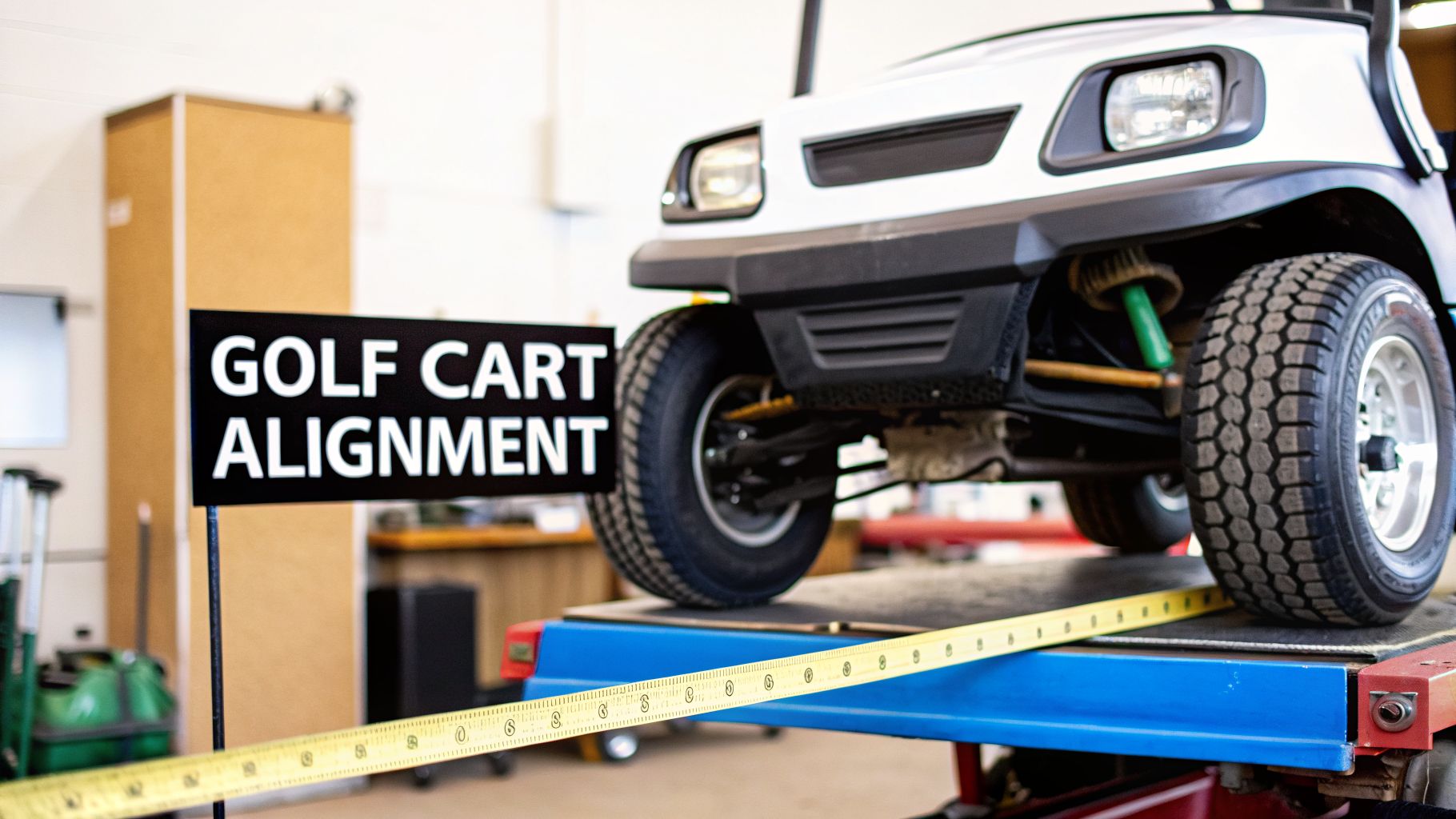
If your golf cart is pulling to one side, you're dealing with more than a minor annoyance. A poor golf cart front end alignment is a sneaky problem that quietly ruins your ride, chews through your tires, and puts a lot of unnecessary stress on your steering parts.
Why Proper Alignment Is Not Just a Minor Tweak

Think of your cart’s alignment as the very foundation of its performance. When it’s even slightly off, everything else starts to suffer. A misaligned front end essentially forces the two front wheels to fight against each other as you drive, creating a domino effect of problems that go way beyond a shaky steering wheel.
This constant battle isn’t just uncomfortable—it's expensive. The most immediate casualty is your tires, which will start to wear down unevenly, especially on the inner or outer edges. You'll also likely notice your battery doesn't last as long, because the motor has to work overtime just to overcome that extra resistance.
The Real-World Signs of Trouble
Most golfers I talk to ignore the early signs of a bad alignment, but that’s like putting off fixing a small leak in your roof. It only gets bigger and more expensive. During your next round, pay close attention to these classic symptoms.
Here are a few common signs of poor alignment and what they really mean for your cart and your wallet.
Signs of Misalignment and Their Hidden Costs
| Symptom | What You'll Notice | The Long-Term Impact |
|---|---|---|
| Constant Pulling | Your cart drifts left or right on a flat path, forcing you to constantly correct the steering. | Driver fatigue and added strain on steering knuckles and tie rods. |
| Uneven Tire Wear | The tread on the inside or outside of your front tires is wearing down much faster than the center. | Premature tire replacement, often thousands of miles sooner than expected. |
| Shaky Steering | The steering wheel vibrates or feels "loose" at certain speeds, especially on smooth pavement. | Accelerated wear on bushings, ball joints, and other front-end components. |
| Crooked Steering Wheel | To drive straight, you have to hold the steering wheel at a slight angle. | It’s a clear sign your wheels aren't in sync, leading to unpredictable handling. |
These are not isolated incidents. As the golf cart market continues to boom—projected to hit USD 3.07 billion by 2029—maintenance is becoming a bigger talking point. Based on data from large fleet operators I've worked with, roughly 70% of carts show signs of needing an alignment after just 1,000 hours of use. Ignoring it often leads to repair bills that are 15-20% higher down the line.
The Impact on Your Ride and Wallet
Getting the alignment right isn't just about a smoother drive; it's about protecting the money you've put into your cart. The core principles are the same as with your car, and it's worth having a basic grasp of how wheel alignment explained works. For golf carts, the consequences of neglect can be just as costly, if not more so relative to the vehicle's value.
A misaligned front end forces motorized accessories, like the Caddie Wheel, to work harder. The motor has to fight against the cart’s natural pull, reducing power efficiency and potentially causing unnecessary strain on the unit. Perfect alignment is non-negotiable for getting the smooth, effortless performance you expect.
Gathering the Right Tools for the Job
There’s nothing worse than getting halfway through a job only to realize you’re missing a crucial tool. A simple front-end alignment can turn into an all-day headache if you’re not prepared. You don’t need a professional mechanic's garage, but having a few specific items on hand will make the entire process smoother, safer, and a lot more accurate.
First things first: you’ll need to get the cart off the ground safely. This means a reliable floor jack and a solid pair of jack stands. I can't stress this enough—never, ever work under a cart that’s only held up by a jack. It’s a non-negotiable safety rule.
Essential Hand Tools and Measurement Gear
Once your cart is safely and securely in the air, you can grab the tools needed to actually make the adjustments. Most of this work boils down to loosening and tightening the tie rods, which are what control your wheel's toe angle.
- Wrenches: You'll need two wrenches for each tie rod—one to hold the rod steady and another to break the jam nut loose. The sizes can differ between E-Z-GO, Club Car, and Yamaha models, but a good adjustable wrench and a standard set of open-end wrenches will get the job done 99% of the time.
- Tape Measure: This is your best friend for this task. I recommend getting one that’s at least 12 feet long with clear, easy-to-read markings. A tape measure with a locking mechanism is a huge help if you're working alone.
- Penetrating Oil: Don't even think about skipping this. Those jam nuts have a tendency to rust and seize up. A quick spray of penetrating oil a few minutes before you start wrenching will save you from a world of frustration and busted knuckles.
For those who want to get things dialed in with extreme precision, you can even rig up a simple string alignment box. All it takes is some basic twine and four extra jack stands to create a perfect rectangle around your cart, giving you an incredibly accurate visual guide for your alignment.
Pro Tip: When you're picking out a tape measure, try to find one with markings printed on both sides of the blade. It seems like a small thing, but it’s a lifesaver when you're lying on the garage floor trying to read a number upside down.
How to Measure and Diagnose Your Alignment
Before you even think about grabbing a wrench, you need to play detective. Getting the diagnosis right is the most critical part of this entire job, and it all starts with a simple visual inspection.
Park your cart on a perfectly flat surface—your garage floor is ideal—and get down to take a close look at the front end. Scan everything for parts that are obviously bent, broken, or just look out of place. Pay special attention to the steering arms, spindles, and tie rods.
A quick visual check can save you a ton of time down the road. If you spot a component that’s clearly bent out of shape, no amount of tweaking is going to fix it. That part has to be replaced before you can even hope to get a proper alignment. While you're down there, give the components a wiggle. Any excessive play or looseness could point to worn-out parts like bad wheel bearings, which can easily be mistaken for an alignment problem. You can find out more about what to look for in our guide to spotting failing wheel bearings.
The Tape Measure Method
The single most important measurement for your golf cart is the toe setting. This is simply whether the front of your tires point slightly inward (toe-in) or outward (toe-out). For just about every golf cart out there, the sweet spot is a slight toe-in of about 1/8 inch. This is what gives you that great, stable feeling when you're driving in a straight line.
To get this measurement, you'll use the tried-and-true tape measure method. It’s simple, but you have to be precise.
- First, get your steering wheel as close to dead-center as you possibly can.
- Pick a matching reference point on the tread of both front tires. A good spot is usually the first major groove in from the inside edge.
- Measure the distance between these two points at the very front of the tires, keeping the tape measure level with the axle. Jot that number down.
- Now, do the exact same thing at the very back of the tires, using the same tread grooves and keeping the tape at axle height. Write that number down, too.
The difference between your two measurements is your toe. If the front measurement is 1/8 inch shorter than the rear one, your toe-in is perfect. If it’s longer, you’ve got toe-out, and that’s what we need to correct.
An accurate diagnosis is everything. Rushing this step and just guessing at the adjustment will almost guarantee you have to do the job all over again. Take your time, measure twice, and be confident in your findings before you pick up a wrench.
Spotting Other Alignment Issues
While toe is the most common issue—and the one you can usually fix yourself—you should also be aware of camber. Camber refers to the inward or outward tilt of the top of the tire when you look at it from the front of the cart.
Most stock golf carts don't offer an easy way to adjust camber, but you can spot a major problem with a simple carpenter's square. Just hold the square vertically against the face of the tire. If you see a big, obvious gap at either the top or the bottom, you’ve probably got a significant camber issue. This usually points to a bigger problem, like bent spindles or other damaged suspension parts.
Ignoring these checks has real-world consequences. Front-end alignment stats suggest that misalignment is responsible for a staggering 40% of all cart breakdowns, with improper toe settings being a primary cause of premature tire wear. Getting your front end dialed in doesn't just save your tires; it can also improve braking response by up to 28%—a massive safety boost.
The image below highlights the basic tools you’ll need to get started with your alignment check and adjustment.

Having a reliable jack, sturdy jack stands, and the right wrenches are non-negotiable for doing this safely and effectively. Once you have these measurements and observations, you’re ready to move on and start making adjustments.
Adjusting the Alignment on Popular Cart Models

Alright, you've got your numbers. Now for the fun part—getting your hands dirty and dialing in that perfect 1/8-inch toe-in. This is where the real work happens, but don't worry. The process is straightforward, though it does demand a bit of patience and a gentle touch.
First things first: safety. Make sure your cart is securely lifted on jack stands with the front wheels clear of the ground. From there, get underneath and find the tie rods that connect your steering box to the wheel spindles. You'll see a long rod with a jam nut at each end. These nuts are designed to lock the tie rod in place, so they'll need to be loosened before you can make any changes.
Be prepared for a little fight. These jam nuts can be incredibly stubborn, so a healthy spray of penetrating oil and some elbow grease will be your best allies. You'll need two wrenches for this job—one to hold the tie rod steady and another to break the jam nut free. Just remember the old mantra: "righty-tighty, lefty-loosey." Loosen the jam nuts on both sides just enough so the main rod can spin.
Fine-Tuning Your Golf Cart's Steering
With the jam nuts loose, you're ready to adjust the toe. The magic happens when you turn the tie rod itself. This action either lengthens or shortens the assembly, which in turn pushes or pulls the front of the tire. The goal is to make identical adjustments on both the driver and passenger sides to keep your steering wheel pointing straight.
- To increase toe-in and pull the front of the tires inward, you need to lengthen the tie rods.
- To decrease toe-in or create toe-out by pushing the front of the tires outward, you will shorten them.
The secret here is to work in tiny increments. I'm talking a quarter-turn at a time on each side. After each small tweak, grab your tape measure and check the distance between the front and back of your tires again. This cycle of adjusting and re-measuring is what separates a sloppy job from a pro-level alignment.
Take your time. Rushing this part is the fastest way to get a crooked steering wheel or have to do the job all over again. Small, symmetrical adjustments are the secret to getting a professional-grade golf cart front end alignment in your own garage.
Once you hit that sweet spot where the front measurement is 1/8 inch less than the rear, it's time to lock it all down. Tighten the jam nuts securely, but be careful not to let the tie rod spin while you do it—that would undo all your hard work. If you were careful, your steering wheel should still be perfectly centered.
Brand-Specific Alignment Quirks
While the fundamental process is the same across most carts, the "big three" manufacturers each have their little quirks. It's helpful to know the specific targets for popular models, like the E-Z-Go Liberty vehicle, before you start turning wrenches.
To make things easier, here's a quick cheat sheet with common specs for the major brands.
Quick Reference Specs for Common Golf Carts
| Golf Cart Brand | Recommended Toe-In Setting | Common Wrench Size |
|---|---|---|
| Club Car | 1/8" to 1/4" | 1/2" and 3/4" often work |
| E-Z-GO | 1/16" to 1/8" | Typically metric; 13mm or 15mm |
| Yamaha | 1/8" to 1/4" | Varies; a good adjustable wrench is key |
These details are more than just trivia. For example, some Club Car models have tie rod ends with both right-hand and left-hand threads on the same rod, which can throw you for a loop if you're not expecting it. And while the components are simple, a bent or worn-out part can make a proper alignment impossible. If you hit a wall and suspect a deeper issue, learning more about the golf cart wheel hub assembly can help you spot other potential culprits.
With everything tightened up, lower the cart and take it for a slow test drive on a flat, straight path. It should track straight ahead with very little steering input. If it still pulls to one side, you might need to make one last, tiny adjustment to the tie rod on the side it's pulling toward. Once it drives true, you can call the job done.
Knowing When to Call a Professional Mechanic
There's a real satisfaction in tackling your own golf cart front end alignment, but even the most seasoned DIY mechanics know when to wave the white flag. There’s a big difference between a tough but doable project and a problem that’s spiraling out of control. Knowing when to step back isn't admitting defeat—it's making a smart call that will save you time, money, and a world of frustration.
I’ve been there myself, hunched over a cart for hours trying to fix what I thought was a simple pull, only to realize the problem was way deeper than a toe adjustment. Sometimes, no matter how carefully you measure, the cart just refuses to drive straight. That’s usually the first sign you’re up against something more serious.
Red Flags That Signal It's Time for a Pro
If you've gone through the alignment process a few times and your cart is still veering off course, it’s time to stop and look for bigger issues. If you spot any of these problems during your inspection, your best bet is to find a local cart shop and let them take it from there.
- Bent or Damaged Components: A bent axle, a cracked frame, or a twisted spindle are all deal-breakers for a home garage fix. These aren't just alignment problems; they're structural issues that demand part replacements and specialized equipment.
- Hopelessly Seized Tie Rods: I'm all for a good dose of penetrating oil and elbow grease, but some rusted jam nuts just won't budge. A professional has torches and tools that can break them free without wrecking the surrounding parts.
- Persistent Pulling After Adjustments: If your adjustments aren’t making a difference, the culprit is likely hidden. Worn-out bushings, failing ball joints, or other suspension issues can throw off the geometry in ways a simple toe adjustment can't fix.
A professional's eye can catch a subtle bend or worn part that most of us would miss. I once spent an entire afternoon fighting with an alignment, getting more and more frustrated. A mechanic took one look and pointed out a slightly warped spindle in less than five minutes. That expert glance saved me from wasting more time and potentially damaging other components.
This is especially critical when you think about the long-term health of your cart. A proper front-end alignment is one of the biggest factors in how long your tires last. Even a minor misalignment from hitting a curb can cause up to 25% more tire wear. With North America making up 52.86% of the global golf cart market, that's a lot of tires wearing out too soon.
When you find yourself in over your head, calling in a professional is always the right move. For other common issues you might be able to handle on your own, be sure to check out our guide to common golf cart repair topics.
Common Questions About Golf Cart Alignment
Even after you get the hang of the basics, a few common questions always seem to come up about golf cart alignment. Let's clear those up so you can feel confident keeping your cart rolling straight and true.
How Often Should I Check My Golf Cart Alignment?
Think of alignment checks as a regular health screening for your cart. For a personal cart that sees average use on well-maintained paths, a check-up once every 6 to 12 months is a great habit. This routine helps you catch small issues before they become major headaches.
However, if your cart has a tougher job—maybe it’s part of a small fleet, you live in a hilly area, or you’re often on gravel paths—you’ll want to be more proactive. In these cases, it's smart to inspect the alignment every 3 to 6 months.
You should also do an immediate check after any major jolt. This includes hitting a curb, bouncing through a deep pothole, or right after installing a new set of tires.
Is Aligning a Lifted Golf Cart Different?
Yes, and it’s a completely different ball game. A lift kit doesn't just raise your cart; it fundamentally changes the steering and suspension geometry. This often introduces problems not just with toe, but also with camber—the vertical tilt of the wheels—which isn't adjustable on most standard carts.
While the basic idea of adjusting tie rods to set the toe is the same, getting it right on a lifted cart is much more complex. Many lift kits need specific adjustable parts and a more detailed procedure to get everything back in spec.
If your lifted cart pulls, wanders, or just feels "off," your best bet is to find a shop that specializes in modified carts. They have the right tools and experience to handle the unique challenges that lift kits create.
Will a Caddie Wheel Affect My Alignment?
The Caddie Wheel is designed so that installing it doesn't change your cart's alignment. That said, having a proper alignment is more important than ever for getting the best performance out of it. Think of it this way: a perfect alignment lets the motorized wheel push the cart in a perfectly straight line, maximizing its power and efficiency.
If your front end is out of whack, the motor has to constantly fight the cart's natural pull. This can drain the battery faster and prevent the unit from giving you the smoothest possible ride. Ensuring your cart is properly aligned lets your Caddie Wheel perform at its absolute best.
What Is the Difference Between Toe-In and Toe-Out?
This is a key concept in alignment. Imagine you’re looking down at your front tires from above.
-
Toe-in is when the front edges of the tires point slightly inward, toward each other. This is the standard for nearly all golf carts because it creates excellent straight-line stability when moving forward.
-
Toe-out is the opposite—the front edges of the tires point away from each other. While this can make steering feel a bit quicker, it usually leads to twitchy, unstable handling and causes rapid, uneven tire wear.
For a smooth, predictable, and safe ride, a small amount of toe-in is always the goal for your golf cart's front end.
Ready to take the push out of your push cart? The Caddie Wheel adds powerful, remote-controlled electric assistance to your existing cart, letting you walk the course without the strain. Learn more and transform your game today at caddiewheel.com.
Partager:
Your Guide to 40 Amp Blade Fuses for Any 12V System
Your Guide to the Golf Cart Gearbox