
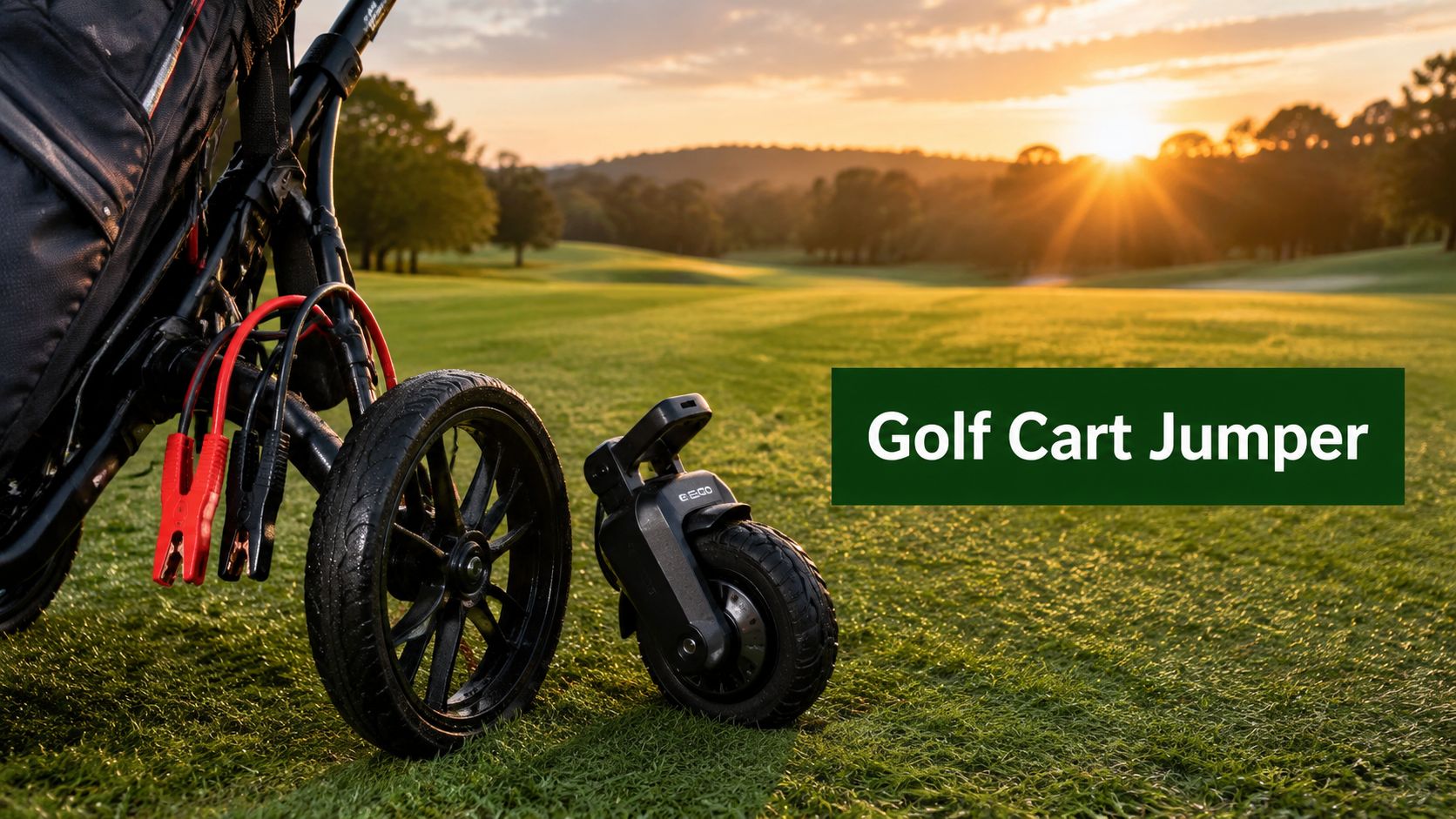
You're probably here for one of two reasons. Your golf cart won't move, and you need a safe way to bring the battery back to life. Or you typed “golf cart jumper” because you want help moving your push cart without wearing yourself out on hills and long walks.
That search term trips up a lot of golfers because it points to two completely different tools. One is a battery jump-starter for an electric riding cart. The other is a motorized assist wheel that helps propel a walking push cart. Same word, very different problem.
If you pick the wrong one, you'll waste time, buy the wrong gear, and possibly damage your cart. So let's clear it up in plain English.
What Do You Mean by Golf Cart Jumper
A golfer leaves the course at dusk, loads up, and finds the cart won't respond. Another golfer is halfway through researching ways to make walking easier, but every search result keeps talking about dead batteries and jumper cables. Both searched for a golf cart jumper, but they weren't looking for the same thing at all.

The two meanings golfers mix together
The first meaning is the traditional one. You have an electric golf cart with a weak or dead battery pack, and you're trying to get it started safely.
The second meaning is newer and much more practical for walkers. You have a push cart, and you want something that gives it powered assistance so you're not pushing the full load yourself for every hole.
Those needs look similar in a search bar. On the course, they're nothing alike.
- Battery jumper need: Your riding cart has lost power and won't start.
- Push cart jumper need: Your walking cart works fine, but you want motorized help.
- Wrong-match problem: Buying a battery jump product won't help your push cart move, and buying a motorized assist wheel won't revive a dead battery pack.
A quick way to know which one you need
Ask yourself one question: Are you trying to fix a no-start problem, or reduce walking effort?
If the cart is already motorized and suddenly dead, you're in jump-starter territory.
If you already enjoy walking but want less strain on your arms, shoulders, or back, you're looking for a powered assist setup for a push cart.
Practical rule: If there's a battery emergency, think voltage and safety. If there's a walking comfort issue, think propulsion and ease of use.
Why this confusion matters
This isn't just a wording issue. A battery jump-starter is an electrical tool. Used the wrong way, it can damage wiring, fuses, or electronic components. A motorized assist wheel is an equipment upgrade. It's about convenience, fatigue reduction, and making walking rounds more enjoyable.
That's why golfers often feel like search results are talking past them. One group needs rescue. The other wants an upgrade.
Once you separate those paths, the decision gets simple. You either need to revive a dead system or add powered movement to a push cart.
Solution 1 Reviving a Dead Battery with a Jump Starter
You get to the cart, turn the key, and nothing happens. That is the first kind of golf cart jumper problem. You are not looking for help pushing less. You are trying to wake up a cart that has lost power.
What a golf cart jump starter is
A golf cart jump starter is a portable power source used to give a depleted golf cart battery system enough power to start again. It is built around one question: does the power source match the cart's full battery bank?
That point trips up a lot of owners because a golf cart battery setup does not behave like a single car battery. Many golf carts use a battery bank made from several batteries connected together, and the cart depends on the total system voltage, not one battery by itself. In simple terms, the pack works like a team. You cannot judge the whole team by looking at one player.
Why voltage matching matters
The jump source needs to match the cart's full voltage. A cart with a 48V battery bank needs a 48V jump source, not a random clamp on one battery and not a standard 12V automotive jumper pack.
KMD Power explains that jump-start connections should go to the main positive (+) and main negative (-) terminals where the large cables feed the controller, not to whichever battery post is easiest to reach, in its jump-starting guidance for golf cart batteries.
That is the key safety idea. Treat the pack as one system.
Why carts end up needing a jump
Sometimes the cause is simple. The cart sat unused, the batteries were already weak, or charging was skipped long enough for the pack to drop too low.
Other times, the charger will not recognize the pack because the voltage has fallen too far. That is where golfers often get tempted to improvise. Improvising with battery systems is like guessing at the right club in the dark. You might get lucky once, but the mistake can cost you.
If you do not know your cart's total voltage and the correct connection points, pause before attaching any jumper.
What helps, and what to avoid
Use the jump starter that matches the entire battery bank voltage. Connect at the main pack terminals. If the cart keeps dying, look past the jump and address the battery condition, charging pattern, and cable health.
Repeated no-starts usually point to a larger battery care issue, not just one bad morning. If you want a clearer handle on charging habits, storage, and routine checks, this guide to golf cart battery maintenance is a smart next step.
Solution 2 Upgrading Your Push Cart with a Motorized Jumper
Some golfers don't have a battery problem at all. They have an energy problem.
They like to walk, they prefer staying active, and they already own a push cart. What they don't love is dragging that load up long inclines, across rough ground, or through the final stretch of a round when legs and shoulders start to fade.

What this kind of jumper does
In this context, a golf cart jumper is really a motorized assist wheel. It doesn't restart a dead riding cart. It gives your existing push cart powered help so you can walk with much less effort.
That's a completely different category of product, and for many golfers it's the more useful one. Instead of solving an emergency, it improves every round.
Why walkers are drawn to this option
A powered assist wheel changes the feel of walking golf. You're still on your feet, still moving, still getting the benefits of walking the course. But you're not spending the day fighting the cart.
That matters for several kinds of players:
- Senior golfers: Less strain over a full round.
- Hilly-course regulars: Better control on climbs and descents.
- Fitness-minded walkers: You keep the walk, not the burden.
- Golfers with minor mobility limits: Less pushing can make more rounds realistic.
The appeal of a drop-on motorized system
The smartest version of this idea isn't a whole new cart. It's a powered wheel unit that works with a push cart you already own.
That's why many golfers start browsing options in the category of motorized push carts and realize there are two routes. You can buy a fully integrated electric caddie, or you can add motorized assistance to a standard push cart.
The second route is often easier to live with. It takes up less space, feels less bulky, and avoids replacing gear that's already working fine.
If your current push cart rolls well and folds well, adding propulsion usually makes more sense than starting over with a completely different setup.
What golfers usually want from it
Most golfers aren't looking for complexity. They want a system that helps with the hard part and stays out of the way the rest of the time.
They tend to care about a few practical things most:
| What golfers care about | Why it matters |
|---|---|
| Easy attachment | Nobody wants a complicated setup in the parking lot |
| Stable propulsion | The cart should help, not fight your line |
| Remote control | Simple movement control makes hills and starts easier |
| Portability | The system should still fit normal golf routines |
This is why the “push cart jumper” idea has gained traction. It's not really about jumping anything electrically. It's about giving your walking setup a useful boost.
Jump Starter vs Motorized Assist Wheel Compared
One product rescues a cart that won't start. The other helps a walking golfer move a push cart with less effort. Side by side, the difference becomes obvious.
Golf Cart Jumper Which Solution Do You Need
| Feature | Battery Jump-Starter | Motorized Assist Wheel (e.g., Caddie Wheel) |
|---|---|---|
| Primary job | Revives a dead electric golf cart battery system | Propels or assists a standard push cart |
| Typical user | Owner of an electric riding cart with a no-start problem | Walking golfer who wants less strain |
| When you use it | During a battery failure or low-power event | During regular rounds |
| Main concern | Electrical safety and voltage compatibility | Ease of walking, control, and convenience |
| Where it connects | Main battery bank terminals | Push cart frame or wheel area |
| Buying mindset | Repair or emergency tool | Performance and comfort upgrade |
| Best result | The cart starts again | The walk feels easier and more enjoyable |
How to choose in one minute
If your cart already has a motor and suddenly won't move, you need the battery jump-starter path.
If you walk with a push cart and want powered help on the course, you need the motorized assist wheel path.
That's the cleanest way to think about it. One solves a failure. One improves the experience.
The mistake to avoid
Golfers often buy based on the word “jumper” without checking which category the product belongs to. That's how someone trying to walk more comfortably ends up staring at battery clamps and voltage ratings, or someone with a dead electric cart ends up reading about powered push cart accessories.
Buy for the actual problem in front of you. No-start issue means electrical equipment. Walking fatigue means propulsion equipment.
Once you sort that out, the rest of the buying decision gets much easier.
How to Safely Jump-Start a Golf Cart Battery
You turn the key, hear nothing useful, and now the word “jumper” suddenly means clamps, polarity, and battery safety instead of easier walking. If you are on the battery-revival path, the goal is simple. Restore power without damaging the cart or creating a spark near the battery bank.

Start with the one rule people get wrong
Connection order matters because you are managing both voltage and spark risk. A golf cart battery pack is more like a chain than a single battery. You need to connect to the correct main terminals and finish with the negative clamp on a clean, unpainted metal chassis point, not directly on the dead battery's negative post.
That final chassis ground helps reduce arcing at the battery. It is a small step that makes the process safer.
Before you attach the clamps
Pause for a minute and check the setup.
- Turn the cart completely off. Remove the key if possible and make sure the cart is stable.
- Wear gloves and eye protection. Batteries can vent gas and corrosion is common around terminals.
- Use the right power source. A portable jump pack made for the cart's voltage is the safer choice.
- Find the main positive and main negative points for the full battery bank. Do not guess by choosing a battery in the middle of the pack.
- Inspect the cables and terminals. Heavy corrosion, cracked cases, or loose connections can turn a simple jump into a repair issue.
If your real goal is walking support rather than battery rescue, skip the clamps and look at a motorized push cart assist wheel instead.
Safe connection order
Use this sequence slowly and in order:
- Connect the red positive clamp to the dead cart's main positive terminal.
- Connect the other red positive clamp to the live jump source's positive terminal.
- Connect the black negative clamp to the live jump source's negative terminal.
- Connect the final black clamp to an unpainted metal chassis point on the golf cart.
Then try to start the cart by following the jump starter's instructions.
Here is the simple version of why the order feels so strict. Positive connections establish the path first. The final ground connection is the point most likely to spark, so you want that spark away from the battery itself.
Here's a useful demonstration to pair with the written checklist:
After the cart starts
Starting the cart is only the first part. The battery still needs time to recover.
As noted earlier, a successful jump should be followed by charging time, and repeated start attempts should be spaced out rather than rushed. If the cart starts, let the system recover and then give the battery pack a full charge. If it does not start after careful attempts, stop guessing. Repeated tries with the wrong setup can heat the cables, stress the battery pack, or point to a deeper electrical fault.
When to stop
Some warning signs mean the job has moved beyond a quick rescue:
- Cables feel hot
- You smell burning
- You see smoke or arcing
- The cart still does nothing after proper connection
- You are not fully sure about the cart's voltage or terminal layout
At that point, the smart move is to get help. Jump-starting a golf cart is manageable when the setup is clear. It gets expensive fast when polarity, voltage, or grounding is guessed instead of confirmed.
Why the Caddie Wheel Is Your Best Choice for a Push Cart Jumper
If your real goal is easier walking, a motorized assist wheel is the better answer than a battery jump product. And among those options, the strongest choice is the one that upgrades the push cart you already like using.
Why this route makes sense
Buying a whole new electric caddie can feel like overkill when your current push cart already folds well, tracks well, and fits your routine. A powered add-on solves the actual problem without forcing you into a bulkier setup.
That's where the Caddie Wheel stands out. The design focuses on simple installation, broad compatibility, and practical control rather than unnecessary complication.
What makes it appealing on the course
The biggest win is usability. You attach the unit to a standard push cart, then control movement with a remote instead of muscling the cart through the round.
That gives you three advantages right away:
- Less pushing: Helpful on climbs, long transitions, and tired legs late in the round.
- Better energy management: You can walk the course without turning the cart itself into the workout.
- No need to replace your existing cart: That keeps the upgrade practical.
Why it beats a DIY workaround
Some golfers consider piecing together their own powered cart setup. That usually leads to awkward brackets, uneven control, and extra hassle every time they load in or out.
A purpose-built unit is cleaner. If you want a straightforward option that turns a regular push cart into a more capable walking companion, the Caddie Wheel unit is the smart place to start. It gives golfers a direct route to motorized assistance without the complexity of a full cart replacement.
Frequently Asked Questions
Can I jump a golf cart with a car battery?
Usually, no. A golf cart battery pack uses a higher total voltage than a standard car battery, so connecting the wrong power source can damage components instead of helping. Use a jump starter that matches golf cart use and the pack you are working with.
Where do the clamps go on a golf cart battery pack?
Place them on the pack's main positive and main negative terminals, which are the posts tied to the large cables feeding the cart's system. In a multi-battery pack, clamping to just one battery is like trying to power the whole cart through one link in the chain. You want the connection points for the full pack.
What if the cart doesn't start after the first attempt?
Pause before trying again. Repeated attempts back to back can add stress to the battery and electrical system. If one try does not work, give the cart time, then reconsider whether the battery is too discharged or whether another issue is preventing startup.
How long should I charge the battery after a successful jump?
Treat the jump as a short-term rescue, not a full recovery. If the cart starts, recharge the battery pack promptly and let it complete a normal full charge cycle based on your battery type and charger instructions. That gives the pack the best chance to recover instead of slipping back into a low-charge state.
Is a motorized push cart jumper the same as a jump-starter?
They solve two different problems.
A jump-starter helps bring a dead riding cart battery pack back to life. A motorized push cart jumper adds drive assistance to a walking push cart during your round. One belongs in a troubleshooting kit. The other belongs in your walking setup.
Which type of golf cart jumper do I actually need?
Start with the problem you are trying to solve. If your riding cart will not power on because the battery is too low, you need a jump starter. If your goal is to make walking easier, especially on hills or over 18 holes, you need motorized push-cart assistance.
That second group is often the one using the term "golf cart jumper" in a completely different way. They are not trying to revive a battery. They want help moving their push cart without buying a whole new electric caddie.
Is the Caddie Wheel hard to install?
It is designed to be a straightforward add-on for standard push carts, which is why it appeals to golfers who like their current cart but want powered help. Instead of replacing your setup, you upgrade the part that does the hard work.
If your real goal is an easier walk, the Caddie Wheel is the clearer answer. It gives your push cart motorized assistance, saves effort over the round, and keeps the focus on golf instead of pushing your gear.
Partager:
How to Replace Motor Brushes Safely & Easily
Expert Guide: How to Use Portable Charger for Caddie Wheel