
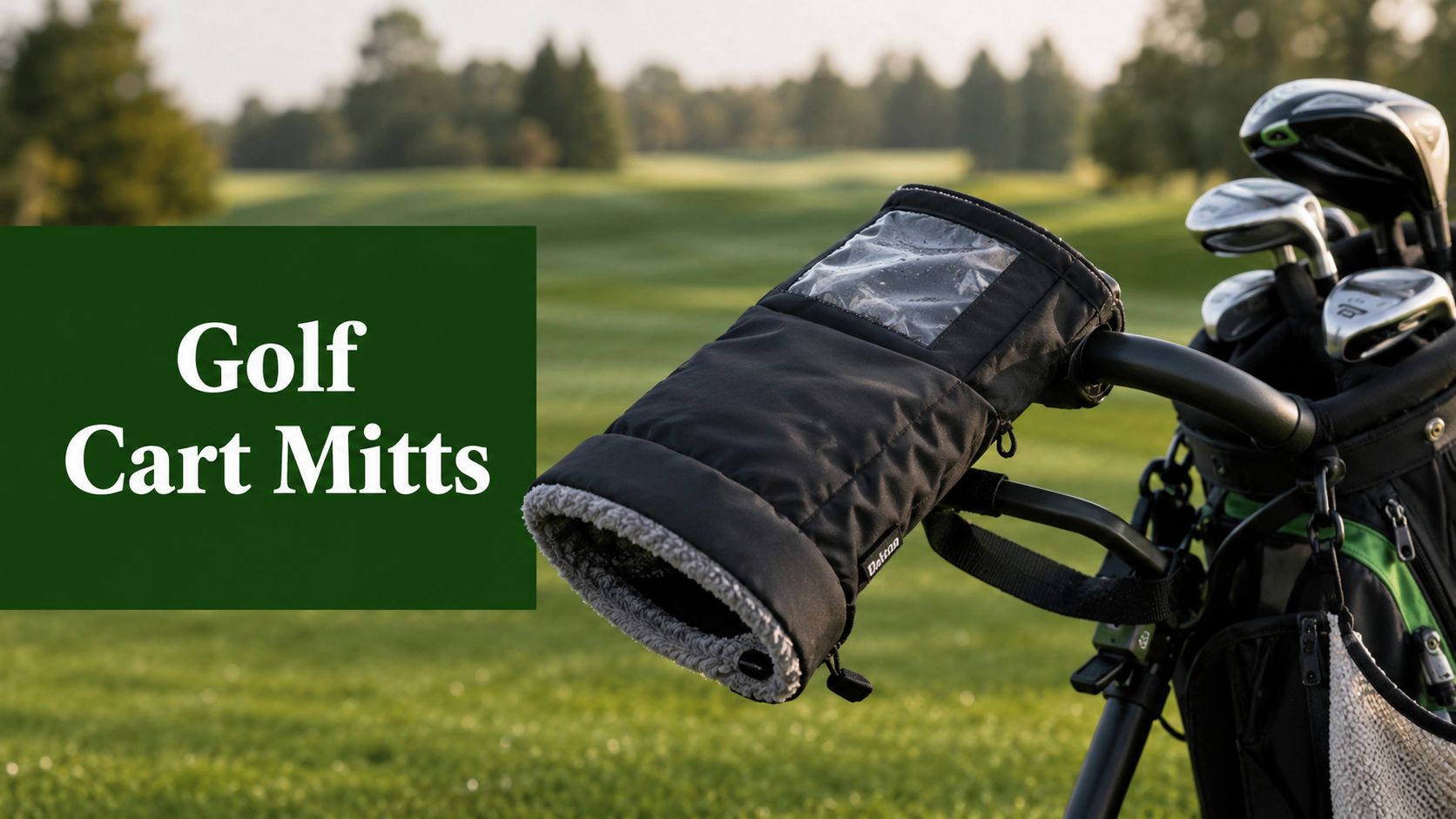
You're halfway through a winter walking round when the cold starts winning. Your fingers stiffen while you wait beside the 12th tee, the handle feels damp from mist, and the next club seems harder to grip than it should. Regular gloves may keep your hands covered, but they can also leave you choosing between warmth and the touch you need for a confident swing.
Golf cart mitts solve a narrower problem. They stay attached to your push cart, keeping your hands warm and protected between shots while allowing you to remove your hands quickly before playing. The best choice isn't just the thickest or most expensive model. It's the mitt that fits your cart, clears the brake lever, stays secure, and works alongside the gloves you prefer for swinging.
Why Cold Hands Can Ruin a Walking Round
A cold walking round rarely becomes unpleasant all at once. It starts with small losses. You grip the trolley handle more tightly, tuck one hand into a pocket, then struggle to pull a club cleanly from the bag. By the time you reach the next tee, your fingers feel slow and unresponsive.
Mist, light rain, frost, snow, and gusty wind make that sequence worse. Retail descriptions position cart mitts for precisely these conditions, with products designed for cold-weather golf and quick hand access during cart use, as shown by FootJoy's winter cart mitt listing. The accessory doesn't improve your swing mechanics or change the club's performance. It protects the short periods when your hands aren't on the club, which can make the next shot feel more manageable.

Why walking golfers notice the difference
A rider can warm their hands inside a vehicle or keep them away from the wind for longer stretches. A walking golfer holds a cart handle continuously, often exposing both hands to moving air while crossing open fairways. That makes a dedicated handle-mounted accessory more practical than repeatedly searching a jacket pocket for a warmer.
The distinction matters because winter gloves and cart mitts serve different moments. Gloves remain on during the swing and must support club control. Mitts prioritize fast entry and exit, so you can warm your hands while walking, then free them before addressing the ball.
Practical rule: Treat cart mitts as a between-shot shelter for your hands, not as a replacement for the gloves you use to hit golf shots.
A good setup also supports rhythm. You don't want to stop beside every tee, remove bulky gloves, or wrestle with a loose cover that has slipped down the handle. The accessory should disappear into your routine. Reach it while walking, warm your hands, remove them before the shot, and continue without changing your tempo.
What Golf Cart Mitts Actually Are
Golf cart mitts are insulated covers that attach to a push-cart handle. They aren't conventional gloves with individual fingers. Instead, they create a warm pocket where you can slide one or both hands while moving between shots, then withdraw them when you need to hold a club.
The standard design has three functional parts:
- An outer shell blocks wind and sheds moisture. Major listings describe shells as windproof, waterproof, or water-resistant.
- An insulation layer traps warmth without making the accessory too rigid.
- A soft lining such as fleece or micro-fleece makes repeated hand entry comfortable.
Titleist's StaDry Cart Mitt specification illustrates the category's familiar construction, pairing a durable water-resistant shell with a soft micro-fleece interior. The shell deals with the weather, while the lining deals with the contact between your hands and the mitt.
How they differ from gloves and hand warmers
A winter glove covers the hand and stays on during the golf swing. That's useful when you need continuous protection, but thick insulation can reduce fingertip feel and make club changes less convenient. A cart mitt leaves the hand open inside a shared warm space, so it's better suited to walking and waiting than to striking the ball.
A hand warmer provides heat from a pocket or pouch, but it doesn't automatically protect the hand from wind and rain. A cart mitt stays on the handle, where you can reach it without digging through clothing. Some designs add heat-pack pockets, but the basic category remains focused on attachment, weather protection, and access.
The design has also lasted. Clicgear mitts were already being sold by 2019, and current listings for 2025–2026 show continued availability, including models associated with several push-cart generations, according to Golf Town's Clicgear cart mitt listing. That history suggests a durable cold-weather niche rather than a short-lived gadget.
If you're comparing the broader idea of mitt construction with other mitten styles, Pandemonium Millinery rosebud mittens offers useful context on how a mitt differs from a fingered glove. For golf, however, the handle attachment is the defining feature.
Materials and Insulation That Actually Matter
Product descriptions often list materials as if every term carries equal weight. It doesn't. For golf cart mitts, focus on how the outer shell, insulation, and lining work together, because a warm interior won't help much if wind enters around the wrist or moisture makes the fabric clammy.
The outer shell handles exposure
A water-resistant shell helps shed mist and light rain, while a windproof construction limits the chilling effect of air moving across the fairway. Some newer products also highlight fluorine-free water-repellent treatments, reflecting a move toward material-led weather protection rather than a simple promise of “warmth.”
A bonded two-layer exterior can balance protection and flexibility. The outer face resists moisture, while the construction remains light enough for your hand to enter and leave quickly. That flexibility matters on a push cart because you'll repeatedly reach into the mitt, pull your hand out for a shot, then return it while walking.
Insulation is a balance, not a contest
More fill can add warmth, but excessive bulk can slow access and interfere with handle control. One widely sold cart mitt specifies 80g synthetic insulation, a 2-layer bonded exterior, and a soft terry interior, as shown in Under Armour's UA Cart Mitt product details.
That specification is useful as a design benchmark. Synthetic insulation offers a practical warmth-to-bulk balance, while the bonded exterior helps manage moisture and the terry interior adds softness. It doesn't prove that every golfer will experience the same warmth, because fit, wind exposure, moisture, and personal cold sensitivity all affect comfort.

The lining affects everyday comfort
Fleece and micro-fleece linings feel soft against the skin and reduce the unpleasant sensation of placing cold hands into a slick synthetic pocket. A terry lining can also provide a more textured interior, which helps the mitt feel less restrictive when you move your hands.
Don't treat a soft lining as proof of superior thermal performance. It contributes comfort, but the shell, cuff opening, and insulation determine how effectively the mitt deals with wind and cold. Listings rarely provide standardized testing for warmth retention, dexterity loss, or performance in wet, windy, near-freezing conditions.
For golfers considering a different approach, heated golf gloves are worth comparing because they stay on the hands during movement. That can suit players who dislike removing and replacing gloves, while cart mitts generally offer quicker access and simpler construction.
Fit, Compatibility, and Attachment Systems
The most common buying mistake is treating “universal” as a guarantee. A mitt can fit over several handles and still sit badly on your specific cart. Handle diameter, shape, brake-lever location, and the distance between the grips all influence whether the opening feels natural.
Cart-specific designs
A cart-specific model usually gives you clearer guidance. One major brand lists compatibility with Clicgear Models 1.0, 2.0, 3.0, 3.5 Plus, and Rovic carts, according to Clicgear's cart mitt information. That level of detail is more useful than a broad “fits most” label because you can match the product to a named frame.
The trade-off is flexibility. If you later change to another push-cart brand, the mitt may no longer align with the handle or brake system. Check the manufacturer's compatibility list before buying, especially if your cart has a shaped or unusually wide handle.
Universal-fit designs
Universal mitts aim to attach to any push cart in seconds. They can be a good choice for households with different carts or golfers who don't want a model-specific accessory. The weakness is that universal fit often depends on adjustable Velcro or straps, not on standardized dimensions.
| Attachment style | Strength | What to check |
|---|---|---|
| Velcro strap | Easy to adjust and remove | Whether repeated hand entry loosens the wrap |
| Snap-in bracket | Precise positioning on compatible carts | Whether your cart frame accepts the bracket |
| Magnetic closure | Fast access and a clean opening | Whether the closure remains aligned during movement |
The critical clearance points are easy to overlook. Make sure the mitt doesn't cover the brake lever, press against a scorecard holder, or sag toward an umbrella mount. Also check whether your hands can enter without pushing the mitt sideways.
A mitt that fits the cart on paper can still fail on the course if the brake lever becomes difficult to reach.
For a wider look at handle-mounted equipment and winter add-ons, best golf cart accessories 2026 can help you assess how a mitt will coexist with the rest of your push-cart setup.
Installation Tips and On-Course Use
Most first installations take only a few minutes, but the first position you choose may not be the best one. Start with the cart folded open and the brake system engaged. Place the mitt where your hands naturally rest, rather than where the handle looks visually centered.
A simple fitting sequence
- Open every strap or closure. Don't attach the mitt under tension before you know how it sits.
- Center the hand opening. Align it with your normal walking grip, leaving enough space for both hands to enter without twisting the fabric.
- Check the brake lever. Pull and release the lever while the mitt is loosely positioned. If the cover blocks access, move it before tightening.
- Secure the attachment. Tighten Velcro or straps until the mitt stays in place, but don't compress the handle so tightly that the opening narrows.
- Test repeated entry. Put your hands in and out several times. The mitt should remain stable rather than sliding down or rotating around the bar.
A loose mitt tends to sag toward the cart basket or scorecard holder. Repositioning the strap closer to the handle bend can improve stability, but avoid placing it where the frame folds. If the fabric interferes with an umbrella mount, shift the mitt slightly toward the center or confirm whether the mount can be moved without obstructing the brake.

Build it into your round
Use the mitt while walking between shots and while waiting for a group ahead. Before you select a club, remove the hand you need and allow the mitt to stay open. If the design gives each hand a separate opening, keep your non-playing hand protected while the other handles the club, but don't force a position that restricts your balance or movement.
The best routine is automatic. Walk with your hands inside, withdraw them before reaching the ball, play the shot, then return them as soon as you're moving again. This keeps the accessory from becoming another item you have to manage.
Course check: Test the brake, scorecard holder, umbrella mount, and hand opening before the first tee. A five-minute parking-lot adjustment is easier than a full round of irritation.
If you prefer a separate pouch for heat packs or personal hand-warming supplies, compare the layout with this golf hand warmer pouch guide. A pouch may be more versatile off the cart, while a mitt offers immediate access at the handle.
Maintenance, Storage, and When Mitts Are Not Enough
Cart mitts collect moisture from more than rain. Damp gloves, cold hands, condensation, and wet cart handles can all leave the lining humid after a round. Open the mitt fully when you get home and let it dry naturally before storing it in a garage, locker, or trunk.
Avoid sealing a wet mitt in a golf bag pocket. That traps moisture against the lining and can create an unpleasant smell. If the shell stops shedding water as effectively, follow the manufacturer's care instructions before applying any treatment, since some coatings and fabrics require specific products.
Keep the structure usable
Inspect the attachment points as part of normal kit maintenance. Look for compressed Velcro, stretched straps, loose stitching, or a lining that has become matted. A mitt that no longer holds its position can expose your hands to wind even if the insulation remains intact.
Storage also affects fit. Don't crush the mitt beneath shoes or heavy clothing. Keep it open or loosely folded so the hand cavity and cuff retain their shape.
Know when another solution works better
Cart mitts aren't automatically the best choice for every cold round.
- Winter gloves make more sense when you need finger separation and continuous coverage while handling clubs, opening zippers, or managing equipment.
- Heated hand-warmer pouches may suit golfers who face more severe cold and want a concentrated heat source that can move with them.
- Weatherproof outerwear can reduce exposure around the wrists and sleeves, which may be enough for golfers who already keep their hands warm through layered clothing.
Some newer mitts add heat-pack pockets, extended cuffs, and fluorine-free water-repellent treatments. Those features show how brands are refining convenience and material performance, but they don't establish which design works best for every golfer. Independent comparisons that measure warmth retention, dexterity, and wet-weather comfort remain limited.
The contrarian answer is simple. Many golfers don't need maximum insulation. They need a convenient place to warm their hands between shots, while serious cold-weather players may get better results by combining a cart mitt with insulated gloves.
For another option focused on portable warmth, review these hand warmers for golfers. The right choice depends on whether your priority is handle access, swing dexterity, or heat intensity.
Price Ranges and How to Choose the Right Mitt
Mainstream cart mitt listings commonly cluster around roughly $19 to $40, according to the market comparison from Red Rooster Golf's winter mitts listing. Premium branded models can sit much higher. DICK'S Sporting Goods listed golf cart mittens at $118.97, reduced from a prior $159.00 price, illustrating how seasonal retail positioning can create a wide gap between basic accessories and premium branded products. Check the live listing before purchasing because prices and availability change.
Price can reflect materials, brand, compatibility, attachment hardware, and added features. It doesn't automatically prove that a premium mitt will keep your hands warmer. A lower-priced model with a secure fit may outperform an expensive one that slips, blocks the brake, or leaves a gap around the handle.
Match the mitt to your routine
Occasional cold-weather golfer: Choose a standard mitt in the mainstream price range. Prioritize water resistance, a soft lining, easy attachment, and a clear fit for your push cart.
Committed walking golfer: Spend more attention on compatibility and stability than on branding. If you walk through mist, frost, and wind regularly, a durable shell and dependable strap system matter more than decorative features.
Serious cold-weather player: Pair the mitt with insulated winter gloves. The mitt can protect your hands between shots, while the gloves preserve coverage when you need to handle clubs or equipment.
Under Armour, FootJoy, Nike, and Titleist all appear in the wider cart-mitt market, alongside specialist products such as Clicgear models. That mainstream presence shows the category has lasting relevance, but it still leaves buyers responsible for checking fit and real-world clearance.
The best purchase is the simplest one that matches your course conditions. Confirm the cart model, inspect the attachment method, check brake access, and choose gloves separately based on the feel you need during the swing.
Caddie Wheel helps walking golfers reduce the effort of pushing a standard golf cart, with a drop-on electric assist and snap-in bracket designed for a straightforward setup. Visit Caddie Wheel to see whether powered assistance can make cold-weather walking rounds more comfortable alongside your cart mitt setup.
Partager:
Best Electric Golf Push Cart: 2026 Buyer's Guide
7 Celebrity Golf Handicaps and What They Reveal