
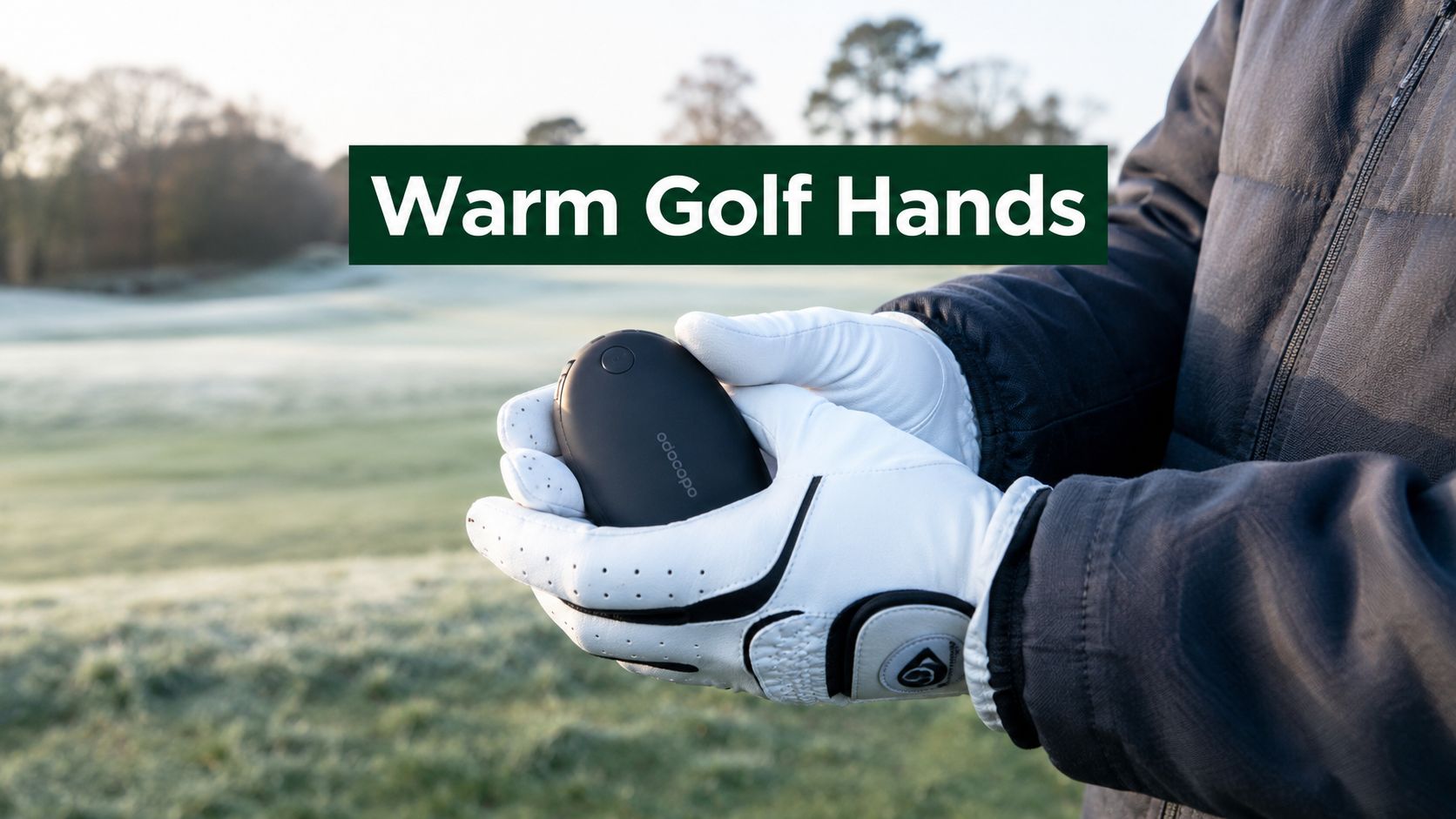
Cold mornings expose every weakness in a golf routine. You make a good swing, catch the ball a groove low, and immediately know why. Your hands never felt alive over the shot.
That's why hand warmers for golfers matter more than most players admit. They aren't just comfort gear for the parking lot and the first tee. They protect grip pressure, preserve touch, and keep you from spending the whole round trying to wake your fingers back up after every walk between shots.
Used well, a hand warmer becomes part of your rhythm. Used poorly, it turns into one more thing rattling around in a pocket, draining battery, overheating your fingers, or creating a rules problem you didn't know existed. The difference usually comes down to choosing the right type, carrying it in the right place, and building a repeatable routine around it.
Why Warm Hands Are a Golfer's Secret Weapon
Cold hands don't just feel bad. They cost shots.
Most golfers notice it first on partial swings and around the greens. The club suddenly feels heavier, the grip feels vague, and the strike gets jumpy. You start squeezing the handle harder because your fingers aren't giving you useful feedback. That tension climbs into your forearms and shoulders, and a simple cold-weather round starts feeling like work.
The practical problem is loss of feel. Golf asks for small adjustments all day long. You need to sense the putter face, control wedge speed, and return the club with enough softness that you're not fighting it. When your fingers are stiff, every shot becomes less precise.
Warm hands don't make you a better golfer. They make it easier to swing and react like yourself.
There's also the mental side. If you're thinking about your fingers, you're not thinking about the shot. That distraction gets expensive over 9 or 18 holes, especially when wind and damp air keep stealing heat between swings.
Comfort gear that affects performance
This is why experienced cold-weather players treat hand warmers as part of the setup, not an afterthought. A good warmer helps in three ways:
- It keeps your grip pressure calmer: You're less likely to strangle the club when your hands feel normal.
- It protects short-game touch: Chips, pitches, and putts demand feel more than power.
- It reduces between-shot recovery time: Instead of spending two holes trying to get circulation back, you stay ready.
Ben Hogan's long-circulating advice about warmth and cold-weather distance still resonates because golfers know the basic truth behind it. Frozen fingers lead to poor contact. Warm fingers give you a better chance to deliver the club the way you intended.
What actually works on the course
There isn't one universal answer. Some players do best with a disposable packet they forget about until it goes cold. Others want an electric unit with adjustable heat. Some walkers want a warmer clipped or strapped where they can reach it instantly between shots.
The right setup depends on how you play, how often you walk, and whether you need light warmth for a cool morning or steady heat through a raw, windy round. The details matter, and so does the routine around them.
Choosing the Right Hand Warmer for Your Game
Cold on the first tee feels manageable. By the sixth hole, the wrong hand warmer starts to show its flaws. Packets can cool off at the wrong time, electric units can die if you forgot to charge them, and bulky options get ignored because they are awkward to use during play.

The right choice depends less on advertised heat and more on your routine. Walkers need warmth they can reach without slowing the group down. Seniors usually benefit from steadier, gentler heat because stiff fingers take longer to recover once they get cold. Competitive players also need to keep Rule 4.2a in mind. Heat for your hands is fine, but anything that could be used to warm the club or ball crosses a line.
The three main types
Air-activated disposable warmers are still the easiest answer for many golfers. Open the packet, let it react with air, and put it where you can use it between shots. They are inexpensive, easy to keep in the bag, and reliable for players who only face cold conditions a few times each season. The trade-off is simple. You get one level of heat, one use, and more trash at the end of the round.
Rechargeable electric warmers suit golfers who play often enough to build a routine around them. They give adjustable heat, and golf-specific designs are usually easier to use than the small pocket warmers sold for commuting or everyday carry. The downside is maintenance. Battery life changes with temperature, heat setting, and how often you turn the unit on and off, so it is smarter to shop for consistency and convenience than to chase big runtime claims on the box.
Reusable gel warmers appeal to golfers who want to avoid both disposables and charging cables. They produce quick heat and can be reset later at home. On the course, though, they are usually a niche option. The warmth tends to come in a shorter burst, which makes them better for a short practice session or a quick nine than a long, raw day on the course.
Hand Warmer Types at a Glance
| Type | Upfront Cost | Per-Use Cost | Duration | Best For |
|---|---|---|---|---|
| Air-Activated | Low | Ongoing | Hours of single-use warmth | Occasional cold-weather golfers |
| Rechargeable Electric | Higher | Low after purchase | Varies by setting and battery | Frequent players and walkers |
| Reusable Gel | Moderate | Low after reset | Shorter burst-style warmth | Golfers who want non-electric reuse |
Where each type fits
Disposable packets are the practical pick for golfers who play a few cold rounds each year. They ask nothing from you. No cable, no battery check, no chance of discovering on the second hole that you forgot to charge the thing the night before.
Rechargeable models make more sense for regular walkers, seniors who struggle with circulation, and players who stay out through fall and winter. The value is not just heat. It is repeatable access to heat during the actual rhythm of a round. The best ones are easy to carry, easy to switch on, and easy to put away before the shot so you are not fiddling with gear while the rest of the group waits.
Reusable gel options work for a smaller group. They are better for golfers who dislike disposable waste and do not mind the reset process at home. For frequent play, that extra prep can become its own hassle.
Buying rule: Match the warmer to the way you actually play. A simpler option you will use every round beats a premium one that stays in the trunk or runs out of charge.
The practical buyer's filter
Use this test before you buy:
- You play cold golf rarely: Choose disposable packets and keep extras in the bag.
- You walk most rounds: Choose a rechargeable model only if you will charge it after every round.
- You are a senior golfer or have circulation issues: Prioritize steady, moderate warmth and easy access over maximum heat.
- You play competition rounds: Choose a setup that warms your hands without creating any temptation or confusion around Rule 4.2a.
- You already depend on winter hand coverage: Pair the warmer with a glove plan that works on the course. This guide to heated golf gloves is a useful starting point.
Good buying decisions in cold weather are usually boring. That is a compliment. The best hand warmer is the one that fits your pace, respects the rules, and keeps your hands ready without turning every green-to-tee walk into a gear project.
Mastering Hand Warmer Placement and Glove Use
Cold-weather rounds are often lost in the gaps between shots. You hit one solid iron, then spend the walk to your next ball with stiff fingers, and by the time you pull a club again your touch is gone.
Where the warmer rides decides whether it helps or becomes one more thing to manage. If you have to stop, unzip, and dig for it, you will stop using it. On the course, convenience beats theory.

Best places to carry it
A front trouser pocket is still the simplest option for disposable packets. It is fast, familiar, and good for golfers who like to keep their pre-shot routine unchanged. The downside shows up after a few holes. The pocket gets crowded with tees, a ball marker, a phone, or a yardage book, and the warmer ends up folded or forgotten.
A jacket pocket keeps heat better, especially in wind. Seniors often prefer it because the opening is easier to reach than a tight pants pocket, and the hand can stay relaxed instead of pinched into a small space. The trade-off is bulk. If the jacket is snug, the pocket can interfere with motion or make the club feel trapped against your body.
A dedicated pouch or belt-mounted warmer is usually the cleanest setup for walkers. It gives both hands one obvious home between shots and keeps heat separate from the other clutter. If you walk with a push cart, this is often the least annoying system over 18 holes. It also helps if you are trying to keep your setup organized, the same basic principle covered in this guide on how to pack a golf bag for fast access on the course.
Use one location all round. Under pressure, muscle memory matters more than a clever setup.
How gloves change the equation
The goal is warm hands at address, not hot hands during the swing. That sounds obvious, but plenty of golfers overdo it and end up with damp palms and less feel.
A few habits work better than others:
- Warm your hands between shots, then let them breathe before you play. That keeps the grip more secure.
- Do not slide a very hot electric warmer inside a fitted golf glove. It creates pressure points, traps sweat, and can leave the hand feeling clumsy.
- Preheating the glove helps. A short spell of warmth inside the glove before you put it on can make the first few swings feel much better.
- Mittens over your regular glove are practical for walkers. They come off quickly and do not ask you to change your grip routine every shot.
Competition golfers should be disciplined here. Rule 4.2a does not allow unusual use of equipment to help with play, so the safer habit is simple. Use the warmer between shots to stay functional, then play with your normal glove and normal grip. If a setup starts to feel like a performance aid instead of cold-weather comfort, it has gone too far.
For a visual on timing and between-shot handling, this quick video is useful:
A better routine for walkers
Walkers need a routine that respects pace and other players. Nobody wants to watch a partner fuss with pockets and straps beside every ball.
A reliable flow is straightforward:
- Warm both hands while walking or waiting.
- Take them out a few steps before the ball so the skin can dry.
- Put on the playing glove only when you are ready to choose the club and hit.
- Play the shot with dry fingers and a normal grip.
- Return your hands to the warmer as you leave the area.
That sequence also helps on greens and tees, where etiquette matters more than golfers admit. Handle the warmer while others are walking or reading putts, not when it is your turn to play.
For seniors and golfers with poor circulation, keep the process even simpler. One storage spot, one glove routine, no extra adjustments. The less you fiddle, the easier it is to stay warm and stay in rhythm.
A Hand Warmer Routine for 9 and 18 Holes
Good cold-weather golf starts before you reach the first tee. The golfers who stay comfortable aren't improvising. They've already decided when the warmer gets activated, where it rides, and how they'll manage it late in the round when the temperature usually feels worse than it did in the parking lot.
Before you leave home
If you use a rechargeable model, charge it the night before and check the charge again before heading out. That sounds obvious, but forgetting is common, especially when the warmer lives in a bag pocket all week.
If you use disposable warmers, activate them before the tee time rather than waiting until your hands are already numb. Early activation gives them time to reach a useful temperature by the opening holes.

A smart 9-hole routine
For 9 holes, simplicity wins. Use one warmer setup and resist over-managing it. If it's a casual late-afternoon loop, the biggest mistake is waiting too long to start using it.
A reliable 9-hole flow looks like this:
- On the way to the course: Get the warmer ready so it's working by the first tee.
- During the opening holes: Warm hands while walking, not just after bad shots.
- On the greens: Keep your routine tidy. Don't juggle glove, ball, marker, and warmer all at once.
- After the round: Recharge or discard promptly so the setup is ready next time.
A better 18-hole rhythm
Eighteen holes exposes every weakness in battery planning. Some rechargeable units perform well, but expectations need to be grounded in actual use. In cold testing, some rechargeable hand warmer pairs maintained steady warmth for about eight hours at around 140 degrees Fahrenheit, according to GearJunkie's hand warmer testing. That's useful, but not every product behaves like the best performers, and weather, wind, and heat setting all change the result.
If your electric warmer has multiple settings, start lower than you think you need. Save higher output for the coldest stretch, which is often the middle of the round after your body settles down and the air cuts through layers.
Course-tested habit: Low heat early, more heat late. Most golfers burn through battery because they chase comfort too aggressively on the first few holes.
Special notes for seniors and steady walkers
Senior golfers often benefit from consistency more than maximum heat. Hands that get stiff easily don't always recover fast once they've gone cold. Steady, moderate warmth is usually better than cycling between overheated and chilled.
Walking golfers also do best when the warmer doesn't interfere with movement. If you're already managing layers, snacks, rangefinder access, and cart handles, a bulky or awkward setup gets abandoned quickly. That's why packing matters. If your bag and cart are cluttered, the hand warmer routine gets clumsy too. This guide on how to pack a golf bag can help streamline where cold-weather gear lives.
One routine that holds up
The golfers who get the most from hand warmers for golfers usually follow the same pattern every round:
- Prepare before leaving.
- Use warmth proactively, not reactively.
- Keep the warmer in one consistent location.
- Manage heat for the whole round, not just the first hour.
That's what turns a useful gadget into dependable equipment.
Hand Warmer Safety Rules and Course Etiquette
Hand warmers are legal for keeping your hands warm. The problem starts when golfers get sloppy about where the warmer sits and what else shares that pocket.

A common misunderstanding among golfers is the strict Rule 4.2a prohibition against placing golf balls in the same pocket as a hand warmer, which can lead to disqualification if a warmed ball is struck. Keeping your hands warm is permitted, as explained in Golf.com's Rules Guy article on hand warmers and golf balls.
What the rule really means
This rule matters because it catches ordinary golfers, not cheaters looking for an edge. A player tosses a spare ball into the same pocket as a warmer, forgets about it, then puts that ball in play. That's where the trouble begins.
The clean habit is simple. Keep golf balls and hand warmers in separate places, always. Don't make exceptions for one hole, one coat pocket, or one rushed walk to the tee.
If a pocket has a hand warmer in it, that pocket is not for golf balls.
Heat safety on the course
Some electric units get hot enough to deserve respect. In a review of the G-Tech Sport 3.0, the warmer was listed with three settings: high at ≥200°F, medium at about 180°F, and low at about 120°F, with the high setting described as hot enough to cause discomfort if held too long. The same review notes runtime of 2 to 4 hours on high, 3 to 6 hours on medium, and 6 to 12 hours on low, plus a waterproof zippered battery compartment and machine washability only if the battery is removed first, according to Plugged In Golf's G-Tech Sport 3.0 review.
That leads to a few basic safety rules:
- Don't pin very hot units against bare skin for long periods: Warmth should be steady, not intense enough to distract you.
- Remove batteries before washing compatible pouches: Ignoring that can damage the heating element.
- Check battery insertion and charge level before the round: Some intermittent heating problems are simple setup errors, not product failure.
Etiquette that keeps play moving
A hand warmer should never turn into a pace-of-play problem. The routine has to be quiet and automatic. Pull your hands out while walking in, not when it's your turn. Put gloves on before you begin your yardage and pre-shot process. Don't stand over the ball while adjusting cords, zippers, or settings.
Good etiquette also applies to the course itself. Dispose of single-use packets properly. Don't leave spent warmers in the cart, on a tee box, or tucked into a cup holder.
While you're thinking about small habits that keep the course in good shape, it's worth brushing up on proper divot repair on the golf course. Cold-weather golf already tests everyone's patience. Clean habits help the round feel smoother for the whole group.
Final Tips and Frequently Asked Questions
The best hand warmers for golfers disappear into the background. That's the goal. You shouldn't be thinking about them all day. You should just notice that your hands still work on the 16th hole.
Akshay Bhatia is a good modern example. He clips on a battery-powered hand warmer between shots to maintain feel in cold, windy conditions, as noted in this winter golf hand warmer article mentioning Bhatia. That's the right mindset. Warmth is there to protect performance, not to become a project.
Pro tips worth keeping
- Carry a backup: Even if you prefer electric, a disposable packet in the bag can save a round.
- Warm between shots, not during them: Most players perform better when the swing itself stays familiar.
- Protect dryness as much as warmth: Damp gloves and sweaty hands cancel out a lot of good gear.
- Keep your system simple: Complicated routines get dropped by the third hole.
- Separate balls from warmers every time: This is not optional.
Frequently asked questions
Can I use hand warmers in the rain
Yes, but the setup matters. A protected pouch or jacket pocket works better than an exposed pocket. In wet conditions, keeping hands dry becomes just as important as heating them.
How do I clean a rechargeable hand warmer pouch
Follow the product instructions closely. Some pouch-style units can be machine washed only after the battery is removed. Don't assume the electronics are safe just because the exterior looks rugged.
Do disposable hand warmers expire
They can lose reliability over time, especially if packaging gets damaged. If you keep spares in the golf bag, check them before a cold round instead of trusting an old packet blindly.
Should seniors choose higher heat settings
Usually not at first. Many senior golfers do better with moderate, steady warmth they can maintain through the round instead of short bursts of intense heat.
Are rechargeable warmers always better for golfers
No. They're better for some golfers. If you won't keep them charged, or if you only play a few cold rounds each season, disposable warmers may be the smarter tool.
If you love walking but want the round to feel easier from the first tee to the last green, Caddie Wheel helps turn a standard push cart into a power-assisted setup without bulky complexity. It's a smart fit for golfers who want to conserve energy, walk more often, and keep their focus on playing rather than pushing.
Share:
Your Guide to What Is Portable Charger for 2026
Best Cheap Golf Range Finders: 2026 Buyer's Guide