
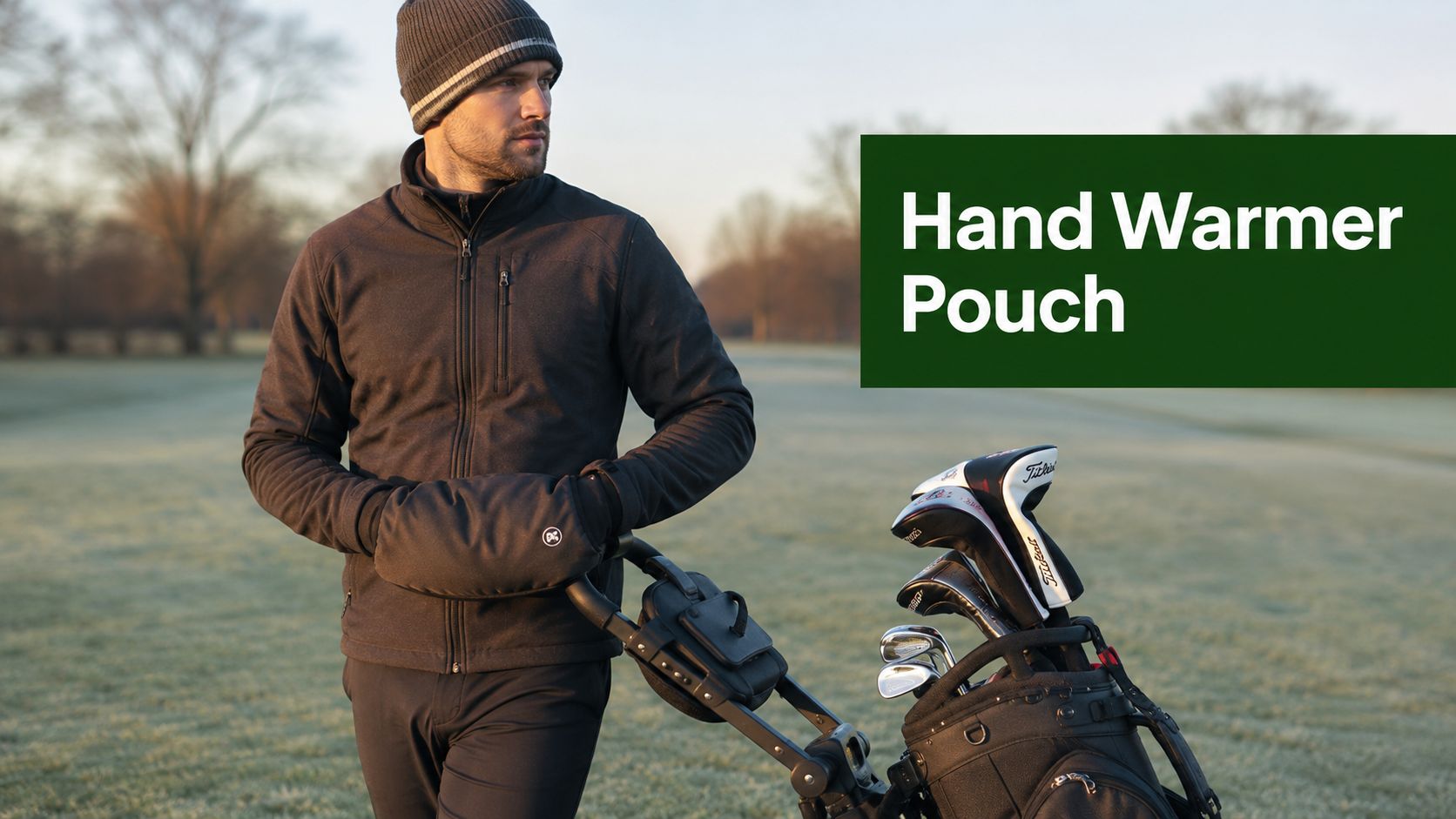
You know the feeling. You step onto the first tee on a cold morning, make a couple of practice swings, and your fingers already feel wooden. The glove helps a little. Keeping your hands in your pockets helps for a minute. Then you hit one thin, lose all feel in your trail hand, and spend the next few holes wondering why a round you were excited to walk suddenly feels like work.
For walkers, cold weather hits differently. You spend more time exposed to the air, more time holding a push cart handle, and more time letting your hands cool between shots. That changes what gear matters. A jacket matters. A beanie matters. But if your hands get cold, your swing, touch, and patience usually go with them.
Conquering Cold Rounds with a Golf Hand Warmer Pouch
A golf hand warmer pouch solves a simple problem that turns into a scoring problem fast. It gives you one reliable place to restore warmth between shots, instead of trying to hide your hands in your jacket or rub them together while your group waits.
For a walking golfer, that matters more than people think. Riding players can tuck into a cart windshield and get a short break from the wind. Walkers don't get that luxury. You push, steer, pull a rangefinder, grab a towel, mark a ball, and keep moving. Your hands are doing small jobs all day, and every one of those jobs gets harder when your fingers stiffen up.
That's why I don't think of a hand warmer pouch as a luxury item. I think of it as performance gear with a comfort bonus.
What the pouch is really doing for you
A good pouch creates a repeatable routine:
- Between shots: Slide your hands in and bring feeling back before the next swing.
- On the walk: Keep your fingers loose instead of letting them tighten hole by hole.
- Late in the round: Protect touch and patience when cold usually starts to win.
If you're building a better cold-weather walking setup, it also helps to look at the rest of your layering system. A solid place to compare affordable headwear options can round out the basics without overcomplicating your kit.
The other key is thinking like a walker, not like a cart rider. How the pouch attaches, where your hands find it naturally, and whether it works with your push cart setup matter just as much as raw heat. Golfers who want a smoother cold-weather routine can also learn a lot from this guide on walking a golf course like a pro, because pacing and organization make cold rounds much easier.
A hand warmer pouch works best when it becomes part of your routine, not something you remember only after your hands go numb.
Why Warm Hands Are a Walking Golfer's Secret Weapon
Cold hands don't just feel bad. They change how you play.

When your fingers lose sensitivity, you stop getting clean feedback from the club. Your grip pressure often tightens without you noticing. Your forearms and hands work harder than they should. That's a bad combination if you're trying to hit a controlled wedge, flight a mid iron, or judge speed on the greens.
High-performance golf hand warmer pouches use integrated lithium batteries with heating elements that can reach up to 85°C (185°F), and the performance goal is to help maintain hand temperature near 35 to 40°C, because cold hands reduce tactile sensitivity and increase muscle tension, which hurts swing consistency and adds fatigue over 18+ holes according to Alpha U heated hand pouch product details.
Where walkers notice the difference most
If you walk, you probably notice cold hands in three places first:
- Off the tee when you need a relaxed start and your hands feel rigid.
- Inside scoring range when partial shots demand feel more than force.
- On and around the greens where tiny changes in touch show up immediately.
That's why warm hands are such a quiet advantage. They help you keep the same grip and same motion from the first hole to the last, instead of adjusting all day to a body that keeps tightening up.
Warmth supports energy too
Walking golfers already know that fatigue isn't only about legs. It's mental too. If your hands are cold, every shot asks for more effort. You fiddle with gloves, blow into your fingers, and rush to get moving again. A pouch cuts down that friction.
Practical rule: If your hands are cold enough that you're thinking about them before the shot, they're already affecting the shot.
Plenty of players pair a pouch with other cold-weather tools instead of relying on one item to do everything. If you want to compare where hand warmers fit against other options, this look at hand warmers for golfers is useful.
The secret isn't just staying warmer. It's keeping your normal golf swing available when the weather tries to take it away.
Comparing the Four Main Types of Hand Warmers
Not every hand warmer works the same way on the course. Some are simple and cheap. Some give steady heat for a full round. Some are easy to forget until they stop being convenient at the worst time.
The main categories are insulated pouches, chemical packets, rechargeable electric models, and fuel-activated warmers.

Golf Hand Warmer Pouch Comparison
| Type | Heat Source | Typical Duration | Reusability | Best For |
|---|---|---|---|---|
| Insulated pouch | Body heat or added warm packs | Varies by conditions | Yes | Mild cold, simple setups |
| Chemical packets | Air-activated packet | Round-dependent, single use | No | Occasional cold rounds |
| Rechargeable electric | Built-in battery and heating element | 3 to 12 hours based on setting, with 3 to 4 hours on high and up to 12 hours on low according to SI on G-Tech Apparel's heated pouch | Yes | Regular walkers, consistent heat |
| Fuel-activated | Liquid fuel unit | Long-lasting heat | Reusable unit, refill required | Golfers comfortable with extra handling |
Insulated pouches
These are the simplest option. Think of them as a sheltered place for your hands, often with fleece or similar lining. By themselves, they don't generate heat. They hold whatever warmth your hands already have, or whatever warmth you add with another source.
That can be enough on cool days. It's less helpful when the air is biting and the wind keeps stripping heat away.
Chemical packets
Chemical warmers are easy to keep in your bag. Open the packet, let air activate it, and tuck it into your pouch or pocket. They're handy because they need no charging and almost no planning.
The downside is consistency. Once they start, they start. You don't dial them up or down, and once they're spent, they're done.
Rechargeable electric pouches
For serious cold-weather golfers, this is usually the strongest category. Rechargeable lithium battery models offer 3 to 12 hours of heat depending on the setting, with high heat typically lasting 3 to 4 hours, enough for an 18-hole round, while low heat can stretch to 12 hours according to SI's review coverage of heated golf pouches.
That flexibility matters. You can use more heat on the front nine when the morning is raw, then back it off as conditions improve. For walkers, the big win is predictable warmth without carrying piles of disposable packs.
Fuel-activated warmers
These have their fans because they can deliver long-lasting warmth. But they ask more from the user. You need fuel, you need care, and you need to be comfortable handling a heat source that isn't as simple as pressing a button.
Some golfers love fuel warmers. Most walkers prefer less fuss on the course.
If you're comparing winter hand gear more broadly, this guide to heated golf gloves can help clarify where gloves end and pouches make more sense.
For most walkers, the choice comes down to this. If you play a few cold rounds each year, chemical packets may be enough. If you walk often and want dependable heat without waste, rechargeable electric is usually the best fit.
Key Features for Integrating with Your Push Cart
The best golf hand warmer pouch for a walker isn't just warm. It fits the way you move down the course.

A pouch can have great heating performance and still be a poor choice if it swings around, blocks your handle area, or makes your cart awkward to control. That's where many general reviews miss the mark. They talk about warmth, but not about placement, attachment, and access.
Attachment matters more than most golfers expect
For push cart users, the pouch should mount securely near your natural hand position. You don't want it hanging so low that you keep searching for it, and you don't want it strapped so wide that it crowds the center of the handle.
Look for attachment systems that feel stable on uneven ground:
- Adjustable straps: Good for wrapping around different handle shapes.
- Buckles or secure loops: Better than weak clips on bumpy paths.
- Minimal swing: A pouch that shifts every few steps gets annoying fast.
The fit also matters if your cart setup includes an assist system and control hardware. A pouch shouldn't interfere with a remote holder or block your hand from reaching controls quickly. It also shouldn't obstruct the bracket area on a cart setup that depends on a clean snap-in or drop-on connection.
Size and shape should support motion
Golfers often assume bigger is better because a larger pouch can carry more. That's not always true for walkers. If the pouch is oversized, it can crowd the handle zone and make the cart feel cluttered.
A better design gives you room for your hands without turning the handle area into a storage bin.
Look for these build details
- Soft interior lining: Easier on bare or gloved hands when the air is cold.
- Weather-resistant exterior: Helps in drizzle, frost, and damp morning grass.
- Opening that stays open enough: You should be able to slide hands in quickly without fighting the fabric.
If you have to look down and fuss with the pouch every time you use it, the setup isn't right yet.
Charging convenience matters for walkers
Newer heated models have become easier to live with because some now include USB-A and USB-C charging ports, which allows rapid recharging from portable power banks for consecutive rounds or extended practice sessions according to Golf.com's G-TECH Sport 4 review.
That feature matters most to walkers who spend long stretches away from outlets. If you practice before your round, warm up on the range, then head straight to the course, being able to top off from a portable charger is a practical advantage.
A quick fit test before you buy
When you evaluate a pouch, picture this setup on your own cart:
| Question | What you want |
|---|---|
| Can you reach it without changing stride? | Easy access near the handle |
| Does it block controls or brake access? | Clear path to every control |
| Will it stay put over bumps and curbs? | Stable attachment |
| Can you charge it simply? | Straightforward cable access |
A walking setup works best when each piece earns its place. A hand warmer pouch should make the round smoother, not busier.
On-Course Usage and Maintenance Tips
A good pouch helps most when you use it on purpose, not randomly. The golfers who get the most from one usually follow a routine before, during, and after the round.
Before you leave for the course
Charge the pouch the night before, then turn it on before the first tee if your model allows safe pre-heating. Starting with a warm pouch is better than waiting until your hands are already cold.
Also think about where it will live on your cart. Don't decide that in the parking lot with cold fingers and a group ready to go.
During the round
Use the pouch in the gaps that already exist in your round. Walking to your ball. Waiting for a playing partner. Standing on a tee while the group ahead clears.
A few habits help:
- Use it early: Don't wait for numb fingers.
- Use it briefly and often: Short returns to warmth keep your hands more stable than long stretches of exposure.
- Keep one routine: Hands in after the shot, hands out as you begin your setup.
Warm your hands between shots, not over the ball. The goal is to arrive at the shot ready, then play without delay.
Managing the pouch without slowing play
One common mistake is turning the pouch into another gadget to manage. Keep it simple. If your gloves, towel, rangefinder, and pouch all compete for the same space, you'll feel rushed.
Try this order on a cold day:
- Park cart.
- Pull club.
- Use the pouch while waiting.
- Step in and hit.
- Return hands to warmth as you move on.
That routine feels natural after a few holes.
After the round
Maintenance doesn't need to be complicated, but it does need to happen.
- Dry it out: If the morning was damp, let the pouch air out before storing it.
- Clean gently: Follow the maker's cleaning guidance for the shell and lining. Avoid rough treatment around battery areas.
- Store smart: Put rechargeable models away in a dry place and avoid tossing heavy gear on top of them.
If you take care of the pouch, it's more likely to be ready the next time the forecast turns ugly.
Navigating Safety and the Rules of Golf
Battery-powered hand warmers are straightforward, but they still deserve respect. If your pouch charges by cable, use the intended charging method and inspect the battery area once in a while for wear, loose connections, or damage after transport. If a unit starts behaving oddly, overheating beyond normal operation, or showing obvious physical damage, stop using it until you know what's going on.
That's the safety side. The golf rules side is where many players get uneasy.
The gray area golfers worry about
A real point of confusion exists around Rule 4.2a(2). The rule prohibits heating a ball, but there's lingering uncertainty about whether indirect heat from a pouch in the same pocket counts as a violation, and golfers don't have clear data on safe usage thresholds according to this discussion of the rules ambiguity in a golf rules community post.
The practical issue is simple. You might keep balls in an outer pocket or pouch area on a cold day. If that same space is getting warmed, you don't want to wonder whether you've crossed a line.
The safest way to handle it
My advice is conservative and easy to follow:
- Keep golf balls separate from any active heat source.
- Use the pouch for hands only unless the product is clearly designed with separate, non-heated storage.
- Avoid same-pocket storage if there's any chance warmth is transferring to the ball.
When the rule feels gray, choose the setup that leaves no doubt.
That approach keeps your focus where it belongs. On the shot, not on a rules argument.
Your Buying Checklist for the Perfect Pouch
A smart purchase comes down to fit, function, and how you play. If you walk with a push cart, the best pouch is usually the one that disappears into your routine.

Professional athletes, including golfers, use heated hand warmer pouches to maintain optimal hand temperature, which supports grip pressure consistency, focus, and physical readiness throughout long rounds according to The Hackers Paradise coverage of the G-Tech Heated Handwarmer 3.0 Sport. That tells you where the category sits now. It's not just comfort gear. It's part of staying ready to perform.
The short list to use before you buy
- Choose the right type: For frequent walkers, rechargeable electric models make the most sense because they deliver repeatable heat and less waste.
- Check the attachment system: Make sure it mounts cleanly to your push cart without crowding your handle area.
- Look at weather resistance: Damp, windy mornings expose weak materials fast.
- Prioritize quick access: Your hands should find the pouch naturally while walking.
- Think about charging habits: If you practice and play in the same day, easy charging becomes more important.
Who should lean electric
If you walk often, play in cold shoulder-season weather, or want one setup you can trust week after week, a rechargeable heated pouch is the strongest all-around choice. It fits the rhythm of walking golf better than single-use options, especially when your hands need regular recovery between shots.
If you're shopping for someone else, this broader ultimate guide for outdoor gifts can help if the golfer in your life also hikes, camps, or spends time outside beyond the course.
The right golf hand warmer pouch should do three things well. Keep your hands ready. Fit your cart setup cleanly. Stay simple enough that you use it every round that calls for it.
If walking is your favorite way to play, adding electric assist can make the whole setup feel smoother from the first hole to the last. Caddie Wheel helps standard push carts move with less effort, so you can save energy for your swing, keep your pace steady, and enjoy more of the round.
Partager:
Waterproofing Electrical Connections: A 2026 Guide
Mastering Electrical Safety Guidelines for Golf Caddies