
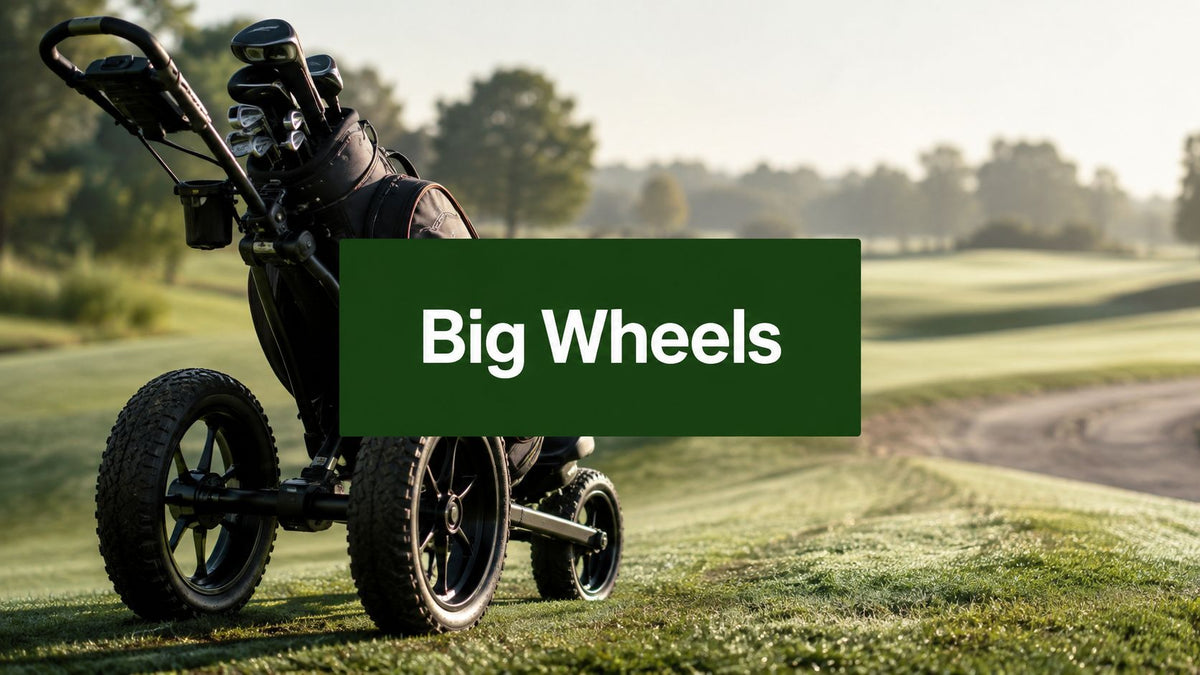
You're halfway through a Sunday round when the difference becomes obvious. One golfer's cart bumps and grinds across a wet rough patch, its small wheels catching on roots and soft ground. Beside it, another cart rolls through with fewer jolts, tracks more cleanly, and doesn't demand a hard tug every few yards.
That contrast is why golf push cart big wheels deserve a closer look. Larger wheels can improve obstacle clearance, rolling efficiency, and control, but they also take up more room, may add weight, and still need to fit your cart and your course rules. The right choice isn't just “buy the biggest wheel.” It's choosing the wheel system that reduces work without creating a new problem in your trunk, garage, or clubhouse.
Why Wheel Size Matters on a Golf Push Cart
A smooth cart path can make almost any push cart feel capable. The test begins when the route turns into wet rough, soft turf, or ground cut by shallow ruts. A small wheel may stop against a root or sink into loose soil, forcing you to push harder and correct the handle more often. A larger wheel changes how the whole cart meets that terrain.
The extra effort usually arrives in small interruptions rather than one obvious failure. Each stall, slip, or sharp drop passes movement into your hands and shoulders. Repeated across a full round, those corrections can make walking less pleasant and place more impact on stock wheels, hubs, and the frame.

Diameter changes the whole ride
Wheel diameter affects several parts of the cart at once:
- Rolling efficiency: A larger wheel approaches bumps at a shallower angle and generally loses less energy.
- Stability: Extra clearance helps the cart remain composed across uneven transitions.
- Bag movement: Fewer sudden jolts mean less abrupt tilting and shifting.
- Steering effort: Better tracking can reduce the repeated push-and-correct motion that tires your arms.
Diameter is only one part of the system. Tread, tire material, pressure, bearings, bag weight, axle position, and frame design also influence how a cart behaves. A large wheel with poor fitment can create rubbing, interfere with folding, or leave the brake unusable. A smaller wheel that fits correctly may work better for a compact setup used mainly on firm paths.
The category's history reflects that there has never been one fixed walking-cart design. Modern golf push carts have documented roots in the late 1930s and World War II era. A 1945 pull cart used two lawn-mower wheels with a spring-suspension chassis, while Bag Boy reportedly manufactured 750,000 carts between 1945 and 1960, according to this history of golf push carts. The Sun Mountain Speed Cart later accelerated the modern three-wheel format in 1999.
Before buying replacements, compare golf cart wheel dimensions and stock fitment. Confirm axle compatibility, frame clearance, brake access, and the folded cart's storage footprint. Caddie Wheel's larger-wheel approach can also fit into an electric-assist workflow on an existing cart, but the added hardware still has to suit the cart and your storage routine.
Practical rule: Choose the largest wheel that improves movement while still fitting the cart, course, and storage space.
How Bigger Wheels Roll Better
A push cart crossing a root or path edge behaves much like a car crossing a speed bump. A large wheel meets the obstacle gradually, while a small wheel strikes a larger share of it. The larger wheel therefore loses less speed and sends less of the obstacle's force into the handle.
At walking pace, that difference is easy to feel. A larger-diameter wheel changes direction less abruptly as it reaches the leading edge of a bump. The cart rises more gradually, so the frame and handle produce less of the sharp lifting motion that makes each push feel jerky.
The physics in plain language
On hard surfaces, rolling resistance generally decreases as wheel radius increases. One engineering explanation describes rolling resistance as inversely proportional to wheel radius. Under the same load and inflation pressure, a larger wheel experiences less relative deformation. An engineering discussion of wheel radius and rolling resistance also supports choosing the largest practical diameter when reducing push force is the goal: engineering discussion of wheel radius and rolling resistance.
The wheel does not work alone. Tire material, tread, pressure, bearings, bag weight, and frame geometry all affect the cart's feel. A large, rigid plastic wheel may clear obstacles well but transmit more vibration than an air-filled tire. A properly inflated pneumatic tire can soften rough ground, while an underinflated tire may feel vague and create more drag.

The practical benefit is a steadier push. A suitable larger wheel can reduce stalls, cross soft lies more easily, and make roots or rough path edges quieter. It will not turn a push cart into a suspension vehicle, but more of each push stroke goes into forward movement.
Clearance improves for the same geometric reason. Rather than lifting the cart's full load sharply at every bump, the wheel rotates over more of the obstacle. Larger diameters therefore suit uneven turf, hills, and wet ground, provided the tire and cart remain compatible.
Guidance on golf push cart wheels reports that larger wheels can improve traction and straight tracking on hilly or uneven turf. The same guide says wheels under 10 inches can struggle in wet grass, while wheels of 11 inches and above handle those conditions better: guide to golf push cart wheel performance.
Big Wheel Size Ranges and What Each Tier Gives You
Wheel sizes overlap across product categories, so treat the following as practical bands rather than strict industry classes. The important question is what changes under the bag, not what the packaging calls the wheel.
| Tier | Diameter | Tire Type | Best For | Rough Performance | Folded Footprint | Price Band |
|---|---|---|---|---|---|---|
| Stock | 8 to 10 inches | Solid or basic molded tires | Smooth paths and flatter courses | Adequate on firm, even ground | Most compact | Usually the least expensive replacement path |
| Crossover | 11 to 12 inches | Solid, foam-filled, or pneumatic | Mixed municipal and resort conditions | Noticeably better clearance and tracking | Moderate increase | Mid-range upgrade |
| Premium terrain | 12 to 16 inches | Specialized pneumatic or solid options | Rugged terrain and hilly layouts | Strongest bump and soft-ground capability | Largest footprint | Higher replacement and fitment cost |
Stock wheels from 8 to 10 inches
A standard non-lifted golf cart is commonly designed for wheels between 8 and 10 inches, with 10 inches effectively the upper end for that stock setup, according to this golf cart wheel sizing guide. These wheels suit golfers who spend most of the round on firm paths or well-maintained fairway turf. They're also easier to store because the folded frame usually remains relatively compact.
The limitation appears when the surface softens or develops frequent bumps. Small wheels can still work, but the golfer feels more of the terrain through the handle and may need to slow down or pull the cart over difficult sections.
Crossover wheels from 11 to 12 inches
The 11 to 12 inch range is the practical middle ground for many walkers. It adds useful clearance without automatically turning the cart into a bulky piece of equipment. Mixed turf, path transitions, shallow roots, and moderate slopes become easier to manage.
This tier makes sense when you want a smoother ride but still load the cart into a normal trunk or store it in a tight garage. Construction matters here. A well-made solid wheel may be low-maintenance, while a pneumatic version can offer more cushioning if you're willing to monitor pressure.
Terrain-focused wheels from 12 to 16 inches
The 12 to 16 inch range favors golfers who regularly encounter rough ground, soft turf, or sustained hills. These wheels can make a push cart feel more like an off-road walking aid than a luggage trolley, particularly when paired with suitable tread and a stable frame.
The trade-off is physical size. Larger wheels can remain prominent after folding, and their hubs may not match a budget cart's axle or brake system. They're useful when terrain is the problem, but excessive when your real challenge is storage or hand fatigue on otherwise smooth courses.
Big Wheels Versus Other Cart Upgrades
A golfer finishing a hilly round may feel two different problems: the cart is striking obstacles, or the golfer is supplying too much force. Wheel diameter mainly addresses the first. An electric assist addresses the second. Choosing well means matching the upgrade to the work you feel, while considering terrain, folded size, and compatibility.
| Upgrade | Best Terrain | Added Weight | Cost Range | Effort Reduction |
|---|---|---|---|---|
| Larger wheels | Uneven turf, roots, soft ground | Can increase system weight | Varies by wheel and fitment | Reduces obstacle-related pushing |
| Four-wheel chassis | Slopes and situations where a broad stance helps | Often greater than a simpler frame | Varies by cart | Improves planted stability, but doesn't remove pushing |
| Pneumatic tires | Mixed turf where cushioning matters | Depends on tire and tube design | Varies by tire | Softens impacts and may improve comfort |
| Electric-assist conversion | Hilly layouts and long walks | Adds a motorized wheel and battery system | Varies by conversion | Reduces the physical work of propulsion |
Bigger wheels
Choose larger wheels when terrain resistance is the main complaint. More diameter helps the wheel climb over roots, gravel edges, shallow ruts, and soft patches with less abrupt interruption. The cart may roll more steadily, but the change does not fix a weak brake, an unstable bag cradle, or poor tracking across a sidehill.
Wheel size works like the cart's first layer of suspension. It deals with the shape of the ground. Tire construction then affects how much vibration reaches the handle, so diameter and tire type should be judged together rather than treated as interchangeable upgrades.
Four wheels
A four-wheel chassis can provide a broader, more planted base on slopes. That stability can make the cart feel easier to control when a bag shifts or the ground falls away to one side.
The trade-off is usually a wider frame and a less compact folded shape. Choose this layout when platform stability matters more than the easiest trunk fit. It will not remove the effort required to push uphill.
Pneumatic tires
Pneumatic tires suit a cart whose wheel diameter already clears obstacles but whose ride feels harsh. Air cushioning softens repeated impacts and can make mixed turf more comfortable. They also bring another task: pressure and puncture checks.
Golf push cart tires commonly use specialized pneumatic or solid designs. Matching tire heights on the left and right matters because unequal wheels can make the cart pull continuously. This guide to golf push cart tire selection explains how tread, construction, and intended surface affect the choice.
Electric assistance
Electric assistance changes the task from overcoming every incline with your arms to guiding the cart while a motor supplies propulsion. Caddie Wheel uses a motorized wheel that attaches to a compatible existing push cart through a bracket-based drop-on design. Its controls provide remote forward, reverse, and braking functions, and the company states that its battery supports up to 36 holes per charge.
A practical setup can combine upgrades. Larger air-filled wheels may help on rough ground, while motor assistance reduces fatigue on long walks and sustained hills. Before combining parts, review custom golf cart wheel compatibility and confirm that the frame, axle, folding mechanism, and braking arrangement can accept the chosen wheels and assist system.
Fitting Big Wheels to Your Existing Push Cart
Bolting a larger wheel onto a push cart isn't always a universal upgrade. The wheel must fit the axle, clear the frame, cooperate with the brake, and avoid interfering with the folding mechanism. A careful measurement before ordering is far cheaper than discovering that a new wheel sits loose, binds against the fork, or leaves the cart pulling to one side.
Check the axle first
Start by identifying the axle shape and size. The common checks include whether the cart uses a 6mm or 8mm hex axle, but budget carts may use proprietary fittings that don't accept standard aftermarket wheels. Don't assume a wheel designed for one three-wheel cart will fit another three-wheel cart.
Measure the hub spacing, inspect the bearing arrangement, and compare the new wheel's rim width with the available clearance. Sealed cartridge bearings generally need less routine attention than loose-ball arrangements, but either design can suffer if grit enters the hub.
Use this accurate wheel diameter measurement method before comparing replacement sizes. Measure the complete outside diameter, not just the rim, because tire height affects frame clearance and folded dimensions.

A sensible installation sequence
- Remove the stock wheel carefully. Pop off the hub cap if the design uses one, then loosen the axle nut without losing spacers or washers.
- Compare the hardware. Check that the replacement hub seats fully and that the axle passes through without force.
- Install the wheel. Slide it into position, reinstall the spacers, and secure the axle nut to the cart manufacturer's specified torque.
- Check clearance. Spin the wheel and fold the cart partially to ensure the tire doesn't touch the frame, brake, or neighboring wheel.
- Test on flat pavement. Roll the unloaded cart first, then add the bag and test steering, braking, and tracking before taking it to the first tee.
A wider rim can shift the cart's center of gravity. In some designs, that may require a counterweight at the handle, particularly when the bag sits high or the front wheel becomes lighter under load.
Avoid mixing wheel diameters between the front and rear unless the cart maker specifically supports that configuration. Different rolling circumferences can create tracking drift, especially on sidehill lies. Install matching left and right wheel heights, then watch whether the cart pulls continuously in one direction.
Maintenance, Storage, and the Assist Trade-Off
Large wheels solve a real problem, but they introduce responsibilities that don't appear in the first few minutes of a showroom test. More surface area, wider hubs, and pneumatic construction can mean more inspection, more cleaning, and more planning after the round.
Maintenance follows the wheel design
Solid tires simplify ownership because you don't have to check air pressure. Pneumatic tires offer cushioning but need regular pressure checks, especially after storage or temperature changes. A soft tire can increase drag, while an overinflated tire can transmit more vibration and reduce its ability to conform to uneven turf.
Bearings deserve attention after wet or muddy rounds. Wipe away grit, inspect for play, and follow the wheel manufacturer's lubrication guidance. On cart-path-heavy courses, tread can also wear faster because a larger contact patch sees repeated abrasion on hard surfaces. Keep the wheels clean before storing the cart so dried mud doesn't interfere with the hub or folding joints.

Storage becomes part of fitment
A wheel that performs beautifully on wet rough may be frustrating if it won't fit your car. A 14-inch wheel may not fold flat into a trunk well designed around 10-inch stock wheels, so measure the trunk opening, depth, and height rather than relying on a label such as “compact fold.” The folded cart also needs room around the bag, shoes, rain gear, and other equipment.
Quick-release axle hardware can help, but it adds another step before and after each round. Store removed wheels where they won't collect grit, and don't leave pneumatic tires pressed against a sharp trunk edge.
Electric assistance changes the calculation
A motorized hub adds equipment to one wheel, yet it can remove the effort that prompted the larger-wheel upgrade in the first place. That makes electric assistance a different kind of solution. Instead of maximizing passive terrain capability, you're reducing the work required to move the loaded cart.
The broader market is moving toward electric assistance. One 2026 projection estimates electric drive at about 70% of the push-pull golf cart market, while other market coverage points to growth in remote-control and lithium-ion segments, as summarized by this push-pull cart market report. That trend doesn't make big wheels irrelevant. It means buyers should compare a larger passive wheel system with a motorized workflow before spending on both.
Choosing the Right Setup for Your Walking Game
Start with three honest questions. How often do you play on soft, wet, or hilly turf? How much trunk and garage space can you spare? Do you care more about walking faster, or about walking with less effort?
Your answers usually point toward one of three setups.
Keep the stock wheels for predictable ground
Stay with the original wheels if your rounds mostly follow smooth paths and firm fairways. This is the most compact option, and it avoids compatibility work, extra maintenance, and changes to the folded footprint. Put your attention instead on brake performance, bag security, handle height, and whether the cart tracks straight.
Stock wheels aren't a failure. They're optimized for a narrower range of conditions.
Choose the crossover range for mixed courses
Move toward 11 to 12 inch wheels when your course regularly combines fairway turf, rough edges, gravel transitions, and occasional soft ground. Air-filled tires make sense when cushioning is a priority, while solid or foam-filled construction may suit golfers who don't want pressure checks.
This is often the most balanced path for a golfer who wants visible improvement without turning the cart into a storage problem. Check left and right tire heights, confirm hub compatibility, and test the folded cart in your actual trunk.
Go larger, or add assistance, when pushing is the problem
Choose 14 to 16 inch wheels when rough terrain and steep layouts dominate your rounds, and when storage space isn't a concern. The added clearance can make difficult ground less disruptive, but the setup remains dependent on your own pushing force.
Choose electric assist when joint sensitivity, long walks, or sustained inclines make every push harder. A motorized conversion can be more useful than a larger passive wheel if the priority is conserving energy rather than gaining clearance. Course policy still matters. Most courses allow electric push carts, but golfers should check local rules, particularly after heavy rain when turf damage becomes a concern.
Tournament transport has its own requirement. A push or pull cart must not be towed beside, behind, or by a shuttle cart while its wheels are rolling on or touching the ground during transportation between holes, according to the push-pull cart policy from the Florida State Golf Association.
The right setup should disappear into the round. If bigger wheels let you cross your course comfortably and still store the cart easily, use them. If air tires solve the harsh ride, stop there. If pushing itself is the obstacle, prioritize assistance over bragging rights at the bag drop.
Caddie Wheel offers a motorized power-assist wheel that attaches to compatible standard push carts, helping golfers control forward movement, reverse, and braking with a remote while preserving their existing cart. Visit Caddie Wheel to compare the drop-on installation approach and see whether electric assistance fits your walking routine.
Partager:
3 Wheel Motorized Cart Guide for Golfers in 2026
How to Charge Portable Charger