

Picking out the right golf cart wheels isn't as complicated as it might seem. Whether you're upgrading your riding cart for a better feel or adding a motorized wheel to your push cart to make the walk easier, it all comes down to one thing: matching the wheel to what you actually need. Get it right, and you’ll notice a difference in everything from stability on the fairways to how much energy you have left on the back nine.
Choosing the Perfect Wheels for Your Golf Cart
Deciding on new golf cart wheels can feel like a big undertaking, but it really just boils down to a few key questions. First, what’s your main goal? Are you trying to get a smoother ride on paved cart paths, more grip on a rugged course, or are you just looking for a way to make walking 18 holes less of a workout?
That first question often leads to a bigger one: the classic golf walking vs. cart debate. How you prefer to play is the single biggest factor, as it determines whether you're shopping for a traditional riding cart or a push cart solution.
And it’s a decision more and more golfers are making. The global golf cart market hit a staggering $1.9 billion in 2023 and is on track to nearly double to $3.5 billion by 2033. This boom is fueled by new courses popping up and a huge shift toward electric models and powerful upgrades.
This simple decision tree can help you visualize that first choice, which sets the stage for everything else.
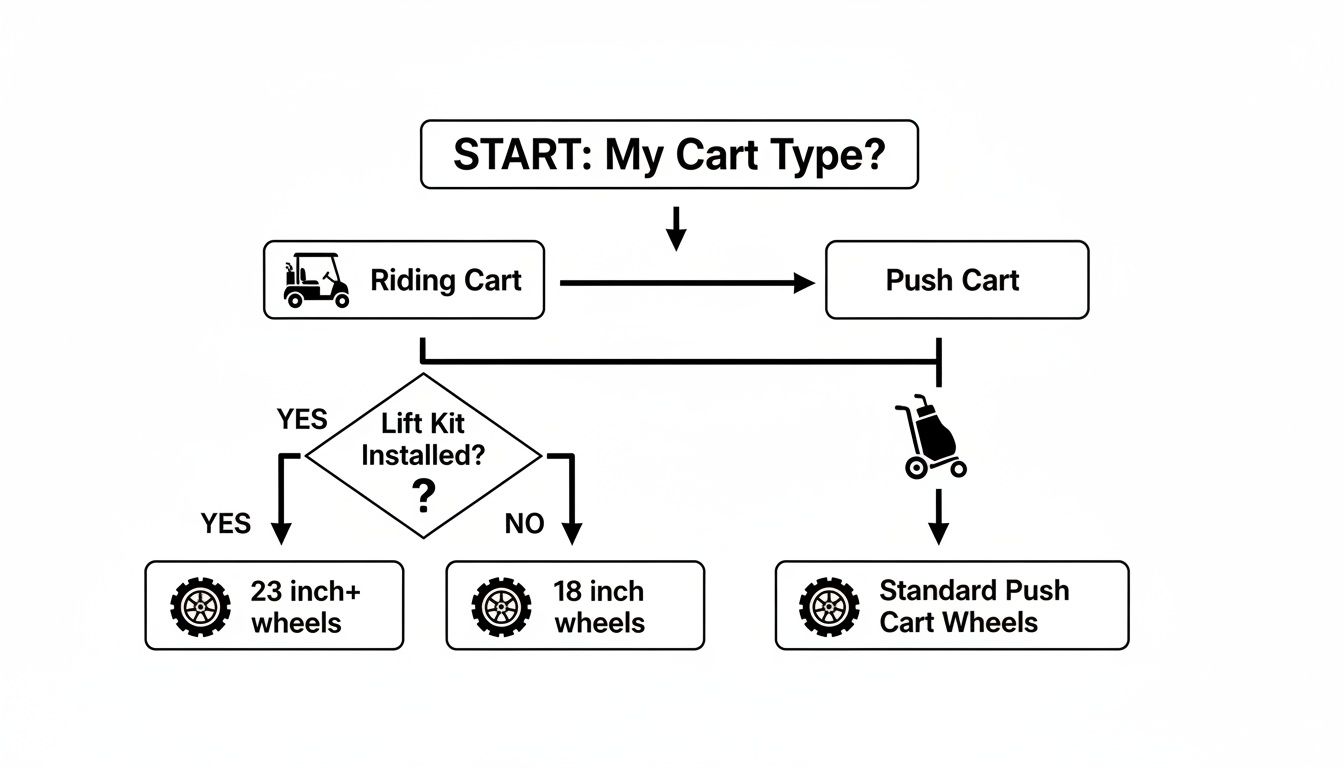
As the flowchart shows, knowing your cart type is the starting line. It sends you down a specific path for sizing, tread, and other features that matter for your setup.
To simplify this initial choice, this table breaks down what you should be focusing on for each type of cart.
Key Wheel Considerations At A Glance
| Factor | Riding Cart Focus | Push Cart / Motorized Wheel Focus |
|---|---|---|
| Primary Goal | Performance, aesthetics, and terrain capability (e.g., off-road). | Reducing physical strain, improving maneuverability, and conserving energy. |
| Size & Fit | Larger diameters for lifted carts; standard sizes for non-lifted models. | Compatibility with your existing push cart frame; lightweight design is key. |
| Tread Type | Aggressive, knobby treads for trails vs. turf-safe treads for the course. | Smooth, low-resistance treads for easy rolling on grass and paths. |
| Material | Often steel or aluminum alloy for durability and style. | Lightweight plastics, solid foam, or rubber to minimize added weight. |
| Key Feature | Offset, bolt pattern, and load rating. | Ease of installation, battery life (if motorized), and portability. |
Ultimately, whether you ride or walk, the right wheels are about making your time on the course better.
Imagine gliding up a steep hill without breaking a sweat or having enough energy left for that crucial final putt—the right wheels can make that happen. From simple stability upgrades to advanced electric assists, just knowing your options is the first step.
This guide will walk you through the different wheel types, materials, and sizes out there. By the time you’re done, you’ll have everything you need to make a smart choice that genuinely improves your game. Let's get rolling.
Understanding Wheel Materials and Construction
Let’s be honest—not all golf cart wheels are built the same. The materials and the way they're put together are the foundation of your cart's performance, dictating everything from ride smoothness to how long they’ll last. It's a classic balancing act between performance, durability, and what you’re willing to spend.
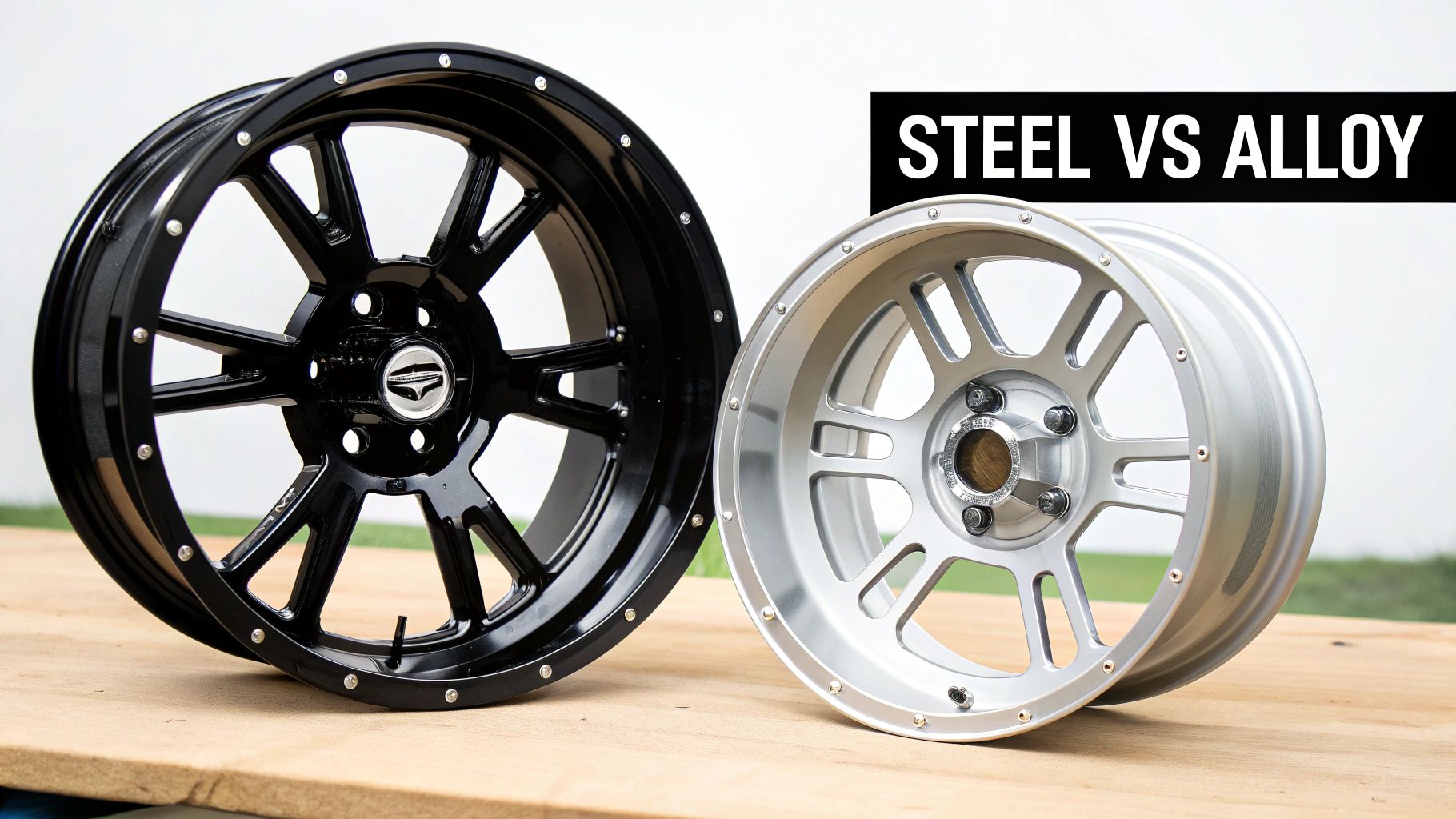
You’ll primarily run into two materials out there: steel and aluminum alloy. Think of them like two different kinds of athletes—one is a rugged powerlifter, and the other is a nimble sprinter. Understanding their unique strengths is the first step to picking the perfect set for your cart and your course.
The Reliable Workhorse: Steel Wheels
Steel wheels are the old-school, no-frills option. They’ve earned a reputation for being tough as nails and easy on the wallet, which is why they come standard on so many factory golf carts. Their strength means they can take a serious beating without cracking, though a hard enough hit might leave them with a bend.
But all that muscle comes with a trade-off: weight. Steel is a good bit heavier than aluminum, and that extra heft can slightly slow down your cart's get-up-and-go and even affect battery life. They’re also prone to rust if the protective coating gets scratched, so they need a bit more TLC to stay looking sharp.
- Pros: Highly durable, very affordable, and easy to find.
- Cons: Heavy, can rust if not maintained, and offers very few style options.
The Lightweight Performer: Aluminum Alloy Wheels
Aluminum alloy wheels are the modern, high-performance choice. Their biggest win is being incredibly lightweight, which reduces what’s known as "unsprung mass." In simple terms, this translates to better handling, a more responsive suspension, and an all-around smoother ride.
Aluminum is also naturally rust-proof, making alloy wheels a fantastic choice for anyone in humid climates or near the coast. From a style perspective, the sky’s the limit—you can find everything from sleek chrome finishes to aggressive blacked-out designs. The only real catch is that they come with a higher price tag than their steel counterparts.
It's worth remembering that a wheel's material directly impacts its connection to the rest of the cart. If you want to get into the nuts and bolts of it, our guide on the golf cart wheel hub assembly explains exactly how these parts work together for a safe, stable ride.
Material Choices For Push Carts
When we start talking about push carts, the conversation around materials shifts completely. Here, the name of the game is minimizing weight, especially when you're looking at motorized upgrades like the Caddie Wheel.
These innovative golf cart wheels are built from durable, lightweight composite materials specifically engineered to house a powerful motor and battery. The goal is simple: give you robust electric assistance without bogging you down. This smart construction means you get all the benefits of a powered push cart without feeling like you're lugging around clunky, heavy equipment. It’s truly the best of both worlds out on the course.
How to Find the Right Golf Cart Wheel Size
Getting the right wheel size is non-negotiable. It’s the difference between a safe, smooth-running golf cart and one that’s headed for trouble. Think of it like finding the perfect pair of shoes—a bad fit will cause problems down the road, guaranteed. This guide will walk you through sizing, bolt patterns, and offset without making you feel like you need an engineering degree.

If you look at a golf cart tire, you’ll see a string of numbers that looks something like 205/50-10. It might seem like a secret code, but it’s actually a simple formula that tells you everything you need to know. Once you break it down, choosing the right golf cart wheels becomes a whole lot easier.
Decoding Tire Numbers
Let's dissect that sizing format to figure out what each number is telling you. A solid handle on these figures is the first step toward buying with confidence.
- 205 (Tire Width): The first number is the tire's width in millimeters. Generally, a wider tire offers a bit more stability.
- 50 (Aspect Ratio): The second number represents the tire's sidewall height, but as a percentage of its width.
- 10 (Wheel Diameter): The last number is the most important one for this conversation—it’s the diameter of the wheel in inches. This number must match the wheel you plan to buy.
Getting these measurements right is crucial. If you want to get into the nitty-gritty, our guide on how to measure wheel diameter accurately offers clear, step-by-step instructions.
Lifted Carts vs. Standard Carts
The biggest fork in the road when choosing a wheel size is whether your cart has a lift kit. A standard, non-lifted cart is typically designed for wheels between 8 and 10 inches in diameter. If you try to slap on anything bigger, the tires will rub against the wheel wells, which can damage both the tire and the cart itself.
On the other hand, if your cart is lifted, you’ve got a lot more room to play. Lift kits raise the cart's body, creating clearance for much larger wheel and tire combos—often ranging from 12 to 14 inches or even more. This doesn't just give the cart a more aggressive look; it also improves its ground clearance for navigating rougher terrain.
Key Takeaway: Always check if your cart is lifted before you start shopping for new wheels. A standard cart needs wheels 10 inches or smaller, while a lifted cart can handle the big stuff. This one simple step can save you from a costly mistake.
Compatibility for Push Carts
For those of us who walk the course, the sizing conversation shifts from diameter to compatibility. The golf cart accessories market is booming, projected to hit a massive $884.4 million by 2035, driven by smart upgrades like wheels and batteries that enhance the gear we already own.
This is where innovative products like the Caddie Wheel come in. They’re designed with universal compatibility in mind, using specialized brackets that attach to most popular three- and four-wheel push cart models. All the guesswork is taken out of the equation. This means you don’t have to buy a whole new cart—you can just add a motorized wheel to your current setup for an instant power boost.
Matching Wheel Treads to Your Course Terrain
Think of the tread on your golf cart wheels like the sole of your golf shoes. It’s what gives you grip, keeps you stable, and ultimately dictates how well you can perform on the course. Picking the right tread pattern isn’t about aesthetics—it’s about matching your wheels to the unique challenges of your home course. A bad match can leave you slipping on hills, tearing up pristine fairways, or worse, getting stuck somewhere out of sight.
Just imagine the difference between a flat, perfectly manicured country club and a rugged, natural course full of steep hills and unpaved paths. Your wheel needs for those two environments are a world apart. You wouldn't wear spikes on a hard court, and you definitely don't want the wrong tread on your cart.
Street and Turf Treads for Manicured Courses
For most golfers, low-profile street or turf treads are the go-to choice, and for good reason. They have a smooth, shallow pattern designed to be gentle on delicate turf while still offering excellent grip on paved cart paths. If you spend most of your time on well-kept courses with gentle slopes and predictable surfaces, these wheels are your best bet.
Their design ensures you won’t leave ugly ruts or chew up the grass, which is a major point of etiquette and often a requirement at private clubs. The trade-off? Their smooth surface offers very little traction in wet, muddy, or sandy conditions.
All-Terrain Treads for Rugged Landscapes
On the other hand, knobby all-terrain treads are built for the wilder side of golf. These wheels feature deep, aggressive grooves that dig into loose surfaces like gravel, dirt, and mud. If your course is known for its steep, grassy hills, wooded trails, or frequently soggy conditions, an all-terrain tread gives you the bite you need to navigate with confidence.
While they’re champions in tough environments, these aggressive treads can be too harsh for manicured fairways and greens. The deep lugs are notorious for tearing up the turf, making them a poor choice for pristine, high-end courses.
Tread Tip: For motorized push cart wheels, a versatile, rugged tread is non-negotiable. It provides the traction needed to power the cart up a slippery hill or across dewy morning grass, ensuring that electric assist actually works when you need it most.
Before you buy, it's a good idea to create a mental checklist of your course's conditions. Is it mostly paved paths and perfect fairways, or do you find yourself trekking through the rough more often than not? Let's break it down to make the choice even clearer.
Matching Wheel Tread To Your Golf Course Terrain
| Tread Type | Best For | Avoid On | Ideal Golfer Profile |
|---|---|---|---|
| Street/Turf | Well-maintained private clubs, resorts, and community courses with paved paths and flat fairways. | Wet, muddy conditions, steep unpaved hills, or sandy/gravel paths. | The golfer who plays on manicured courses and prioritizes protecting the turf. |
| All-Terrain | Rugged, natural courses with steep inclines, unpaved trails, gravel paths, and frequently wet or soft ground. | Pristine, high-end courses where turf damage is a major concern. | The adventurous golfer whose home course is hilly, natural, or often wet. |
| Hybrid | Courses with a mix of paved paths and moderately challenging unpaved areas. Good for all-around use. | Extremely muddy or very delicate, soft greens. | The versatile player who needs a single set of wheels for varied course conditions. |
Ultimately, choosing the right tread is a balancing act between protecting the course and making sure your cart can handle whatever the day throws at it. Taking a moment to honestly assess the conditions you play in most often is a simple step that ensures your new golf cart wheels will enhance your game, not hold it back.
The Power of Electric Wheels for Push Carts
One of the most exciting developments in golf cart wheels has nothing to do with the big, four-wheeled riding carts at all. It’s a complete game-changer for the millions of us who love to walk the course. Motorized wheel assists are totally transforming the humble push cart, merging the health benefits of walking with the pure convenience of an electric caddie.
The concept is brilliantly simple. Instead of shelling out for a brand-new, expensive electric trolley, you just upgrade the cart you already have and love. With a system like the Caddie Wheel, you literally swap one of your regular push cart wheels for a sleek, self-contained, battery-powered unit. In just a few minutes, your manual cart becomes a motorized powerhouse.

You feel the difference on the very first tee. Those steep hills that used to sap your energy? They become effortless climbs. You’re conserving stamina for your swing, cutting down on physical strain, and walking up to the 18th green feeling fresh instead of wiped out. It's a huge advantage for players of all ages, but it’s especially helpful for seniors or anyone nursing an old injury.
What to Look For in an Electric Wheel
When you start shopping for a motorized wheel assist, a few key features separate the truly great products from the rest. Think of these as the non-negotiables that guarantee you’ll have a reliable, frustration-free experience out on the links.
- Battery Life: You need a high-capacity battery that can comfortably last a full round, and ideally two. A solid system should promise 18 to 36 holes on a single charge.
- Remote Control Functionality: A simple, intuitive remote is a must. You want responsive controls for forward, reverse, and braking without needing an instruction manual every time you use it.
- Ease of Installation: The best systems are engineered for quick, tool-free installation. A snap-in bracket and a drop-on wheel mean you can be ready to roll in minutes.
- Build Quality: Your cart goes everywhere you do. A durable, rugged wheel is essential for handling everything from soggy grass to bumpy gravel paths.
This whole trend is being driven by the same tech that has taken over the broader golf cart market. Electric carts are king, fueling a market expected to grow by nearly $1 billion by 2028. For walkers, this means that powerful, efficient motor technology is finally available in a compact wheel. Studies have even shown these assists can slash physical effort by a whopping 75%, letting golfers upgrade their existing gear without the hefty price tag of a new trolley. Discover more insights about the golf cart market on SkyQuestt.com.
Motorized wheels bridge the gap perfectly between manual pushing and a full electric trolley. They offer an affordable, effective, and simple upgrade for a huge number of golfers who love to walk but want to save their energy for the game itself.
The Heart of the System: The Hub Motor
At the core of this technology is an integrated hub motor. Unlike old-school motors that rely on a clunky system of gears and belts, a hub motor is built directly into the wheel itself. This design is far more efficient, much quieter, and requires way less maintenance.
It’s the magic that allows a single wheel to contain the motor, battery, and gearing all in one tidy package. For those curious about the mechanics, understanding the basics of a wheel hub motor kit can give you a real appreciation for the engineering that makes walking 18 holes feel like a stroll in the park. This clever integration delivers serious power without adding a bunch of unnecessary bulk or complexity to your setup.
Frequently Asked Questions About Golf Cart Wheels
Let's be honest, the world of golf cart wheels can get confusing fast. Whether you're upgrading a riding cart or looking at motorized options for your push cart, you probably have a few questions. That's perfectly normal. Getting straight answers is the key to a smart purchase, and that's exactly what this section is for.
We're going to tackle the most common questions we hear from golfers every day. Think of it as a conversation with a pro who’s seen it all—from simple tire pressure checks to the nitty-gritty of fitting larger wheels. Our goal is to arm you with the confidence to choose the right wheels and keep them in great shape.
Can I Install Larger Wheels on My Non-Lifted Golf Cart?
This is the big one, and the short answer is a firm "it depends, but probably not." Your standard, non-lifted golf cart is built with very specific clearances in the wheel wells. They’re designed to comfortably handle wheels up to 10 inches in diameter, and that's about it.
If you try to squeeze on a set of 12-inch or 14-inch golf cart wheels, you’re asking for trouble. The tires will almost certainly rub against the frame or body, especially when you turn or hit a bump. This can shred your new tires and do some serious damage to the cart itself. If you want to go big, you absolutely need to install a lift kit first. No exceptions.
How Do I Know if a Motorized Wheel Will Fit My Push Cart?
It's a great question, especially since push carts come in a million different shapes and sizes. The good news is that the best motorized wheel systems, like the Caddie Wheel, are engineered with universal compatibility in mind. They typically use a clever bracket system designed to clamp onto the frame of most popular three- and four-wheel push carts out there.
Before you buy, just double-check the manufacturer's compatibility list or measurement guide. This little step ensures the bracket will lock on securely, letting you drop the motorized wheel into place and get moving without any headaches or modifications.
Key Insight: The best motorized wheel systems are designed for a "drop-on" installation. The process should be quick and require no special tools, turning your existing push cart into a powered caddie in just a few minutes.
What Is the Correct Tire Pressure for Golf Cart Wheels?
Proper tire pressure is a game-changer for safety, handling, and making your tires last. But there's no single magic number. The right pressure, measured in PSI (pounds per square inch), is almost always printed right on the tire's sidewall.
- Low-Pressure Tires: These are common on standard club cars and usually need 12 to 14 PSI.
- Street or High-Pressure Tires: You'll see these on customized or street-legal carts, and they often require 20 to 25 PSI.
Make it a habit to check your tires with a reliable pressure gauge before you head out. Running them low will cause sloppy handling and premature wear, while overinflating them leads to a bone-jarring ride and a higher risk of a blowout.
How Often Should I Replace My Golf Cart Wheels and Tires?
There's no fixed schedule here; it all comes down to how much you use them, the terrain you're on, and how well you take care of them. Instead of marking your calendar, just keep an eye out for these tell-tale signs:
- Tread Wear: Once the tread is worn down to 1/16th of an inch or less, it's time for a new set.
- Cracks or Bulges: Any visible cracking on the sidewalls or weird bulges means the tire's internal structure is failing. Replace it immediately.
- Visible Damage to the Wheel: Dents, cracks, or heavy rust on the wheel itself isn't just ugly—it's a safety hazard that can affect balance.
- Frequent Air Loss: If one tire is constantly going flat, it likely has a slow leak that's not worth patching.
A quick inspection and cleaning now and then will help you spot these problems early and get more life out of your investment. And since you're thinking about total cart health, you might also want to explore more about golf cart batteries to keep every part of your ride in peak condition. A well-maintained cart is a reliable cart.
Ready to make walking the course effortless? The Caddie Wheel transforms your existing push cart with powerful, lightweight electric assistance. Its simple drop-on design, long-lasting battery, and intuitive remote control let you conquer hills and conserve energy for your best game.
Share:
Your Guide to the Perfect Golf Bag Cart Electric Upgrade
A Practical Guide to Golf Cart Parts for Every Owner