
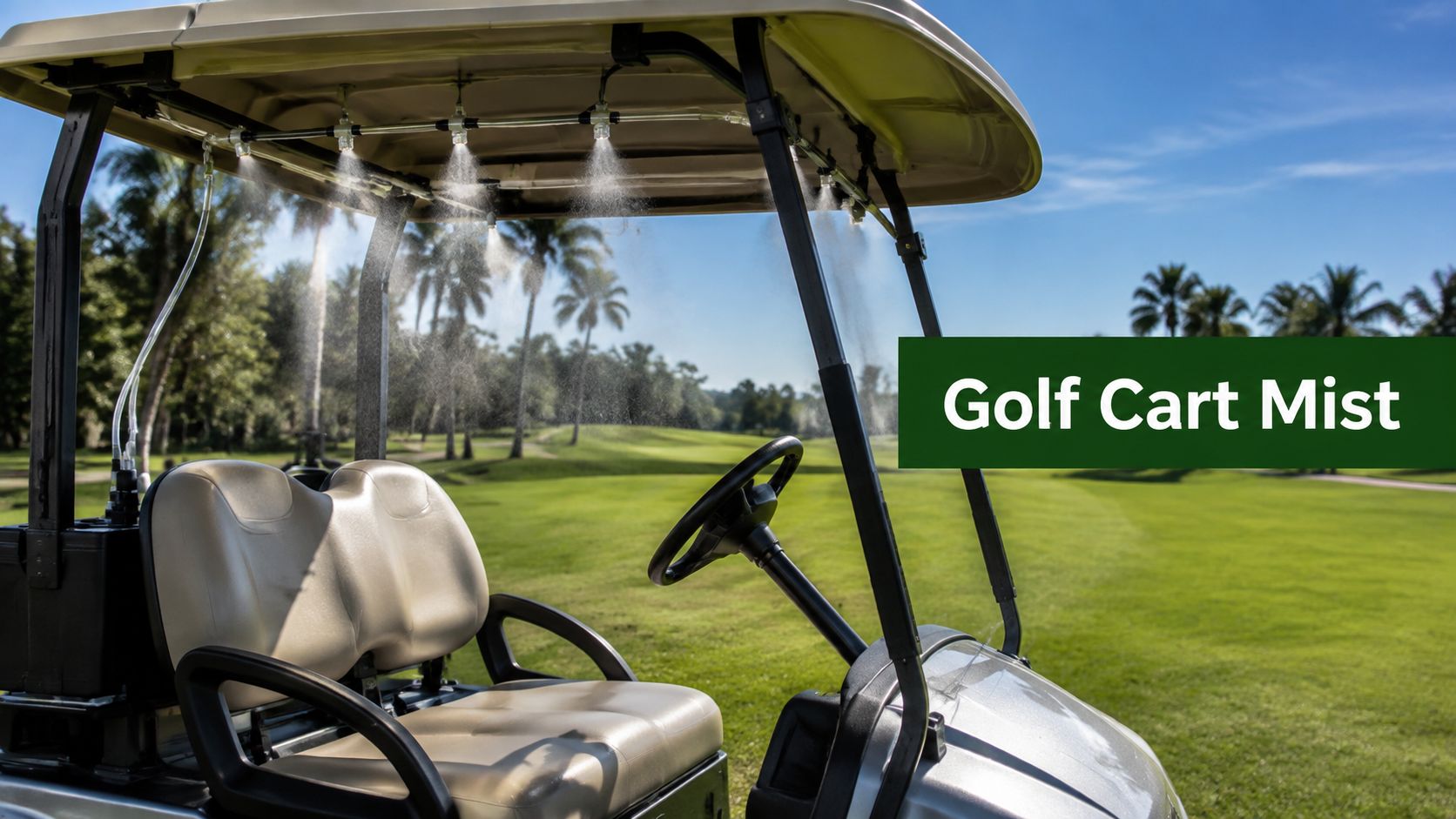
A hot Saturday round can start feeling wrong by the third tee. The towel on your shoulder's already damp, your cap's hanging on by instinct, and every parked cart feels like it's sitting in a patch of oven air. Then a fine mist hits your forearms as the cart rolls, and the day doesn't suddenly become cool, but it does become playable.
That's why portable misters for golf carts have carved out their own niche. They're not just a fancier fan. They combine airflow with evaporative cooling, and that matters because the cooling effect depends on the air, the droplets, and how the cart is set up to move that air where your body feels it.

Why Golfers Are Adding Portable Misters to Their Carts
The first time a golfer really notices a mister, it usually isn't in a parking lot demo or a product video. It's on a still summer fairway, after the seat has already heated up, after the drink in the cooler is no longer cold enough to matter, and after the towel has become part of the problem because it's wet and warm. A fine mist over moving air can feel like the cart finally starts helping instead of just carrying you from one hot patch to the next.
Traditional comfort tricks still matter, but they only go so far. A towel cools your neck for a minute, shade helps while the cart is stopped, and cold drinks help you recover after the damage is done. Portable misters for golf carts are different because they try to cool the immediate air around the player during the round, not just the player after the round.
The appeal is really about attention
Heat doesn't just make you uncomfortable, it steals focus. A golfer who's distracted by a burning seat, sticky hands, or a shirt clinging to the back is less likely to stay patient over the ball. That's why the category keeps growing in heat-prone golf markets, especially places where outdoor rounds are routine and summer heat is part of the game.
The interesting part is that the product isn't one single thing. Some setups are basically compact accessories, some are cart-integrated systems, and some are aimed at golfers who want a full-round solution without modifying the cart permanently. Independent product coverage notes that the category now spans from roughly $35 to $45 for entry-level misting fan combos to about $189 to $239 for dedicated cart systems, which shows how much the use case changes as the equipment gets more specific. The pricing spread comes from Amazon product coverage of portable misting systems.
Practical rule: If the heat only bothers you on the drive between holes, a fan may be enough. If the air feels dead by the first tee and stays that way all round, misting starts to make sense.
What this guide helps you sort out
The buying mistake isn't choosing the wrong brand, it's choosing the wrong setup for your climate and cart. A system that feels refreshing in dry heat can feel clingy in high humidity. A system that's easy to mount can still be annoying if it splashes the bag, drains too fast, or needs refilling before the back nine.
That's why the useful questions aren't “Does it look cool?” or “Does it install fast?” The better questions are whether the mist evaporates fast enough, whether the cart can power it, and whether the water stays where it belongs while the cart rattles down the path.
How Evaporative Cooling Actually Works on a Cart
Evaporative cooling sounds technical, but the idea is simple. Water needs energy to turn from liquid into vapor, and when tiny droplets evaporate, they pull that energy from the surrounding air and from your skin. That's why a cart mister can feel surprisingly effective even when it doesn't blast cold air like an air conditioner.
The best way to think about it is a sweaty athlete. Sweat only helps when it can evaporate, which is why a breeze after a workout feels better than standing still in the same temperature. On a golf cart, the mister gives the air something to evaporate, and the fan gives that air a reason to move across your body instead of hanging around in one heavy pocket.
Why droplet size and airflow matter
A mist is not the same as a spray. Fine droplets evaporate faster because they have more surface area relative to their size. That's why one commercial cart unit specifies up to 170 psi, a 16-foot mist line, and 4 nozzles, since fine atomization depends on pressure and nozzle geometry rather than just dumping more water into the air. Those details are described on the LuxMist golf cart misting system page.
Airflow matters just as much. If the air is moving, it can carry away water vapor and make room for more evaporation. If the air is stagnant, the mist lingers, settles on the cart, and turns into dampness instead of relief.
Useful shortcut: Dry air plus moving air gives you the best chance of real cooling. Thick, still air gives you the best chance of wet armrests.
Why dry climates usually win
Geography plays a key role. Evaporative cooling has historically been favored in outdoor comfort systems in hot, dry regions, which helps explain why golf-cart misting gets so much attention in places like the U.S. Sun Belt, the Middle East, and parts of Australia. In those settings, the air can absorb more moisture before it feels saturated, so the mist has a better chance of evaporating before it lands.
Humid climates change the equation. When the air is already carrying a lot of moisture, the same mist has a harder time evaporating, so the cooling effect weakens and the remaining droplets are more likely to settle on skin, seats, grips, and gear. That doesn't mean the system becomes useless, but it does mean the expected result changes from “cool relief” to “mild help with more surface dampness.”
Types of Portable Misters for Golf Carts
The market looks crowded until you sort it by form factor. Then the choices become much clearer, because each type solves a different problem. Some are built for quick breezy relief, some for longer cart-specific use, and some for golfers who already have a power setup they trust.
The four types that actually show up in the real world
Clip-on misting fans are the simplest entry point. They're compact, usually USB-rechargeable, and easy to move from cart to cart. They suit golfers who want a light cooling boost and don't want reservoirs, lines, or a lot of setup. Their limits show up fast, though, because they cool a smaller area and usually don't match the output of a dedicated cart system. A separate category overview of golf cart fan accessories is also useful for context, like this Caddie Wheel guide on battery-operated fan options.
Fan-plus-mist combos with built-in reservoirs are the middle ground. They combine airflow with a small water supply, which makes them a better fit for golfers who want mist without building a larger system. These often feel like the most familiar “portable” option because they're self-contained and easy to understand.
Reservoir-based systems with separate pumps and longer mist lines are closer to a purpose-built cart accessory. They're designed for two-seat carts and longer sessions, and the separate pump lets the misting line reach farther across the seating area. That makes them better for riders who want coverage across both seats instead of a single directed stream.
High-pressure nozzle kits for carts that already have a battery are the most modular choice. They make the most sense if you already have the power source and want to add cooling without starting from scratch. The tradeoff is that they rely more on installation judgment, so they're better for golfers who don't mind thinking a little harder about mounting and routing.
Quick category check
- Clip-on fan combos: best for short rounds, light cooling, and minimal fuss.
- Fan-plus-mist units: best for players who want a balance of portability and comfort.
- Reservoir systems: best for longer rounds and broader cart coverage.
- High-pressure kits: best for golfers who want customization and already have cart power in place.
The pricing spread matters because it matches these use cases. Consumer guidance from 2026 places entry-level misting fan combos around $35 to $45 and cart-specific systems around $189 to $239, which is a good sanity check when you're comparing options rather than chasing the cheapest listing.
Power, Battery Life, and Water Capacity
Runtime is where most buyers get fooled by a spec sheet. A big number on a battery doesn't tell you much if the pump is hungry, the mist setting is high, or the tank is too small for the way you play. The practical question isn't “How long can it run?” It's “How long can it run at the cooling level I'll use on an 18-hole day?”
Think of runtime as a budget
Battery, water, and pump duty cycle all spend at once. A lithium pack built for a low-current pump can feel generous on paper, but once you start misting continuously, the battery and reservoir both become limiting factors. That's why USB-rechargeable systems can behave very differently depending on whether you're pulsing mist in bursts or running it almost constantly.
One cart-mounted system reports about 3.5 hours of continuous spray per charge, or over 5 hours when an auto-off saver is enabled, along with a 1.5-gallon to 2.5-gallon collapsible tank sized to last a full round. Another says 1 gallon can last up to 2.5 hours on low speed, which shows the key point, runtime depends more on pump duty cycle and mist intensity than on tank size alone. Those figures come from Misterhub's portable collapsible rechargeable system listing.
What those numbers mean on the course
A system that lasts a few hours can still be perfectly usable for nine holes, practice sessions, and cooler-weather afternoons. For a full 18, the question becomes whether you'll use mist the entire time or only when the sun and heat are at their worst. A fan-driven unit with long runtime may cover a whole day more comfortably than a stronger misting system that runs out early.
A separate consumer guide notes that some misting fan runtimes can reach 40 to 48 hours on low, depending on battery size and mist use, while one portable golf-cart misting fan listing advertises up to 45 hours of runtime. That range, cited in a 2024 to 2026 consumer product wave video overview, helps explain why fan-only accessories can outlast mist-heavy systems by a wide margin.
| System Type | Typical Runtime | Water Capacity | Best Fit |
|---|---|---|---|
| Clip-on misting fan combo | Several hours on high, much longer on low | Small built-in reservoir | Quick relief, short rounds |
| Fan-plus-mist cart unit | Around a full round with selective mist use | Moderate reservoir | Mixed climates, casual riders |
| Reservoir-based cart system | About 3.5 hours continuous spray, over 5 hours with saver mode | 1.5 to 2.5 gallons | Full-round cart use |
| Low-output misting fan | Up to 45 hours on low | Small water use or fan-only mode | Long days, minimal misting |
A simple sizing rule
If you want all-day cooling, size the water tank and battery together, not separately. A larger battery doesn't help if the tank empties early, and a large tank doesn't help if the pump quits before the back nine. The best fit is the system whose mist level matches the weather you play in most often.
Mounting and Placement on a Standard Cart
A good mister can still feel bad if it's mounted in the wrong place. The goal is to create a stream that reaches the golfer, not a cloud that drifts over the clubs, the windshield, or the cart floor. Placement matters because mist follows air movement, and air movement follows the cart's structure.
The four mounting approaches golfers actually use
Built-in magnets are the cleanest option when the cart has steel roof or frame sections. They're quick, they avoid drilling, and they let you reposition the unit if your preferred spot doesn't work on the first try.
Velcro straps around bag supports are useful when you want a steady attachment point without relying only on metal. They also help when the cart frame shape doesn't give the magnets much surface area.
Clamp-style brackets on canopy struts make sense when the cart has a tubular structure and you want a firmer mechanical grip. For a broader look at bracket fit and cart compatibility, the Caddie Wheel golf cart bracket guide is a helpful reference point for how accessory brackets are typically approached on carts.
Removable hook-and-loop bases for fiberglass carts solve a different problem. If magnets won't bite, you need an attachment method that can hold without permanent modification. That's why portable systems increasingly lean on hybrid mounting instead of one rigid solution.
What tool-free really looks like
MisterHub's installation sequence is simple and revealing. You fill the bottle, place the water container in the golf cart, insert the tube into the bottle coupling, secure the hose with a Velcro strap, attach the pump handle to the cart's metal frame with magnets, and connect the USB cable to the cart's USB port. That's not marketing fluff, it's a real tool-free setup that confirms the system depends on a frame-mounted layout and a USB power source. The steps are documented on MisterHub's installation page.
A separate standard model listing also says the unit can be hooked on and removed in less than a minute, with built-in magnets and a 1.5-gallon collapsible water bottle. That description is on Walmart's Misterhub standard model page.
Placement rule: Aim the nozzles slightly forward and across the seating area, not straight down at the bag. Keep the pump lower than the reservoir so priming is easier and the line doesn't fight gravity.
The other useful habit is restraint. Too much mist pointed at the clubs, towel, or console can create the exact mess you were trying to avoid. A clean setup feels like a breeze with a little water in it, not a portable sprinkler.
Video example
Here's a visual example of a cart-mounted configuration in use.
Humid Climates, Course Rules, and the Mess Factor
This is the question most guides glide past. Does a cart mister help if you play in Houston, Tampa, coastal Australia, India, or Southeast Asia, where the air already feels heavy before the first tee? The short answer is that it can help, but the margin gets thinner as humidity rises, and the chance of wet grips and damp seats goes up.
When the mist helps and when it doesn't
In moderate humidity, mist can still evaporate enough to give you some cooling. In very humid conditions, the air is already close to saturated, so evaporation slows and the cooling benefit drops. That's why the same setup can feel refreshing in dry heat and clammy in muggy conditions.
MisterHub's guidance is practical rather than theoretical. It recommends running the fan continuously and turning on mist only when direct sun and stagnant heat are at their worst, while using shorter mist bursts in humid conditions and relying more on airflow. That operating rule is laid out on MisterHub's hot-rounds advice page.
The mess question matters as much as the cooling
Water logistics are part of the buying decision, not a side issue. Existing coverage often talks about quick setup and portability, but golfers still have to deal with refills, overspray, and whether the system stays tidy when the cart bounces. The most comfortable mister may be the one that needs fewer stops and puts less water where your hands, clubs, and scorecard live.
That also means course etiquette matters. Check with the pro shop before spraying, especially if the club has rules about cart modifications or anything that adds water to the seating area. Don't aim nozzles at a neighbor's cart, and don't assume every course treats misting gear the same way.
Good habit: If you have to choose between maximum mist and a dry grip, choose the dry grip.
The last piece is the course surface itself. Rough terrain can shift hoses, tilt bottles, and push overspray where you didn't plan for it. That's why systems with secure mounting, modest reservoir sizes, and clear on-off control often feel better than systems that advertise the strongest cooling effect on paper.
Buying Checklist and FAQs for Cart Misters
A smart purchase starts with a simple match-up between weather, cart, and habit. If you play in dry heat, prioritize stronger evaporative performance. If you play in sticky humidity, prioritize airflow, restraint, and easy control. If you play long rounds, prioritize battery and reservoir together so you're not topping off at the turn.
Quick buying checklist
- Climate fit: Choose a mister only if your air can support evaporation for most of your rounds.
- Runtime fit: Make sure the battery survives your usual 9 or 18 holes at the setting you'll use.
- Mount fit: Match magnets, straps, or clamps to your cart's frame material.
- Water fit: Pick a reservoir that avoids mid-round refills.
- Storage fit: Confirm it collapses or packs small enough to live in your trunk or bag.
Four questions golfers ask right before buying
How long does a full tank last? It depends on mist intensity and pump duty cycle, not just tank size. The numbers above show that some systems are built for a full round, while others are better for shorter sessions.
Are they allowed at private clubs? Sometimes yes, sometimes no, so the pro shop is the only safe answer. Cart accessories that add water, hoses, or mounting hardware can fall under local club rules.
How do you winterize one? Drain the reservoir completely, clear the line, and store the battery at a sensible charge level in a cool, dry place. Moisture left in the pump or tubing isn't friendly to off-season storage.
How portable is “portable”? Very portable systems collapse to a small storage size and come off fast, but bigger reservoir setups still take up trunk space. The term matters less than whether you can remove it, store it, and reinstall it without making a project out of every round.
If you want the cart to feel cooler without turning it into a maintenance chore, start with the least complicated setup that still matches your climate. The best mister is the one you'll use on the hottest day, not the one with the flashiest cooling claim.
If you're comparing golf comfort upgrades beyond misters, Caddie Wheel brings the same practical mindset to the rest of your round, lightweight design, quick installation, and simple control that keeps your focus on the game. Visit Caddie Wheel to see how easy performance-focused golf gear can fit into your setup.
Partager:
Rain Cover for Golf Cart: The Complete Guide 2026
Motorcaddies Golf Cart: 2026 Guide to Choosing Your Caddy