
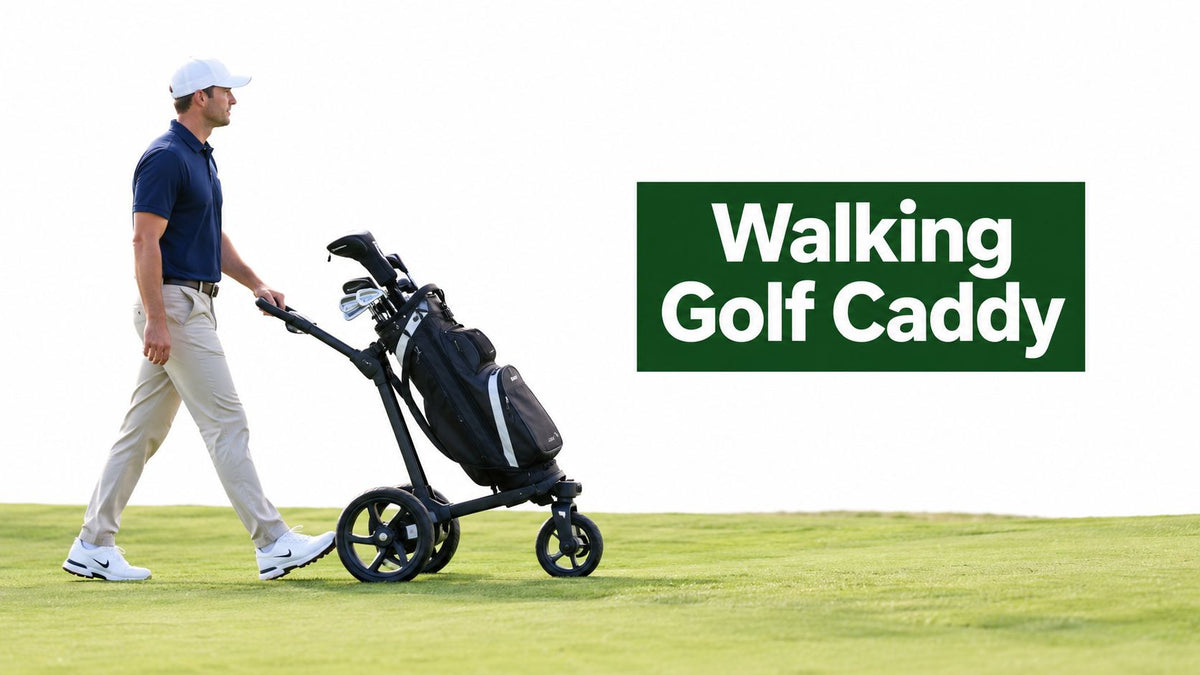
You know the feeling. The front nine was fine, but somewhere around the back nine your shoulders start arguing with the bag, the fairways feel longer, and every step to the next tee seems to cost a little more than it did at the first hole. That's usually the moment golfers start wondering if there's a smarter way to keep walking without letting the bag turn the round into a grind.
A walking golf caddy is the answer to that problem. It keeps the walk, keeps the rhythm, and takes the drag out of moving your clubs, so the round stays closer to golf and less like hauling luggage across a parking lot.
Why Walking the Course Feels Harder Than It Should
The hard part usually doesn't show up right away. On the first few holes, your body is fresh, your grip is relaxed, and even a slightly awkward bag feels manageable. Then the day starts adding up, especially on hilly layouts, wet grass, or courses where the cart path sits annoyingly far from the next tee.
By hole 14, little pulls become a pattern. Your shoulder tightens every time the bag shifts, your forearm starts doing extra work, and your focus drifts from the next shot to the thing hanging off your body. That's when a round that started as fresh-air exercise turns into a tug-of-war.
Practical rule: If you notice yourself adjusting the bag more often than you're checking yardage, the walk is costing you energy that should be going into the swing.
A lot of golfers assume the only options are to carry everything yourself or ride in a cart. That's too narrow. If the walk itself is the part you want, a better setup can keep the pace and scenery while reducing the wear on your body, and that's where a walking golf caddy starts to make sense. For long-walk habits, these distance-walking tips fit right into the same problem.
What a Walking Golf Caddy Actually Means
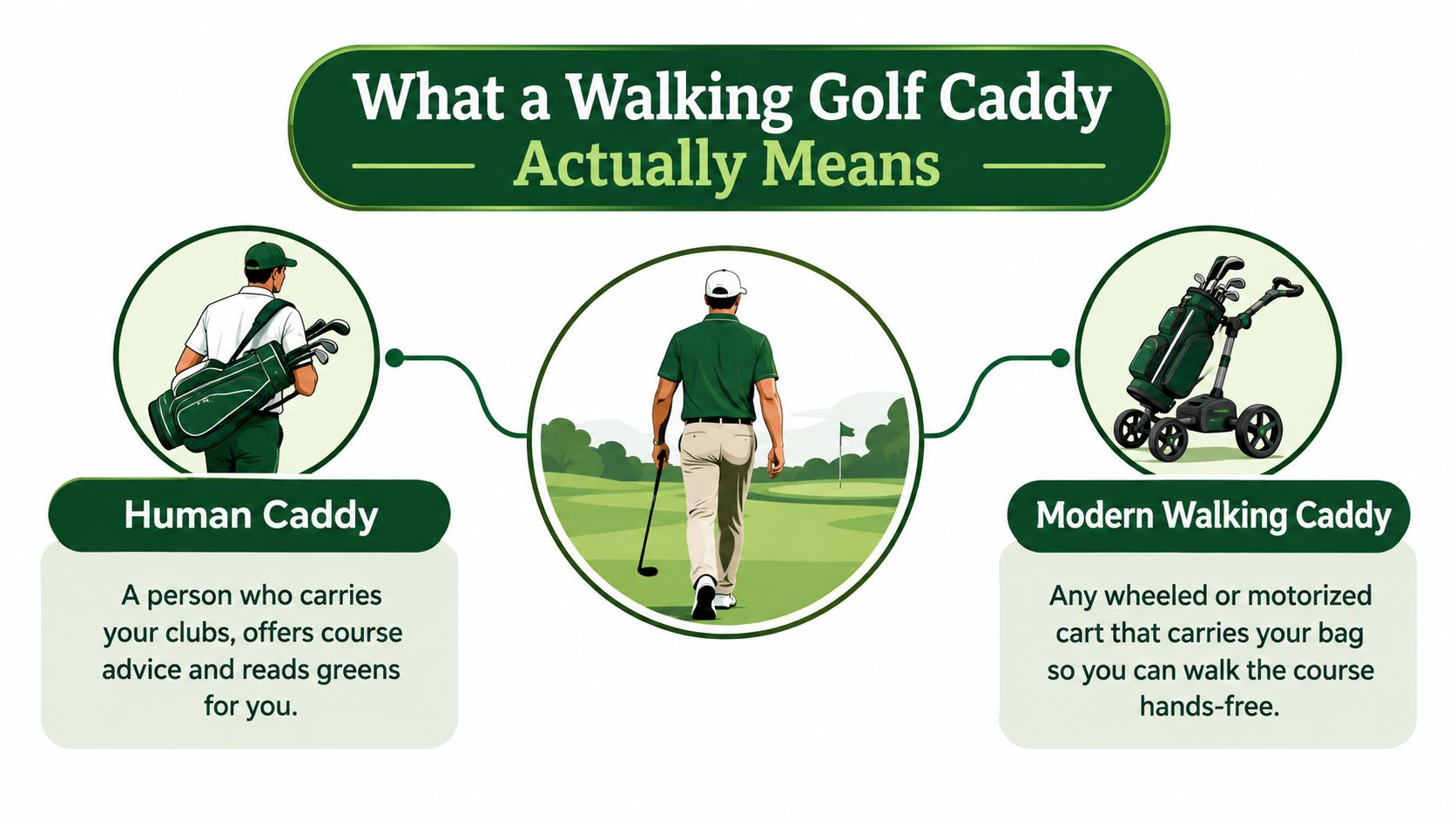
A walking golf caddy can mean two different things, and the confusion is pretty normal. In the traditional sense, it's a person who carries your clubs, reads the course, and helps manage the round. In the modern gear sense, it's any wheeled or motorized device that carries the bag while you walk.
Human help versus rolling help
The difference between dragging a duffel through an airport and rolling a suitcase. Both get you to the gate, but one makes your shoulder hate you by baggage claim. The human caddy changes the round through advice and bag carrying, while the modern device changes the round by removing the physical drag.
Most everyday golfers mean the gear category. That includes manual push carts, electric push carts, and drop-on motorized wheel systems that attach to an existing frame. The right choice depends on how hilly your course is, how much effort you want to keep, and whether you want the simplest setup or the most hands-off one.
The spectrum matters
Once you see the category as a spectrum, the term gets much easier to use. At one end is the person-caddy model. In the middle are push carts and electric assist add-ons. At the far end are fully motorized units that do most of the work for you.
That's the useful part for shoppers. You're not just asking, “Do I need a caddy?” You're asking how much walking you want to preserve and how much pushing you want to eliminate.
How Much Effort a Walking Round Actually Requires
A walking round can demand more from your body than the first tee suggests. Research on walking golf rounds reports about 4 to 5 miles over 18 holes and up to roughly 500 calories per hour. One comparison recorded walk-caddy rounds at an average of 7.89 km and about 1,527 total calories per round, compared with 3.86 km and 1,303 calories for golfers riding in a cart (walking-golf round data).
Distance is only part of the workload. A golf bag may feel manageable at the start, then grow noticeably heavier after hours of lifting, turning, and correcting its position. Add water, a rangefinder, rain gear, and other accessories, and the bag becomes a moving weight that your shoulders and arms must keep controlling.
Why the workload matters on the course
Carrying or pushing that weight can take energy away from the swing, especially during the later holes. Reducing the load on your body lets you keep the aerobic benefit of walking without turning the round into a prolonged shoulder and forearm workout. It can also make walking more practical on courses where cart paths are inconvenient or carts are restricted.
The distinction is similar to hiking with a loaded backpack versus walking with the same pack on a small rolling frame. You still cover the trail under your own power, but your upper body does less stabilizing work. A walking golf caddy follows the same principle, whether it is a manual frame, a powered add-on, or a fully motorized unit.
Caddying research reinforces that course walking involves sustained activity rather than casual strolling. A 2023 study recorded caddies averaging 15,480 ± 4,089 steps per day, 224 minutes of light-intensity activity, and 115 minutes of moderate-to-vigorous activity across 38 hours and 13 minutes of caddying in a week (caddie activity study). An assist system that reduces bag drag can therefore make repeated walking rounds easier to maintain without removing the walk itself.
| Metric | Typical Range | What It Feels Like |
|---|---|---|
| 18-hole walking distance | About 4 to 5 miles | A long on-foot outing, not a short stroll |
| Calories burned in a walking round | Up to roughly 500 per hour | Real exercise, especially in heat or hills |
| Walk-caddy round energy use | About 1,527 total calories per round in one study | Enough effort to notice late in the day |
| Cart round energy use | About 1,303 total calories per round in one study | Easier on the body, but less walking benefit |
If the course already feels like a workout, reducing bag drag does not make the round lazy. It makes the walk more sustainable.
Manual Carts, Full Electric Carts, and Drop-On Wheels
The simplest way to sort the options is to compare how much help each one gives you. A manual push cart still asks you to do the pushing, especially on wet grass, side slopes, or long walks between tees. It's light, familiar, and easy to live with if your course is flat and your bag stays modest.
A full electric trolley changes the feel of the round more dramatically. The motor handles propulsion, many models add downhill braking, and the whole setup is built as a powered unit from the start. The trade-off is that you're buying into a heavier, more expensive frame that isn't tied to the cart you already own.
The middle ground most golfers miss
Drop-on motorized wheels sit in the middle. Instead of replacing the whole cart, they attach to an existing push cart and turn it into a powered walking setup. That keeps the frame you already know while removing the hardest part of the round, which is pushing or pulling a loaded bag over long distances.
If you want a visual sense of the powered-cart side of the market, the top electric golf cart models roundup is a useful reference point for seeing how different powered systems are positioned.
| Format | Effort Required | Weight | Cost Range | Best For |
|---|---|---|---|---|
| Manual push cart | Moderate to high on hills | Light | Lower | Flat courses, casual walkers |
| Full electric cart | Low | Heavier | Higher | Frequent walkers who want full motor support |
| Drop-on motorized wheels | Low, with familiar push-cart handling | Moderate | Varies by add-on | Golfers who already own a cart and want an upgrade |
The profile match is pretty clear. Manual carts suit players who don't mind doing the work. Full electric carts suit people who want a dedicated powered rig. Drop-on wheels fit golfers who like their current cart but want the walk to feel easier without starting over.
What to Look for Before You Buy
Start with installed weight. Anything over 15 pounds changes how the cart feels when you lift it in and out of the trunk and when you're steering it over a full round. A setup that sounds light in a product listing can still feel bulky if all the weight sits high or far back.
Compatibility comes before features
Next, check whether the system fits your existing cart cleanly. Frame width, wheel axle size, and bag mounting shape matter more than flashy add-ons, because a weak fit creates wobble and frustration. If you already own a push cart, the smartest move is to confirm that the assist system matches the frame you're keeping.
Battery life deserves an honest look too. A typical 18-hole round needs enough range for real course walking, and lithium packs usually outlast lead-acid packs in everyday use. For battery-assisted push carts, many sources say a full charge commonly covers at least 36 holes, with some setups stretching usable range to 54 holes depending on terrain and use, and recharge windows often landing in the 3 to 5 hour range (battery and range guidance).
Small details that save headaches
Installation is another filter. Some systems clamp on, some strap on, and some use a true drop-on design. The difference isn't just convenience, it's whether you'll use the cart often enough to justify the upgrade.
Simple buying test: If setup feels like a project, the cart will start staying in the garage.
Also check folded size, downhill braking behavior, warranty terms, and whether tires, batteries, and other replacement parts are easy to get later. Those are the details that decide whether the cart feels like a long-term tool or a short-lived gadget.
Here's a practical guide for choosing a push cart setup that matches the same thinking: how to choose a golf push cart.
The video below is worth a quick look if you want to see how buyers tend to think through the cart decision in real life.
Where the Caddie Wheel Fits In
A golfer can move from a human caddie to a manual push cart, then to motor assistance, and finally to a fully motorized cart. A drop-on wheel occupies the useful middle ground. It adds power without asking you to replace a three-wheeled push cart that already fits your bag, storage space, and walking routine.
Many golfers own a cart that still works well. The strain comes from the loaded frame, especially on hills or soft ground. A self-contained assist wheel changes that one demanding part of the round while leaving the rest familiar. You still walk the fairway, choose your pace, and experience the course instead of riding through it.
For a closer explanation of how this setup works, see this overview of the electric assist wheel.
Why that middle option feels practical
A full electric cart replaces the whole setup. A manual cart keeps all the pushing in your hands and shoulders. A drop-on system sits between them, adding motorized help while preserving the frame you already know.
That arrangement suits golfers on hilly courses, older walkers who want to keep walking, and players whose backs or knees make each round harder than before. It also preserves familiar storage, balance, and folding habits. You gain assistance without learning an entirely new cart.
The product choice becomes less about maximum power and more about protecting the walk. A good assist system should feel like a helpful tailwind, noticeable on the climb but easy to forget on level ground. That balance lets walking remain part of the round rather than the reason to avoid it.
Walking More, Pushing Less
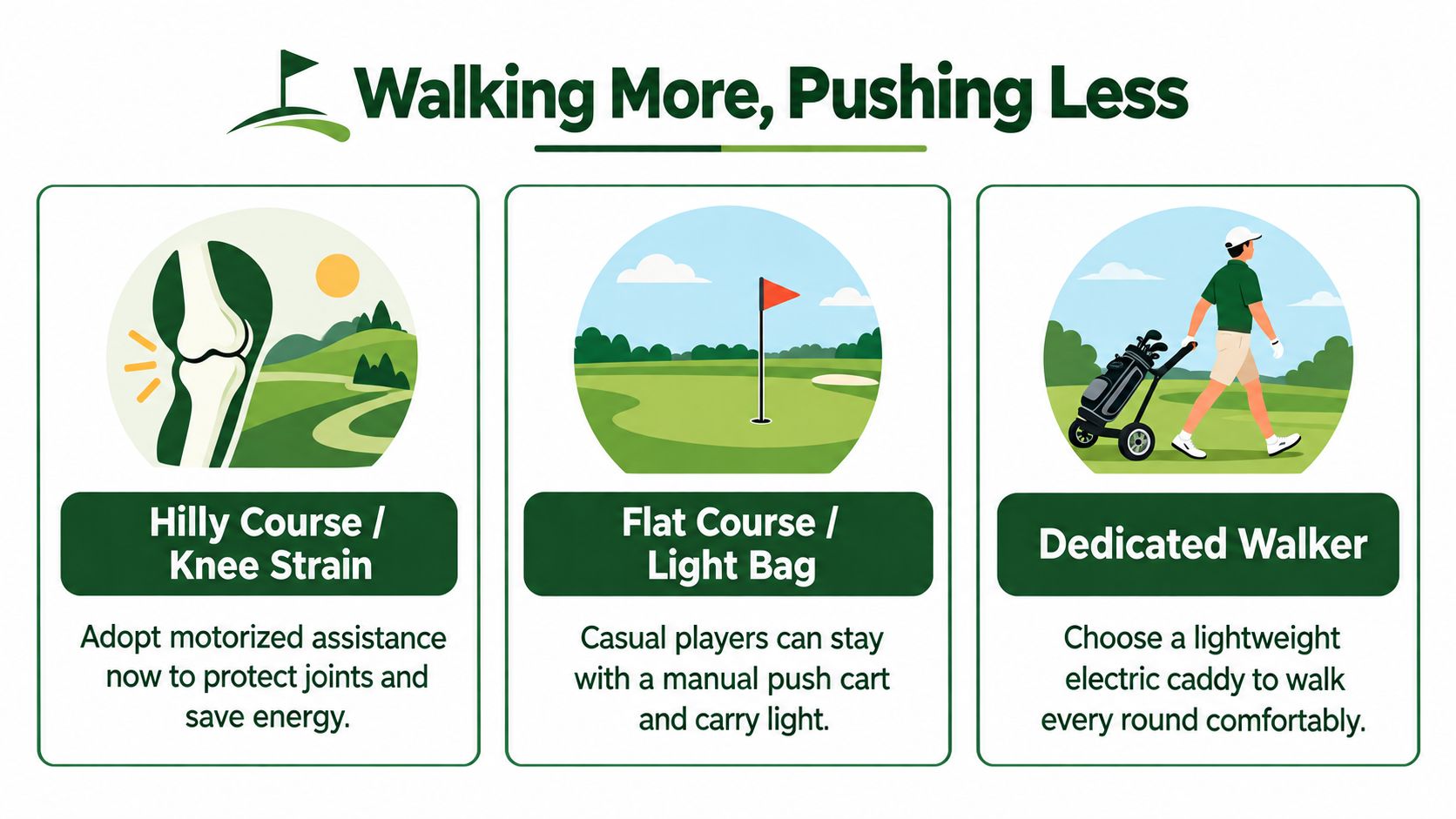
If your home course has hills, rough cart paths, or long stretches between tees, motorized assist is worth serious attention now. If you mostly play flat courses with a light bag and don't feel worn out, a manual cart can still do the job for a while. The best time to upgrade is usually before your body starts making the decision for you.
A simple final filter
Before you buy, ask one question, will this still help me if the battery dies or the motor fails? If the answer is yes, you've probably chosen a setup that won't trap you on the course. If the answer is no, you may be looking at a convenience feature instead of a reliable walking tool.
The best walking golf caddy is the one that keeps the walk intact and makes it easier to finish the round the way you started it. That's the goal, not skipping the walk, but protecting it.
If you're comparing ways to keep walking without dragging a cart uphill, Caddie Wheel is built for that middle ground, it turns an existing push cart into a motor-assisted setup without forcing you to replace the frame you already know. Visit Caddie Wheel to see how the drop-on approach fits into your own rounds and course conditions.
Partager:
Snap Up Bracket Install Guide for the Caddie Wheel
Electric Golf Caddy Price: What Drives Cost in 2026