
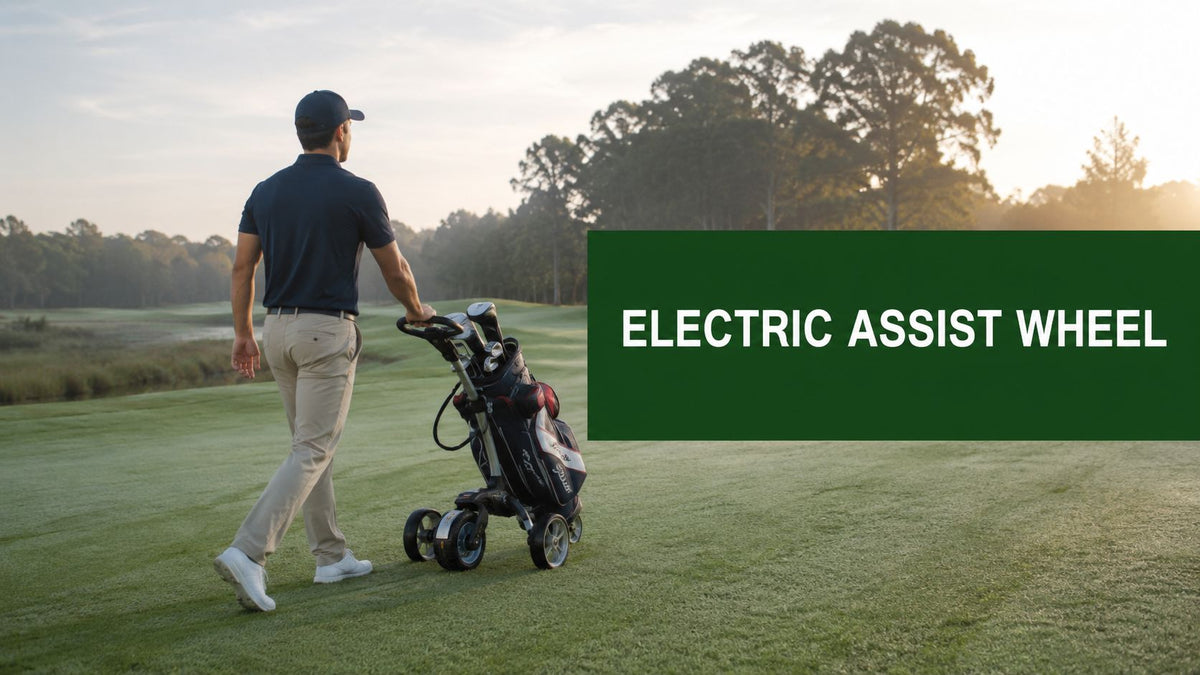
You're on the final par-5, the fairway is climbing, and the push cart that felt effortless earlier now seems to pull against every step. Your shoulders are tight, your legs are fading, and the thought of walking back to the clubhouse competes with the next shot. An electric assist wheel addresses that specific problem. It adds motorized help to a compatible push cart, letting you keep walking while reducing the effort required to move your clubs.
The idea sits between a traditional manual cart and a full electric trolley. You keep the frame, bag position, and walking routine you already know, but a powered wheel supplies assistance where the course demands it most. That makes the category worth understanding before you buy, particularly if your main questions are practical ones: Will it fit my cart? How far will the battery really go? Is it acceptable on my course?
Walking the Course Without the Wear and Tear
The closing holes can expose the hidden cost of walking. A loaded cart becomes harder to move across slopes, wet grass, and uneven paths, so pushing uphill changes your posture and adds work for your shoulders. By the time you reach the green, that effort may affect your focus, putting routine, or commitment to the next swing.
An electric assist wheel offers a practical upgrade path for the push cart you already own. Instead of replacing the cart, you add powered help to a compatible frame. The motor drives the wheel while you walk beside the bag, steer the cart, and choose its route. On level ground, the assistance reduces rolling resistance. On an incline, it supplies the extra push that keeps the cart from pulling back against you.
The walking experience remains yours. The motor simply takes over much of the cart-moving effort.
That difference defines the category. You still walk between shots, follow your usual pre-shot routine, and stay connected to the course. The cart remains under your supervision. An assist wheel does not make it an autonomous vehicle, so you still need to control its speed, position, and stopping distance around other golfers.
Retrofit fit matters from the first step. A wheel that works with one push-cart frame may not attach correctly to another, and the added bracket, motor, and battery can change how the folded cart is stored or lifted. Check compatibility before treating the purchase as a simple accessory upgrade.
Powered assistance can also keep walking manageable for golfers dealing with fatigue, joint discomfort, or recovery after an injury. It does not remove exercise, but it can reduce the effort required to move the bag over a long or hilly layout. The broader health and enjoyment case appears in this guide to the benefits of walking the golf course.
Electric trolleys are already established in several golf markets. A 2022 industry report summarized by MyGolfSpy's analysis of electric trolley use found use reaching two-thirds of regular golfers in some surveyed golf nations. It also reported 76% satisfaction among electric-trolley users, compared with 45% among golfers using other transport methods. Those figures describe powered golf transport broadly, not every retrofit wheel. They do show why an assist wheel can be viewed as a lower-disruption upgrade to an existing walking setup.
What an Electric Assist Wheel Actually Is
An electric assist wheel is a powered wheel fitted to a manual golf push cart. Instead of buying a complete trolley with a factory-integrated frame, motor, and battery, you add a drive unit to a cart you already own, provided the frame and mounting system are compatible.
The simplest analogy is power assistance for a bicycle. The rider still chooses the direction and remains responsible for control, but the motor reduces the effort required to move. With a golf cart, the powered wheel usually contains the hub motor and gearing. A battery mounted on the frame supplies energy, while a controller manages how much power reaches the motor. A handheld remote or handlebar control lets you start, stop, reverse, or adjust speed, depending on the design.
That differs from a full electric trolley in an important way:
- A retrofit wheel adds propulsion to an existing three-wheel or four-wheel push cart.
- A full electric trolley arrives as one integrated platform, with its own frame, wheel layout, battery, motor, and controls.
- A manual push cart relies entirely on your arms and body position to move the bag.
The retrofit approach can preserve the folding pattern and bag setup you already like. It can also avoid replacing a sound push cart merely because hills have become tiring. The trade-off is that the powered wheel and bracket add equipment to lift, store, and maintain.
The parts that determine whether it will work
Compatibility isn't a minor detail. The bracket must attach securely to the cart's frame or axle area, and the wheel needs enough clearance to rotate without rubbing the frame or bag. Buyers should check the mounting points, wheel diameter, supported bag weight, folded dimensions, and the manufacturer's compatibility list before ordering.
A three-wheel cart may accept a different adapter from a four-wheel model. Even carts from the same brand can use different frame shapes or axle arrangements. If the product documentation isn't clear, a quick conversation with the manufacturer can prevent an expensive return and an unsafe installation.
How the Motor, Battery, and Remote Work Together
An electric assist wheel depends on four components working as one system: the motor, battery, controller, and user control.
The motor sits inside the drive wheel and converts electrical energy into rotation. Many modern systems use low-voltage brushless motors in roughly the 240-watt class, with an example configuration using dual 120-watt motors. The Navee Birdie 3X specifications list a 21.6-volt, 220 Wh battery, speed control from 1 to 9 km/h, and a maximum incline rating of 25%. These specifications illustrate the design target: controlled torque for a loaded cart on slopes, not high-speed travel.
The battery stores the energy. Voltage tells you about the electrical system's operating level, while watt-hours give a clearer sense of energy capacity. Range still depends on terrain, cart weight, bag load, speed, grass conditions, and how often the motor works against a hill. That's why a manufacturer's hole estimate should be treated as a use-case guide rather than a promise for every course.
The controller acts as the traffic manager. When you press a button on the remote, it meters current to the motor rather than sending unrestricted power. It also helps manage overload, heat, and battery discharge. A deeper explanation of the motor technology appears in this overview of an electric gear motor.
What the remote really controls
The remote may offer forward movement, reverse, speed adjustment, and braking control. Some systems include preset distance functions. For example, a remote-controlled push cart can use a timer for forward movements of 15, 30, or 60 yards, as described in Club Booster's eWheels introduction. That can be useful when you want the cart to move ahead while you walk toward your ball, but you still need to watch its path.
Some assist wheels use regenerative braking. During deceleration or downhill travel, the motor can resist rotation and operate partly as a generator. The controller routes some of that electrical energy toward the battery, while the battery management system limits the current it can accept. As this explanation of regenerative braking makes clear, recovered energy varies with speed, slope, controller design, and battery condition.
Regeneration is therefore a small efficiency benefit, not a replacement for charging or a guarantee of strong downhill stopping. Use the cart's mechanical brake and follow the manufacturer's stopping instructions, particularly on steep ground.
Electric Assist Wheel Versus a Full Electric Trolley
You reach the first tee with a push cart that still folds neatly, holds your bag securely, and rolls reliably. An electric assist wheel can add power to that setup without asking you to replace the whole cart. A full electric trolley makes more sense when you need a new frame anyway, or when your existing cart cannot accept a safe retrofit.
The choice is less about motor output than ownership. With an assist wheel, the cart remains the foundation, while the motor, battery, bracket, and controls become an added layer. A complete trolley arrives as one designed system. That usually reduces fit questions, but it also means replacing equipment that may still suit your routine.
| Factor | Electric Assist Wheel | Full Electric Trolley |
|---|---|---|
| Starting point | Uses a compatible push cart you already own | Requires a complete trolley platform |
| Fit | Depends on bracket, axle, and frame compatibility | Components are designed to work together |
| Storage | Usually preserves much of the existing folded-cart footprint | May need dedicated storage for the integrated frame |
| Upgrade logic | Strong when the manual cart is still in good condition | Strong when you need a new cart anyway |
| Walking feel | Keeps you beside and actively guiding the cart | Can feel more like managing a powered vehicle |
| Main trade-off | Extra attachment weight and compatibility checks | Larger replacement cost and less flexibility |
Storage can decide the purchase. A retrofit often keeps the folded shape you already know will fit your vehicle. A full trolley may fold differently and require room for its integrated frame or larger battery. The same loading principles apply to other wheeled gear, so golfers planning family outings may find these hassle-free family beach trips useful when assessing folded dimensions and transport routines.
Course etiquette also changes slightly. An assist wheel generally stays close, preserving the familiar rhythm of walking and guiding a push cart. A remote trolley can travel farther ahead, but you must keep it under control, watch its path, and avoid letting it obstruct another group. Local course rules may also determine whether remote operation is permitted in particular areas.
The walking sensation is different too. The powered wheel feels like assistance added to a normal push, especially on a hill. A full trolley can feel more like managing a small powered vehicle. Neither choice is automatically better. The right path depends on whether you want to upgrade a cart you already trust or adopt a complete system, as explained in this guide to electric golf trolleys.
Compatibility, Installation, and Battery Life in the Real World
The first purchase decision isn't motor power. It's whether the wheel fits your cart safely.
Start by identifying the cart's wheel arrangement and the diameter of the rear axle tube. Common mounting patterns include 1-inch and 1.25-inch axle tubes, but the bracket must match the actual frame rather than a similar-looking product photo. Brand-specific brackets may be available for Clicgear, Bag Boy, Rovic, and Sun Mountain. If your model isn't listed, contact the manufacturer before buying.

A safe installation normally follows a straightforward sequence:
- Remove or loosen the existing rear wheel according to the cart and wheel instructions.
- Align the bracket with the frame or axle tube, checking that the drive wheel sits squarely.
- Slide the motor hub into place and engage the quick-release mechanism.
- Confirm clearance around the tire, frame, brake, and bag.
- Pair the remote and test forward, reverse, speed, and stopping functions before taking the cart onto the course.
The hardware may install quickly, but don't rush the inspection. A wheel that sits slightly out of alignment can affect tracking, tire wear, and stability on a slope. Test on a level surface first, then try a gentle incline while keeping both hands and your attention available for control.
Battery claims need the same practical reading. Independent coverage says powered golf push carts commonly use lithium batteries rated for roughly 18 to 36 holes per charge, with terrain, load, and usage pattern affecting real-world range, as reported by GolfOnline's Navee Birdie 3 review. One tested system lists a 50-yard remote-control range, a 36V 4.4Ah lithium-ion battery, and a 27-hole rating, showing why control distance and round capacity should be evaluated separately. See MyGolfSpy's Alphard eWheels test for those specifications.
A product may complete a long round on a flat course and provide less assistance on a steep layout. Treat the longest and hilliest course you regularly play as the true test, not the most favorable advertised scenario.
Who Gets the Most Out of an Electric Assist Wheel
The strongest use case is a golfer who wants to keep walking but doesn't want cart propulsion to dominate the physical experience.
A 65-year-old regular walks twice a week at a hilly municipal course. The first holes feel comfortable, but the back nine turns into a test of shoulders and lower back. A powered wheel reduces the force needed on the climbs, allowing that golfer to preserve energy for the shots rather than spending it on the cart.
A 40-something player at a mountain course may have a different problem. Elevation changes can leave the legs heavy by the middle of the round, even when the golfer is fit enough to walk. In that setting, motor torque and controlled speed matter more than remote range. The useful assistance is the steady support that keeps the cart moving without forcing a hard pull up every slope.
Then there's the fitness-focused walker. This golfer wants the movement and cardio of walking, but doesn't want a heavy bag and cart combination to aggravate a shoulder. An assist wheel lets the golfer stay active while shifting the most repetitive propulsion work to the motor.
Finally, consider the value-conscious owner of a good push cart. If the frame folds well and the wheels, brake, and bag supports remain sound, replacing the entire cart may feel wasteful. A compatible add-on can provide a middle path, though the buyer still needs to verify the bracket, battery expectations, and warranty before judging the savings.
The best candidate isn't necessarily the golfer who wants the most automation. It's often the golfer who wants to walk more consistently.
Country-level behavior supports that broader use case. Market research on electric golf carts reports 24% pushcart use and 57% riding in a U.S.-focused survey, with the remaining 19% split between electric trolleys and carrying. The same source says more than one-third of surveyed golfers believed electric trolleys helped them play better, while nearly half said they played more often when fatigue or fitness issues might otherwise keep them home. Those findings point to a practical role for assistance, reducing the strain that makes walking less attractive.
Maintenance, Charging Habits, and Long-Term Care
An electric assist wheel needs a simple routine, not constant attention. Charge the battery after a round when practical, avoid storing it fully depleted, and follow the manufacturer's charging instructions. Lithium batteries perform poorly when exposed to temperature extremes, so keep the pack in a dry, moderate environment rather than leaving it in a hot vehicle or an unheated space during severe weather.
Before storage, inspect the battery condition and connector. The correct off-season charge level depends on the manufacturer, so use the supplied guidance rather than assuming every lithium pack follows the same rule. A battery that won't charge, becomes unusually hot, swells, or develops a damaged casing needs professional attention.

The pre-round check
A quick inspection can prevent many avoidable interruptions:
- Clean the hub: Remove mud and grass from the motor wheel, especially around moving parts and cooling areas.
- Inspect the bracket: Check the quick-release, bolts, and locking points for looseness before loading the bag.
- Examine the tire: Look for cuts, embedded debris, and unusual wear that could reduce traction.
- Test the controls: Confirm the remote connection, forward movement, reverse, speed response, and stop function on level ground.
- Protect the remote: Wipe it dry after a wet round and store it where buttons won't be pressed accidentally.
Some newer models may offer firmware or app updates through Bluetooth. Install updates only through the manufacturer's stated process, and don't begin a round with a control system that hasn't been tested after an update.
Warranty terms also need careful reading. An electronics warranty may cover failures in the motor, controller, battery, or remote, while excluding collision damage, water intrusion, worn tires, incorrect installation, or normal battery aging. If the wheel cuts out repeatedly, the motor makes a new grinding sound, the bracket shifts under load, or the battery behaves unpredictably, stop using it and contact the manufacturer rather than opening sealed components yourself.
Is an Electric Assist Wheel Worth the Upgrade
An electric assist wheel earns its place when it solves a specific problem without forcing you to abandon a push cart that already works. It can preserve the walking experience, reduce the effort of hills, and make regular walking more realistic for golfers whose fatigue, joints, or recovery time would otherwise limit their rounds.
The trade-offs are straightforward. You'll add a motor, battery, bracket, and charging responsibility to your setup. You'll need to confirm that the wheel fits securely, learn the control response, and accept that range depends on terrain and load. Some courses or events may also have preferences about how players operate powered equipment, so course acceptance belongs on the buying checklist.
Rules deserve particular care. A governing-body policy example permits electric push carts, but states that transporting the player any distance on the cart breaches the transportation rule and carries a general penalty, as summarized in GolfMagic's electric trolley buying guide. An assist wheel that moves the cart while you walk is different from using it to transport yourself, but tournament committees and clubs can apply local conditions. Ask before an event, and use the wheel considerately around other groups.
| Factor | Manual Push Cart | Electric Assist Wheel | Full Electric Trolley |
|---|---|---|---|
| Walking effort | Highest cart-propulsion workload | Reduced propulsion effort while walking | Lowest manual propulsion workload |
| Existing equipment | Uses the current cart as-is | Upgrades a compatible cart | Replaces the current cart |
| Complexity | Minimal | Requires mounting, charging, and control checks | Integrated system, but more components overall |
| Course connection | Direct, hands-on walking | Walking with powered assistance | More remote or vehicle-like depending on use |
| Best fit | Flat courses and golfers comfortable pushing | Owners seeking reduced strain without a full replacement | Buyers who need a complete powered platform |
A sensible decision framework is short: confirm compatibility, compare the battery's realistic range with your longest round, read the warranty exclusions, and give yourself a full season of regular use before deciding whether the upgrade has paid off in comfort and consistency. Caddie Wheel, for example, offers a motorized wheel attachment for standard three- and four-wheel push carts, with a drop-on design, snap-in bracket, handheld forward, reverse, speed, and brake controls, and a battery rated for up to 36 holes per charge, according to the publisher's product information. It's one example of the retrofit approach, not a substitute for checking your own cart and course requirements.
If your push cart is still in good shape but hills and fatigue are changing how often you walk, start by checking its axle and frame compatibility against an assist wheel system. Visit Caddie Wheel to review the retrofit approach, then compare its fit, controls, battery expectations, and warranty with the courses you play.
Share:
Golf Cart Wheel Cover Guide for 2026 Buyers
Motorized Push Cart for Sale: A Smart Buyer's Guide