
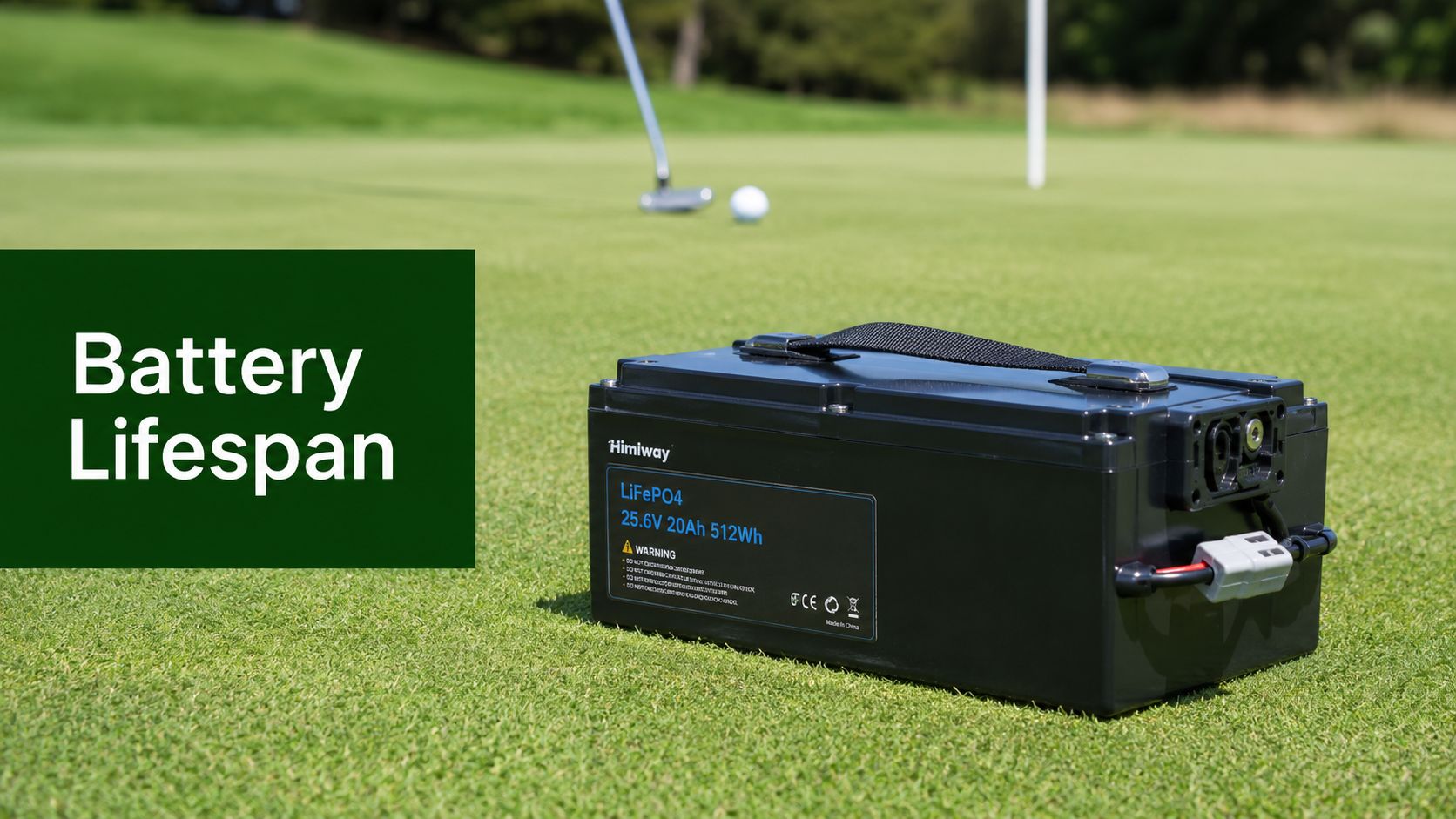
You're on the back nine, the course is warm, and your electric-assist wheel has started to feel less certain on the climbs. Your playing partner's wheel, bought at the same time and carrying what appears to be the same battery, keeps moving without complaint. Yours reaches the fifteenth hole and fades out.
That difference can feel mysterious because batteries rarely wear out in a simple, predictable line. One pack may spend its life on gently rolling fairways, receive moderate top-ups, and rest in a cool garage. Another may face hills, rough ground, summer heat inside a trunk, and long periods stored fully charged. To understand why do some batteries last longer, you need to look beyond the label and into the way each pack is used.
Two Identical Batteries, Two Different Stories
After three seasons, two electric caddie wheels sit beside each other on a paved path near the clubhouse. They came from the same manufacturer, carried the same stated capacity, and started with similar performance. One still rolls smoothly through eighteen holes. The other begins losing power by the fifteenth, especially when the course turns uphill.
Neither owner necessarily abused the battery. The difference may have formed through ordinary routines. One golfer topped up after nine holes, carried the wheel into a shaded garage, and stored the pack separately during the winter. The other waited until the indicator was nearly empty, charged in a hot trunk, and left the battery at full charge between rounds.

The specification sheet describes what the batteries can do when new. It doesn't describe every hill, stop-start stretch, storage condition, or charging decision. Batteries respond to accumulated stress, and two owners can create very different stress histories without noticing.
The useful question isn't only “What battery is this?” It's also “What has this battery been asked to do?”
The rest of the explanation comes down to several variables: chemistry, depth of discharge, temperature, C-rate, charging habits, and the battery management system. Each one affects a different part of the battery's working life. Together, they explain why a pack that looks identical on paper can tell a very different story after a few seasons.
The Building Blocks Every Battery Shares
Battery terminology can sound more complicated than it needs to be. A golfer mainly needs four ideas to understand what happens between the first tee and the final green: chemistry, capacity, cycle life, and C-rate.
Chemistry sets the design trade-off
Chemistry describes the materials inside the cells. Lithium-ion packs are common in portable electric equipment because they store substantial energy without the weight associated with older lead-acid designs. That higher energy density matters to a walking golfer, because less battery weight leaves more of the equipment's weight available for the wheel, frame, and golf gear.
Different lithium-ion chemistries also make different compromises. Lithium iron phosphate, or LFP, is often selected where durability and thermal stability matter. Other lithium-ion designs may prioritize compact size or stored energy. The chemistry sets the ceiling, but daily use determines how close the pack gets to that ceiling.
Capacity is the fuel tank
Capacity is the amount of charge a battery can hold. Ampere-hours, written as Ah, describe how much electrical charge can move from the pack over time. Think of capacity as the size of a fuel tank, not as a guarantee of how long the vehicle will run.
A larger pack may support more distance per charge, but it can still age quickly if its owner repeatedly empties it, charges it while hot, or stores it under stressful conditions. A smaller pack treated gently may remain useful for longer than a larger pack treated harshly.
Cycle life counts energy moved
Cycle life describes how many charge and discharge cycles a battery can complete before its capacity falls to a defined level. One full cycle doesn't have to happen in one outing. Using half the pack and later replenishing that half represents roughly half of a full cycle, because the calculation follows the total energy moved.
Manufacturers commonly specify lithium-ion batteries at about 300 to 500 discharge and charge cycles, although the actual result depends heavily on discharge depth and operating conditions, as summarized by Battery University's lithium-ion longevity guide.
C-rate describes the pace
C-rate compares current flow with battery capacity. Pulling energy gently is like watering a green with a garden hose. Asking for a large burst of power is more like opening a fire hose. Steep climbs, rough ground, and rapid starts demand more current, and that work can produce more internal heat.
For a fuller technical explanation of electric trolley battery construction and terminology, see this complete electric trolley battery explainer.

How Depth of Discharge Quietly Multiplies Lifespan
Depth of discharge, or DoD, measures how much of the battery's available energy you use before recharging. A 100% DoD means the pack has been taken through its full usable range. A 40% DoD means the owner has used a smaller portion before plugging in.
That distinction matters because deeper cycling creates more chemical and mechanical strain inside the cells. Repeatedly moving the electrodes through a wide range can increase fatigue and accelerate the growth of protective reaction layers, including the solid-electrolyte interphase on the anode. Shallow cycling reduces the distance those materials travel each time.
A technical engineering reference illustrates the relationship with approximately 300 cycles at 100% DoD, 1,500 cycles at 40% DoD, and roughly 10,000 cycles at 10% DoD in its comparison of discharge depth and cycle life.
Depth of Discharge vs Approximate Cycle Life
| Average Depth of Discharge | Approximate Cycle Life | Practical Implication |
|---|---|---|
| 100% | Approximately 300 cycles | Full drains place the greatest repeated stress on the pack |
| 40% | Approximately 1,500 cycles | Partial use can extend usable life substantially |
| 10% | Roughly 10,000 cycles | Very shallow cycling minimizes stress, though it may require frequent charging |
The precise result for a golf wheel will depend on its chemistry, controller, load, terrain, and end-of-life definition. The direction is clear, though. A golfer who recharges before the battery reaches the red zone usually asks less of the cells than a golfer who drains the pack every round.
A lithium-iron-phosphate study reported 1,800 to 2,500 cycles at 80% depth of discharge, demonstrating that controlled use can still produce thousands of charge-discharge cycles before major wear appears, as documented in this U.S. Department of Energy technical record.
For a caddie wheel, the practical habit is simple: top up before a full drain when convenient, especially if the next round includes hills. Charging after nine holes can be sensible if the battery and charger have cooled, but the goal isn't to chase a perfect number. It's to avoid making a complete empty-to-full swing the default pattern.
Temperature, C-Rate, and the Heat a Golfer Creates
C-rate describes how quickly current leaves or enters a battery relative to its capacity. A low C-rate resembles a steady walk on a flat fairway. A high C-rate appears when the motor must produce a strong burst of torque, such as a fast start, a steep climb, or movement through thick grass.
The current itself isn't the only concern. Electrical resistance inside the cells turns part of that work into heat. A compact pack has less surface area available to release heat, so repeated bursts can raise its internal temperature even when the air around the wheel feels comfortable.
Temperature and C-Rate Effects on Lithium-Ion Lifespan
| Condition | Typical C-Rate | Cell Temp Rise | Relative Aging Penalty |
|---|---|---|---|
| Gentle movement on flat fairways | Below 0.5C | Lower | Lower stress when heat remains controlled |
| Steady uphill movement | Around 1C | Higher | More heat and greater chemical strain |
| Stop-start movement on rough ground | Around 1C or more during bursts | Higher and uneven | Repeated thermal and current stress |
The table describes operating patterns, not universal measurements for every wheel or pack. Actual current depends on motor size, load, slope, tire resistance, and control settings. The underlying battery evidence is consistent: a 2024 study found that increasing temperature reduced anticipated cycle life by 23% to 42% at a fixed discharge rate, while another automotive study found cells cycled at 45°C lost capacity about 50% faster than cells cycled at 25°C in the reported degradation research.
A trunk parked in summer sun can become a poor battery cupboard. So can a closed garage that stays hot for long periods. Heat speeds chemical side reactions, and storage adds calendar aging even when the wheel isn't moving.
Let the pack cool after demanding use before charging, and keep it out of direct sun whenever practical.
Cold needs care as well. Charging an ordinary lithium-ion battery below 0°C without manufacturer approval can cause permanent damage and create a safety risk, according to this Li-ion longevity design guide. Moderate conditions are kinder than extremes, so bring the battery indoors when seasonal storage exposes it to severe heat or cold.
The Battery Management System as an Invisible Co-Pilot
A battery management system, or BMS, is the protective control layer inside a rechargeable battery pack. It monitors cell behavior, manages charging and discharging, and helps prevent one cell from being pushed beyond safe limits while the others remain within range.
For a golfer, the BMS acts like a quiet co-pilot. You don't steer it directly, but it watches the conditions that could damage the pack.
What the BMS monitors
A BMS may track:
- Individual cell voltage
- Pack current
- Temperature
- Charging and discharging limits
- Differences between cells
Common protective thresholds include an overvoltage cutoff near 4.2 volts per cell and an undervoltage cutoff near 2.5 volts per cell, alongside overcurrent, short-circuit, and thermal protection. These values are design references, not settings owners should alter. The pack manufacturer determines the actual limits.
During charging, passive balancing can bleed a small amount of energy from cells that reach the upper voltage first. That gives lower-voltage cells time to catch up, helping the pack remain coordinated rather than allowing its strongest cell to dictate the end of every charge.
What failure looks like
A bypassed or damaged BMS can allow excessive discharge during a demanding round. The wheel may shut down suddenly on a hill, show an unexpectedly low run time, or refuse to charge normally. A counterfeit pack may lack adequate balancing circuitry, so performance can deteriorate even when the outer case looks convincing.
Water ingress creates a different problem. Moisture can corrode the circuit board and its connectors, leading to intermittent cutouts, charging faults, or a pack that loses usable range within a season. Swelling is a serious warning sign, not a normal aging feature. Stop using a swollen or damaged battery and follow the manufacturer's safety guidance.

Don't bypass a BMS to gain extra runtime. The apparent benefit can trade away cell protection, safe voltage control, and reliable shutdown behavior. Use a compatible charger and a genuine replacement pack designed for the wheel.
Calendar Aging vs Cycle Aging and Why Both Matter
A battery can age while sitting in a garage. That surprises many owners because they associate wear with movement, but rechargeable cells experience calendar aging, the gradual chemical change that occurs with time. Temperature and state of charge influence that process, even when the wheel never leaves its storage space.
Cycle aging comes from charge and discharge activity. Depth of discharge, current, temperature, voltage, and cell balance all affect how much capacity the battery loses as energy moves through it.
Two different clocks
Calendar aging is the clock on the shelf. A pack stored fully charged in a hot environment can lose useful capacity without completing a single round. Cycle aging is the clock on the course. It accumulates as the motor draws energy, the charger replenishes it, and the electrodes repeatedly expand and contract.
Research summarized in an Oxford technical document reports that a lithium-ion cell stored at 25°C and 40% state of charge loses roughly 2% to 3% capacity per year, while the same cell stored at 100% charge loses about 4% to 6% annually in the cited storage-aging discussion. Those figures describe a particular cell and storage comparison, not a promise for every golf battery.
A Caddie Wheel left fully charged in a hot garage over winter can therefore age substantially before the next tee time. A battery used hard all summer may suffer cycle wear, while an idle pack faces time, heat, and high charge stress. Both owners can be disappointed in spring for different reasons.
For a broader look at service life and the factors that shape it, see this guide to how long golf cart batteries last.
Store the pack at a moderate partial charge, commonly around 40% to 60% when the manufacturer permits it, and keep it in a cool, dry place. Check the product instructions before seasonal storage, because chemistry, charger design, and BMS behavior can vary.
Practical Habits That Actually Make a Battery Last
Battery care doesn't require a laboratory routine. It requires a few repeatable decisions made before the pack becomes hot, empty, or forgotten.
- Store at 40% to 60% when permitted. A partial storage charge reduces the stress associated with leaving a lithium-ion pack full for months. Confirm the recommended storage level in the product manual.
- Avoid ambient temperatures above 30°C. Heat accelerates aging, so don't leave the battery in a sun-heated trunk or an unventilated garage. A shaded, moderate indoor location is generally more suitable.
- Recharge before the pack drops below 20% when practical. This limits deep discharge and reduces the chance of a shutdown on the final holes. You don't need to interrupt every short outing, but don't make near-empty operation your normal routine.
- Use the manufacturer-supplied charger matched to the BMS. Charging voltage and current are part of the battery's design. Higher peak voltage can accelerate wear, and one technical summary reports that reducing peak charge voltage by 0.10 volts per cell approximately doubles cycle life in its discussion of charging voltage. Don't substitute a charger because its connector happens to fit.
- Unplug after a full charge when the instructions allow it. Long periods at maximum voltage can add storage stress. Follow the manufacturer's guidance if the charger is designed for a specific maintenance mode.
- Clean the terminals quarterly. Dirt, oxidation, and loose contacts increase resistance and can create heat or intermittent power. Inspect the connectors during routine equipment cleaning, and keep moisture away from the pack and control board.
- Avoid constant micro-top-ups after a full charge. Frequent tiny charging events aren't automatically harmful, but repeatedly holding a pack at maximum voltage can be less helpful than charging for the use you need. Let the battery rest at its recommended level between rounds.
- Log use and watch for changes. Note charging behavior, approximate rounds, unexpected shutdowns, and reduced hill performance. A simple record can help you arrange service or replacement before the battery fails halfway through a round.
For additional practical guidance, read how to extend battery life. Owners comparing storage systems can also find useful parallels in this resource on maximizing solar battery lifespan, especially the focus on temperature, charge level, and maintenance.

Use the following video as a visual reminder of the basic care routine:
Write this inside the trunk: “Keep it cool, recharge before empty, and store it partly charged.”
The One Principle Behind Every Long-Lasting Battery
The details reduce to one rule you can remember before the first tee: keep the battery cool, keep it moderately full, and keep its stress brief.
“Keep it cool” covers storage, charging, and demanding use. Temperature accelerates chemical activity and capacity loss, so a battery that avoids repeated heat exposure has a better chance of retaining useful energy. “Keep it moderately full” addresses both depth of discharge and the strain of sitting at maximum voltage. Partial use usually asks less of the cells than routine full drains, while partial storage is kinder than leaving the pack full for a long idle period.
“Keep its stress brief” brings C-rate and charging behavior into the same picture. Gentle movement on ordinary terrain creates a different load from repeated hard starts on hills. A lower-power charging routine also avoids making high-current charging the default. The BMS helps manage these conditions, but it can't make a hot trunk cool or turn a deep discharge into a shallow one.
Battery chemistry establishes the pack's basic characteristics. Capacity determines how much energy is available. Cycle life describes how the pack responds over repeated use. Depth of discharge, temperature, voltage, current, and storage time determine how quickly the owner spends that useful life.
The same principle applies beyond golf equipment. For readers planning resilient household storage, this guide to battery backup for Pennsylvania homes offers a broader look at how battery systems fit into real-world energy needs.
Return to those two wheels on the back nine. Their labels may match, but their environments and routines didn't. One owner managed heat, avoided unnecessary deep drains, and stored the pack thoughtfully. The other let ordinary convenience decisions accumulate. That is why do some batteries last longer than others. The answer usually lives in the weeks between rounds, not just in the battery's chemistry.
Caddie Wheel offers lightweight electric power assist for standard golf push carts, with a drop-on design, snap-in bracket, variable-speed remote control, and a battery rated to support up to 36 holes per charge. If you want to reduce pushing strain while applying the battery habits described here, visit Caddie Wheel to explore the system and its compatibility with your cart.
Partager:
How to Charge Portable Charger
3 Wheel Golf Trolley Reviews That Actually Help You Choose