
You're on the fifteenth hole, the wind is in your face, and the push cart feels heavier than it did that morning. Your clubs rattle over the path, your palms are damp, and the uphill walk has taken just enough out of you to make the next shot feel harder than it should. The problem isn't that you don't want to walk. It's that pushing a loaded bag for several hours can steal attention from the part of golf you came to enjoy.
A 3 wheel motorized cart can change that experience without turning your round into a ride in a conventional golf car. The most useful version for many walkers isn't a completely new vehicle. It's a motorized wheel or drive system that drops onto the push cart you already know, leaving your bag, folding routine, and familiar setup largely intact.
Picture Yourself Walking the Back Nine
The fifteenth tee is where a lot of walking rounds tell the truth. Early in the day, pushing uphill feels like part of the exercise. Later, the same slope has your shoulders tight, your grip too firm, and your breathing just uneven enough to affect club selection. You reach the ball, set the cart beside you, and realize you're thinking more about getting through the last holes than committing to the shot.

That's where electric assistance makes sense. The golfer still walks from tee to ball, reads the green, chooses the club, and carries the rhythm of the round. The drive wheel supplies the push that your arms and back have been providing for every incline, soft patch, and long transition between holes.
Practical rule: The best assist removes the tiring part of moving the bag, not the walking part of playing golf.
Think about the last four holes on your regular course. If fatigue makes you rush between shots, dread hills, or lose concentration near the finish, a motorized push-cart upgrade may give you energy to spare. It won't fix a poor swing or make a steep course flat, but it can reduce one source of friction throughout the round.
The question is what equipment delivers that help. A three-wheel motorized cart sounds like a small golf vehicle, but the useful designs vary widely. Some are complete replacement carts. Others are retrofit systems built to turn a standard manual push cart into a remotely controlled walking companion.
What a 3 Wheel Motorized Cart Actually Is
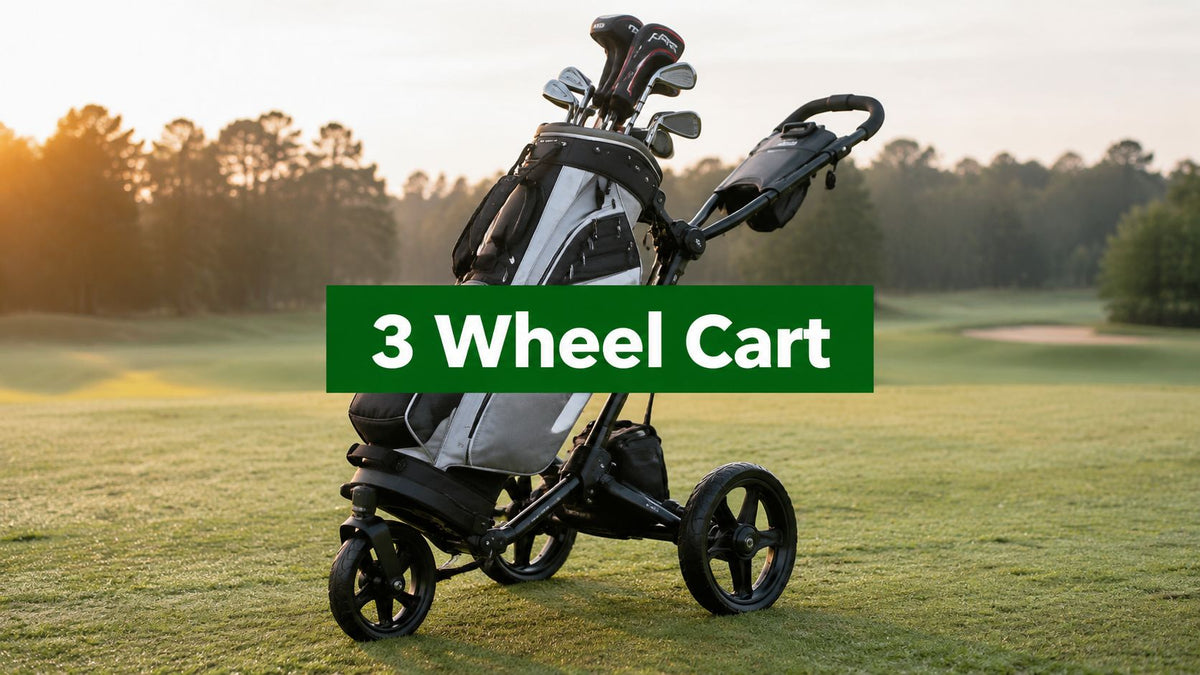
A 3 wheel motorized cart is a three-wheeled golf push cart fitted with an electric drive motor, a rechargeable battery, and controls that let the golfer move the bag without keeping both hands on the frame. The simplest analogy is a shopping trolley with larger wheels, a golf bag cradle, and a small electric drivetrain. You guide the round on foot, while the cart follows your commands.
The three wheels usually consist of two supporting wheels and one steering or drive wheel. Depending on the design, the motor may sit inside a rear wheel housing or attach as a drop-on hub that replaces or supplements an existing wheel. Retrofit systems focus on that second idea. Rather than asking you to abandon a push cart that already fits your bag and trunk, they add powered movement to the frame you already use.

The parts that matter
The chassis is the folding frame that supports the bag. A bag cradle or top bracket keeps the clubs secure, while the wheels provide the contact with turf and paths. The battery stores energy, the motor converts that energy into wheel movement, and the controller manages speed, direction, and braking.
A handheld throttle or remote usually gives you forward and reverse control. Some systems let you vary speed gradually, which feels more natural than an abrupt on-or-off switch. That distinction matters on a tee box, near a bunker, or beside another group.
This isn't a sit-in golf car. You don't steer from a seat, and you aren't replacing the walking portion of the round. It also isn't the same as a traditional pull cart, where the golfer supplies all the force, or a standard four-wheel push cart, where the extra wheel arrangement improves support but doesn't provide propulsion.
The useful mental model is simple: the cart carries the bag, the motor supplies the push, and you remain the person covering the course on foot. That makes a drop-on conversion especially appealing to golfers who like their current push cart but dislike the effort required to move it over a full round.
Three Wheels or Four Wheels and Why It Matters
Three wheels and four wheels solve different problems. A three-wheel cart generally turns more tightly because the front end can pivot around a single steering wheel. That helps when you're threading between trees, skirting a bunker, or making a sharp correction beside a green.
A four-wheel cart usually tracks more predictably across a side slope because its broader contact pattern spreads support across the frame. That doesn't make it automatically safer on every course. Stability still depends on load placement, wheel position, braking, ground conditions, and how quickly the cart is moving.
| Feature | 3 Wheel | 4 Wheel |
|---|---|---|
| Turning | Tighter pivot around obstacles | Requires more room |
| Side-slope tracking | More sensitive to steering correction | Often feels more planted |
| Hill handling | Manoeuvrable, but demands careful braking | Added support on uneven grades |
| Folded storage | Often more compact | Can take more space |
| Best match | Tight, tree-lined parkland layouts | Open, firm, hill-heavy courses |
Match the layout to the frame
A narrow course with frequent trees and awkward paths rewards manoeuvrability. You can position a three-wheel cart close to the ball without making a wide arc around every obstacle. On a firm, open course with pronounced cross-slopes, a four-wheel setup may feel calmer because it resists small directional changes.
The same trade-off appears in storage. Three-wheel designs often appeal to golfers who want a smaller folded package and less equipment around the trunk. Four-wheel models can make sense when a larger frame, heavier accessory load, or ride-along seat matters more than compactness.
For a closer look at the alternative layout, compare the practical design considerations in four-wheel push golf carts.
A three-wheel cart is not the universal winner. It's the better tool when tight turning and compact storage matter more than maximum planted feel.
The rule of thumb is straightforward. Choose three wheels for manoeuvrability, storage, and most ordinary parkland courses. Consider four wheels when steep side slopes, rougher ground, a larger bag load, or a seat create a stronger need for extra support.
Inside the Motor, Battery, and Controls
Three engineering choices determine how a motorized cart feels more than the word “electric” does: motor placement, battery capacity, and control design. Think of the motor as a tailwind, the battery as your water bottle for the round, and the controls as the volume knob that lets you set the effort level.
Motor placement changes the feel
A hub motor sits inside the wheel, keeping the outline clean and placing the drive force close to the ground. A bracket-mounted motor can offer strong torque, but the mounting position may raise the center of gravity if the motor sits high on the frame. On a three-wheel layout, that matters because a higher load can require more steering correction on slopes and uneven turf.
Independent electric golf push-cart examples commonly use dual motors rated from 120 watts to 240 watts each, paired with battery packs around 220 watt-hours, with claimed ranges of 18 to 36 holes per charge and hill capability up to a 25% grade. Those figures come from a product example at Kemimoto's electric golf push cart listing, and they shouldn't be treated as a guarantee for every cart or course.
A motor's practical value appears at startup and on hills. The controller needs to deliver useful torque when the cart is barely moving, because a loaded bag on soft turf asks more from the system than a flat, smooth path does.
Battery capacity is usable energy
Battery capacity tells you how much energy the cart stores, but range depends on hills, turf, bag weight, stops, and speed. A larger number on the label doesn't eliminate the need to match the system to your longest normal round.
| Component | Typical Range | What It Means On-Course |
|---|---|---|
| Dual motors | 120 W to 240 W each | Stronger low-speed assistance for starts and inclines |
| Battery pack | About 220 Wh in one market example | Energy reserve for repeated movement, not a guaranteed distance |
| Claimed operating range | 18 to 36 holes | A reference point that changes with terrain and load |
| Hill capability | Up to a 25% grade in one example | Useful comparison, but actual control depends on surface and braking |
Controls should disappear into the round
A thumb throttle, variable-speed dial, or remote control should respond smoothly rather than lurch forward. Forward and reverse are obvious functions, but downhill braking is just as important. A USB port, distance timer, or charge indicator may seem secondary, yet these details reduce small annoyances during a long walking day.
For a broader look at motor selection, how to choose an electric motor for a golf cart is a useful starting point. Focus on controlled torque and predictable braking, not top speed alone.
Which Golfers Benefit Most from Going Motorized
The best candidate for a motorized cart isn't necessarily the golfer who wants to avoid exercise. It's often the golfer who wants to keep walking but remove the repetitive strain of pushing a loaded bag.
Consider the senior walker who starts the round comfortably but loses focus on the back nine. Electric assistance can reduce the arm and shoulder effort that accumulates over several hours, leaving more attention for club selection and putting. The golfer still walks every shot, but the bag no longer becomes an extra burden on every incline.

Four familiar playing partners
The fitness-minded player may have the opposite concern. Walking is part of the workout, but pushing hard uphill can shift the effort away from the swing and toward fatigue management. Assistance lets that golfer keep the walking habit while choosing how much energy to spend on the bag.
On a hilly course, the benefit is control. A motorized wheel can handle the forward movement while the golfer uses the controls to manage pace and braking, rather than gripping the handle tightly and wrestling the cart down every descent. The system doesn't remove the need for caution, especially on wet turf, but it can make the cart less demanding to manage.
Then there's the parent walking with a child. A hands-free setup makes it easier to help with a junior's club, ball, or scorecard without abandoning the cart on a slope. The walking golfer remains part of the group instead of constantly stopping to reposition equipment.
The motor should remove friction from the round, not remove the round from the golfer.
These benefits are qualitative rather than automatic. A poorly matched system can add weight, complicate folding, or behave unpredictably on a hill. The right conversion gives the golfer a more manageable way to move the same bag across the same course.
Making Sure Your Push Cart Plays Nice with the Motor
A drop-on motorized wheel only helps if it fits the push cart underneath it. Major retrofit systems are designed around supported push-cart frames, with bracket kits or attachment hardware matched to particular cart shapes. Some systems may fit common three-wheel and four-wheel push carts, but “fits most” still means you need to confirm your exact frame before ordering.
Start with the wheel and axle. Measure the axle diameter and usable width, then inspect how the existing wheel releases. A quick-release wheel may accept an attachment differently from a permanently mounted wheel. The frame must also leave room for the drive housing, battery mount, and any cable or control bracket.

Run these checks before buying
- Identify the retrofit system. Find the manufacturer's compatibility list and the bracket intended for your cart model.
- Measure the axle. Record axle diameter, spacing, and the amount of exposed shaft available for the attachment.
- Check folding clearance. Fold the empty cart and look for contact between the motor housing, frame tubes, brake hardware, and wheel supports.
- Inspect the bag area. An oversized top well or low-hanging bag may interfere with the motor housing or battery position.
- Confirm the load rating. Add the bag, clubs, accessories, battery, and drive assembly before comparing the total with the cart's supported load.
Brake-equipped push carts deserve extra attention. A brake lever or cable that occupies the mounting area can prevent a clean fit, while a frame with a non-standard axle may require different hardware. Don't assume that a wheel's diameter alone proves compatibility.
For a practical installation overview, use this push-cart-to-electric conversion guide as a reference.
Buying the motor before checking the cart is the most common and most preventable mistake in this category. Measure first, confirm the bracket, and only then compare motors and batteries.
Buying, Upgrading, and Avoiding the Wrong Cart
A retrofit wins when your existing push cart already feels right in your hands. You know how it folds, where the bag sits, and whether it fits the trunk. Adding a powered wheel preserves that familiarity while changing the one part you dislike, the effort required to move it.
The upgrade also keeps the equipment modular. You may be able to remove the motorized wheel for storage or transport, then use the frame in its manual configuration when that suits the course. That flexibility can matter more than a long feature list, especially if your garage, car, or travel routine has limited room.
Compare the attachment, not just the advertised range
Look at drive-wheel position, axle spacing, clamp range, controller response, battery chemistry, total weight, service support, and warranty terms. A smooth release matters. So does the ability to free-wheel when the motor is off or when you need to move the cart manually.
Be wary of bargain kits that provide no supported compatibility list, describe battery performance vaguely, or seal the controller and battery into a unit with no clear replacement path. If a part fails after repeated use, access to replacement wheels, controllers, chargers, and batteries may matter more than an attractive initial specification.
Buying test: Load the bag exactly as you play, then test the powered setup on an incline and beside the scorecard before trusting it on a crowded course.
A full replacement cart still makes more sense for some golfers. Choose that route when you need an integrated seat, substantial storage, built-in navigation, support for a heavy accessory load, or a platform designed for unusually steep or rough terrain. It may also be the better option when the existing push cart is damaged, incompatible, or uncomfortable even before adding a motor.
Before committing, check transport rules, charging requirements, water-resistance guidance, and local course policies. A good retrofit should make the round easier without making the bag less secure, the trunk more crowded, or the next outing harder to organize.
Your Short Checklist Before You Buy
Start with the course, not the gadget. Note the hills you regularly climb, the walking distance between greens and tees, the condition of cart paths, and whether any part of your normal route calls for a ride-on vehicle instead of a walking cart.
Then examine your existing push cart as if you were fitting a new wheel to a machine. Measure axle width and diameter, inspect brake hardware, and account for accessories such as a seat, umbrella holder, cooler mount, or scorecard tray. Confirm that the manufacturer explicitly supports your frame rather than relying on a photograph that looks similar.
Turn the decision into a practical test
Ask how the motor behaves under load. You want controlled starts, usable speed settings, predictable downhill braking, stable tracking, and a free-wheel option when you need to reposition the bag by hand. Compare the system's usable range with your longest normal round, not an ideal route on flat ground.
Battery questions deserve their own line on the checklist. Verify whether the pack removes from the cart, how charging works, whether the charger suits your travel setup, and what support exists when the battery eventually loses capacity. Ask whether the firmware, controller, wheels, and battery are replaceable or sealed into one difficult-to-service assembly.
| Check | What to Verify |
|---|---|
| Course terrain | Regular hills, slopes, turf, paths, and wet-ground exposure |
| Push-cart fit | Axle dimensions, wheel release, frame shape, brakes, and folding clearance |
| Loaded performance | Startup torque, speed control, braking, tracking, and free-wheel behavior |
| Battery routine | Removal, charging location, charger requirements, range, and replacement support |
| Transport | Folded dimensions, lifting weight, trunk space, and travel restrictions |
| Durability | Water-resistance guidance, exposed connectors, and cleaning requirements |
| Ownership terms | Warranty coverage, returns, replacement parts, and technical support |
| Course policy | Whether motorized walking carts are permitted on your usual layouts |
Add the motor and battery to the lifting routine before purchase. A setup that moves easily on the course can still be awkward if you can't comfortably lift it into the car. Measure the folded cart, practice with the controls in a safe open area, and make sure the bag stays secure during starts, stops, turns, and descents.
The right choice ties together three things: health, terrain, and budget. You're still walking, but you're spending less effort on the equipment. You're choosing enough control for the course you play, while avoiding a replacement vehicle when a simple retrofit can solve the actual problem.
If your current push cart already fits your bag and your trunk, visit Caddie Wheel to see how its drop-on electric power-assist approach can add remote-controlled movement without replacing the whole setup. Compare the attachment and control design with your course terrain, then choose the option that helps you finish the round walking with more energy left for your game.
Partager:
How to Control a Motor on a Golf Push Cart
Golf Push Cart Big Wheels: A Practical Buyer's Guide