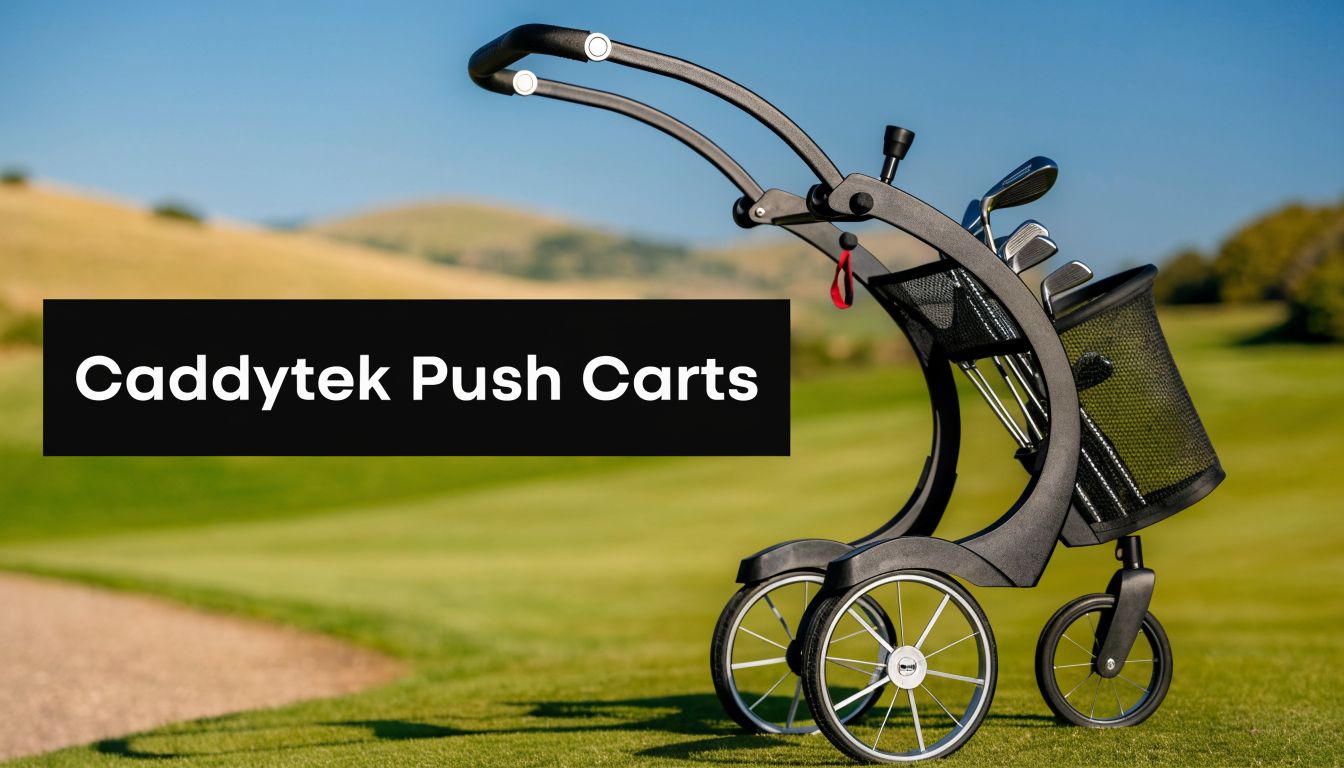
Walking golfers usually reach the same point. You enjoy being out there, you want the exercise, and you don’t want to drag a heavy bag through the back nine. But the cart you already own may feel awkward to fold, shaky on side slopes, or bulky in the trunk. That’s when Caddytek starts to make sense.
Caddytek golf push carts sit in a practical sweet spot. They’re built for golfers who want walking to feel easier without jumping straight to a premium-priced cart. That value reputation is a big reason the CaddyLite EZ V8 was recognized as the best value golf push cart in MyGolfSpy’s 2025 buyer’s guide.
This guide takes a slightly different angle. Instead of treating a push cart as a one-time purchase, I’m looking at Caddytek the way an upgrade-minded golfer does. Is the frame stable enough? Is the wheel setup sensible? Will the cart still make sense later if you decide you want electric help on hills or during long walking rounds? Those are the questions that matter if you want to buy once and keep your options open.
Your Guide to Caddytek Golf Push Carts
A lot of golfers arrive at Caddytek after a frustrating round. Maybe you walked eighteen, played fine for twelve holes, then felt your legs get heavy and your pace slow down. Maybe your old pull cart fought you on every slope. Or maybe you’ve started walking more often and realized the cart matters more than you expected.
That’s the appeal of Caddytek golf push carts. They’re easy to understand, easy to live with, and aimed at golfers who want the practical benefits of walking without turning every round into a gear-management chore. If you’re still narrowing down what kind of cart fits your game, this short guide on how to choose a golf push cart is a useful companion.
What makes Caddytek stand out
Caddytek’s lineup keeps coming back to a few basics that golfers value on the course:
- Value first: The brand has earned a reputation for giving you useful features without forcing you into the premium tier.
- Folding that feels simple: A cart that folds quickly gets used more often. A cart that fights you in the parking lot gets old fast.
- Walking comfort: Stable wheel layouts, useful handle-area storage, and straightforward brakes matter more than flashy extras.
Practical rule: The right push cart should disappear during the round. You should notice your golf, not the cart.
For many golfers, that’s why Caddytek works. It doesn’t try to impress with gimmicks. It focuses on portability, stability, and price discipline. If you’re shopping with one eye on future upgrades, that foundation matters even more.
Why Caddytek Dominates the Push Cart Market
Caddytek’s position in the market isn’t accidental. The brand has been strong at picking the features golfers care about most, then packaging them in carts that stay within reach for regular players.

One sign of that traction showed up early. By 2020, Caddytek’s 4-wheel variant reached #2 most popular on Amazon’s push/pull carts, during a period when walking golf in the US rose 20% post-2020, according to The Golfing Lad’s 2026 roundup. That matters because popularity in this category usually follows simple things: ease of ownership, sensible pricing, and carts that solve real annoyances.
The value equation is straightforward
Golfers don’t judge push carts the way they judge drivers. Nobody cares about marketing language if the cart is annoying to fold or feels tippy with a full bag. Caddytek has done well by focusing on everyday use.
Three decisions explain a lot of the brand’s success:
- Aluminum frames: They keep weight manageable and resist rust.
- Compact folding systems: These help with trunk storage and garage storage.
- Feature discipline: Most Caddytek carts include the extras golfers use, such as basic storage, holders, and brakes.
Caddytek understands the parking lot test
The first test of any push cart happens before the first tee. Can you lift it out easily? Can you unfold it without staring at hinges? Can you load your bag and get moving?
Caddytek golf push carts usually pass that test because they don’t overcomplicate the process. That sounds minor, but it affects ownership more than most spec-sheet items.
A push cart earns its place when it makes walking easier before the round starts, not just after you’re already rolling down the fairway.
Stability matters more than golfers think
Golfers often shop by wheel count alone, but the underlying issue is confidence. A cart that tracks predictably and feels settled under a loaded bag is easier to push, easier to park, and less distracting on uneven ground.
That’s why Caddytek has stayed relevant across both 3-wheel and 4-wheel designs. The lineup gives different golfers different answers. If you want compactness, there’s a fit for that. If you play hilly courses and want a broader, calmer base under load, there’s a fit for that too.
Decoding Caddytek Features and Technology
Product pages can make all push carts sound the same. They aren’t. With Caddytek golf push carts, the details that matter most are the folding system, wheel construction, and how the cart carries weight through a round.

What EVA wheels actually mean
Caddytek uses EVA wheels with precision ball bearings. On paper, that can sound like catalog filler. On the course, it means smoother rolling and less fuss.
MyGolfSpy’s review of the CaddyLite One S V8 notes that Caddytek uses 11.5-inch rear wheels, and that the ball-bearing setup helps the cart roll smoothly on high grass and uneven surfaces in addition to normal fairway terrain, as described in their CaddyLite One S V8 review.
Here’s the practical translation:
- Larger rear wheels: Better support when the course tilts or the ground gets patchy.
- Ball bearings: Less drag and less jerky feel while pushing.
- EVA construction: Low-maintenance wheels that don’t ask much from the owner.
If you’ve ever used a cheap cart with stiff wheels, you know the difference immediately. The cart feels reluctant instead of cooperative.
Folding systems are more important than they sound
Golfers often underrate folding design because it doesn’t affect ball flight. But it affects whether you enjoy owning the cart.
Caddytek has leaned into patented fold designs across multiple models. That matters for two reasons. First, quick folding saves time at the car. Second, compact folded shapes make a cart much easier to store without constantly rearranging other gear.
A useful side note for upgrade-minded golfers: if you ever add a braking or powered accessory to a cart, understanding how the base cart folds becomes even more important. If you’re curious how assisted braking concepts work more broadly, this explanation of a regenerative braking system and how it works gives helpful background.
Accessory design affects daily convenience
Storage sounds secondary until you don’t have it. Caddytek has generally done a good job with real-life accessory placement. Cooler baskets, mesh storage, phone holders, and simple console areas can make a round feel calmer because you stop digging through bag pockets.
That convenience matters most for golfers who walk often. You want tees, rangefinder, drink, glove, and scorecard items close at hand. You don’t want the cockpit so cluttered that folding becomes awkward.
A quick look at one Caddytek model in action helps make those design choices easier to visualize.
Why upgrade-minded golfers should care about wheel layout
When golfers think about future upgrades, they usually focus on battery or motor questions first. I’d start with the cart’s geometry.
A stable rear-wheel platform, predictable tracking, and enough frame rigidity make a cart easier to adapt later. That doesn’t guarantee compatibility with every third-party system, but it gives you a stronger base to work from. Caddytek’s better models tend to make sense here because the wheel and frame design already prioritize stable movement instead of bare-minimum portability.
Comparing Top Caddytek Models for 2026
The right Caddytek cart depends less on “best overall” and more on how you play. Some golfers need compact storage above all else. Others need extra stability because their home course has constant side slopes. Others want the front end to feel more agile around tight paths, curbs, and parking-lot turns.

The compact value pick
The CaddyLite EZ V8 is the model many golfers start with, and for good reason. It has strong value credentials and a folding system that fits the life of a regular walker.
If trunk space is your main concern, Caddytek’s folding engineering is a real advantage. The CaddyLite EZ-Fold Pro compacts to 28.4" × 16.5" × 14.4", and models like the Caddylite EZ V8 weigh under 18.5 lbs, which supports easy single-person handling and trunk-friendly storage, according to Caddytek’s product information on folding and sizing.
Who it fits best:
- Frequent walkers with normal trunk space
- Golfers moving up from an old 2-wheel pull cart
- Buyers who want value without a stripped-down feel
The stability-focused option
The Explorer V8 is the one I’d point hilly-course golfers toward first. Four-wheel designs usually appeal to players who care more about planted stability than the smallest folded package.
That doesn’t make it clumsy. It just shifts the priority. If your current cart feels nervous on slopes or with a heavier bag, the Explorer line makes more sense than trying to force a lightweight compact model into a job it wasn’t built for.
If your course asks the cart to hold its line on side-hills and uneven lies, a more stable platform usually beats a slightly smaller folded shape.
The maneuverability choice
The One Swivel V8 suits golfers who want easier turning and a more responsive front end. That’s useful on courses with narrow walk paths, tighter staging areas, or frequent direction changes around greens and tees.
The appeal here isn’t raw stability. It’s handling. Some golfers prefer a cart that feels easier to point and guide with one hand.
Quick comparison table
| Model | Wheels | Weight (lbs) | Folded Size (inches) | Best For |
|---|---|---|---|---|
| CaddyLite EZ V8 | 3 | Under 18.5 | Compact trunk-friendly fold | Value-minded walkers |
| Explorer V8 | 4 | ~16.5 | 17.5 x 13.4 x 24 | Hilly courses and golfers who want extra stability |
| One Swivel V8 | 3 | ~15 | Not specified in verified data | Golfers who want easier turning |
How I’d choose between them
Use your home course as the tiebreaker.
If your course is mostly flat and you care most about folding simplicity, the EZ V8 is the straightforward choice. If you routinely play terrain that makes lighter carts feel unsettled, go Explorer V8. If you value steering ease and quick direction changes more than anything else, the One Swivel V8 deserves a close look.
A few common buyer mistakes are worth avoiding:
- Buying only by weight: A lighter cart isn’t always the better cart for your course.
- Ignoring your trunk opening: Folded dimensions matter more than marketing photos.
- Underestimating bag fit: A cart can feel very different with a full cart bag versus a lighter stand bag.
A note on the infographic models
You may also see shoppers compare the CaddyLite 15.3 and CaddyCruiser ONE when browsing the Caddytek family. Those models matter in the broader lineup, but if you’re focused on current upgrade potential and practical walking use, the EZ V8, Explorer V8, and swivel-style options are usually the most revealing place to start.
Future-Proof Your Purchase with Electric Assists
The most overlooked question in push-cart buying is simple: what happens if your needs change?
A lot of golfers start manual, then later want help on hills, in heat, or during longer walking stretches. That’s why Caddytek golf push carts deserve a second look from upgrade-minded buyers. Their frames and wheel layouts often make them sensible candidates for third-party electric assist systems, even though many reviews barely touch the subject.

Caddytek’s own product collection leaves a noticeable information gap around this topic. As noted in their push cart collection overview, there’s strong attention on manual features, but very little direct guidance on compatibility with add-on electric power assists. For seniors, mobility-conscious golfers, or anyone who plays demanding terrain, that missing information matters.
What makes a cart a good upgrade platform
When I evaluate a cart for future assist compatibility, I care about four practical traits:
- Frame rigidity: Aluminum construction helps because the cart needs to stay composed under added drive force.
- Stable rear platform: A cart that already tracks well manually usually makes more sense for assisted use.
- Wheel clearance and layout: You need room for accessories and clean wheel movement.
- Folding sanity: The cart still has to be convenient after any removable assist is detached.
Caddytek often scores well, as the brand’s carts are already designed around portability and stable rolling, which are the same traits that make future upgrades easier to think about.
A realistic way to think about power assists
Not every golfer needs a fully integrated electric caddie. Some just want relief on climbs or less pushing fatigue late in the round. That makes add-on systems appealing because they let you keep the cart you like and upgrade only the propulsion side.
One example is the electric golf push cart conversion kit, which explains the drop-on conversion approach and how standard carts can be adapted for assisted propulsion. For a golfer already considering a Caddytek V8-style cart, that kind of modular path can be more practical than replacing the whole setup.
Buy the cart for how you walk today. Keep an eye on whether it can support how you may want to walk next season.
That mindset turns a push cart from a simple accessory into a longer-term platform.
Maintenance Warranty and Long-Term Value
Push carts don’t ask for much, but they do reward simple maintenance. If you want a Caddytek cart to feel smooth after many rounds, pay attention to the wear points that matter: wheels, brake function, folding joints, and bag straps.
There’s also a trust issue here. Reviews often celebrate the first impression, but long-term ownership data is thinner than many buyers expect. Breaking Eighty highlights that gap around durability, especially questions about brake wear and wheel integrity after 50+ rounds on hilly or rough terrain, in its best push cart roundup.
What to do after regular rounds
A small maintenance routine goes a long way:
- Wipe down the frame: Grass, grit, and moisture build up around hinges and contact points.
- Inspect the wheels: Look for wobble, debris, or anything that changes the cart’s tracking feel.
- Test the brake before storage: You want it engaging cleanly, not only when you’re already on a slope.
- Store it dry: That helps preserve moving parts and keeps folding action from getting sticky.
How to think about warranty and value
Before you buy, read the warranty terms for the exact model you want. Focus on what the manufacturer calls normal wear versus defect coverage. On push carts, brake components, straps, wheels, and hinges are the parts most likely to generate ownership questions.
My advice is simple. Buy Caddytek for its practical strengths, not because you expect lifetime indestructibility. Treat it well, inspect it periodically, and you’ll give yourself a much better chance of getting strong long-term value.
Frequently Asked Questions About Caddytek Carts
Are Caddytek carts good on hilly courses
They can be, but model choice matters. If you play a course with frequent slopes, broader and more stable designs usually make more sense than choosing the lightest cart you can find. Golfers who face hilly terrain often lean toward 4-wheel layouts or wider bases for that reason.
Do Caddytek carts work with stand bags and cart bags
In most cases, yes. The key is how securely the bag sits in the upper and lower supports. Stand bags usually work well, but some oversized bags can feel less tidy on compact carts. If you carry a bulky setup, pay close attention to how the bag sits once strapped in.
Is a 3-wheel or 4-wheel Caddytek better
That depends on your priorities. A 3-wheel model often feels easier to maneuver and store. A 4-wheel model usually gives you more planted stability, especially on uneven ground. Neither is automatically better. The course you play and the bag you use should decide it.
Are Caddytek carts a smart choice for future upgrades
Often, yes. That’s one of the stronger arguments for them. Their aluminum frames, practical folding systems, and stable wheel layouts can make them attractive as a base cart if you later decide to explore removable power assists.
What should I check before buying
Start with the basics:
- Your trunk space: Folded size matters more than showroom appearance.
- Your course terrain: Flat, rolling, and steep courses reward different cart designs.
- Your bag type: A light stand bag and a loaded cart bag change how a cart behaves.
- Your long-term plan: If you may want electric assistance later, choose a cart with a stable structure and sensible wheel layout.
If you like the idea of keeping your current walking setup but reducing pushing effort later, Caddie Wheel offers a power-assist approach built for standard push carts, including compatibility options for some Caddytek models.
Partager:
Remote Control Cart: Your Guide to Walking Smarter
Find Your Ideal Club Cart Seat for 2026