
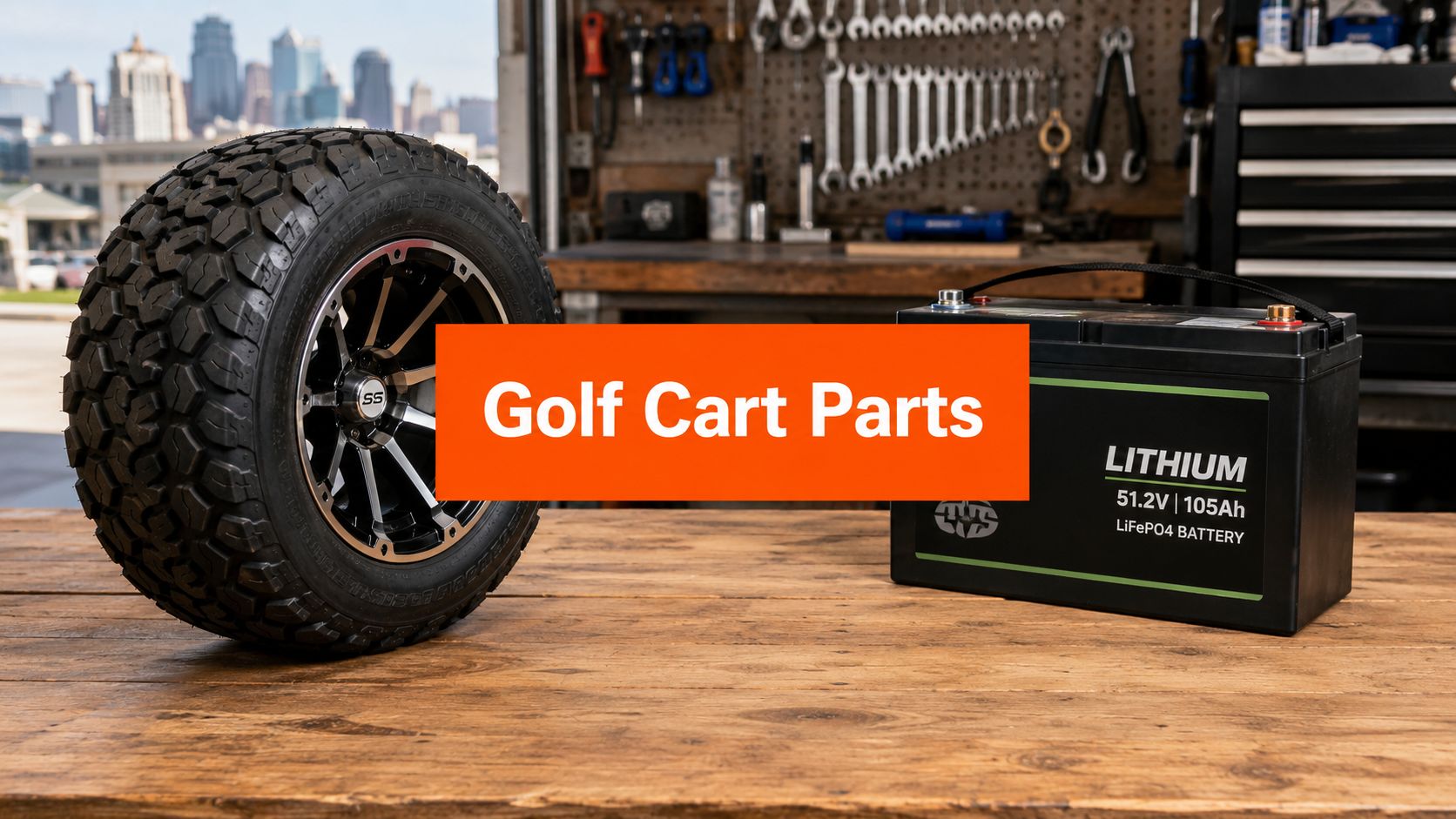
A cart never seems to quit in the garage. It quits when you're loaded up, tee time is close, and you need it to move right now. In Kansas City, that usually means one of two things. Either you're hunting down the right part fast, or you're trying to figure out whether the part is even the true problem.
That's where most owners get stuck. They search for golf cart parts in Kansas City, get a list of shops, and still don't know who can tell them what failed, who has it on the shelf, and who can get the cart rolling again without a week of guessing.
Your Guide to Golf Cart Repair in Kansas City
If your cart dies halfway through a round or won't leave the driveway, the repair usually turns into a speed problem before it becomes a parts problem. You don't just need “a store.” You need a shop or supplier that can help you narrow down the fault, confirm fitment, and tell you whether the fix is simple or worth handing off.
Kansas City is a better market for that than a lot of golfers realize. The U.S. golf cart market was valued at USD 1.7 billion in 2024 and is projected to grow at a 6.4% CAGR from 2025 to 2034, while a local directory for the Kansas City area lists 10+ shops and 10+ professional repair centers, which points to a real local service ecosystem rather than a niche sideline. That combination matters when you need recurring maintenance items, electrical parts, batteries, tires, or brake work without treating every repair like a special order from another state, according to GM Insights on the U.S. golf cart market.
I've learned to treat a dead cart the same way I'd treat a bad swing on the range. Don't start changing five things at once. Start with the symptom. No power at all, weak acceleration, charger not engaging, brake drag, one tire wearing funny, lights cutting in and out. Each one points you in a different direction.
Practical rule: The fastest repair starts with the best description of the failure, not the fastest click on a parts page.
A lot of owners lose time by buying the obvious part first. New batteries for a cart with a bad cable end. A charger for a cart with a failed receptacle. Brake parts when the cart is binding at the hub or parking brake linkage. Good local repair work starts with diagnosis, and that's why a quick read through common golf cart repair issues and fixes can save you from buying the wrong thing.
What gets carts fixed faster in Kansas City
- Clear symptoms: Tell the shop whether the cart is dead, slow, noisy, pulling, not charging, or only failing under load.
- Correct cart identity: Have the brand, model, and serial number ready before you call.
- Realistic repair path: Decide early whether you need same-day pickup of a part or actual diagnostic help.
- Transport plan: If the cart can't move safely, ask about pickup before you start ordering components.
Kansas City has enough local activity in this market to give you options. The trick is choosing the option that shortens downtime instead of adding another wrong part to the shelf in your garage.
Common Golf Cart Parts That Need Replacement
Most golf cart repairs fall into a handful of categories. If you know the usual failure points, you can ask better questions and avoid buying parts by guesswork.
Power system parts
Batteries are the first thing owners think about, and for good reason. When a cart gets weak, slow, or unreliable, the battery pack is always part of the conversation. But the battery isn't the only suspect. Corroded terminals, tired cables, and bad connections can mimic a failing pack.

The next tier is the control side. Solenoids, chargers, charge ports, and controllers often cause the classic no-start or no-move complaint. When the cart has power but doesn't respond correctly, I stop thinking “battery only” and start checking whether the system is delivering power where it needs to go.
A lot of owners searching for golf cart parts and replacement components are really dealing with one of these three situations:
- Dead cart: Start with battery state, terminal condition, main cables, fuse protection, and solenoid behavior.
- Weak cart: Look at battery health, cable resistance, charger performance, and rolling resistance from brakes or tires.
- Intermittent cart: Suspect loose electrical connections, aging switches, or a controller issue before you assume the whole pack is bad.
If the cart works one day and acts haunted the next, don't order parts until you've checked every major connection you can see and touch.
Drivetrain and chassis wear items
Brakes, tires, bushings, and steering components don't fail as dramatically as electrical parts, but they're the reason many carts feel sloppy, slow, or unsafe. Worn brake shoes or dragging brakes rob power. Old tires change ride height and traction. Loose tie rod ends or tired bushings turn a simple ride into a constant correction job.
On gas carts, belts, filters, and ignition parts belong on the short list. On electric carts, hub noise, wheel-end play, or uneven tire wear usually points you toward mechanical service rather than another electrical purchase.
A quick way to sort priorities is to ask one question: Is the cart refusing to move, or is it moving badly? If it won't move, start electrical. If it moves badly, start with tires, brakes, steering, and suspension before you go deep into expensive electronics.
Upgrade parts that actually change performance
Not every part purchase is a repair. Sometimes it's a worthwhile upgrade, especially if your cart struggles on hills, feels lazy off the line, or doesn't hold pace over a long outing.
One meaningful benchmark in the electric-cart world is a 48V lithium (LiFePO4) pack paired with a 5000W AC motor, which can deliver a 20 MPH top speed and about 40 miles of range on a single charge, based on the listed specifications for a Kandi electric golf cart at Lowe's product page for the 48V lithium and 5000W AC setup. That doesn't mean every owner needs that setup. It does give you a practical reference point for what a real battery and drivetrain upgrade can achieve.
What doesn't work is upgrading one major component without checking the rest of the system. A stronger battery setup won't fix bad cables, dragging brakes, or worn steering parts. Good performance comes from a healthy cart first, upgrades second.
How to Guarantee Part Compatibility for Your Cart
You pull the old solenoid, brake cable, or hub off on a Friday night, order what looks right, and by Saturday morning you are staring at a part that is close but wrong. That is how a one-hour fix turns into a lost weekend.
Brand alone will not protect you from that mistake. Club Car, E-Z-GO, and Yamaha all have model-year changes, trim differences, and replacement parts that look similar in a photo but install very differently on the cart.

Start with the serial number
The serial number is the fastest path to the right part. Before you shop, find the tag or sticker and take a clear photo of it. Then keep that photo on your phone so you can text it to a parts counter, compare it against a listing, or pull it up in the garage without crawling back under the cart.
Write down these details while you are at it:
- Brand
- Model family
- Approximate year
- Voltage
- Gas or electric
- Any modifications from stock
That last item causes plenty of bad orders in Kansas City garages. Lift kits, wheel swaps, upgraded controllers, converted battery setups, and aftermarket brake parts all change what fits and how long the repair takes. A stock parts diagram helps, but it does not tell the whole story if a previous owner has already changed the cart.
Match the cart you have, not the cart you think you have
A Club Car DS and a Precedent can need different steering, suspension, and body parts. One E-Z-GO TXT may use different hardware than another depending on year and setup. Yamaha owners run into the same issue with front-end parts, switches, and electrical pieces.
The quickest way I know to avoid a return is to slow down for five minutes before checkout:
- Pull the serial number
- Confirm the exact model family
- Note any non-stock parts
- Set the old part next to the product photo
- Call or message the seller if the listing is vague
That last step saves more time than it costs. A good parts desk can usually tell, fast, whether you need the newer style, the older style, or a brand-specific variation that will not show up clearly in a generic online listing.
For a broader reference, it helps to review U.S. golf cart parts options by cart type and category and compare how parts are described across models. The useful listings usually spell out model family, year range, and fit notes instead of saying a part fits "most carts."
If a seller asks for the serial number and a photo of the old part, that is usually a sign they are trying to get you the right repair on the first order.
Here's a useful walkthrough if you want to see how parts identification is handled in practice:
Double-check before checkout
Compare the replacement against the old part in three practical ways:
- Mounting points: hole spacing, tabs, brackets, bolt pattern
- Connections: plug shape, terminal type, wire length, cable path
- Physical size: length, width, offset, clearance, orientation
If any one of those is off, stop and confirm before you buy.
That habit matters even more if you need the cart back quickly for a round, neighborhood use, or fleet duty. Fast repair in Kansas City is not just about finding a store with inventory. It is about diagnosing the failure correctly, matching the exact version of the part, and avoiding a second trip for something that only almost fits.
Where to Buy Golf Cart Parts in the Kansas City Area
A cart quits on Friday afternoon, your tee time is Saturday, and now the part hunt matters as much as the repair itself. Around Kansas City, the best place to buy golf cart parts depends on one thing first. Do you already know the exact failure, or do you still need help pinning it down?
If the diagnosis is solid and you have a confirmed part number, buying gets easier. If the symptom is still vague, a weak battery one minute, a controller issue the next, the seller matters a lot more than the shelf price. The fastest repair usually comes from a supplier who can confirm fit, check stock, and tell you whether you are solving the actual problem or just swapping guesses.
Local dealers and repair shops
For same-day repairs, local shops usually give you the best shot at getting the cart running without a second trip. Shops in the Kansas City area that work on Club Car, EZGO, and Yamaha carts every week tend to know the common failure points and the parts that get mixed up. That saves time.
Counter support matters here. A good parts desk will ask for the cart model, serial plate info, and often a photo of the failed part. That extra five minutes can save a full weekend if the cart has a mid-year change, an aftermarket conversion, or wiring that no longer matches the factory diagram.
Local suppliers are usually the best fit when:
- You need the part today: Pickup beats waiting on shipping.
- You need a diagnosis check: The symptom points to two or three possible parts.
- You own a common fleet brand: Club Car, EZGO, and Yamaha parts are easier to source quickly through shops that see them every day.
- You may need service if the part does not fix it: A shop can often move from parts sale to repair without starting over.
Salvage and used parts
Used parts have their place. I use them for body pieces, seat frames, wheel sets, and older trim that is hard to find new. For that kind of repair, a clean used part can make perfect sense.
I avoid used electrical parts unless there is a clear reason to trust the part. Solenoids, controllers, chargers, brake components, and battery-related parts can waste a lot of time if the replacement comes with its own problems. Saving money only helps if the cart stays fixed.
Used parts are best for appearance, older carts, and non-critical hardware. They are a gamble for diagnosis-heavy repairs.
Online parts sellers
Online sellers work well for routine items like brake shoes, light kits, switches, filters, and tune-up parts, assuming you already know exactly what the cart needs. The selection is wider, and pricing is often competitive.
The trade-off is downtime. One wrong click on a year range or connector style can turn a one-day repair into a week of shipping and returns. Online ordering is strongest when the repair is simple, the part number is confirmed, and you do not need anyone to sanity-check the diagnosis.
Kansas City parts sourcing comparison
| Sourcing Option | Best For | Typical Speed | Cost | Expertise/Support |
|---|---|---|---|---|
| Local dealer or repair shop | Same-day needs, fitment help, brand-specific parts | Fastest when in stock | Usually mid-range | Strong hands-on support |
| Salvage or used seller | Cosmetic parts, older carts, budget repairs | Variable | Often lower | Limited, depends on seller knowledge |
| Online retailer | Exact known part numbers, routine replacement items | Slower due to shipping | Often competitive | Usually weaker for diagnosis |
Choosing the Right Supplier
Choose the supplier based on the repair, not just the part category. If the cart is down and the cause is still uncertain, buy from a place that can help verify the failure and confirm fitment before you spend money. If the issue is straightforward and you have already matched the part number, online or used options can work fine.
Kansas City owners usually need three things at once. Fast availability, correct fit, and someone who can tell them when a symptom points somewhere else. The supplier that can do all three is often the one that gets you back on the course fastest.
DIY Installation Versus Using a Professional Service
Once the part is in your hands, you've got one more decision to make. Install it yourself, or let a shop handle it.
A lot of golf cart owners can do more than they think. A lot of them also tackle jobs they should've stopped on sooner. The smart move is knowing which camp your repair falls into.
Jobs most owners can usually handle
Simple replacement work is often worth doing at home if you've got basic tools, a clean place to work, and the discipline to label what you remove.
Good DIY candidates usually include:
- Battery swaps: Straightforward if you document cable placement carefully and work safely.
- Light assemblies and bulbs: Low complexity, easy to verify.
- Mirrors, seats, and accessories: Mostly basic hand-tool work.
- Tire and wheel changes: Simple if you already know safe lifting and torque habits.
- Basic bolt-on parts: Covers, trim pieces, and straightforward hardware replacement.

If you enjoy wrenching, these jobs can save labor and teach you the cart well enough to catch future wear before it strands you.
Jobs that belong in a shop
Electrical diagnosis is where a lot of DIY jobs go sideways. The same goes for controller-related issues, wiring faults that appear only under load, brake work you can't fully verify, and anything involving a cart that has already been modified by a previous owner.
Kansas City shops also don't always make turnaround expectations obvious. One notable gap in the local market is clear information on service turnaround, diagnostic process, and typical repair timelines, which makes serviceability a major question to ask before you commit, as discussed by Botero Carts on Kansas City golf cart repair and service.
Ask these questions before dropping off a cart:
- Do you diagnose before ordering parts?
- What brands do you regularly service?
- Can you estimate turnaround once diagnosed?
- Do you offer pickup and delivery for non-running carts?
The honest dividing line
Here's the dividing line I use. If the repair is visible, direct-fit, and easy to test after installation, DIY is reasonable. If the failure is hidden, intermittent, safety-related, or tied to multiple possible causes, pay for diagnosis.
That same thinking applies to walking gear too. If you use powered golf equipment, some owners are comfortable replacing straightforward accessory or replacement items themselves, while others would rather use official Caddie Wheel parts and support options when fitment or function matters more than experimentation.
The cheapest repair is the one you only do once.
Your Roadmap to a Fast and Easy Repair
You load the clubs, turn the key, and the cart does something wrong right when you need it. In Kansas City, the fastest repair usually goes to the owner who identifies the failure clearly before buying a single part.
Start by narrowing the problem to one lane. Power, charging, steering, brakes, suspension, or noise. That cuts down wasted orders and shortens the time it takes for a local shop or parts counter to point you to the right fix.
A simple checklist that works
-
Write down the exact failure
Keep it specific. No crank, weak on hills, charger will not start, brake drag, front-end play, or cutout after a few minutes. -
Find the serial number
Take a clear photo before you call, text a shop, or place an order. -
Confirm the exact part
Match the old part to the cart model, year range, and any changes made by a previous owner. -
Pick the source that fits the problem
Local sellers help most when you need the part fast or the diagnosis is still uncertain. Online ordering makes more sense when you already have the part number and know it is correct. -
Be honest about the install
Straightforward, visible jobs are usually manageable at home. Electrical faults, brake work, and anything with mixed symptoms deserve proper diagnosis.
What saves time is serviceability. A shop that answers fitment questions, checks the model before ordering, and tells you what they can test the same day is often worth more than a big catalog. Fast shipping does not help much if the first part is wrong.
Kansas City owners have good options, but the smart move is to treat repair as a diagnosis problem first and a parts purchase second. That approach gets the cart back on the course faster and cuts down on repeat trips, return shipping, and guessing.
If you prefer to walk instead of ride, Caddie Wheel is another route. It adds electric power assist to a standard push cart and can make a round easier on your back, shoulders, and legs without changing the rest of your setup.
Partager:
Gyroscopic Remote Control: The Golfer's Edge
The 7 Parts of a Golf Swing for Better Consistency