
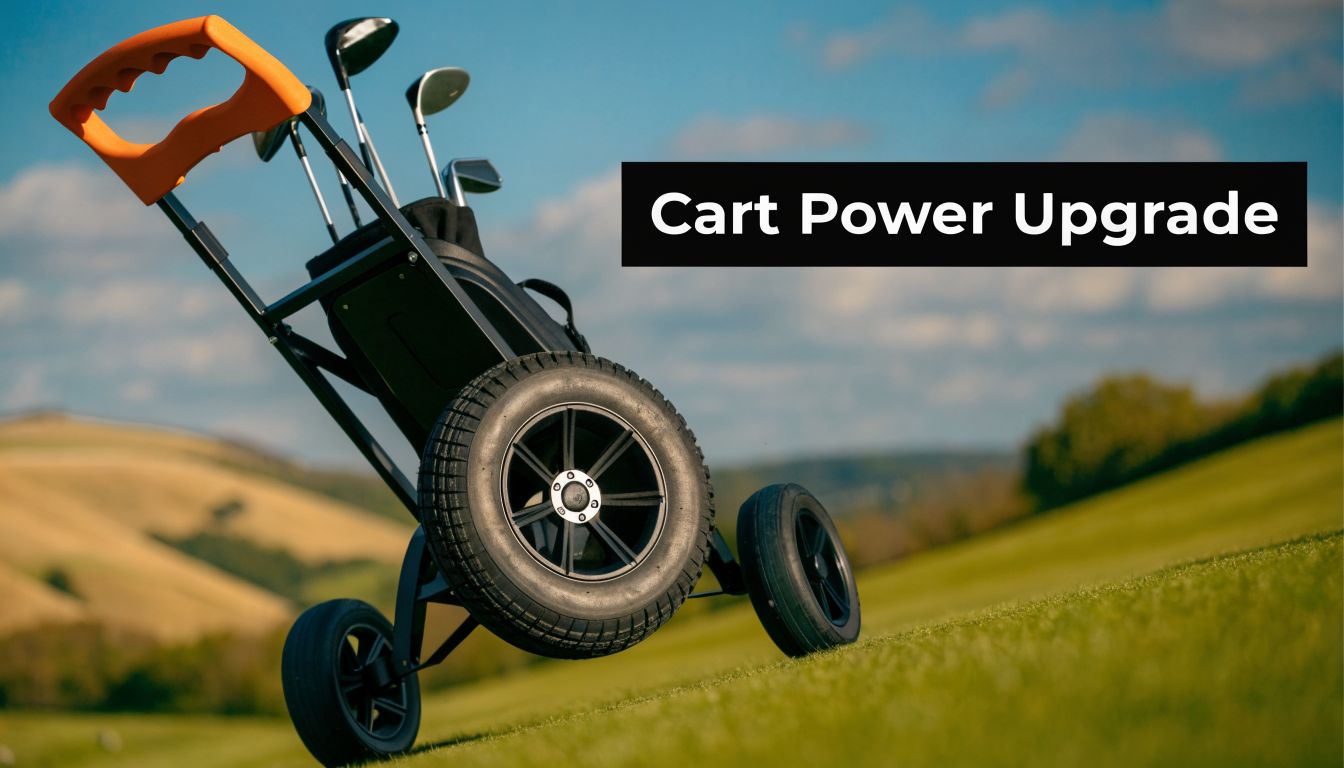
You like walking. That’s why you bought a push cart in the first place.
The problem starts around the middle of the round. A fully loaded bag gets heavier on every incline, the cart starts tugging at your shoulder on side slopes, and by the back nine you’re spending energy on the cart instead of the course. A lot of golfers hit that point and assume the only answer is a full electric caddie or some complicated workshop project.
It doesn’t have to be that way. For a walking golfer, the smartest golf cart power upgrade usually isn’t a deep electrical rebuild. It’s a simple power-assist setup that motorizes the push cart you already own, keeps the walk intact, and removes the part that wears you down.
Why a Push Cart Power Upgrade is a Game Changer
Walking is still the best way to experience a golf course. You see the contours better, you stay engaged between shots, and the round feels less rushed. For a lot of golfers, it’s also the easiest way to keep the game active and enjoyable without relying on a riding cart.
The downside is obvious if you play a hilly course, carry extra gear, or deal with a cranky back, knees, or shoulders. Pushing is work. Pulling through rough patches is more work. Steering a loaded cart across uneven lies can turn a good walk into a grind.
It saves energy for golf, not hauling
A powered push cart doesn’t replace the walk. It removes the part of the walk that isn’t helping your score.
Instead of leaning into the handle on every rise, you guide the cart. Instead of wrestling it across a sidehill, you control the pace and line. That changes how the round feels. You get to the ball less winded, less tense, and more ready to hit the next shot with some focus left.
The best push-cart upgrade doesn’t make you less of a walker. It makes the walk sustainable.
That matters most late in the round. Plenty of golfers can push for six or seven holes without thinking about it. The fatigue usually shows up later, when small climbs feel bigger and your pace starts to slow. A motor assist helps keep your energy more even from the first tee to the last green.
It reduces wear on your body
Most golfers don’t need more strain in their weekly routine. They need less. A powered cart is especially useful if you’ve had enough of shoulder tension, wrist irritation, or that twisting effort that happens when a loaded cart wants to drift off line.
For senior players and golfers coming back from aches or minor mobility issues, this kind of upgrade can be the difference between walking regularly and giving up on walking altogether. It’s practical help, not overkill.
If you’re weighing the health side of walking versus the effort of pushing, this rundown on the benefits of electric push carts for golfers is worth a look.
It gives you modern electric help without a garage project
A lot of golfers hear “power upgrade” and picture a bench full of wires, controllers, battery specs, and motor swaps. That’s part of the confusion. Many golfers associate upgrades with full cart modifications like AC motor conversions, which can deliver 25-30% more torque but require a full system overhaul, while AC motors can reach 95% efficiency compared with 80% for DC according to this golf cart performance breakdown.
That kind of engineering makes sense for a full-size electric cart. It usually doesn’t make sense for a walking golfer with a perfectly good push cart.
What makes a push-cart power upgrade a game changer is accessibility. You keep the walking experience, cut the physical drag, and avoid turning a simple equipment upgrade into a hobby project.
Evaluating Your Power Upgrade Options
Not every power-assist route fits the same golfer. Some players enjoy tinkering and don’t mind piecing together parts. Most just want something that works, travels well, and doesn’t consume a weekend.
For push carts, the main choice usually comes down to this: build a multi-part setup yourself, or use an integrated assist system designed to attach cleanly to an existing cart.

DIY kits versus integrated assist systems
A DIY approach appeals to golfers who like adjusting components and experimenting with fit. You may be looking at separate batteries, drive components, brackets, throttle controls, and hardware. That can work, but it puts the burden on you to make everything play nicely together.
An integrated single-wheel assist takes the opposite path. The motor, power delivery, and mounting approach are designed as one package. That lowers the chance of compatibility headaches and makes setup far more approachable for the average golfer.
A broader guide to choosing the best electric motor for a golf cart can help if you want to understand motor behavior before buying anything, but for push carts, simplicity usually wins.
The comparison that matters most
Here’s the practical breakdown.
| Feature | DIY Multi-Component Kit | Integrated Single-Wheel Assist (e.g., Caddie Wheel) |
|---|---|---|
| Installation complexity | Higher. You may need to align and secure several separate parts. | Lower. Designed as a matched system with simpler attachment. |
| Technical skill required | Better for golfers comfortable with tools and troubleshooting. | Better for golfers who want a straightforward install. |
| Portability | Can be bulkier, especially if battery and controls are separate. | Usually easier to remove, transport, and store. |
| Compatibility risk | Higher, because fit and function depend on multiple components working together. | Lower, because the system is pre-matched. |
| Course-day convenience | More setup points to check before a round. | Faster to mount and get moving. |
| Best fit | Tinkerers who enjoy customizing gear. | Walkers who want dependable power with less hassle. |
Cost is only part of the decision
Price matters, but it isn’t the only cost. Time, complexity, and reliability count too.
A cost-benefit analysis notes that full lithium and AC motor upgrades can cost over $2,000 plus professional installation fees, while budget-friendly motorized wheel assists offer strong value with variable-speed control for hilly terrain and up to 36 holes of use per charge without complex wiring or warranty concerns, according to this 2026 upgrade analysis.
That’s the key trade-off. A cheaper-looking DIY path can become expensive in time and frustration if the fit isn’t clean or the controls feel awkward on the course. A more integrated system often costs you less in hassle, even before you think about repairs or replacements.
Buying rule: Choose the upgrade you’ll actually use every week, not the one that looks clever on a workbench.
What works best for most walking golfers
For most players, the best golf cart power upgrade is the one that keeps the push cart familiar. You still fold it. You still load your usual bag. You still walk your normal route. The only difference is that the cart helps carry its share of the load.
That’s why drop-on and snap-in assist designs make so much sense. They treat motorization as an upgrade to the walking experience, not a full rebuild of your equipment life.
Your Step-by-Step Installation Guide
The beauty of a single-wheel assist is that it’s built to feel manageable. You’re not trying to convert a full-size electric cart from 36V to 48V, where mismatched components account for 70-80% of upgrade failures and unsynchronized builds can see a 25% failure rate. Push-cart assist kits avoid that by using a pre-matched, all-in-one setup designed for near-100% success, as explained in this golf cart speed upgrade guide.
That difference matters. It means you can focus on fit and setup, not electrical theory.

Check your cart’s compatibility
Start with the frame, not the motor. Look at the rear axle area or the lower frame section where a bracket would attach. You want enough clearance for the assist wheel to sit squarely and roll without rubbing the main cart wheels or frame.
Also check how your cart folds. A good setup shouldn’t force awkward compromises every time you load the trunk. If your cart has unusual tubing, accessories mounted low, or a brake cable routed through the intended bracket area, sort that out before installation day.
A quick review of how freewheel systems are removed and handled can help you think through wheel clearance and hardware placement.
Practical rule: Install loosely first. Tighten fully only after you’ve checked wheel clearance, foldability, and straight tracking.
Mount the bracket level
Once you’ve identified the mounting point, attach the universal bracket according to the product’s instructions. Don’t rush this part. Most handling issues on a powered push cart come from a bracket that’s slightly crooked or mounted too high or low.
Set the cart on a flat surface. Stand behind it and sight the bracket from both sides. The assist wheel should sit centered and level so the cart tracks naturally when power is applied.
A small adjustment here saves a lot of frustration later. If the unit sits off-center, the cart may pull to one side or feel jumpy at low speed.
Attach the drive unit and secure all connection points
With the bracket in place, mount the motorized wheel or drive assembly. Most integrated systems are designed to lock or snap into place without much drama. You should feel a clean, secure fit, not a forced one.
Check every latch, pin, or locking point twice. Then roll the cart by hand with the system switched off. It should move freely and stay stable.
Look for three simple signs of a good install:
- Straight rolling: The cart tracks cleanly on a flat surface.
- No interference: Nothing rubs when the wheel rotates.
- Stable attachment: The unit doesn’t wobble under light pressure.
Connect the power source and test at low speed
If the battery is separate, mount it where the system is designed to carry weight properly. If the battery is integrated, make sure it’s fully seated and charged before testing. Power the unit on and begin with the lowest speed setting.
Don’t head to the course for the first test. Use a driveway, garage slab, or quiet path. Walk behind the cart and check how it responds when starting, slowing, and stopping. You’re looking for smooth engagement, not sudden surges.
This is a good point to watch a visual install before your own first attempt:
Fine-tune before the first round
Minor tweaking is normal. You may need to rotate the bracket slightly, re-seat a clamp, or adjust how cables or accessories sit around the mounting area.
Do one final checklist before you load the cart for golf:
- Battery charged
- Remote or controls paired
- Bracket tight
- Wheel spins cleanly
- Cart still folds and fits your vehicle
If a push-cart power upgrade feels complicated halfway through installation, something is off. These systems should get simpler as you go, not harder.
Mastering Your Newly Powered Cart
Getting the unit mounted is the easy part. Using it well is what makes the upgrade feel natural by the second or third round.
The biggest adjustment for most golfers is pace control. A powered push cart works best when you let it move with you, not ahead of you. Keep the speed a touch slower than your fastest walking pace at first. That gives you time to learn how the cart responds on turns, slopes, and starts near tee boxes or greens.

Use the controls smoothly
Remote systems are easiest to master when you think in small inputs. Tap the speed up gradually. Brake early on downslopes. Use reverse deliberately, especially around curbs, bridges, staging areas, or the path beside a green.
If your unit offers variable-speed control, take advantage of it. The best pace on a steep climb won’t be the best pace on a flat fairway. Smooth control keeps the cart stable and saves battery too.
A few habits help right away:
- On hills: Let the motor do the work, but stay close enough to guide direction.
- Around tight spaces: Slow down sooner than you think you need to.
- Cross slopes: Keep one hand ready to steady the handle even when power is doing most of the pull.
Build smart battery habits
Modern power assists commonly use lithium-ion batteries, and that’s one reason they feel so consistent during a round. These batteries can offer a lifespan of up to 3,500 cycles and deliver steady power, which stands in sharp contrast to full-cart lead-acid to lithium conversions that can cost $2,000-$6,000 and still require broad system changes to achieve gains such as 2-5 mph in speed, according to this golf cart upgrade overview.
For a push cart owner, the practical takeaway is simpler than the tech. Charge the battery after use, don’t leave it neglected for long stretches, and store it according to the manufacturer’s guidance during the offseason.
A powered cart feels most reliable when charging becomes part of your post-round routine, just like cleaning clubs or emptying a rangefinder pocket.
Troubleshoot the common stuff first
Most early problems aren’t serious. They’re setup issues.
If the cart pulls to one side, check bracket alignment before blaming the motor. If the remote seems inconsistent, make sure it’s paired properly and that the battery is adequately charged. If the cart feels jerky, lower the speed and test on level ground before heading back to a hilly course.
A simple troubleshooting order works well:
- Power check for battery charge and secure connection
- Control check for pairing and response
- Alignment check for bracket level and wheel tracking
- Course test on flat pavement before another round
Once you’ve got those basics down, a powered push cart starts feeling like normal equipment. That’s the point. It should disappear into the round and leave you with more energy to enjoy the walk.
Course Etiquette and Long-Term Maintenance
A powered push cart should make your round easier without becoming anyone else’s problem. Good etiquette matters just as much as good setup.
Keep the cart controlled around other players. Slow it down near tees and greens, and park it where it won’t block lines, walkways, or players moving to their balls. If your course has local rules about motorized walking equipment, follow them closely and ask the shop if anything is unclear.

Keep it quiet and predictable
The best on-course use is almost invisible. Don’t send the cart far ahead in busy areas. Don’t let it roll unattended toward a green complex. And don’t assume every slope will behave the same way under power.
Playing partners usually appreciate a powered cart when they barely notice it. That comes down to controlled speed, smart parking, and paying attention when the terrain gets awkward.
Follow a simple maintenance routine
A push-cart assist has a real edge over a full-size golf cart power upgrade. A full 36V to 48V conversion can deliver about 33% more power and often costs $500-$2,000, but it requires substantial electrical knowledge and is often best handled by professionals, while a single-wheel assist is far closer to maintenance-free, as outlined in this golf cart upgrade guide.
For long-term care, keep the routine basic and consistent:
- Clean the drive area: Wipe down the wheel, housing, and bracket after dusty or wet rounds.
- Inspect moving parts: Look for loosened hardware, especially after transport in the trunk.
- Check the tire condition: A worn or damaged wheel changes how the cart tracks.
- Store the battery properly: Don’t leave it in extreme heat or forgotten for the entire offseason.
- Test before the first spring round: A quick driveway run beats discovering an issue on the 1st tee.
Treat a powered push cart like a piece of golf equipment, not like a workshop machine. Clean it, charge it, and check the obvious things regularly.
Responsible ownership pays off
Golfers sometimes overcomplicate maintenance because they’re thinking about full-size electric carts with controllers, solenoids, and battery packs. A push-cart assist is a different category. It’s meant to support the walk, not turn you into a technician.
That’s why the smartest golf cart power upgrade for a walker is usually the one you can install easily, use politely, and maintain with almost no fuss. When you get that balance right, you walk more often, finish rounds with more energy, and keep the game feeling like the game.
If you want a simple way to motorize the push cart you already own, Caddie Wheel is built for exactly that job. Its drop-on design, snap-in bracket, variable-speed control, and battery support for up to 36 holes make it a practical fit for golfers who want less strain and more enjoyment from every walk.
Partager:
Ultimate Lightweight Electric Golf Cart Buying Guide
Remote Control Cart: Your Guide to Walking Smarter