

For golfers who love to walk the course, electric golf pull carts are a true game-changer. They perfectly merge the health benefits of walking with the pure convenience of a motorized caddy. These smart helpers, which come as complete carts or easy add-on wheels, take the load off your shoulders by carrying your heavy bag, saving your strength for what really matters—your swing.
The Shift to Smarter Golf Carts
The old debate—carry your own bag and risk exhaustion, or rent a loud, expensive gas cart—is officially over. We're in a new era of on-course assistance, one that's personal, quiet, and powered by efficient electric motors. This isn't just a fleeting trend; it’s a fundamental change in how we experience the game.
At its heart, an electric golf pull cart is much more than a luxury. It’s a strategic piece of equipment. Think of it as your personal caddy, silently handling the grunt work so you can stay locked in on your next shot. By taking away the strain of hauling a heavy bag across miles of rolling fairways, you save both physical energy and mental focus, especially on those critical final holes.
The Rise of Eco-Friendly Course Technology
This evolution is part of a bigger movement toward cleaner, smarter tech on the golf course, and the demand for eco-friendly options is reshaping the entire industry. You can see this shift clearly in the booming golf cart market, which hit USD 2.45 billion in 2025 and is on track to reach USD 3.96 billion by 2033. Electric models are already leading the charge, holding a massive 55.30% market share thanks to their lower running costs, quiet operation, and better energy efficiency.
That same desire for quiet, low-maintenance technology is what’s making personal electric caddies so popular. Golfers are realizing the benefits go far beyond just being environmentally friendly.
An electric caddy transforms the physical grind of a walking round into a refreshing, low-impact workout. It lets players of all ages and fitness levels enjoy the game the way it was meant to be played—on foot—without the exhausting downside.
A Smarter Way to Play for Every Golfer
Whether you’re a senior golfer trying to extend your playing years or a competitive player looking to eliminate fatigue as a factor in your performance, the appeal is universal. The goal is straightforward: arrive at your ball on the 18th hole feeling just as fresh as you did on the first tee. You can dive deeper into the differences and benefits in our guide on the modern golf power cart.
This is exactly where innovative add-on systems like the Caddie Wheel come in. They offer an affordable and accessible way to get into electric assistance, letting you convert your current push cart into a powerful, remote-controlled caddy in just minutes. It’s the next logical step for any golfer who values their health, their performance, and a smarter way to get around the course.
How Electric Caddies Elevate Your Performance
Adding power to your walk is about so much more than convenience—it gives you a genuine competitive edge on the course. The single biggest benefit of using golf pull carts electric is simple: you conserve an incredible amount of physical energy. That energy savings translates directly into better mental focus and more consistent shots, especially on the back nine.
Think about this all-too-common scenario. You’re standing on the 16th tee, facing a steep uphill fairway. With a standard push cart, you’d be grinding, heart pounding, arriving at your ball completely gassed. By the time you pull a club, you're mentally and physically taxed.
Now, imagine gliding effortlessly up that same hill, your electric caddy doing all the work. You arrive at your ball fresh, clear-headed, and ready to execute a precise shot. That difference is huge.
And this advantage isn't just for one type of player. It’s a true game-changer for golfers from all walks of life.
Who Benefits Most From an Electric Caddy
- Senior Golfers: For many seniors, an electric caddy is the key that unlocks years of future walking rounds. It removes the biggest barrier—physical strain—letting them enjoy the health benefits of walking without the risk of overexertion.
- Competitive Players: Every serious golfer knows that fatigue is a performance killer. By eliminating the constant physical drain of pushing a heavy cart, they can maintain peak focus and finer muscle control from the first tee to the final putt. Fewer late-round mistakes often mean the difference between winning and losing.
- Fitness-Conscious Golfers: Even players who walk specifically for the exercise see a major benefit. An electric caddy transforms a strenuous push-and-pull workout into a low-impact, steady-paced walk, allowing for longer, more enjoyable rounds without nagging joint pain.
This growing desire for a healthier, more strategic way to play is fueling some serious market growth. The global golf push and pull cart market is projected to more than double, jumping from USD 0.29 billion in 2026 to USD 0.65 billion by 2035. This boom is largely driven by health-conscious players and a rising tide of millennial interest in the sport.
But let's bring it back to the course. Beyond the obvious physical perks, an electric caddy is your secret weapon for mastering the mental game of golf. When you're not wasting energy hauling your clubs, your mind stays sharp.
By outsourcing the heavy lifting to a motor, you free up your body and mind to concentrate solely on the next shot. The result is less fatigue, sharper decision-making, and ultimately, lower scores. An electric caddy isn’t just carrying your clubs; it’s carrying your potential for a better round.
To really understand the difference, let's look at how a round feels with and without electric assistance.
Manual Push Cart Vs Electric Pull Cart On-Course Experience
Over 18 holes, the small struggles of pushing a manual cart add up, impacting both your physical stamina and your mental game. Here’s a side-by-side comparison of how the two experiences stack up from the first tee to the final green.
| Aspect of the Game | Manual Push Cart | Electric Pull Cart (like Caddie Wheel) |
|---|---|---|
| Early Holes (1-6) | Manageable, but you're already expending energy, especially on inclines. | Effortless cruising. You arrive at each shot feeling fresh and relaxed. |
| Mid-Round (7-12) | Fatigue starts to set in. Hills feel steeper, and focus can begin to wander. | Still feeling great. You're walking freely, conserving energy for the back nine. |
| The Back Nine (13-18) | Physical drain is noticeable. Small swing flaws creep in; mental errors increase. | You're still physically and mentally sharp, able to finish the round as strong as you started. |
| Uphill Walks | A real grind. Heart rate spikes, and you arrive at your ball out of breath. | A smooth, hands-free climb. You arrive calm and ready to assess your next shot. |
| Post-Round Feeling | Tired, maybe even sore. The physical effort is a major part of the experience. | Energized. You enjoyed a great walk without the exhaustion, ready for the 19th hole. |
As you can see, the benefits go far beyond simple convenience. An electric caddy helps you play your best golf by ensuring you have the physical and mental resources to execute when it matters most.
Your Smart Buyer's Checklist For Going Electric
Choosing the right electric assistance for your golf game can feel a little overwhelming, but it doesn’t have to be. If you focus on a few key factors, you can cut through the marketing noise and find a system that’s a perfect match for your game, your home course, and the push cart you already own. This checklist will walk you through making a smart, confident investment in your game.
Think of this process like picking the right club for a tricky shot—you have to consider the conditions and what you’re capable of. The goal here is to find that sweet spot between features, performance, and price that will genuinely make your rounds more enjoyable.
Cart Compatibility and Fit
First things first: make sure the electric system will actually work with your current push cart. Most conversion kits, like the Caddie Wheel, are designed with universal mounting brackets to fit a ton of popular three- and four-wheel models. Still, you absolutely have to confirm this.
Take a look at the manufacturer’s compatibility list or just measure the axle area of your cart yourself. A snug, proper fit is what ensures stability and efficient power transfer, preventing any annoying wobble or strain on your cart's frame. A poorly matched system is just a recipe for frustration on the course.
Battery Range and Power
Your next big decision centers on the heart of any golf pull carts electric system: the battery. Manufacturers will often advertise a maximum range, like "up to 36 holes," but keep in mind that real-world conditions can change that number.
- Course Terrain: Hilly courses are battery drainers. They’ll chew through a charge way faster than a flat track.
- Bag Weight: It takes more juice to haul a heavy tour bag than it does a lightweight stand bag. Simple physics.
- Ground Conditions: Wet, soft turf creates more resistance, forcing the motor to work harder and use more energy.
For most golfers, a battery rated for 27-36 holes gives you a comfortable buffer. You’ll be able to finish a long round or even sneak in an extra nine without sweating it. You should also check the charging time—a battery that charges quickly means less downtime between your rounds. For a deeper dive, check out our guide on everything you need to know before buying an electric golf push cart.
This decision tree helps visualize if an electric caddy is the right call for conserving your energy and playing better golf.
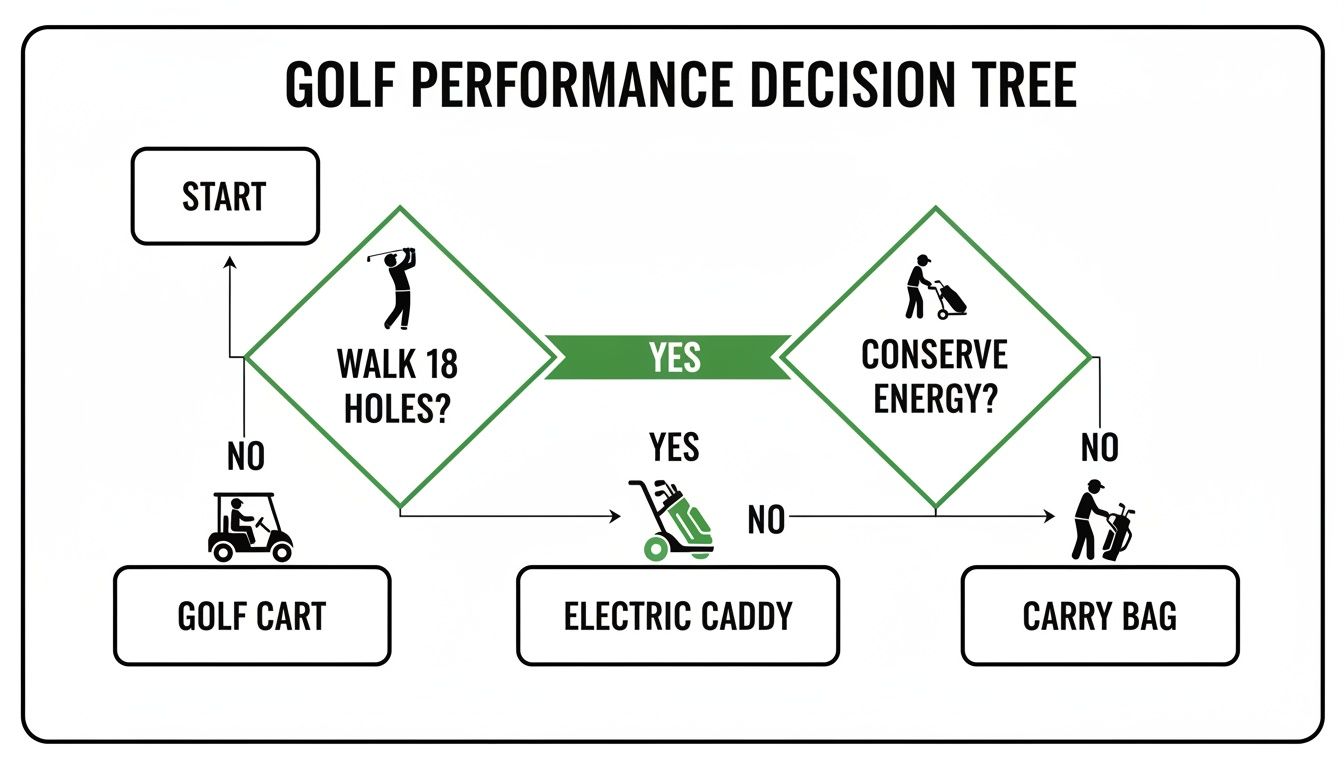
As you can see, for golfers who walk 18 holes and want to save energy for their shots, an electric caddy is the logical next step for better performance.
Controls and Usability
How you actually interact with your cart on the course is a huge deal. Some models keep it simple with handlebar-mounted controls, while others get fancy with sophisticated remotes that manage speed, forward, reverse, and braking. You can even find high-end "follow me" tech, though it definitely comes with a bigger price tag.
Key Takeaway: The best control system is the one you find the most intuitive. A simple, reliable remote that lets you focus on your next shot is often way more valuable than a system overloaded with complex features you'll never use.
Before you pull the trigger, it’s a good idea to see a detailed comparison between electric golf carts and golf scooters to figure out which style is a better fit for your game. Finally, always check the warranty. A solid 12-month warranty is a good sign that the manufacturer stands behind its product, giving you peace of mind and protecting your investment.
Installing Your Electric Cart Conversion Kit
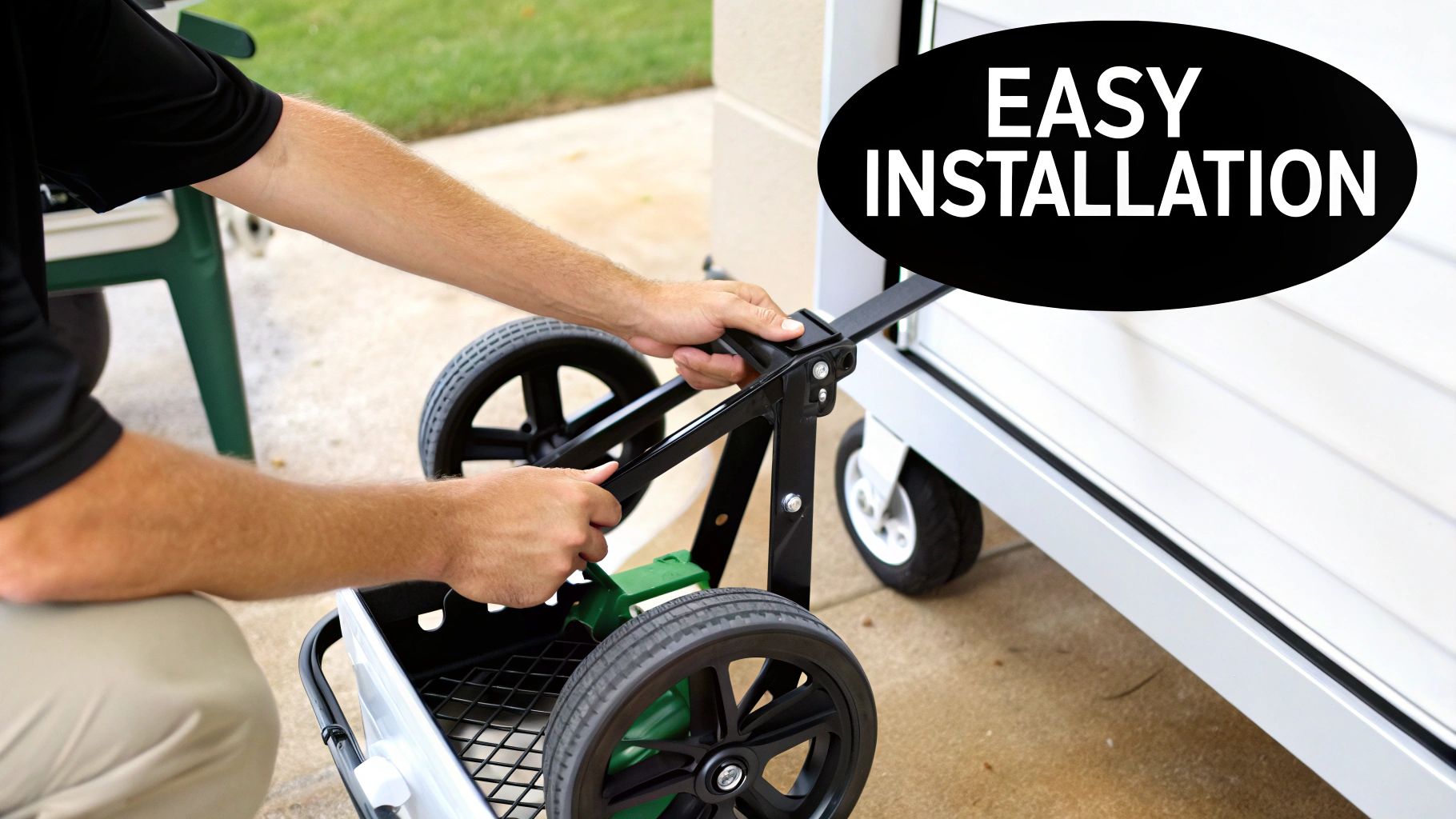
The thought of bolting a motor onto your trusty push cart might sound like a job for a mechanic, but modern conversion kits have made it shockingly simple. Forget about digging out the toolbox or dealing with a mess of wires. Systems like the Caddie Wheel are designed for a quick, frustration-free setup that gets you on the course in no time.
This isn't a complex mechanical project. Think of it more like assembling a new piece of furniture—the goal is to get you from unboxing to your first motorized round with as little fuss as possible.
From Box To Fairway In Minutes
The real magic of a well-designed kit is its "drop-on" functionality. Most of the hard work is already done for you, leaving just a few simple steps. Let’s walk through a typical setup using the Caddie Wheel as an example to show just how easy it is to upgrade.
- Attach the Mounting Bracket: This is the heart of the system. The bracket is designed to clamp or snap right onto the lower axle of your push cart. It’s built to be universal, fitting a huge range of cart models securely with just a few turns of a knob. No drilling, no problem.
- Mount the Motorized Wheel: Once that bracket is locked in, the main wheel unit just slides or clicks right into place. It’s a clean, solid connection that ensures stable power without any wobble. This step usually takes less than a minute.
- Sync the Remote Control: Power on the battery, power on the remote, and press a button to sync them up. That’s all it takes to establish a reliable connection. With the Caddie Wheel, you even get a free extra remote, so you’ve always got a backup ready to go.
And that’s it. You’ve just turned your manual push cart into one of the most efficient golf pull carts electric on the market. For a closer look, you can find more details in this easy DIY guide on how to convert a push cart to electric.
Pre-Round System Checks
Before you roll up to the first tee, it's always a good idea to run a quick systems check. This builds confidence and makes sure there are no surprises waiting for you on the back nine.
A simple, two-minute check on your driveway or in the parking lot is all you need for peace of mind. Test the forward, reverse, and braking functions to confirm the remote is synced and the wheel is responding perfectly.
This quick once-over confirms your battery is charged and the remote is communicating properly. It’s a small habit that guarantees your new motorized caddy is ready to perform when you are. The whole process proves you don't need to be an engineer to motorize your game—just a golfer ready for an easier walk.
Mastering Your Motorized Caddy On The Course

Once your new golf pull carts electric conversion kit is installed, the real fun begins. Getting the hang of it is pretty intuitive, but a few smart habits will have you handling your motorized caddy like a seasoned pro from your very first round. Think of it less like learning a new skill and more like fine-tuning your on-course strategy.
The first thing you’ll notice is the freedom. With a remote in hand, you’re no longer tethered to your gear. You can send your cart ahead to the next tee box while you walk to the green to finish your putt. This simple move doesn’t just speed up play; it keeps your head in the game, focused on the shot at hand instead of the chore of dragging your clubs around.
Navigating Different Terrains
Your home course is a mix of different landscapes, and your electric caddy is built to handle it all. The key is simply managing its speed. On flat, open fairways, you can set a comfortable walking pace and just let it cruise alongside you.
When you see a hill coming up, it’s a good idea to slow the cart down a touch before you start the climb. This gives you a steady, controlled ascent without putting extra strain on the motor. On the flip side, steep downhill paths are where the braking features really shine. Use them to keep the cart from getting away from you, keeping both you and your clubs safe and sound.
Smart Battery Management
Today’s lithium-ion batteries are incredibly efficient, but a little bit of smart management will guarantee you never run out of juice mid-round. The explosion in electric golf cart popularity—now making up nearly 70% of total unit sales in the United States—was driven by these battery improvements. With over 75,000 electric carts sold across the US and Canada in 2024 alone, this is proven, reliable tech that offers up to 40% greater energy density than older batteries. You can dig into more data on the North American golf cart market if you're curious.
To get the most out of every charge, just think about your course’s layout. If you know the back nine is a beast with lots of hills, conserve some power on the front nine by using a slightly slower pace on the flat ground. It’s a small tweak that ensures you have plenty of battery for that second 18.
Here are a few more practical tips for on-course mastery:
- Around the Green: Use the reverse function to easily back out of tight spots near bunkers or water hazards. No more awkward three-point turns.
- Parking Brake: When you stop on a sidehill lie, always engage the brake. It’s the simplest way to prevent your cart from rolling away while you take your shot.
- Remote Discipline: Keep your remote handy, but don’t constantly fiddle with the speed. Find a good pace and let the caddy do its job.
Mastering these simple techniques will make using your electric caddy feel like second nature, letting you focus completely on your game.
Got Questions? We’ve Got Answers.
Deciding to motorize your push cart is a pretty big step, and it's totally normal to have a few questions before you pull the trigger. We hear them all the time. Golfers worry about compatibility, control, and what it takes to keep these things running. The good news? The answers are usually a lot simpler than you'd expect.
Let's cut through the noise and get straight to what you really want to know. This is the no-fluff guide to the most common questions we get about golf pull carts electric.
Will It Fit My Current Push Cart?
This is the big one, the question we get more than any other. And the answer is almost always a confident "yes." Modern electric conversion kits like the Caddie Wheel are designed from the ground up to be universally compatible. The goal is to seamlessly fit the widest possible range of popular three- and four-wheel push carts out there.
The magic is in the mounting bracket. It's built to be adaptable, clamping onto the lower frame or axle of your cart. The Caddie Wheel, for example, uses a simple snap-in bracket that secures itself to most standard cart frames in a matter of seconds. No engineering degree required.
To be 100% certain, you should always double-check the manufacturer’s compatibility list or shoot their customer support a quick message with your cart’s make and model. But chances are, if you have a standard frame, you're good to go.
How Hard Is It To Control On Hills?
Another huge question centers on control, especially when the course gets bumpy. Nobody wants their cart running away from them down a steep hill or stalling out on a tough climb. Rest assured, today’s systems are built to handle exactly these kinds of challenges with total precision.
A quality electric pull cart gives you total command, not the other way around. With features like variable speed and electronic braking, you can navigate the toughest parts of the course with confidence, knowing the cart will respond exactly how you want it to.
With a simple remote in your hand, you're the pilot. You can dial in the perfect speed for any slope, slow it to a crawl for a tricky climb, or hit the brake for a safe and controlled descent. The Caddie Wheel gives you forward, reverse, and braking all from one small, intuitive remote. Seriously, after a hole or two, managing the cart becomes second nature.
Is The Battery Really Good For 36 Holes?
We get it—there's a lot of skepticism around "up to 36 holes" claims. But thanks to huge advances in high-capacity lithium-ion batteries, that number is more realistic than ever. While you might not squeeze out a full 36 on a super hilly course with a tour-sized bag, most golfers easily get 27 to 36 holes from a single charge on a typical layout.
Think of it like the mileage on your car—your results will vary based on the driving conditions. A few things can affect how long the battery lasts:
- The Course Itself: More hills mean the motor works harder.
- Your Gear: A heavier golf bag needs more juice to move.
- The Ground: Soft, wet turf creates more drag than a firm, dry fairway.
As for charging? It couldn't be simpler. A full recharge usually takes just a few hours with the portable charger. It’s a routine as easy as plugging in your phone after a long day. Just plug it in when you get home, and it’ll be ready for your next round.
What Kind Of Maintenance Does It Require?
Here's one of the best parts about an add-on motor wheel: there’s barely any maintenance. These systems are designed to be tough and simple, so you can spend your time golfing, not tinkering in the garage. The motor is typically a sealed unit, keeping all the important bits protected from dirt, grass, and moisture.
Your entire maintenance checklist is refreshingly short:
- Keep It Clean: A quick wipe-down after your round to get rid of mud or grass is all it needs.
- Check the Tire: Make sure the tire pressure is good. A properly inflated tire runs more efficiently.
- Store the Battery Smartly: If you're not playing for a while, just store the battery in a cool, dry spot.
That’s pretty much it. No oil changes, no spark plugs, no complicated parts to worry about. A little cleaning and regular charging are all it takes to keep your electric caddy running like a champ for years.
Ready to make every walk on the course effortless? The Caddie Wheel is designed for golfers who want to conserve energy and focus on their game. Experience the difference a lightweight, powerful, and easy-to-install electric motor can make.
Partager:
Golf cart dimensions: A Comprehensive Guide to Sizes (golf cart dimensions)
Best motorized push cart: Your guide to the best motorized push cart options