
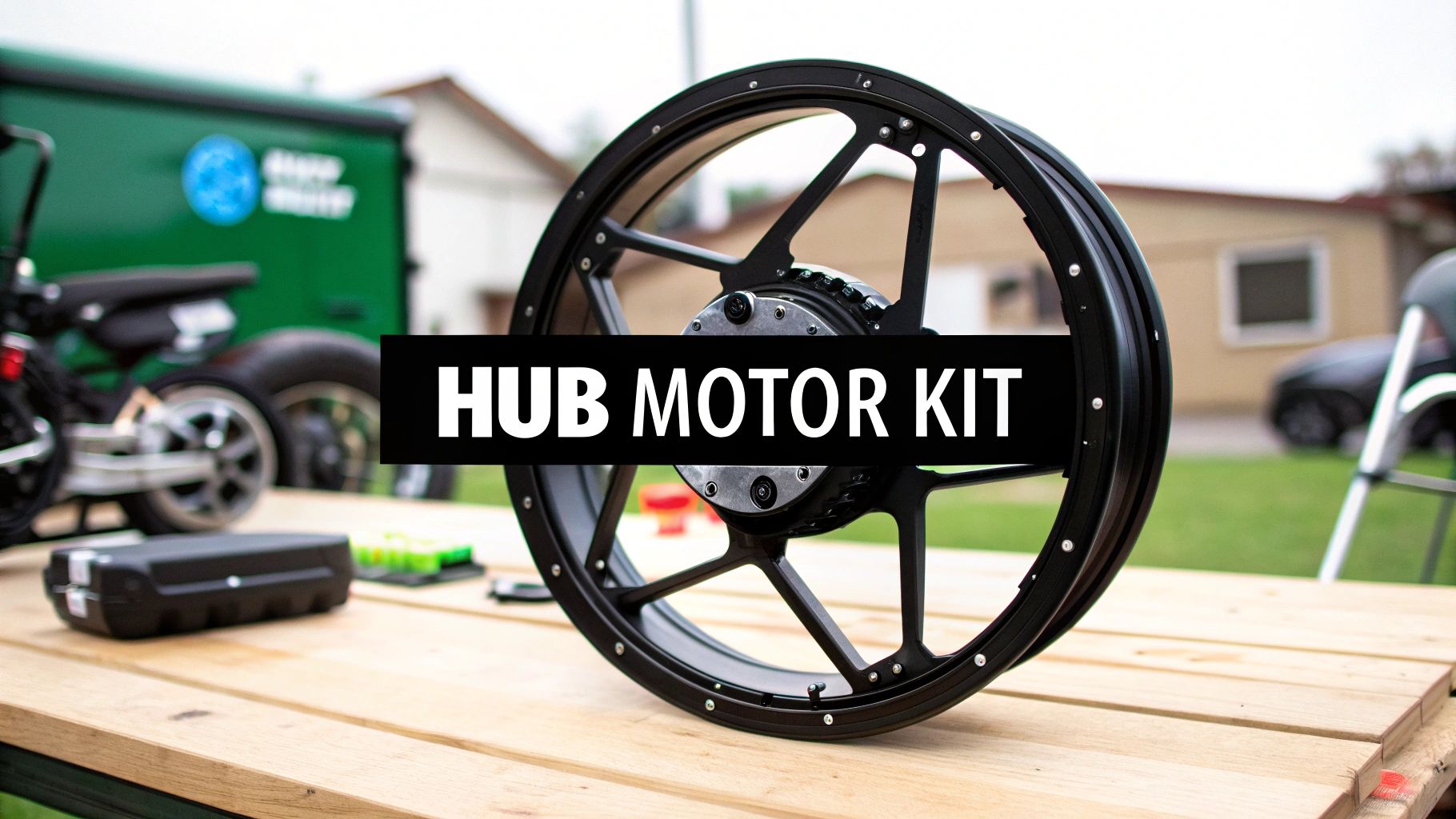
At its core, a hub motor kit is a clever all-in-one system designed to turn a regular bicycle or push cart into an electric-powered machine. It neatly packages the motor, controller, and gearing directly into the center of a wheel, offering a surprisingly simple way to add power without a messy, complicated installation.
Decoding the All-in-One Power Wheel
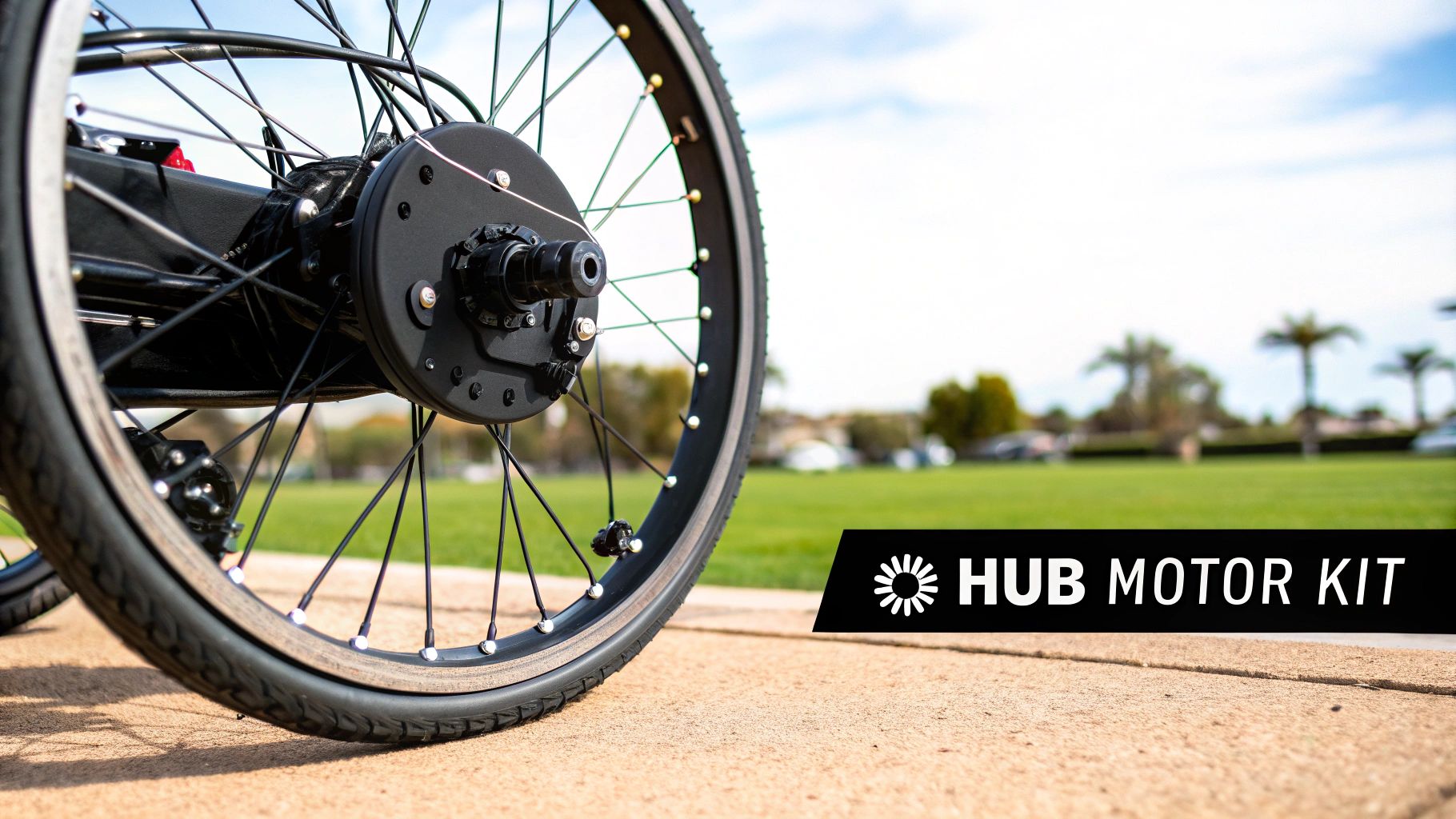
Think of a hub motor kit as a self-contained engine built right into your wheel. Instead of bolting a separate motor to the frame and fussing with chains or belts, this design integrates everything you need directly into the wheel’s hub. It’s an elegant solution that takes the headache out of going electric.
The magic happens the moment you ask for power. A battery sends juice to a controller—the brain of the operation—which then tells the motor exactly how fast to spin. Just like that, the wheel turns, and you’re moving forward effortlessly.
The Core Components
Every hub motor kit, at its heart, is made up of a few key parts working together. Getting to know them is the first step to seeing just how effective this simple technology can be.
- The Hub Motor: This is the powerhouse of the kit. It's a brushless motor tucked away inside an oversized wheel hub, generating the torque needed to get you moving.
- The Controller: This small electronic box is the manager. It takes your commands from a throttle or remote and tells the motor what to do, managing the flow of power from the battery.
- The Battery: This is the fuel tank for the entire system, usually a rechargeable lithium-ion pack. Its size and capacity will determine your range and how much punch you get.
- The Throttle or Remote: This is how you communicate with the system. It could be a thumb throttle on a bike or a simple handheld remote for a push cart, giving you control over speed and power.
This streamlined, all-in-one design is a big reason why hub motors lead the e-bike industry. Their versatility makes them perfect for everything from city commuters to heavy-duty cargo bikes. In fact, the global e-bike motor market is expected to hit USD 42.73 billion by 2034, with hub motors dominating thanks to how easy they are to retrofit onto existing frames.
A Real-World Example on the Golf Course
Picture this: you're standing at the bottom of a steep hill on the 12th hole. Instead of gritting your teeth and shoving your heavy push cart up the incline, you just press a button. That’s a hub motor kit like the Caddie Wheel in action.
The Caddie Wheel takes the hub motor concept and dials it in perfectly for golfers. It’s a tough, powerful wheel that you simply drop onto your existing push cart, instantly turning it into your own electric caddie. No complicated wiring, no bulky external batteries—just clean, reliable power.
This is the ultimate benefit of a well-designed hub motor kit: it makes powerful technology accessible. It lets you upgrade the gear you already own with minimal fuss, saving your energy for what really matters—your golf game. By packing everything into a single wheel, it completely removes the technical barriers that used to make electric conversions feel so intimidating. If you're curious and want to dive deeper into how all these pieces fit together, check out our guide on how a wheel hub motor kit functions.
Comparing the Different Types of Hub Motors
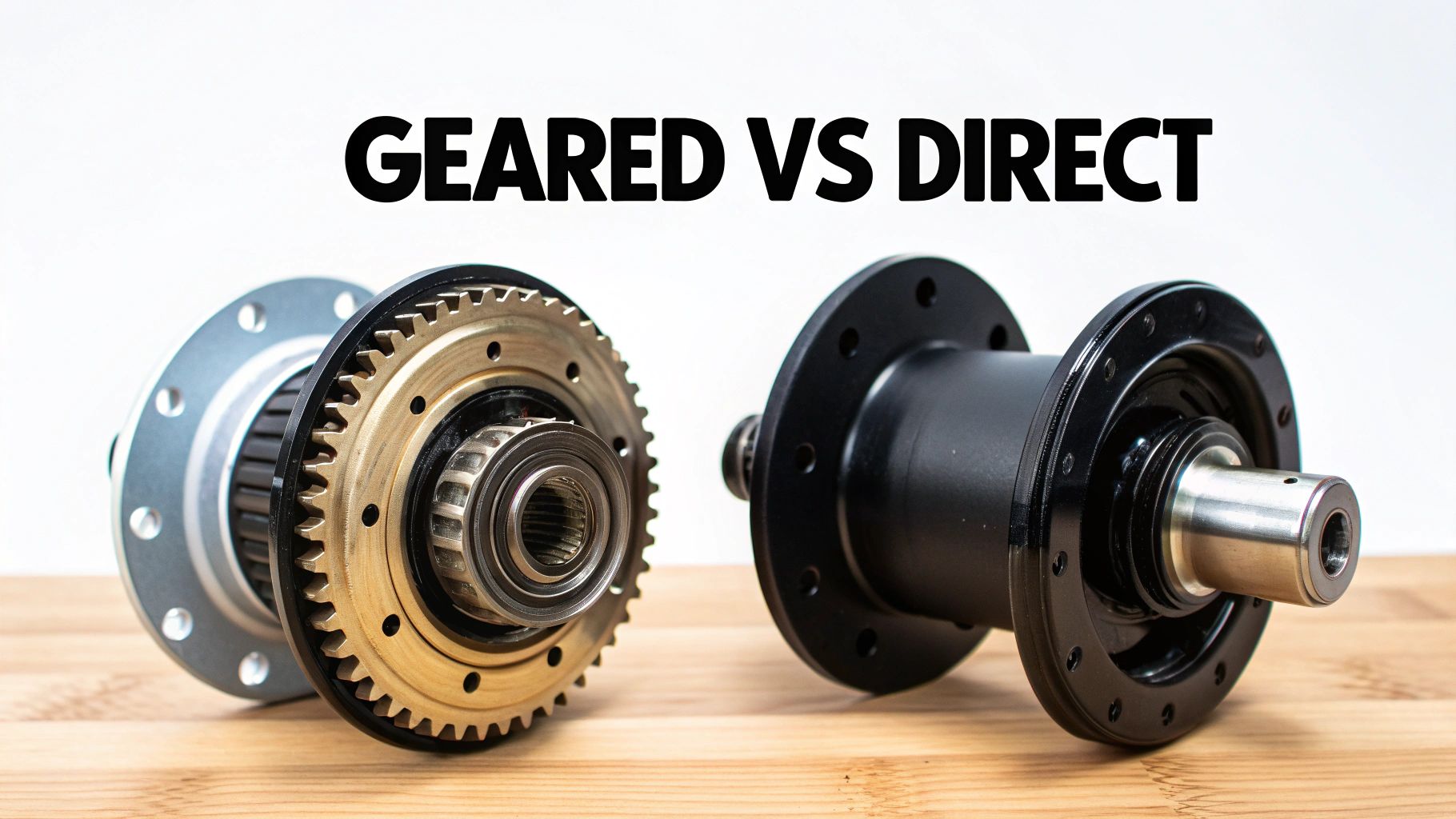
When you start looking into hub motor kits, one of the first forks in the road you'll encounter is the choice between two core designs: geared hubs and direct drive hubs. Think of it like picking between a vehicle with a transmission and one without. Each has its own distinct personality and is built for different kinds of performance.
A geared hub motor has a clever system of planetary gears tucked inside its casing. This internal gearing acts like a small transmission, letting a smaller, high-revving motor spin at its sweet spot while turning your wheel at a slower, much more powerful rate. It’s a real game-changer for getting serious torque out of a compact package.
On the other hand, a direct drive hub motor is pure simplicity—no internal gears at all. The motor's axle is the wheel's axle, meaning the motor spins at the exact same speed as the wheel. This design is mechanically straightforward, with the hub itself being the only major moving part. The result is whisper-quiet operation and the ability to add cool features like regenerative braking.
While they both get the job done, their differences in weight, torque, and efficiency make them better suited for very different tasks, from zippy city e-bikes to rugged golf course workhorses.
Geared Hub Motors: The Torque Kings
Ever tried to push a heavy door open by pressing near the hinge versus pushing from the handle? The handle gives you leverage, making the job worlds easier. The internal gears in a geared hub motor work on the exact same principle, multiplying the motor's force to deliver fantastic low-speed torque.
This is what makes geared hubs the undisputed champions of hill climbing. For any golfer who's had to wrestle a heavy bag up the steep, rolling hills of a course, this is non-negotiable. A geared hub motor kit delivers the raw pulling power needed to climb an incline without breaking a sweat.
- Lightweight Design: Because the internal motor can be smaller and more efficient, geared hubs are typically much lighter. This improves handling and makes the cart or bike easier to manage.
- High Torque Output: That gear reduction is perfect for getting going from a dead stop and conquering hills.
- Freewheeling Efficiency: When you’re not using the motor, an internal clutch allows the wheel to spin freely with almost zero drag.
This winning combination of low weight and high torque is precisely why the Caddie Wheel uses a geared hub motor. It provides the ideal power-to-weight ratio for a golf course's demanding terrain without adding a bunch of unnecessary bulk to your push cart.
Direct Drive Hubs: The Silent Operators
A direct drive motor is the strong, silent type in the hub motor world. With no gears clattering away inside, its operation is incredibly smooth and quiet. The motor simply and directly spins the wheel, making for a reliable, no-fuss system.
One of the standout features of a direct drive hub is its ability to perform regenerative braking. When you slow down or go downhill, the motor can act as a generator, converting your momentum back into a small trickle of electrical energy to recharge the battery.
A geared hub is like a powerful rock climber, using leverage and technique to scale steep faces. A direct drive hub is more like a marathon runner—built for silent, sustained endurance on flatter ground.
While "regen" is a neat trick, direct drive hubs are heavier and larger than their geared cousins. They also struggle a bit with efficiency at low speeds, which can be a real downside in stop-and-go situations or when you're staring down a steep hill. If you're curious about other electric motor designs that are pushing the boundaries of efficiency and design, it's worth learning about the axial flux motor.
Geared Hub vs Direct Drive Hub Motor Comparison
To make the choice clearer, here’s a side-by-side look at how these two motor types stack up.
| Feature | Geared Hub Motor | Direct Drive Hub Motor |
|---|---|---|
| Torque | High, especially at low speeds and on hills | Low, less effective for steep inclines |
| Weight | Lighter and more compact | Heavier and larger |
| Noise Level | Audible whirring from internal gears | Nearly silent operation |
| Efficiency | More efficient at low speeds | Less efficient at low speeds, better at high speeds |
| Complexity | More internal moving parts (gears) | Mechanically simple, with one moving part |
| Regenerative Braking | Not possible due to the freewheeling clutch | Yes, can recapture a small amount of energy |
| Best For | Hill climbing, heavy loads, stop-and-go (like golf) | Commuting on flat terrain, high-speed cruising |
Ultimately, the right motor depends entirely on the job you need it to do. For applications like a golf caddie, where conquering hills with a heavy bag is the primary challenge, the high torque and low weight of a geared hub make it the obvious winner.
How to Choose the Right Hub Motor Kit
Picking the right hub motor kit can feel a bit like staring at a foreign language. But once you know what to look for, the technical specs start to make sense, and the whole process becomes much more straightforward. The key is to stop thinking about abstract numbers and start focusing on what they mean for you out in the real world.
The goal here is simple: find a kit that matches what you want to do, whether that’s building a zippy e-bike for your commute or motorizing a golf push cart to take the strain off your back. Getting this part right means you’ll have all the performance you need without paying for power or features you’ll never touch.
Decoding Power and Voltage
The first specs you’ll likely run into are watts (W) and volts (V). It’s helpful to think of voltage as the “pressure” in an electrical system—it’s what pushes the power to the motor. Wattage, on the other hand, is the total power that motor can put out. A higher voltage system, like 48V, is generally more efficient at delivering that power than a 36V system, which often translates to better all-around performance.
Wattage is what you’ll feel in terms of raw power and speed. A 250W motor is perfectly fine for cruising on flat ground, but if you’ve got steep hills on your route, you’ll be glad you have the extra muscle of a 750W or 1000W motor. For a golf push cart, however, it’s not about top speed. It’s all about sustained torque—having enough grunt to pull a heavy bag up a grassy hill without breaking a sweat.
Understanding Battery Compatibility and Range
Your battery is the fuel tank. How far you can go on a single charge comes down to its capacity, which is measured in Amp-hours (Ah) and Watt-hours (Wh). To get the clearest picture of a battery's total energy, look at the Watt-hours. You can calculate it yourself by multiplying the volts by the amp-hours (for example, 36V x 10Ah = 360Wh).
A bigger Wh number means you’ve got more fuel in the tank for longer rides. But your actual, real-world range depends on a lot more than just that number.
- Terrain: Hills are a battery killer. They’ll drain your power way faster than a flat bike path.
- Load Weight: The heavier you are—or the heavier your golf bag is—the more energy the motor needs to use.
- Assist Level: If you’re constantly using the highest power setting, don’t expect to get the maximum advertised range.
For a golfer, range isn't about miles; it's about holes. That’s why a system like the Caddie Wheel is built with a high-capacity battery specifically optimized to last for up to 36 holes. It’s designed so you can play two full rounds without ever worrying about running out of juice.
This is the advantage of an all-in-one system. Instead of playing a guessing game trying to match a motor to a third-party battery, you get a setup that’s already dialed in for its job, guaranteeing performance you can count on.
Ensuring Correct Wheel Size and Fit
This is a step you absolutely can't skip. A hub motor kit is useless if it doesn't physically fit on your bike or cart frame. The most important measurement you need is the dropout spacing—that’s the distance between the two frame arms where your wheel’s axle sits. For bikes, this is often 100mm for the front and 135mm for the rear, but you have to measure your own to be sure.
The wheel diameter also has to match your existing wheels, whether it's 26-inch, 27.5-inch, or 700c. When you’re dealing with something specialized like a golf push cart, getting the fit right is even trickier. This is where a purpose-built solution really shines. The Caddie Wheel, for instance, was designed with a universal bracket system that snaps onto most three- and four-wheel push carts in minutes, no modifications needed. It just works.
If you want to dig deeper into the different motor options available, check out our guide on how to choose the best electric motor for a golf cart.
Looking at the big picture, the hub motor market reflects a broader move toward these kinds of compact, efficient electric motors. The market was valued at USD 11.32 million in 2023 and is projected to hit USD 17.26 million by 2032. Pedelecs (pedal-assist e-bikes) are the biggest piece of that pie, because hub kits make it so easy to add power to lightweight vehicles—like an electric golf caddie. For Caddie Wheel, this heritage results in a tough, reliable wheel that snaps onto a cart and gives you enough battery to play all day, without any bulky or complicated setup. You can find more market insights over at SkyQuestt.com.
Evaluating Controllers and Displays
Finally, you need to think about how you’ll actually use the motor. The controller is the brain of the whole system, and your display or remote is how you tell it what to do. The options here are pretty broad, from a simple thumb throttle to a fancy LCD that works with pedal-assist sensors (PAS).
On an e-bike, a PAS is fantastic. It senses when you start pedaling and kicks in a bit of power, which feels really natural. But for a golf cart, simple is almost always better. A straightforward handheld remote with buttons for forward, reverse, and speed adjustments is far more practical than a complicated display you have to fiddle with. An integrated kit like Caddie Wheel comes with a pre-programmed remote that’s intuitive to use right out of the box.
An Overview of the Installation Process
The thought of installing a hub motor kit might feel a bit intimidating, but it’s usually much more straightforward than it looks. You don’t need to be an engineer. The whole process is really just a logical sequence of steps that anyone can follow. Let’s walk through what a typical installation looks like to demystify the process and show you what to expect.
Forget dense technical manuals. A standard conversion really only breaks down into three main phases: swapping out the wheel, mounting your components, and then tidying up all the wiring. Each part is a manageable task that gets you one step closer to that effortless ride.
Swapping the Wheel
First things first, you'll be replacing one of your existing wheels with the new hub motor wheel. This is the biggest part of the job. You'll start by removing the old wheel, which is usually as simple as undoing a few nuts or flipping a quick-release lever. Then, you just slide the new hub motor wheel right into the same slots on your frame, which are called dropouts.
You want to make sure the axle fits in there snugly. Once it’s in place, you’ll tighten it down with the nuts and washers that come with the kit. But this is also where a crucial safety component comes into play.
Why Torque Arms Are So Important
One of the most vital—and most often overlooked—parts of any hub motor installation is the torque arm. A hub motor puts out a serious amount of rotational force. Without a torque arm to brace it, that force can literally cause the axle to spin right inside the dropouts, which can chew up your frame and, in a worst-case scenario, cause the wheel to fall off.
A torque arm is a small metal bracket that braces the motor’s axle against the frame itself, stopping it from spinning. If your kit is pushing anything over 250W, installing a torque arm is non-negotiable. It’s an insurance policy that keeps all that power safely under control.
Installing a powerful hub motor without a torque arm is like trying to hold back a fire hose with just your bare hands. You might hang on for a second, but eventually, that force is going to win. The torque arm gives you the mechanical leverage needed to handle that power safely.
Mounting Components and Routing Cables
With the wheel securely in place, it’s time to find a home for the other key parts of your kit. This means finding a good spot on your frame to mount the battery pack and the controller (the brains of the system). Most kits will give you brackets or bags specifically for this.
Once everything is mounted, you connect it all together by routing the cables. Think of this step as connecting the nervous system for your new electric ride. You'll run wires from the battery to the controller, and from the controller out to the motor and the throttle. Taking a few extra minutes to manage your cables neatly isn't just about looks; it keeps wires from getting snagged or damaged. A few zip ties along the frame will give you a clean, professional finish that’s built to last.
A Radically Simpler Alternative
While a standard e-bike conversion is definitely a doable project, some solutions have completely redesigned the process to be as simple as possible. The Caddie Wheel, for example, was built from the ground up to eliminate almost all of these steps for golfers.
Instead of a multi-hour project with a toolbox and a bit of technical know-how, the Caddie Wheel offers a "drop-on" installation that’s about as easy as it gets.
- Remove Your Old Wheel: Just pop off one of your push cart's rear wheels.
- Attach the Caddie Wheel: Slide the Caddie Wheel right onto the same axle.
- Snap on the Bracket: Secure it with a simple, tool-free bracket.
And that’s it. The whole thing takes less than two minutes. There’s no separate battery to mount, no controller to wire up, and no need for a torque arm. It’s a fully integrated system where the motor, battery, and receiver are all housed inside a single, tough-as-nails wheel. This is a world away from a typical e-bike conversion and highlights its biggest selling point: making electric power truly accessible to every golfer, no matter their technical skill.
Keeping Your Hub Motor Kit Running Smoothly
Once you've got your hub motor kit installed, a little bit of care goes a long way. Think of it less like serious mechanical work and more like a simple health check-up you'd do before a long trip. Staying on top of a few key things helps you catch small issues before they turn into bigger headaches, ensuring your ride is always smooth, safe, and ready to go.
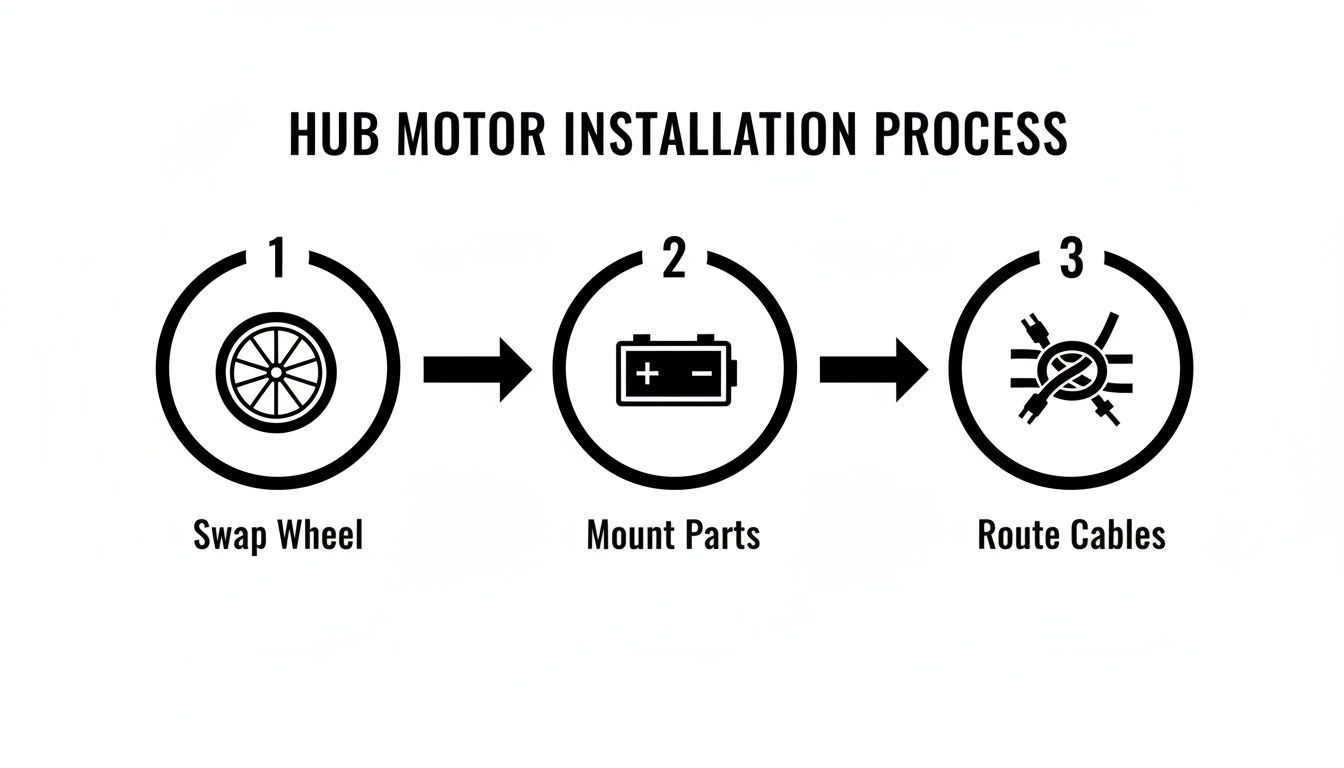
At the end of the day, the whole process really just boils down to swapping out the original wheel, mounting the key components, and connecting everything with the included cables.
Your Essential Maintenance Checklist
Just like any other vehicle, your new electric-assist setup will thank you for some routine attention. A quick once-over every few rides can make a huge difference. This short list covers the most important things to keep an eye on.
- Inspect Electrical Connections: Wiggle the plugs and connectors to make sure they're seated firmly. Keep them clean and dry, as a loose or dirty connection is a classic culprit for power cutting out unexpectedly.
- Monitor Tire Pressure: The extra weight from the motor and battery makes proper tire pressure more important than ever. An underinflated tire creates more drag and will absolutely drain your battery faster.
- Check Spoke Tension: That motor puts a lot of torque through the wheel. Every so often, just gently squeeze pairs of spokes around the wheel. If any feel obviously loose or flimsy, they might need tightening. A well-tensioned wheel is a strong wheel.
Maximizing Your Battery Lifespan
The lithium-ion battery is the heart and soul of your kit, so treating it right is the secret to its longevity. These batteries are happiest when they aren't constantly pushed to their absolute limits.
Try to avoid running the battery completely dead before you charge it. A great habit is to top it off after each use, or at least before it dips below 20%. On the flip side, don't leave it sitting on the charger at 100% for weeks if you aren't using it. For long-term storage, like over the winter, aim for a charge level somewhere between 40-60% and store it in a cool, dry place. For a deeper dive, check out our complete guide to golf cart battery maintenance.
Critical Safety and Legal Considerations
With more power comes a greater need for awareness. The extra weight and speed from a hub motor will change how your bike or cart handles—especially when it comes to braking. Always give yourself a bit more stopping distance than you're used to. For higher-powered kits on bicycles, a torque arm is a non-negotiable piece of safety gear that prevents the motor's force from damaging your frame's dropouts.
It’s also crucial to know the rules of the road (or path). Many regions have specific laws for e-bikes, often limiting motor power to 750W and capping the assisted speed on public trails.
The Caddie Wheel is engineered specifically for the low-speed, unregulated environment of a golf course. This design choice eliminates any legal guesswork, letting you focus entirely on your game with the added confidence of a comprehensive 12-month warranty.
This focus on simplicity is what has propelled the entire e-bike conversion scene. Hub motor kits have made it incredibly easy for anyone to upgrade their ride, contributing to a global market expected to hit USD 13.51 billion by 2031. This explosive growth is led by geared hub motors, which captured a staggering 61.45% market share in 2025 because they are so affordable and straightforward to install. You can learn more about this trend with additional market analysis from Mordor Intelligence.
Frequently Asked Questions About Hub Motor Kits
Even after getting the hang of how hub motor kits work, it’s totally normal to have a few questions pop up. This is where we tackle the practical, real-world concerns that come to mind when you start getting serious about picking the right kit. We'll give you clear, straight answers to help you feel confident in your decision.
How Much Power Do I Actually Need?
The perfect amount of power really boils down to what you’re trying to do. It’s not about chasing the biggest number; it's about matching the motor’s muscle to the job. For an e-bike meant for cruising around town on flat streets, a 250W to 350W hub motor kit is often the sweet spot. It also keeps you on the right side of local regulations in many areas.
If your daily commute includes some decent hills or you plan on hauling heavier loads, bumping up to a 500W kit strikes a fantastic balance between power and battery efficiency. For anyone tackling seriously steep terrain or looking for some real zip, kits in the 750W to 1000W range deliver that extra torque and acceleration.
But for a specialized job like powering a golf push cart, the whole game changes. Top speed is completely irrelevant. What you actually need is controlled, steady torque at very low speeds.
Think of it this way: a sports car’s high-horsepower engine is great for a racetrack but totally useless for towing a heavy boat. For that job, you need the low-end grunt of a truck. A golf cart motor needs to be the "truck," not the "sports car."
This is exactly why a product like the Caddie Wheel works so well. Its motor isn't built for speed—it's optimized to deliver the consistent pulling power needed to get a heavy golf bag up grassy, slick, and steep hills without skipping a beat.
Will a Hub Motor Kit Fit My Bike or Cart?
Compatibility is one of the most important—and easiest to overlook—parts of choosing a hub motor kit. While these kits are designed to be pretty adaptable, they are definitely not one-size-fits-all. The single most crucial measurement you need to take is the "dropout" spacing. This is simply the distance between the two points on your frame where the wheel's axle mounts.
For most bikes, this is typically 100mm for a front wheel and 135mm for a rear wheel, but you absolutely have to measure your specific bike to know for sure. Trying to force a hub that doesn't match your dropout spacing is a recipe for a failed installation or, worse, a damaged frame.
Beyond that, you have to think about a few other things:
- Frame Material: Is your frame strong enough for the motor's torque? (Aluminum and steel are usually fine, but carbon fiber can be tricky).
- Brake Type: Will the motor hub work with your disc brakes, or is it made for older rim brakes?
- Axle Design: For push carts, the axle diameter and the way it mounts have to be a perfect match.
This is where the guesswork can get you into trouble. Purpose-built solutions are designed to get rid of these headaches entirely. The Caddie Wheel, for example, was engineered with specific compatibility brackets that guarantee a perfect, secure fit on the vast majority of major three- and four-wheel push cart models, taking all the installation anxiety out of the equation.
What Is the Difference Between a Hub Motor and a Mid-Drive Motor?
The main difference between these two popular motor types comes down to where they're located and how they get power to the ground. A hub motor, as we've covered, lives in the center of the wheel itself. It spins the wheel directly and works completely independently of the bike's gears, which makes it simpler, cheaper, and way easier to install.
A mid-drive motor, on the other hand, is mounted right where your pedals are, at the crankset. It drives the chain, which means it can take advantage of the bike's existing gears. This lets the motor run in its most efficient RPM range, giving it incredible performance on really long, steep climbs. The trade-off is that mid-drive systems are more expensive, much more complex to install, and put extra wear and tear on your chain and cassette.
For any application that doesn’t have gears, like a golf push cart, a hub motor kit is the obvious and logical choice. It delivers power directly and efficiently without a complex system you don't even need.
How Long Does the Battery Last on One Charge?
Battery range is probably the trickiest thing to pin down because it's affected by so many real-world factors. The range advertised on the box is just a starting point. Your actual distance will come down to:
- Battery Capacity: Measured in Amp-hours (Ah) or Watt-hours (Wh), this is basically the size of your "fuel tank."
- Motor Power: A 1000W motor will chew through a battery much faster than a 250W one.
- Total Weight: The combined weight of the rider, bike, and whatever you're carrying (like a golf bag).
- Terrain: Hills are the biggest battery drain for any electric motor. Period.
- Assist Level: Running on the highest power setting all the time will definitely shorten your range.
A typical 36V 10Ah e-bike battery might get you 20-40 miles, but for a golfer, the metric isn't miles—it's holes. A well-designed system gets this. The Caddie Wheel's high-capacity battery is specifically matched to its motor's power draw and the typical demands of a golf course, ensuring it can easily last up to 36 holes (two full rounds) on a single charge. That’s more than enough juice for even the most dedicated golfer's longest day on the links.
Ready to take the strain out of your walk and focus purely on your game? The Caddie Wheel offers a powerful, reliable, and incredibly simple hub motor solution designed by golfers, for golfers. Experience the difference of a perfectly integrated system that installs in minutes and lasts for 36 holes.
Partager:
Your Complete Guide to a Golf Cart Battery Watering System
The Ultimate Guide to Electric Golf Walking Carts