
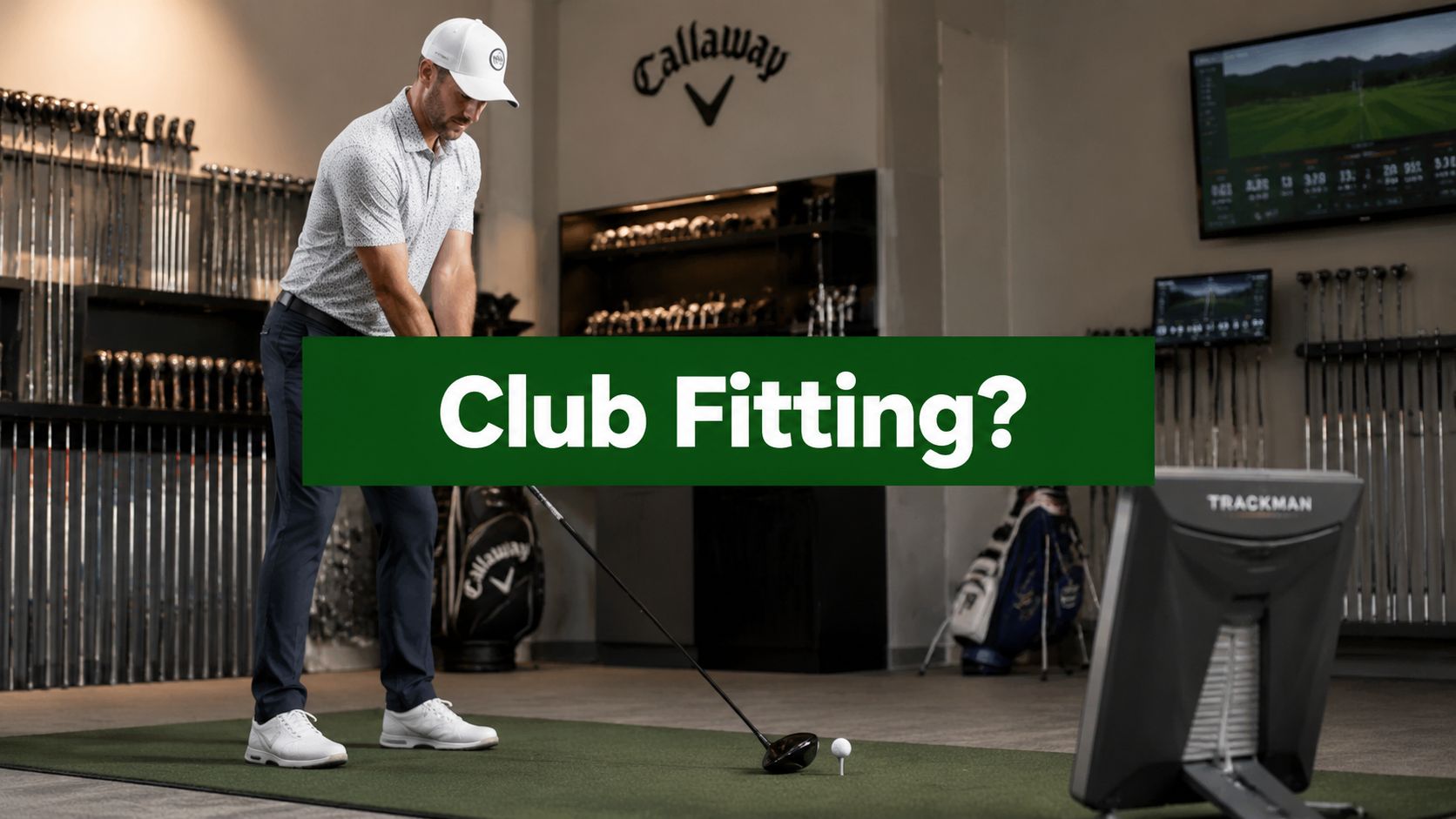
You buy a new driver, take it straight to the course, and expect at least one problem to disappear. Maybe the weak cut finally turns into a playable fade. Maybe the pull with the irons settles down. Maybe the contact stops feeling random.
Then the round starts, and the same misses show up.
That's the moment most golfers ask the wrong question. They ask whether club fitting is worth the money in general. The better question is whether getting fit for golf clubs is worth it for your game, your budget, and your goals.
Lessons and fittings do different jobs. A lesson changes motion. A fitting changes the tool. If your swing is the main issue, no shaft on earth fixes that. But if you've got a repeatable move and the club is fighting you, practice can turn into expensive frustration.
The Frustrating Plateau Most Golfers Face
A lot of golfers reach the same point. They practice enough to know their tendencies. They can hit some very good shots. They can also hit the same bad shot over and over with different clubs and start to wonder whether they're making the right swing or just compensating for the wrong equipment.
That's where the plateau gets frustrating. You're not clueless anymore, but you're not improving the way you expected to.
When the problem isn't only the swing
I've seen golfers buy solid off-the-rack sets and still fight start direction, strike quality, and distance control. They assume the answer must be more reps. Sometimes it is. Sometimes the club is a bad match for the way they stand to the ball, deliver the head, or release the face.
A player with clubs that are too long may never look comfortable at address. A player with the wrong grip size may squeeze too hard or struggle to square the face. Someone using a shaft that doesn't fit their tempo may feel like they're timing the club rather than swinging it.
The biggest mistake is expecting equipment to fix a broken motion, or assuming equipment never matters. Both ideas cost golfers strokes.
There's also a physical side to this. If a golfer is fighting tight hips, back stiffness, or limited rotation, the club and the body can work against each other. For players trying to sort out that side of the game, this overview of chiropractic for golfers is a useful complement to the equipment conversation.
The real question is personal ROI
This is why “is getting fit for golf clubs worth it” doesn't have a simple yes or no answer. For a committed golfer with a stable swing, it can be a smart performance investment. For a beginner whose swing changes every lesson, it can be money spent too early.
A good fitting doesn't promise magic. It gives you a clearer answer to three practical questions:
- Are your clubs helping or hurting? You want to know whether ball flight problems come from motion, equipment, or both.
- Will better specs show up on the course? Range sessions can fool you. Scoring is what matters.
- Is the cost justified for your level of play? That depends on how often you play, how seriously you practice, and what kind of improvement matters to you.
That framework matters more than hype. If you use it objectively, you can decide whether fitting is a smart next step or a distraction.
What Actually Happens During a Professional Club Fitting
A professional fitting is closer to tailoring than shopping. You're not picking the prettiest head and hoping for the best. You're testing how specific club variables affect your launch, direction, strike, and consistency.
The session starts with your current pattern
A fitter usually begins by watching you hit your own clubs. That baseline matters. Without it, there's no way to tell whether a new setup is better or just newer.
The session usually looks at your normal ball flight, your common miss, and how the club interacts with the ground. If you want a better sense of the equipment categories involved before you go, this guide on how to choose golf clubs for your game is a helpful primer.
What the fitter is trying to change
Fitters aren't guessing. They're matching measurable club properties to what your swing does.
According to fitting guidance from Stix Golf, equipment variables can measurably change launch conditions and dispersion, and a shaft that is too stiff or soft, or a lie angle that is too upright or flat, can alter face delivery and start direction, forcing compensations that reduce repeatability and consistency in the first place (Stix Golf on golf club fitting).
That sounds technical, but the practical version is simple:
- Shaft fit affects timing and delivery. Weight, flex, and profile influence how the club feels during the swing.
- Lie angle affects start direction. If it's wrong, you may keep seeing the same directional bias.
- Loft affects launch and gapping. The goal isn't “stronger” or “weaker.” It's playable ball flight.
- Length affects posture and strike. The right length helps you set up naturally and find the middle more often.
- Grip size affects hand action and comfort. Too big or too small can change how you release the club.
What you should expect from a good fitter
A good fitter explains cause and effect. If you test a different shaft, you should hear why it's being tested. If they bend lie angle or change loft, you should understand what problem they're trying to solve.
Practical rule: If the session feels like a sales demo instead of a diagnosis, it's not a fitting. It's shopping with a launch monitor.
The best fittings also stay grounded in your actual game. A golfer who plays once a month doesn't need the same level of optimization as a player trying to shave strokes off a reliable handicap. The clubs still need to fit, but the level of precision worth paying for is different.
Fitting is optimization, not rescue
Golfers often misinterpret the role of a fitting. They show up hoping the fitter can erase a slice or produce effortless distance. A real fitting won't do that.
What it can do is remove equipment mismatch so your motion has a fair chance. That's a big difference. If the club stops forcing bad compensations, your good swings become more repeatable and your misses often become more playable.
Quantifying the Performance Gains from Fitted Clubs
Golfers hear vague promises all the time. Better feel. More confidence. More forgiveness. Those things matter, but they're hard to price.
The stronger case for fitting is that it can show up in actual scoring.

The clearest data point most golfers care about
A major independent survey reported by Greystone Country Club found that golfers who were custom-fit were 22% more likely to improve their scores by 2 strokes or more per round, and 56% more likely to improve by 3 strokes or more per round (Greystone Country Club on custom fitting results).
That matters because score is the only result most golfers can't talk their way around. You can love the sound of a driver and still shoot the same number. You can feel great over a set of irons and still miss greens in the same places. If fitting helps move actual scoring, the conversation gets more serious.
Why those gains happen
The gains usually don't come from one dramatic change. They come from small improvements stacking up over a round.
A properly fit driver can help you start the ball in a better window and keep your misses tighter. A better iron fit can improve start line and turf contact. Wedges that match your setup and delivery can make distance control less guessy.
For golfers working on the full motion side too, understanding the parts of a golf swing helps separate what belongs to technique from what belongs to equipment.
What fitting improves most often
The strongest real-world benefits usually fall into three buckets:
-
Accuracy and dispersion
If your clubs fit your delivery, you don't have to make as many compensations. That often means a tighter pattern, even when the swing isn't perfect. -
Distance that's usable
More distance only matters if the ball flight is playable. A fitter tries to find launch conditions that produce carry you can trust, not just one hero shot. -
Consistency under normal play
The best evidence of a good fit isn't one flushed shot. It's when your ordinary swing produces more ordinary good results.
Good fitting makes your normal swing work better. It doesn't build you a tour swing for free.
Who sees the biggest payoff
Not every golfer gets the same return. In my experience, the biggest payoff usually goes to players who already have a repeating pattern. They may not be scratch. They may still fight one side of the course. But they deliver the club similarly enough that a fitter can match equipment to that motion.
Golfers at that stage often stop chasing random upgrades and start seeing the bag as a scoring system. Driver launch, iron start line, wedge distance control, and comfort all start to connect.
That's why the value of fitting is often misunderstood. The point isn't to own custom clubs. The point is to reduce mismatch so the swing you brought to the course has a better chance to produce shots you can plan around.
Breaking Down the Costs and Calculating Your ROI
Most golfers don't hesitate because they doubt the concept. They hesitate because they're doing the math.
That's fair. A fitting can be a smart investment, but only if the timing and scope match your game.
What you may actually pay
Golf.com notes that fittings can range from roughly $50 to $600+ depending on the scope, and it also points out that for many beginners, swing patterns change after coaching, which can reduce the long-term payoff of a full fitting done too early (Golf.com on club fitting costs and timing).
That range alone tells you something important. “Club fitting” isn't one product. It can mean a quick single-club session, a driver-only analysis, or a full-bag appointment.
How to think about value instead of price
A lot of golfers spend emotionally on gear and logically on fitting, when it should often be the reverse. Buying a random new club because it looks better is easy. Paying for a process that tells you what fits feels less exciting, even though it may be the smarter use of money.
That's true in golf and outside it. If you like thinking in terms of durable purchases that justify their price over time, this guide for investing in professional fitness gear offers a useful mindset.
You can also compare fitting cost against the mistake it prevents. Buying the wrong set off the rack is expensive if you then spend months trying to play around it. For golfers shopping with budget in mind, looking at the best golf sets for the money can help frame whether a fitting should come before or after the club purchase.
A practical ROI checklist
Use these questions before you book anything:
-
How stable is your swing right now?
If your setup, tempo, and miss pattern change every week, a full fitting may not hold value yet. -
What are you trying to improve?
If the goal is better scoring, you need more than a vague hope of “better clubs.” Define the problem. -
How often do you play and practice?
The more often you play, the more chances you have to benefit from a better fit. -
Would lessons come first?
For many newer golfers, a few lessons may create a better swing baseline and improve the eventual value of fitting. -
Do you need a full-bag fitting?
Not always. Sometimes the best ROI is driver only, irons only, or even a simple lie-angle and grip check.
A fitting has the best ROI when it removes a known mismatch from a game you already care enough to keep improving.
Who shouldn't spend big yet
If you're brand new, still taking your first lessons, or still unsure whether golf will become a regular part of your life, keep the spend controlled. Get something functional. Learn your tendencies. Build a repeatable setup first.
That isn't anti-fitting. It's good timing.
For a committed player, the answer to “is getting fit for golf clubs worth it” often becomes yes because the money buys clarity, not just equipment. For a brand-new golfer, the same money may be better spent on coaching and a basic evaluation before diving into a full custom build.
Fitted vs Off-the-Rack vs DIY A Practical Comparison
A golfer shoots 92 with a stock set, borrows a friend's driver and gains 12 yards, then spends a month watching equipment videos and adjusting settings. The score barely changes. That is the comparison problem in real life. Golfers often judge clubs by one good range session, not by which buying path gives the best return over a full season.
The three common routes are simple. Buy standard clubs. Pay for a professional fitting. Make your own changes and hope you diagnose the problem correctly. All three can work. The better question is which option gives you the best performance per dollar for your game.
The difference is not only ball flight
PGA TOUR Superstore notes that properly fitted clubs can reduce strain on muscles and joints, which matters for older golfers, players with mobility limits, or anyone who walks the course and wants better playing longevity (PGA TOUR Superstore on why fitted clubs matter).
That matters more than many golfers admit. A club that lets you stand in better posture, hold the club without excess tension, and swing without fighting the shaft or lie angle can make 18 holes feel very different. Distance gets attention. Comfort keeps people playing.
Club Acquisition Methods Compared
| Method | Best For | Pros | Cons |
|---|---|---|---|
| Professional fitting | Committed golfers with a repeatable pattern | Clubs match your delivery, launch window, and setup needs. Better chance of fixing a specific miss. Higher confidence in the bag because the specs were tested, not guessed. | Higher upfront cost. Poor fittings exist. If your swing changes a lot, the result can lose value fast. |
| Off-the-rack | Beginners, casual players, tight budgets | Fast, simple, and usually good enough to start. Lets you play now without spending heavily before your game takes shape. | Built for average specs, and average rarely fits anyone perfectly. Common misses can get worse if length, lie, shaft weight, or grip size are off. |
| DIY adjustments | Experienced golfers who understand equipment basics | Low cost. Useful for testing grip size, lead tape, loft sleeve settings, or small setup changes when you already know your tendencies. | Easy to change the wrong variable. Trial and error can cost time, range balls, and confidence without producing a clear answer. |
Where each option tends to break down
Off-the-rack clubs make the most sense when the goal is to get on the course and build experience. They lose value once a player has enough consistency to notice the same bad pattern over and over. At that point, saving money up front can mean paying later through replacement, resale loss, or hours spent adapting to clubs that do not suit the swing.
DIY can be smart in narrow cases. Good players often adjust driver loft, add lead tape, or switch grips because they understand cause and effect. The trouble starts when a golfer treats a slice, heavy strike, or low launch as a single-issue problem. Club length, shaft weight, head design, lie angle, and strike location all influence each other. Changing one piece blindly often sends the player in circles.
Professional fitting usually has the highest ceiling, but it is not automatic value. A good fitting works best when the player brings a stable enough motion, honest feedback, and a clear goal. A bad fitting can turn into an expensive purchase with a launch monitor printout attached.
Who gets the best return from each path
Professional fitting tends to give the strongest ROI to golfers who play often, track their misses, and care about scoring. They have enough skill to use the benefit and enough reps to spread the cost over time.
Off-the-rack is still the sensible buy for new golfers, occasional players, and anyone unsure how serious they will get. Spending less can be the smarter performance decision if the saved money goes toward lessons, practice, and rounds.
DIY sits in the middle. It works best for experienced players making small, informed changes rather than trying to build an entire bag by instinct.
Equipment should fit your current game, your budget, and the amount you play. That is how you judge the return, not by whether custom clubs sound better than standard ones.
The practical verdict
If the choice is fitted vs off-the-rack vs DIY, start with expected return. Off-the-rack gives the best short-term value for beginners. DIY gives decent value for golfers who already understand equipment. Professional fitting gives the best long-term value when you have a repeatable swing, defined goals, and enough playing volume to make the investment pay off.
Your Action Plan How and When to Get Fitted
Timing matters more than most golfers think. A fitting done at the right moment can sharpen your whole bag. A fitting done too early can become outdated before you've had time to benefit from it.

When the timing is right
Industry guidance summarized by Backswing says the best time for amateurs to get fit is as soon as they are committed to playing golf, but for brand-new players it's usually better to wait until after 4 or 5 lessons so the swing is established first (Backswing on when to get fitted for golf clubs).
That's a sensible line. Commitment matters. Repeatability matters more.
A golfer who has taken a few lessons, plays regularly, and can describe a typical miss is usually in a useful spot. A golfer who's still changing grip, posture, and swing shape every session should wait.
How to book the right kind of fitting
Use a short filter before you schedule:
-
Look for explanation, not brand pressure
A good fitter should be able to tell you why a change helps. -
Bring your current clubs
You need a real baseline, not just a fresh start. -
Go in with one or two clear goals
Better driver control and more playable irons is enough. “Fix everything” isn't. -
Be honest about your game
If you play twice a month, say that. If your body feels beat up after walking, say that too.
Here's a useful video if you want a visual sense of the process before booking:
The simplest decision test
If you want the shortest honest answer to “is getting fit for golf clubs worth it,” use this test:
- You play enough to care.
- Your swing is stable enough to measure.
- You have a ball-flight problem or comfort issue you can describe.
- You want clubs that support scoring, not just shopping satisfaction.
If that sounds like you, fitting is usually worth serious consideration. If not, get a few lessons, learn your tendencies, and revisit it when your swing gives the fitter something consistent to fit.
If you enjoy walking but want to save energy for your swing and your score, Caddie Wheel is worth a look. It adds remote-controlled power assist to many standard push carts, which can make long or hilly rounds easier on the body while you focus on playing.
Partager:
What Is the Most Important Golf Club? an Expert's Guide
The Ultimate Golf Cart Towel Guide for 2026