
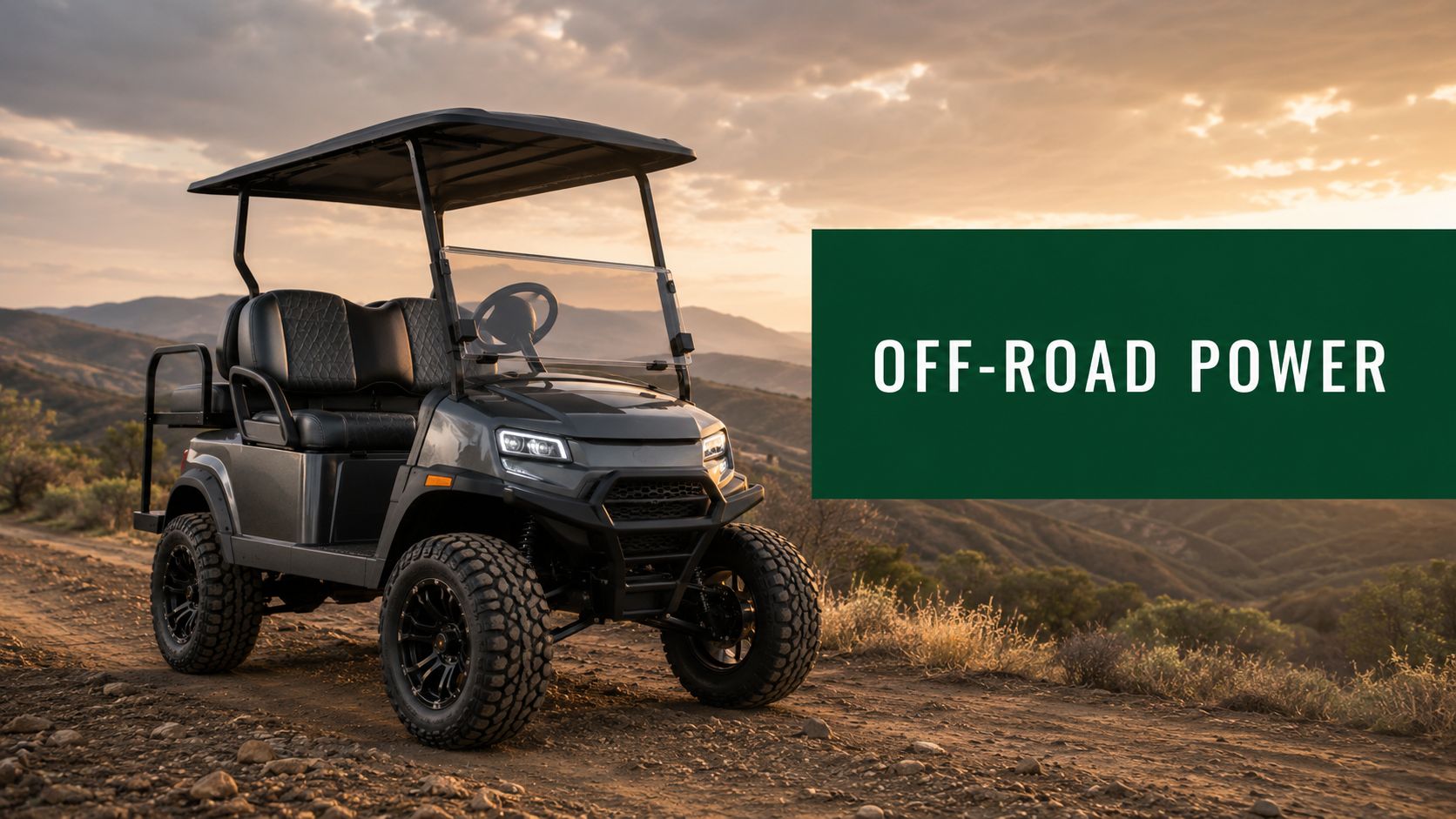
A lot of golfers reach the same point on a hilly course. The walk still feels right. Riding still feels like too much vehicle. But by the back nine, the cart paths tilt, the rough gets patchy, and your push cart starts fighting you on every climb.
That's where interest in off road electric golf carts usually begins. Not with extreme trail riding. With fatigue. With courses that look great on the scorecard and feel a lot steeper by hole 14. If you've ever played a mountain layout or a course with long path climbs, you already know that terrain changes club selection, pacing, and energy management. Some of the most hilly golf courses in North America make that painfully obvious by the turn.
The good news is that golfers now have more than one way to solve the problem. Some players need a purpose-built machine with lift, suspension, and battery capacity to handle steep grades and rough access paths. Others just need their existing walking setup to stop feeling like dead weight uphill. Those are very different needs, and they shouldn't lead to the same purchase.
Conquering the Course Beyond the Fairway
A standard course cart is built for maintained turf, paved paths, and predictable use. An off-road model is built for uneven ground, steeper climbs, looser surfaces, and more punishment over time.
That distinction matters because a lot of buyers see one lifted cart and assume the job is done. It isn't. Height alone doesn't create capability. A cart only works well off pavement when the frame, suspension, tires, and drivetrain support each other.
What changes from a standard cart
The first change is ground clearance. Rocks, washouts, roots, and path edges can catch the underbody of a low cart fast. A lift kit helps the cart clear obstacles without scraping battery trays or frame components.
The second is traction. Turf tires are fine on maintained fairways. They're a liability on loose dirt, wet grass, gravel, and mixed surfaces. Off-road builds use more aggressive tread patterns so the cart can hold a line instead of spinning or sliding.
The third is chassis control. Once the surface gets uneven, suspension quality matters as much as raw power. A stiff or basic setup bounces the cart, unsettles passengers, and reduces grip because the tires lose consistent contact.

The system matters more than one upgrade
Industry trend coverage says lifted carts with all-terrain tires are booming, and electric carts accounted for 81.81% of market share in 2025 with a projection of 85% in 2026 according to golf cart industry trend reporting on lifted and electric models. That tells you buyers are moving toward more capable, multi-surface electric setups, not just basic fairway cruisers.
A useful shopping filter is this:
- Frame first: If the cart isn't built to take repeated stress on uneven ground, bolt-on accessories won't save it.
- Suspension second: Better articulation and damping improve comfort, but they also help the tires stay planted.
- Tires with purpose: Aggressive tread helps in dirt and gravel, but it can also change ride feel and steering effort.
- Power matched to use: A strong motor on weak tires is wasted. Big tires on a weak powertrain feel sluggish.
If you want a deeper look at how terrain-focused builds differ from standard course vehicles, this guide to an all-terrain golf cart is a helpful comparison.
Off-road capability isn't one part. It's a package. When one piece is out of balance, the cart feels compromised everywhere else.
Key Performance Features for Tough Terrain
What gets an electric cart moving on rough ground isn't top speed. It's torque delivery under load. That's why a cart that feels quick on flat pavement can still feel weak on a climb with wet grass, a full bag load, and uneven footing.
Why torque matters more than speed
Think of speed as a sprinter and torque as a weightlifter. Off-road driving asks for the weightlifter. The cart has to start cleanly on a grade, keep moving through resistance, and avoid bogging down when the tires hit soft ground.
That's why serious off-road builds focus on motor output and current delivery, not just the battery label on the spec sheet. Some 72V off-road models use 7,500-watt AC motors, and some high-capacity lithium packs are rated for up to 200A continuous discharge and 400A peak for 35 seconds, as shown in off-road electric golf cart power specifications. In practical terms, that's the kind of headroom that helps a cart pull through steep sections and loose surfaces without feeling strained.
Battery type changes how the cart feels
The battery discussion often gets simplified to range. On rough terrain, that misses the point. Battery chemistry affects how consistently the cart delivers power during climbs and repeated acceleration.
A few real-world patterns matter:
- Lead-acid setups tend to feel more tired under repeated load, especially on hills.
- Lithium packs usually deliver stronger, steadier response when the course keeps asking for current.
- Controller tuning matters because the cart needs usable low-speed pull, not just a higher number on paper.
That's also why suspension shouldn't be treated as a cosmetic upgrade. If the cart bucks and unloads the tires on broken ground, some of that motor advantage gets wasted. If you want a broader primer on how suspension tuning affects control on uneven surfaces, these CA Tech USA suspension upgrades examples are worth reviewing because they show how damping and geometry change vehicle behavior under load.
Real range is a terrain question
Published range figures can be useful, but they're never the whole story. One off-road 4WD cart is listed at up to 40 miles per charge and 25 mph in street-legal mode, while another off-road configuration reports 70 to 90 km loaded range, 32 to 40 km/h top speed, a 3 m turning radius, and 20% climbing ability in EA4x4 off-road cart specifications. Those figures tell you something important. Range is tied to load, speed, terrain, and grade resistance, not just pack size.
Practical rule: When a seller talks range without mentioning hills, load, or surface, assume the number came from friendlier conditions than your course.
For golfers trying to make sense of motor specs, this breakdown of motor torque ratings helps separate useful numbers from marketing shorthand.
Safety Rules and Legal Considerations
The first thing to get right is simple. A lifted cart that feels stable on flat ground can become a different machine on a side slope or a downhill turn.

Some electric carts are tested to climb 25% grades, but guidance on electric golf cart hill limits also warns that steeper inclines, especially with heavier loads, can become unsafe and increase rollover risk. That warning matters more than the headline grade number. A cart's safe limit changes with passengers, gear, tire choice, surface condition, and how abruptly the driver inputs steering or throttle.
What to check before you buy
If you plan to use the cart beyond the course, ask a dealer direct questions instead of assuming “street legal” means anything universal.
- Road-use status: A golf cart isn't automatically a street-legal low-speed vehicle. Local rules usually depend on required equipment and registration standards.
- Brake confidence: On hills, stopping and holding position matter as much as climbing.
- Passenger setup: Rear seats, cargo boxes, and coolers shift weight and can affect balance on grades.
- Tire compromise: Aggressive tread helps in loose conditions, but it can also change steering feel on hard surfaces.
How to drive hills safely
A cart should go up and down hills in a straight, controlled line whenever possible. Side-hilling is where casual driving habits turn risky fast.
A few habits reduce trouble:
- Climb with momentum, not speed. You want steady pull, not a hard run at the slope.
- Descend slowly. Let braking and control do the work rather than carrying speed into the bottom.
- Reduce load on steep sections. Extra passengers and gear narrow your safety margin.
- Avoid sudden steering inputs. Sharp corrections raise rollover risk on uneven terrain.
This short video is a useful visual reference for the kind of cart setup many buyers are considering:
A cart that can climb a hill isn't automatically a cart that should. Safe operation depends on load, surface, and driver restraint.
Choosing the Right Cart for Your Game
Most buyers don't need the same machine. The mistake is shopping by appearance instead of use case. A golfer who occasionally deals with steep cart paths should not buy like someone using the same cart for hunting access roads and rough property tracks.

The adventurous trailblazer
This golfer treats the cart as more than golf transport. It may see trail access, utility duty, and rougher terrain where golf use is only part of the picture.
What matters most
- High-output drivetrain: Strong low-speed pull matters more than cruising speed.
- Serious suspension: Repeated bumps, washboard surfaces, and uneven access roads punish weak setups.
- Aggressive tires: Grip and puncture resistance matter more than a soft turf-friendly feel.
- Frame protection: Undercarriage abuse is common once you leave maintained paths.
This is the buyer who benefits from a purpose-built off-road cart. For this profile, a heavy-duty machine makes sense.
The hilly home-course regular
This golfer mostly stays on the course, but the course itself is the challenge. Think long climbs between holes, raised tees, sloped path transitions, and enough rough terrain to punish a basic push.
The smart setup here is more selective. You want:
| Need | Must-have feature | Nice to have |
|---|---|---|
| Hill climbing | Strong torque delivery | Larger wheel and tire package |
| Stability | Quality suspension tuning | Lifted stance |
| Battery confidence | Lithium power system | Faster charging convenience |
| On-course manners | Predictable steering and braking | Cosmetic extras |
This buyer often overpays for rugged features they'll rarely use. If your cart is spending almost all its time on golf property, a balanced hill-capable build is usually the better fit than a full trail rig.
The community cruiser
This golfer wants one vehicle for neighborhood errands, club use, and occasional rough patches near paths or overflow parking. Comfort, legality, and ease of use take priority over extreme terrain hardware.
A practical setup usually looks like this:
- Moderate all-terrain tire choice instead of the most aggressive tread available
- Comfort-focused suspension rather than the tallest lifted configuration
- Clear road-use compliance questions answered up front if neighborhood driving matters
- Simple maintenance access because the cart will be used often, not babied
Buy for your worst regular condition, not your most exciting hypothetical one.
If you only face steep fairways and the occasional rough shoulder, you may not need a full off-road vehicle at all. That's where a retrofit starts making more sense than a whole second machine.
The Smart Retrofit Alternative Caddie Wheel
A full-size off-road cart solves a real problem. It also creates a few new ones. Storage gets harder. Transport gets harder. Cost goes up. Weight goes up. For many walking golfers, that's a lot of machine to solve a simpler issue, which is getting a push cart up hills and across uneven ground without burning energy.

The broader market helps explain why retrofit options are getting more attention. The U.S. electric golf cart market was estimated at USD 529.4 million in 2024 and is projected to reach USD 886.7 million by 2033, with a projected 6.2% CAGR from 2025 to 2033, according to Grand View Research on the U.S. electric golf cart market. That growth reflects a mainstream move toward electric assistance, not just full vehicle ownership.
When a retrofit is the better answer
A retrofit makes sense when the golfer wants to keep walking but remove the worst part of walking with gear. That usually describes players who already own a push cart they like and don't want to replace it with something much larger.
A retrofit also fits golfers who care about:
- Lower hassle: No separate vehicle storage, registration questions, or trailer decisions
- Course flexibility: You still walk the course instead of switching to a ride-on habit
- Less bulk: You upgrade the equipment you already use
- Targeted assistance: The motor helps where walking golfers struggle, mainly hills and long transitions
A realistic alternative for most walking golfers
Caddie Wheel offers a logical fit. It's a motorized drop-on wheel that adds electric power assist to a standard push cart, rather than asking the golfer to buy a full off-road vehicle. For the player whose real problem is pushing a loaded cart up steep terrain, that's a very different value proposition from buying a lifted four-seat cart with trail-oriented hardware.
That doesn't make a retrofit the answer for everyone. If you need passenger capacity, property utility use, or regular multi-surface driving beyond the course, a dedicated off-road cart is still the right tool. But if you're a walking golfer who wants less strain and more energy left for the swing, the lightweight route is often the smarter one.
Frequently Asked Questions About Off-Road Carts
How much water is too much for an off-road golf cart
Water deeper than the floorboards is the line you shouldn't casually cross. Wet-condition guidance for lifted golf carts warns that deeper water can damage electrical components. If you can't judge depth clearly, don't drive into it.
What should I do after a muddy round
Clean the cart before mud dries around suspension parts, brakes, and wheel areas. Check for packed debris, inspect exposed wiring areas, and look for trapped moisture around electrical components. The same wet-use guidance recommends dielectric grease as a protective measure in muddy or wet conditions.
Do off-road carts need different charging habits
They need more awareness, not necessarily a complicated new routine. Hard hill use, loose terrain, and repeated acceleration put more demand on the battery, so it's smart to recharge promptly after heavy use and avoid treating every range estimate as if it applies to rough conditions. If your round includes lots of climbing, assume the battery worked harder than it would on flat ground.
If you want to keep walking without fighting every hill, Caddie Wheel offers a simple way to add electric assist to the push cart you already own. It's a practical option for golfers who need less strain, easier climbs, and a lighter alternative to buying a full off-road cart.
Partager:
Proper Divot Repair Golf: Master Course Care in 2026
What Is the Most Important Golf Club? an Expert's Guide