
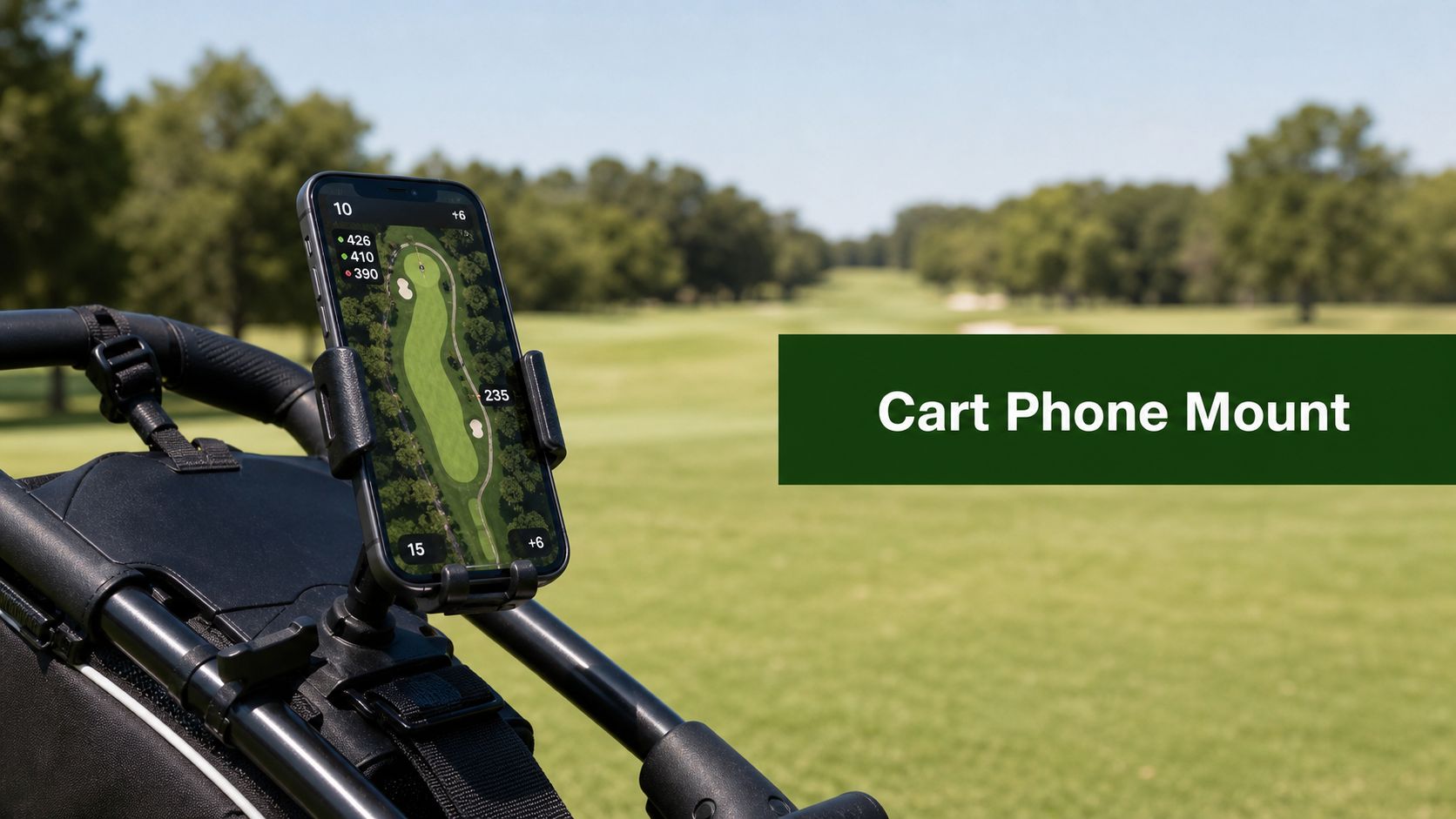
You're halfway through a round, the course is rolling, and your phone slides off the push cart handle just long enough to miss a GPS yardage, a score update, or a call you needed to take. That small annoyance is exactly why the push cart phone holder has become more than a convenience item for walking golfers. It keeps the screen where you can see it, keeps your hands free, and keeps you from fishing around in a pocket every time you need a quick glance.
The tricky part is that not every holder that says “universal fit” is secure once the cart starts rattling over real turf. If you're trying to choose one for your own setup, or you're comparing accessories the way you'd compare wedges or gloves, start with fit, clamp strength, and how the mount behaves under motion. A good place to think about what counts as useful gear is this roundup of must-have gear for improving your game from Tattoo Golf, because the best accessories solve an on-course problem instead of just looking tidy in a product photo.
Why a Push Cart Phone Holder Matters
A lot of golfers notice the need for a phone holder after a small mishap. The phone slips into the basket, tilts sideways in the cup holder, or ends up buried under a towel right when a yardage or score app is needed. The round turns into a little scavenger hunt, and the rhythm of walking golf gets interrupted by something that should have stayed simple.
The core purpose
A push cart phone holder keeps the phone visible without demanding attention. That matters because modern golf is not just about carrying clubs from tee to green, it also depends on quick screen access for navigation, score tracking, and communication while you are still moving. The holder gives the device a fixed place, so the cart works more like a control point than a moving pile of loose items.
That same practical logic shows up across the accessory category. Many players already look for add-ons that solve an on-course problem, and a useful roundup like must-have gear for improving your game makes the point clearly. A phone mount fits that mindset because it earns its place by keeping information ready when you are on foot, not by adding another piece of clutter.
A holder only helps if it keeps the phone readable while the cart is moving, not just when it is parked on the practice green.
For walking golfers, the value is in cutting down small interruptions. You glance once, keep moving, and do not have to stop the cart or dig into storage every time you want to check something. That matters even more once the cart starts rattling over real turf, because a mount that feels secure in the hand or in a product photo can still shift when an oversized phone, a rugged case, or a motorized wheel conversion like Caddie Wheel adds extra vibration and weight. A good holder acts like a snug glove, not a loose pocket.
What a Push Cart Phone Holder Is
A push cart phone holder is easiest to understand if you compare it with a car phone mount. Both are built around the same basic idea, a stable attachment point, a cradle or grip for the phone, and the ability to angle the screen where you can see it without holding the device yourself. The difference is that golf carts move over grass, slopes, and vibration, while a car mount usually deals with smoother road motion and a much more rigid dashboard.

The parts that matter
Most mounts are built from the same functional pieces. The clamp grabs the cart tubing, the arm creates spacing, the pivot or ball joint handles angle changes, and the cradle or holder secures the phone itself. If any one of those pieces is weak, the whole setup becomes annoying on a bumpy fairway.
The broader market for car phone holders helps explain why this accessory format feels familiar rather than experimental. Grand View Research estimated the car phone holder market at USD 1.18 billion in 2024 and projected USD 1.68 billion by 2030 at a 6.1% CAGR from 2025 to 2030, while IMARC valued it at USD 1.26 billion in 2024 and projected USD 1.92 billion by 2033 at a 4.55% CAGR; IMARC also reported that Asia-Pacific held over 40% of the market in 2024 and that the United States accounted for 93.80% of North America's demand that same year (Grand View Research market context). Those figures don't describe golf specifically, but they do show that phone mounting is a mature accessory habit, not a novelty.
Why golf changes the design priorities
Golf use is harsher than ordinary dashboard use. Uneven terrain, repeated pushes, and quick turns all put stress on the joint and clamp, so the mount has to resist rotation and loosening even when the cart shakes. That's why golf-specific holders need more than a nice-looking cradle, they need a clamp that stays planted and contact points that help the phone remain steady.
Practical rule: if a holder works in a parking lot but drifts on the course, it's not built for walking golf.
That difference is the whole reason to separate a general phone mount from a push cart version. On paper they may look similar, but the golf version has a much narrower job, and the job is to stay readable while the cart keeps moving.
Mounting Types and Cart Compatibility
The first fit question isn't about the phone, it's about the cart. A holder can be perfectly fine on one frame and awkward on another because push carts and motorized add-ons don't all use the same tube shapes, spacing, or accessory mounting points. That's why clamp style matters so much, especially if you're dealing with standard carts and motorized wheel conversions.
Clamp-on designs versus vague universal claims
The cleanest mounting pattern is the clamp-on system. One independent golf source describes a push-cart phone and GPS mount as a completely adjustable clamp-on setup that attaches securely to any golf push cart, and another notes installation in seconds with no tools required plus an included umbrella-holder mount and universal clamp (Caddie Buddy mount details). Those are useful details because they tell you how the product attaches, not just that it “fits.”
That distinction matters with carts that already carry add-ons or have unusual handle geometry. If the holder relies on a slippery grip or a shallow clip, it may feel fine at the curb and wobble once the cart starts moving downhill. A true clamp-on design gives you a more predictable connection, especially when it includes non-slip pads or a broader clamp face.
For golfers using motorized wheel conversions, the same principle applies. A setup like the one discussed in the Caddie Wheel golf cart bracket guide makes the accessory question more specific, because you're no longer thinking only about the push cart itself, you're also thinking about where the added hardware sits and how much room is left for a phone mount.
What to check before you buy
The simplest compatibility check is visual and physical, not marketing-based.
- Look at the tube shape: Round, tubular handles are the easiest match for clamp mounts.
- Measure the mounting area: A wider adjustment range is safer than a narrow one, but only if the clamp still bites firmly.
- Check accessory overlap: Umbrella holders, drink holders, and motorized wheel hardware can crowd the same handle zone.
- Confirm viewing position: The screen should sit where you can glance at it without bending your wrists or twisting your shoulders.
A holder that fits the cart but blocks your hands isn't really a good fit. The right one feels integrated, almost like it was always part of the handle.
Key Features for a Reliable Holder
A holder can look universal on the shelf and still fail once it meets real course movement. The difference shows up in the fit details people usually skim past, especially with oversized phones, rugged cases, and cart vibration that keeps working on every bump. That is why a reliable choice starts with the spec sheet, not the marketing line.
The numbers that matter
A practical target for a push cart phone holder is clamp compatibility in the 15–40 mm diameter range, because that covers many tubular golf-cart-style frames and similar supports (engineering benchmark). That range matters more than a vague universal claim, since a clamp that fits loosely can feel fine at rest and still shift once the cart starts moving.
Some mounts also specify phone envelopes around 4.5–7.0 inch screens and up to about 0.5 inch thickness with a case, which is useful for golfers carrying a larger phone in a rugged shell. A bigger phone acts like a longer wrench on the pivot, so if the joint is weak, vibration has more force to pull the screen off angle.
| Technical Fit Specifications | Supported Range |
|---|---|
| Clamp diameter | 15–40 mm |
| Phone screen envelope | 4.5–7.0 inches |
| Phone thickness with case | about 0.5 inch |
| Tubular support compatibility | round handlebar-style frames |
Material choice matters just as much as fit. One premium design uses neodymium N52 magnets, engineering-grade nylon composite, stainless-steel ball joints, brass threaded inserts, and UV-stabilized TPR overlays, which shows how a mount can be built to resist force, corrosion, and thread wear at the same time (premium construction example). That same product line also lists phones 65–92 mm wide and 15 mm thick or less, with a clamp range of 16–42 mm cylindrical supports and a published 300 g load rating, which gives a clearer picture of what the hardware is built to hold than the word universal ever will.
Buyer shortcut: if the phone fits but the clamp diameter does not, the mount is the wrong product, no matter how “universal” the listing sounds.
A secure setup for golfers usually comes down to a rigid arm, rubberized contact points, and enough clamp tension to resist vibration without slipping. That combination helps the screen stay readable on rougher fairways and keeps the holder from drifting out of position hole after hole. For a related comparison, the cell phone mount for golf cart discussion is useful because it stays focused on mounting geometry and compatibility, which is the same concern that comes up with motorized wheel conversions like Caddie Wheel.
Installing and Caring for Your Phone Holder
The fastest way to ruin a decent holder is to install it loosely and forget about it. Most problems people blame on the product are setup problems, especially with clamp position and joint tension. If the mount isn't seated squarely, every bump on the course works against it.
Setting it up the right way
Start by placing the clamp on a straight section of tube, not right at a bend or seam. That gives the jaws more consistent contact and helps the mount resist twisting when the cart changes direction. Then snug it down until it feels stable, but don't crank so hard that you deform a lightweight part or make later adjustment difficult.
Retail specs give a useful boundary here. One listing for a golf or push-cart holder notes compatibility with smartphones up to 4 inches wide, clamp fit from 1/8 inch to 1-1/2 inch handles or bars, and 360-degree rotation with nearly any angle adjustment (retail specification example). Those numbers are helpful because they show you what the mount is designed to handle before you start forcing it to do more.
The best setup usually ends with a screen angle that's easy to scan but not so vertical that glare takes over. If the holder uses a pivot, tighten it enough that the phone stays where you put it, then test it with a few cart pushes before you head out.
Care that prevents loosening
Maintenance is simple, and it pays off. Wipe grit off the rubber contact points, check screws or cam levers for play, and re-seat the clamp if the holder starts drifting. Dirt and moisture are small problems until they collect around the joint and make the mount slip more easily.
If the phone starts to bounce or the angle slowly drops during the round, don't blame the screen size first. Check the clamp face, the joint tension, and whether the mount has been pushed out of square by another accessory. A minute of adjustment at home is a lot better than fighting the holder on the seventh tee.
Practical Scenarios for Different Golfers
The right holder means different things depending on who's pushing the cart. A senior golfer may care most about not bending over to retrieve a phone, while a fitness walker wants a clean, steady setup that doesn't interrupt pace. A budget-minded player may just want a mount that works every week without needing replacement after a few rough rounds.
Three common buyer profiles
The golfer with a large phone and rugged case is the one most likely to feel the gap between “universal fit” and true retention. Current marketplace talk often stays broad, but the practical question is whether the holder still grips when the cart hits bumps, slopes, or turns, especially with a thicker device and case. That's the underserved angle in this category, secure fit under vibration, not just fit on paper, and it's why clamp geometry and locking force matter more than a checkbox.
A senior walker may appreciate a holder that keeps navigation and scoring visible without making the cart harder to steer. For that golfer, the win is fewer stops and less fumbling. A practical resource for older walkers is the 7 essential golf aids for seniors in 2025, because phone access is only one part of making the round easier on the body.
The fitness-minded player usually wants the opposite of clutter. They're already trying to keep the round smooth, so a holder that sits close to the handle and doesn't wobble feels like part of a well-organized kit. If you already use supportive gear for your body, something like golf braces sleeves for better play fits the same mindset, because both kinds of accessories are about keeping motion comfortable and controlled.
A mount should feel invisible once it's installed, useful when you need it, and forgettable when you don't.
That's the true test across all golfer types. If the phone stays in place, the screen stays readable, and the cart keeps moving without extra fuss, the holder has done its job.
Final Thoughts on Push Cart Phone Holders
A good push cart phone holder solves a small problem in a very golf-specific way. It keeps your screen visible, keeps your hands free, and keeps your round from being interrupted every time you want to check something. The catch is that the best choice is rarely the one with the broadest marketing claim.
The more useful filter is mechanical. Check whether the clamp matches your cart tubing, whether the phone envelope really fits your device and case, and whether the joint stays steady when the cart vibrates. That's where the phrase “universal fit” starts to lose its power, because universal doesn't mean secure, and secure is the thing you need on the course.
Motorized wheel conversions add one more layer to that decision. Once a cart includes extra hardware, the mounting space becomes more valuable, and compatibility has to be judged by real clearance, not by a general promise on the package. If you think like that before buying, you're much less likely to end up with a mount that looks right but fails in motion.
The simplest buying mindset is this. Match the clamp to the cart, match the cradle to the phone, and prefer a design that stays put after repeated bumps. If it can do those three things, it's probably a keeper.
If you're ready to make your push cart easier to use, explore what Caddie Wheel offers for golfers who want a cleaner, more integrated setup. Its drop-on electric assist is built to work with standard push carts, so you can pair better propulsion with the kind of phone access and accessory control walking golfers use.
Partager:
Lay Up in Golf: Smart Strategy for Every Situation
Golf Divot Repairer Guide: Types, Technique, and Best Picks