
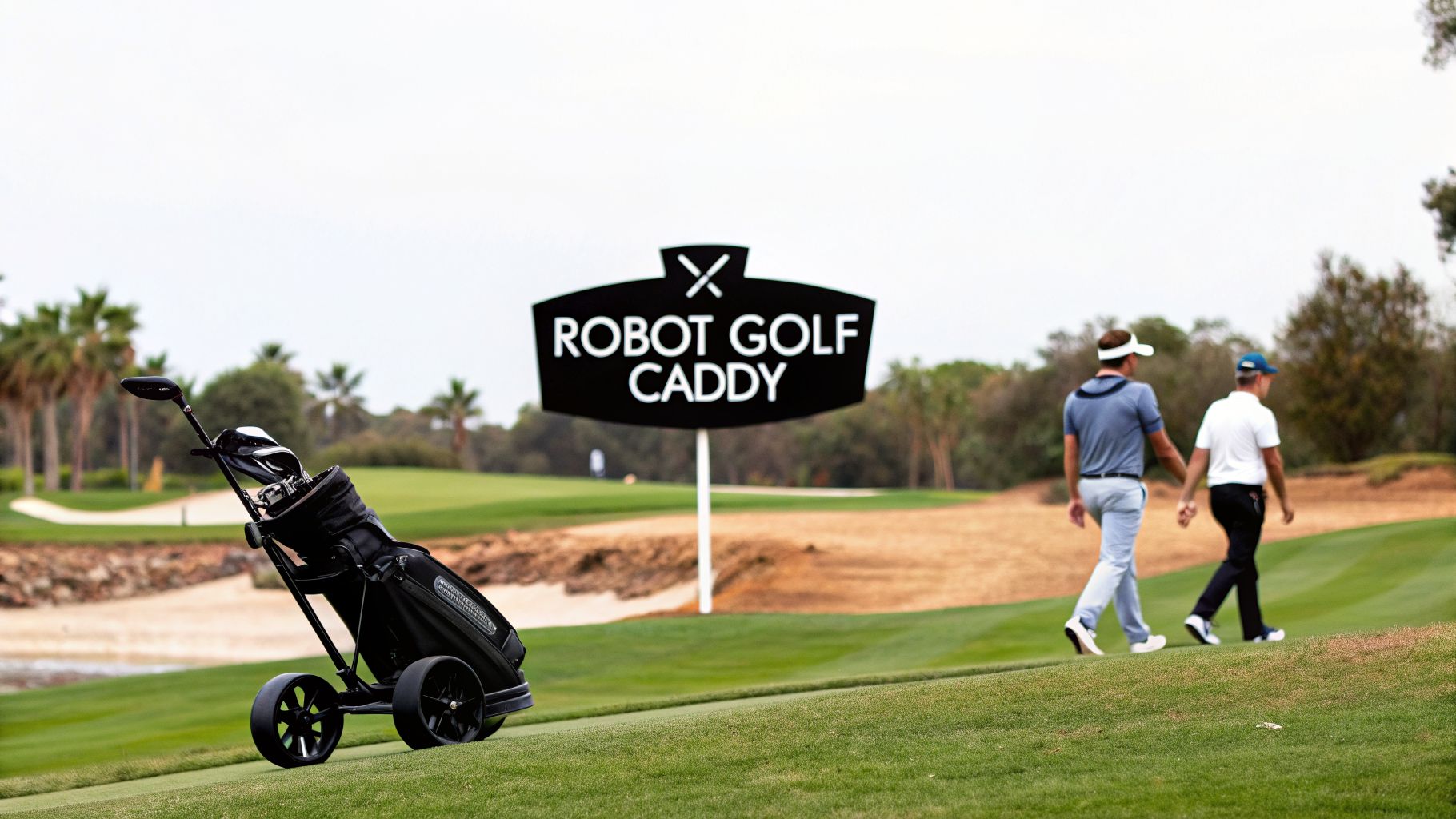
A robot golf caddy is essentially a motorized push cart that takes over the job of carrying your bag, letting you enjoy all the health benefits of walking the course without the back-breaking strain. These high-tech partners use electric power to glide across the fairways, so you can save your energy for what really matters: your swing.
Walk the Course Smarter Not Harder

Picture this: you’re cruising through 18 holes, totally dialed in on your next shot, instead of dreading the steep hill ahead. A traditional push cart definitely helps, but it still takes a toll over a four-hour round. That slow burn of energy can creep up on you, hurting your stamina and focus on the back nine. This is where a robot golf caddy completely changes the game.
The classic debate of walking vs riding a golf cart is a familiar one. Many of us want the exercise, but nobody wants the exhaustion. A robot caddy strikes the perfect balance, giving you the physical perks of walking while shouldering the load of your clubs. By the time you get to the 18th green, you feel fresher and ready to sink that final putt.
The True Advantage of an Automated Partner
At its core, this technology is all about energy conservation. Think about it. Instead of showing up to your ball out of breath, you arrive composed and ready to execute the shot with precision. It might seem like a small change, but it sends a positive ripple effect through your entire game.
This guide is your complete roadmap to understanding this technology. We'll dig into how a robot golf caddy can help you:
- Conserve physical and mental energy for more consistent, focused play.
- Reduce strain on your back, shoulders, and legs.
- Fully enjoy the walk and the social side of the game.
- Navigate hilly courses with ease, turning tough climbs into casual strolls.
We’ll break down the differences between fully autonomous caddies and smart electric-assist upgrades that you can add to a standard push cart. By the end, you'll know everything you need to find the perfect high-tech partner for your game.
What Exactly Is a Robot Golf Caddy?
The push toward automated help on the course is more than just a passing trend—it's changing how we experience the game. A robot golf caddy isn’t just a simple motorized cart. Think of it as an intelligent partner designed to make every round more enjoyable by taking over the tough job of hauling your gear.
At its core, this technology is all about freedom. Instead of being chained to your push cart, you can walk freely down the fairway, thinking about your next shot while your caddy keeps pace right beside you. This is all possible thanks to a mix of smart features, from advanced GPS and intuitive remote controls to clever obstacle-avoidance sensors that keep it from taking a detour into a bunker or a water hazard.
This isn't just about a cool gadget; it’s about making golf more accessible and fun for everyone. It helps seniors reduce physical strain and allows serious competitors to save every bit of energy for their performance.
The Tech Behind the Trend
The real magic of a robot golf caddy is its ability to navigate the course with very little help from you. The simpler models use a straightforward remote control, letting you steer it forward, backward, left, or right with just a button press. The more advanced, fully autonomous versions often use a combination of tech:
- GPS Tracking: Some high-end units can map out an entire course, allowing them to follow pre-programmed paths to the next tee box without you lifting a finger.
- "Follow-Me" Technology: This is a popular one. You wear a small sensor on your belt or keep it in your pocket, and the caddy locks onto that signal, following you at a steady distance as you walk.
- Obstacle Avoidance: Using ultrasonic sensors or cameras, these caddies can spot and steer around things like trees, other players' bags, and course signs.
This tech is catching on fast, and the market is booming to prove it. The demand for autonomous golf caddies was valued at USD 107.6 million in 2024 and is expected to climb to USD 182.03 million by 2033. This surge is being driven by golfers who want to stay active without the fatigue that comes from pushing or carrying a heavy bag. You can dive deeper into the autonomous caddy market trends to see how this demand is shaping the future of golf.
This shift empowers players to walk more often and for longer, preserving their physical well-being while still getting the full on-course experience. The goal is simple: end the round feeling as strong as you did when you started.
Of course, the revolution in golf tech doesn't stop at the fairway. It’s also transforming how we practice and play indoors with amazing home golf simulator setups. Whether you're on the course or in your basement, technology is making the sport more engaging than ever.
Autonomous vs Electric-Assist Caddies
When you start looking into robot golf caddies, you’ll quickly find there are two very different paths you can take. Each one offers a unique way to take the strain out of your walk, but they’re built on fundamentally different ideas of what a high-tech golf partner should be. Understanding this choice is the first step to finding the right fit for your game.
On one side, you have the fully autonomous 'follow-me' caddy. This is the personal robot valet of the golf world. These sophisticated machines use a combination of GPS, sensors, and remote signals to shadow your every move on the course. They are designed to operate completely hands-free, leaving you to focus on nothing but your next shot.
But all that high-tech wizardry comes with its own set of trade-offs. Fully autonomous units are often significantly heavier and more complex, which can make getting them from your car to the first tee a workout in itself. Their biggest drawback for many golfers, though, is the price tag—often running into thousands of dollars.
The Smart Upgrade: Electric-Assist Wheels
On the other side of the spectrum is the electric-assist conversion. Instead of replacing your entire cart, this solution adds a powerful, motorized wheel to the push cart you already own and love. Think of it like adding a quiet, efficient engine to your favorite bicycle—it gives you the power you need without making you buy a whole new ride.
This approach offers a much more practical and affordable entry into the world of motorized caddies. It delivers the core benefit—effortless walking—without the steep cost or complexity of a fully autonomous system. You maintain control with a simple remote, making it a straightforward upgrade that just works.
This decision tree shows how your golfing style—walking or riding—can lead you to different equipment choices.

As you can see, for golfers committed to walking, the next question is whether to keep pushing or to automate the process for a less strenuous round.
Comparing Your Options Head-to-Head
To make the decision a little clearer, let’s break down the key differences between these two types of robot caddies. Each has distinct advantages depending on your priorities, your budget, and how you like to play.
The core difference isn't just about technology; it's about philosophy. One offers a completely hands-off experience at a premium, while the other provides smart, affordable assistance to the equipment you already trust.
The table below gives you a direct, head-to-head comparison to help you figure out which path is right for you. For an even deeper dive, you can also explore our detailed guide on the best electric golf push cart that follows you.
Autonomous Caddy vs Electric-Assist Wheel
Deciding between a fully autonomous "follow" caddy and an electric-assist wheel like the Caddie Wheel really comes down to your priorities on the course. Do you want a completely hands-off, premium experience, or do you prefer a practical, affordable upgrade to your existing gear? Let's compare them side-by-side.
| Feature | Fully Autonomous 'Follow-Me' Caddy | Electric-Assist Wheel (like Caddie Wheel) |
|---|---|---|
| Operation | Hands-free; follows you via a sensor or remote beacon. | Remote-controlled; you steer the cart with a handheld remote. |
| Cost | High initial investment, typically $1,500 - $3,500+. | Lower cost, often under $800, as it upgrades an existing cart. |
| Weight & Size | Heavier and bulkier, which can be difficult to lift and transport. | Lightweight and compact, adding minimal weight to your current setup. |
| Setup | Can involve pairing sensors, calibrating GPS, and more complex steps. | Simple installation, often attaching to the axle in minutes. |
| Compatibility | A standalone unit; you can’t use it with your existing push cart. | Designed to fit a wide range of popular push cart models. |
Ultimately, the choice is yours. The "follow-me" caddy is an impressive piece of tech for those with a bigger budget, while an electric-assist wheel provides the core benefit of an effortless walk in a simple, reliable, and much more accessible package.
Key Features to Evaluate Before You Buy
Choosing the right robot caddy means looking past the flashy marketing and getting down to what actually matters on the course. Whether you're considering a fully autonomous unit or a smart electric-assist wheel, a handful of key features will decide if it helps your game or just adds another headache to your pre-round routine.
Asking the right questions upfront ensures you invest in a partner that’s going to work for you, not against you.
Powering Your Round
First up, and arguably the most important feature, is battery life. There’s nothing worse than your high-tech caddy dying on you mid-round, leaving you to wrestle a heavy, dead-weight cart up the 15th fairway. A reliable robot caddy should, at a minimum, last a full 18 holes, with the best models easily handling 36.
This is one area where technology has made massive leaps. The market for these caddies is exploding, especially in North America, where the U.S. market alone hit USD 95 million in 2024. This boom, driven by over 25 million golfers tired of push fatigue, has pushed manufacturers to innovate.
As a result, around 80% of current models can now power through 36 holes, thanks largely to lithium-ion batteries that recharge quickly. If you want to dive deeper into the market, you can find additional insights on auto-follow caddy trends.
Before you pull the trigger, be honest about your playing habits. Are you a 36-hole-a-day warrior? If so, a long-lasting battery isn’t a luxury—it’s a necessity.
Weight and Portability
Remember, your caddy's journey doesn’t start on the first tee; it starts in your garage. A robot caddy that's a beast to lift into your car will quickly become a source of frustration. Weight and portability are practical, day-to-day considerations that have a huge impact on your overall experience.
Look for models designed for easy transport. Here’s what to check:
- Total Weight: Can you comfortably lift it yourself?
- Folded Dimensions: Will it actually fit in your trunk with your clubs?
- Assembly: How fast can you get it set up or broken down before and after a round?
This is where an electric-assist wheel really shines, as it adds very little weight to the push cart you're already used to.
An overly complex or heavy caddy defeats the entire purpose of conserving energy. The goal is to make your walk easier from start to finish, not just on the fairways.
Terrain Handling and Control
A golf course isn't a sidewalk. Your caddy has to navigate steep hills, thick rough, and slick, wet grass without tipping over or getting stuck. Look for models with a low center of gravity for stability and large, rugged wheels that grip the turf. The motor needs to have enough juice to climb hills without losing steam.
Just as important is the control system. Is the remote intuitive? Or does it feel like you need a pilot’s license to operate it? You should be able to adjust speed, steer, and brake without a second thought. A simple, responsive remote lets you focus on your next shot, not on babysitting your equipment.
Ultimately, a great robot caddy should feel like a natural extension of your walk, not a machine you have to constantly manage.
Spotlight On The Caddie Wheel Electric-Assist Solution

For the millions of golfers who already own a push cart they love, dropping a ton of money on an entirely new robot caddy feels like overkill. That’s where a smart, practical solution like the Caddie Wheel comes in. It offers a simple yet powerful upgrade that bridges the gap between manual labor and full automation.
The Caddie Wheel was created by avid golfers to solve a real problem they faced themselves. The idea was simple: why replace a cart that already works perfectly fine? Instead, they designed a way to enhance it.
This approach delivers the core benefits everyone wants from a motorized caddy—less fatigue, more focus—without the hefty price tag or unnecessary complexity. It’s built for the player who just wants an effortless walk, not another complicated gadget to learn. By converting your current setup into a remote-controlled powerhouse, the Caddie Wheel keeps things simple, affordable, and lets you enjoy the game more.
A Focus On Simplicity And Performance
The entire philosophy behind the Caddie Wheel is clear: make it easy to install and even easier to use.
The drop-on installation is a huge plus, letting most golfers attach the motorized wheel to their cart in just a few minutes. You don’t need a toolbox or a complicated wiring diagram.
Once it’s on, the experience is totally seamless. The system is built around a few key advantages that directly address what walking golfers actually need:
- Intuitive Remote Control: A simple remote puts forward, reverse, and braking functions right at your fingertips. No confusing menus, just the controls you need.
- Rugged All-Terrain Build: This wheel is designed to handle the realities of a golf course, from steep, grassy hills to bumpy, uneven cart paths.
- Long-Lasting Battery: Its high-capacity battery is engineered to last up to 36 holes on a single charge. You’ll never have to worry about running out of juice mid-round.
- Lightweight Design: It adds motorized power without turning your cart into a lead weight, so lifting it into your car is still a breeze.
The real value of the Caddie Wheel is in its practicality. It doesn't try to reinvent the push cart; it perfects it by adding the one thing every walking golfer wants—effortless forward motion.
This no-fuss approach is exactly why it’s become such a popular choice. For those comparing different upgrade options, our guide on a great Alphard Golf alternative offers more detail on what makes this system stand out.
Ultimately, it’s all about making the game more accessible and enjoyable for everyone.
Why Upgrading Your Push Cart Makes More Sense
At the end of the day, any robot golf caddy has one job: to help you play better and enjoy the game more. It does this by saving your energy for the swing, taking the strain off your back and shoulders, and letting you walk off the 18th green feeling as fresh as you did on the first tee.
But here’s the thing—you don’t need to replace your entire setup to get there. For the huge number of golfers who already own and love their push carts, buying a fully autonomous caddy is often a massive, expensive leap that just doesn't make sense. A simpler, more practical solution is a much smarter play for most people.
This is where an electric-assist wheel becomes the clear winner. It gives you the core benefits you’re actually after—effortless walking and more stamina—without the crazy price tag or complexity.
The Smart Investment for Your Game
For golfers who already own a push cart—and that’s about 40% of all walkers—an electric assist like the Caddie Wheel is a game-changer. Instead of replacing a perfectly good cart, you simply upgrade it. This makes a huge difference, especially since 60% of golfers over 50 prefer walking but need ways to ease the strain on their joints over a typical 5-to-7-mile round.
The numbers don't lie. Walkers who use a powered assist end up playing 25% more holes each year and see their injury rates drop by a significant 18%. It’s not just a convenience; it’s a smart investment in playing more golf, more comfortably, for years to come.
Want to learn more? Check out the latest stats on the growth of manual and assisted golf caddies.
Frequently Asked Questions
Thinking about upgrading your push cart? It's natural to have a few questions. We've gathered some of the most common ones to help you see how an electric-assist wheel can change your game.
How Difficult Is Installation?
This is where the Caddie Wheel really shines. It was designed from the ground up to be incredibly simple, with a "drop-on" installation that requires zero technical skills or special tools.
You just snap a bracket onto your cart’s axle, and the motorized wheel locks right into place. Most golfers get it done in under 10 minutes, which means less time tinkering in the parking lot and more time on the first tee.
Will It Genuinely Improve My Performance?
While a robot caddy won't fix your slice, it attacks one of the biggest reasons scores fall apart: fatigue. Pushing a heavy bag for four hours drains a surprising amount of energy. By taking that job off your hands, you save a ton of stamina.
That saved energy translates directly to better focus and more strength on the back nine, which is where so many good rounds go to die. When you walk up to each shot feeling fresh instead of winded, you make better decisions and more consistent swings. It absolutely can lead to lower scores.
The real game-changer is finishing the 18th hole with the same energy you had on the first. That level of consistency is what separates a good round from a great one.
How Does It Handle Tough Course Conditions?
The Caddie Wheel was built for the real world of golf, not just perfectly flat fairways. Its rugged, all-terrain tire gives you excellent traction on wet, slippery grass and up steep, challenging hills.
The motor keeps a steady pace, powering up inclines without you ever having to help it along. Plus, the remote gives you total control over braking, which is a huge deal when you're navigating a steep downhill path and need to keep the cart from getting away from you.
What Kind of Warranty and Support Is Offered?
Every Caddie Wheel is backed by a 12-month manufacturer's warranty covering any defects in materials or workmanship. It’s peace of mind knowing your investment is protected.
Better yet, our support team is based in the U.S. and run by the actual golfers who designed the product. If you ever have a question or need a hand, you’re talking to experts who know the Caddie Wheel and the game of golf inside and out. You'll get real, practical help when you need it.
Ready to make your walk effortless and focus on what truly matters? Upgrade your game with the Caddie Wheel. Learn more and order yours today at caddiewheel.com.
Partager:
Segway Golf Carts Your Guide to Upgrading Your Game on the Green
Electric Golf Carts for Sale: Discover electric golf carts for sale now