
Finding the best golf cart battery charger isn't about chasing a single brand—it's about finding the perfect match for your specific battery system. Get it right, and you protect your battery investment and ensure your cart is always ready for the course. Get it wrong, and you can shorten its life or even cause permanent damage.
How to Choose the Right Golf Cart Charger
Think of your golf cart's battery as its fuel tank and the charger as the fuel pump. You wouldn't put diesel in a gasoline engine, and the same logic applies here. Picking the right charger is the single most important thing you can do to protect your battery investment, maximize its lifespan, and get reliable performance every time you hit the links.
This guide is designed to cut through the noise and give you a clear roadmap to a smarter purchase. We'll start with the core concepts you absolutely have to understand before you even think about buying. These are the non-negotiables that form the foundation of a good decision.
- Battery Chemistry: Is your cart running on traditional Lead-Acid batteries or modern Lithium-ion? Each type demands a completely different charging algorithm to stay healthy.
- System Voltage: You must match your charger's voltage to your battery pack's total voltage, which is almost always 36V or 48V. A mismatch here is a recipe for disaster.
- Charger Amperage: This number is all about charging speed. A higher amperage means a faster charge, but it has to be appropriate for your battery's capacity and chemistry.
This decision tree gives you a great visual of the simple, three-step process for narrowing down your options.
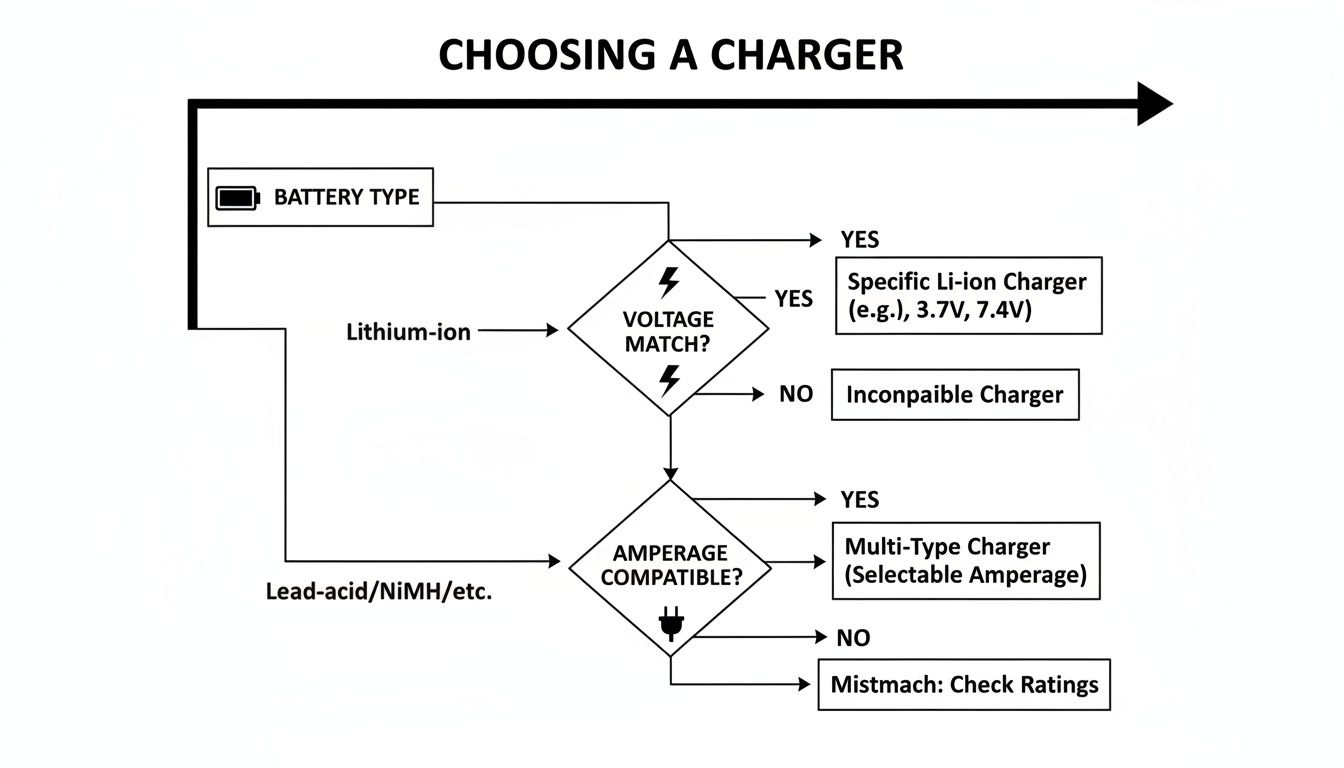
As the flowchart shows, figuring out your battery type, voltage, and the charging speed (amperage) you need are the first and most critical steps.
Framing Your Charger Decision
We're going to frame every decision around real-world needs, helping you pick a charger that's not just compatible, but truly optimal for your cart. A lot of the thinking behind golf cart chargers—like voltage, amperage, and safety features—is shared with the broader world of electric vehicle charging. For instance, you can check out guides on different types of electric car home chargers to see a lot of the same principles at play.
The goal here is to move beyond a simple replacement and think more like you're making a strategic upgrade. A smart charger doesn't just pump power back in; it actively manages your battery's health, which can save you hundreds of dollars in premature replacement costs down the road. You can dive deeper into these specifics by exploring our Caddie Wheel guide to cart chargers. It will give you a much better handle on what to look for.
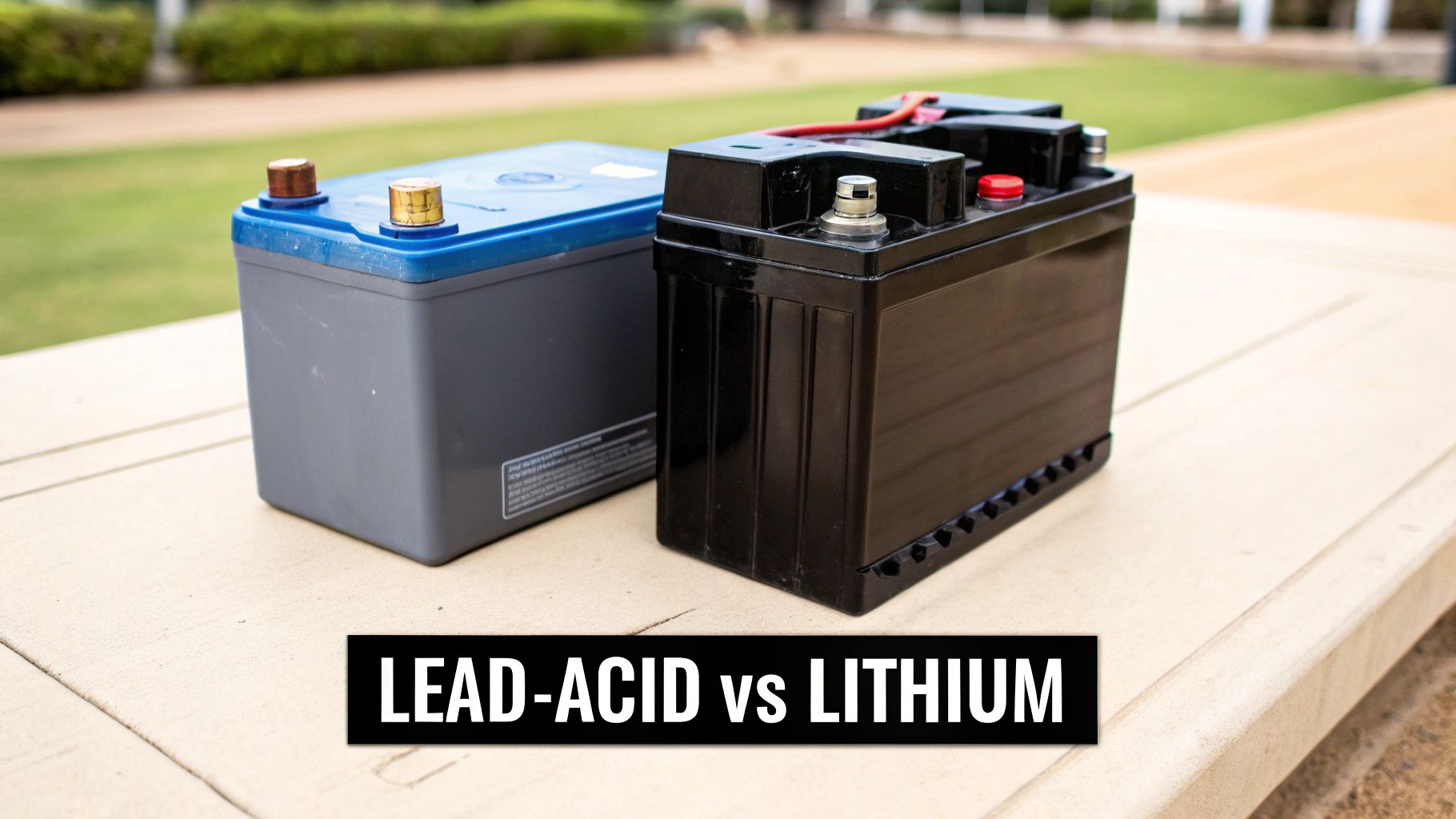
Lead-Acid vs. Lithium-Ion: The Two Types of Batteries
To find the best golf cart battery charger, you first have to know what you’re charging. Your golf cart's power source isn't just one big "battery"; it's a complete system. The technology inside dictates everything about how it needs to be charged, and grabbing the wrong charger is a fast track to poor performance and expensive damage.
At the heart of it all are two very different chemistries: the old-school lead-acid and the modern lithium-ion. Think of lead-acid batteries as the reliable workhorse of the golf world—a marathon runner. They’re heavy, dependable, and have powered fleets for decades, but they need a very specific, multi-stage charging routine to stay healthy.
On the flip side, lithium-ion batteries are the sprinters—lightweight, powerful, and built for speed and efficiency. They pump out consistent power from full charge right down to empty and can be topped off much faster. Each battery type has its own "charging profile," which is like a specific recipe of voltage and current it needs to soak up energy safely and effectively.
Key Differences in Charging Needs
So, what makes them so different? It really comes down to how each battery type handles energy. A lead-acid charger follows a careful three-stage process (bulk, absorption, and float) designed to gently saturate the lead plates without frying them. A lithium charger, however, uses a much more direct and faster two-stage process (constant current, constant voltage) that’s tailored specifically to lithium cells.
Using a lead-acid charger on a lithium battery can cause undercharging and throw the cells out of balance. But using a lithium charger on a lead-acid battery is even worse—you’re basically guaranteeing dangerous overcharging and overheating. That’s because the lithium charger is missing the crucial "float" stage that lead-acid batteries depend on for maintenance.
Critical Takeaway: A charger is not a one-size-fits-all device. The charging algorithm is specifically programmed for either lead-acid or lithium chemistry. Using the wrong one will, at best, slash your battery's lifespan and, at worst, create a serious safety hazard.
Maintenance and Lifespan Considerations
Beyond just charging, the day-to-day upkeep for these two batteries is worlds apart. This has a huge impact on their long-term value and your overall experience.
- Lead-Acid Maintenance: These batteries need you to regularly top them off with distilled water to replenish the electrolyte that evaporates during charging. Forget this step, and you can kiss your battery pack goodbye. They are also incredibly heavy, often weighing over 300 pounds, and typically last for only about 500-700 charge cycles.
- Lithium-Ion Maintenance: This is where lithium really pulls ahead. These batteries are completely sealed, requiring zero watering or terminal cleaning. They're also way lighter—often 70% less than their lead-acid counterparts—and can last for 3,000-5,000 charge cycles. That’s nearly ten times longer.
This table breaks down the essential differences in what each battery type needs from a charger.
Lead-Acid vs. Lithium-Ion Battery Charger Requirements
| Feature | Lead-Acid Batteries | Lithium-Ion Batteries |
|---|---|---|
| Charging Profile | 3-stage (Bulk, Absorption, Float) | 2-stage (Constant Current, Constant Voltage) |
| Maintenance Charge | Requires a "float" or "trickle" charge | No float charge needed; can be damaging |
| Charging Speed | Slower; typically 8-12 hours | Much faster; often 2-4 hours |
| Voltage Sensitivity | Sensitive to over-voltage and under-voltage | Managed by a Battery Management System (BMS) |
| Key Safety Concern | Gassing and potential for acid spills | Overheating if charged improperly or with wrong charger |
| Charger Compatibility | Must use a lead-acid specific charger | Must use a lithium-specific charger with a BMS |
As you can see, the requirements are fundamentally different. Trying to use one charger for both types of batteries is a recipe for disaster.
The clear advantages in longevity and ease of use are why the market is shifting so dramatically. The global golf cart battery market, valued around USD 160 million in 2025, is projected to climb to over USD 220 million by 2030, a steady growth driven largely by the switch to superior lithium technology.
Understanding these power systems is key. It’s a bit like how someone designing a bigger solar panel for a big battery pack has to match the panel’s output to the battery’s capacity. For a deeper dive into the benefits of making the switch, our guide on why a golf cart lithium battery conversion is a smart move has all the details. Your choice between lead-acid and lithium dictates not just your charger, but your entire ownership experience.
Matching Charger Voltage and Amperage to Your Cart
Now that you know your battery chemistry, it’s time to get into the nuts and bolts: voltage (V) and amperage (A). Getting these two numbers right is the most important part of choosing a charger.
Think of your golf cart’s electrical system like the plumbing in your house. Voltage is the water pressure, while amperage is the flow rate—how much water is actually moving through the pipes.
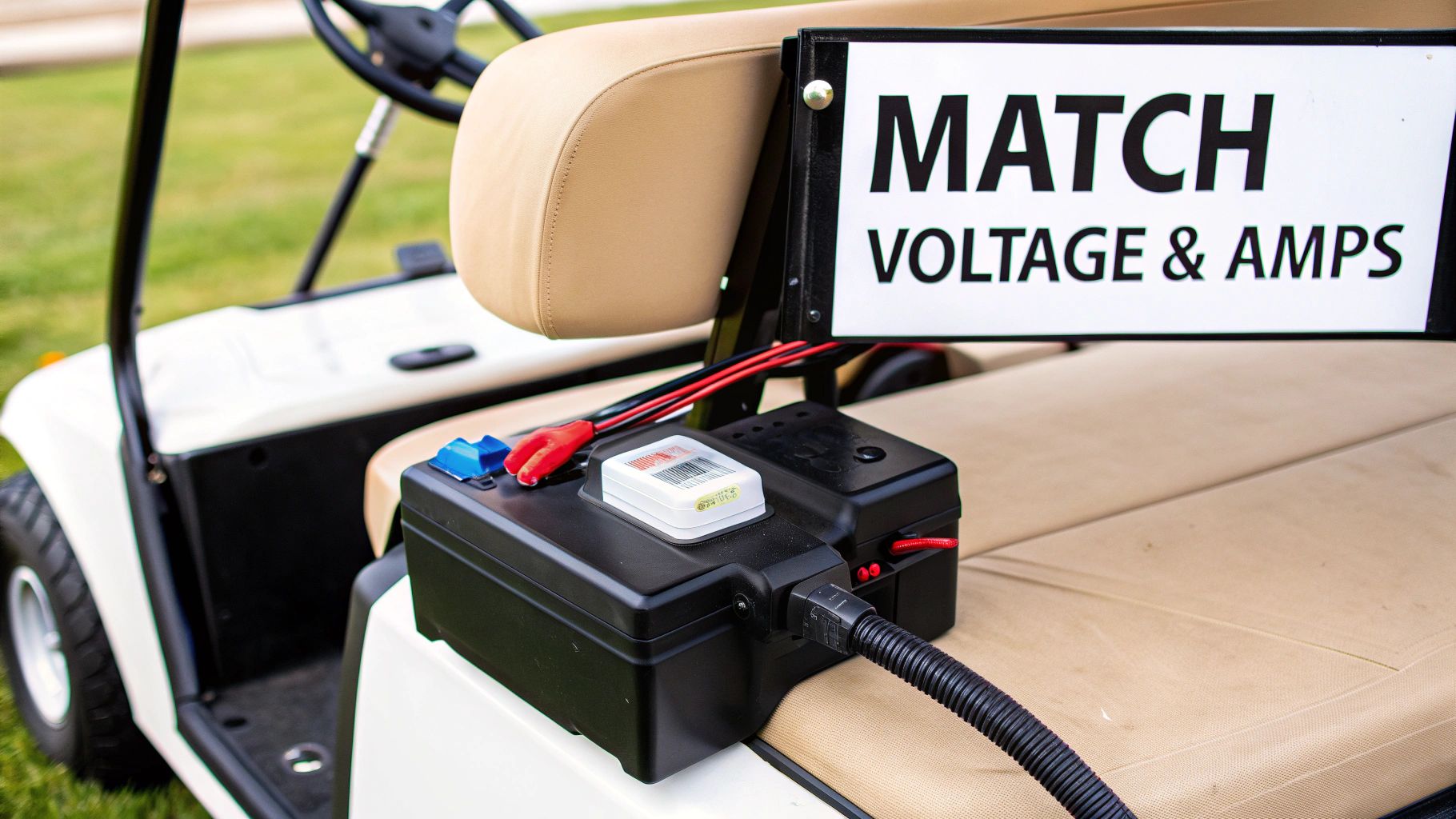
Before you worry about anything else, you have to get the pressure right. This is non-negotiable. A 48-volt (48V) battery system absolutely requires a 48V charger. A 36V system needs a 36V charger. There’s no wiggle room here.
Using the wrong voltage is like hooking up a high-pressure fire hose to a delicate garden sprinkler. A lower-voltage charger won’t have enough “push” to fill the batteries at all. Worse, a higher-voltage charger will overwhelm the system, causing permanent damage, dangerous overheating, and a serious fire risk.
How to Confirm Your Cart's Voltage
Figuring out your cart's system voltage is pretty simple. Most modern carts have the voltage clearly labeled on the batteries or near the charging port. If you can’t find it, there’s a foolproof method for lead-acid batteries.
Just look at one of the batteries in your pack and count the plastic caps on top. Each cap covers a water fill hole, and each of these "cells" represents 2 volts of power.
- Count the cells on a single battery. (For example, 3 cells)
- Multiply that number by 2 to get the battery's voltage. (3 cells x 2 volts = a 6V battery)
- Count how many identical batteries are wired together. (Let's say there are 6 batteries)
- Multiply the single battery voltage by the total number of batteries. (6V x 6 batteries = a 36V system)
A few common setups you’ll see are six 6V batteries making a 36V system, or six 8V batteries (each with 4 cells) for a 48V system. Lithium batteries make it even easier—the voltage is almost always printed right on the battery casing.
Key Takeaway: Before you even think about charging speed or fancy features, you must confirm your cart's system voltage. Matching the charger's voltage to your battery pack is the single most critical step in finding the best golf cart battery charger for your setup.
Understanding Amperage and Charging Speed
With the correct voltage locked in, we can move on to amperage (A). If voltage is the pressure, amperage is the flow rate. A charger with a higher amp rating pushes more electrical current into your batteries at once, which means they fill up faster.
For instance, a 25-amp charger will top off your batteries much quicker than a 15-amp charger. This is a huge plus if you use your cart daily or need a fast turnaround between rounds on the course.
But faster isn't always better. The ideal amperage really depends on your battery's total capacity, which is measured in amp-hours (Ah). Pushing too much current too fast can create a lot of heat, which is the enemy of battery health—especially for traditional lead-acid batteries.
A good rule of thumb is to pick a charger with an amp rating that is roughly 10% of your battery pack's total Ah capacity. So, if you have a 200Ah battery pack, a charger around 20 amps would be a perfect match. For a deeper dive, our guide on choosing a lithium battery charger for a golf cart covers the specifics for matching amperage in those advanced systems.
Most aftermarket chargers you'll find for standard 36V and 48V carts are in the 15A to 25A range. This is the sweet spot, offering a great balance between a quick charge and long-term battery care. For the vast majority of cart owners, choosing a charger in this range is a safe and effective bet that gets you back on the move without putting unnecessary strain on your investment.
Why Smart Chargers and Safety Features Matter
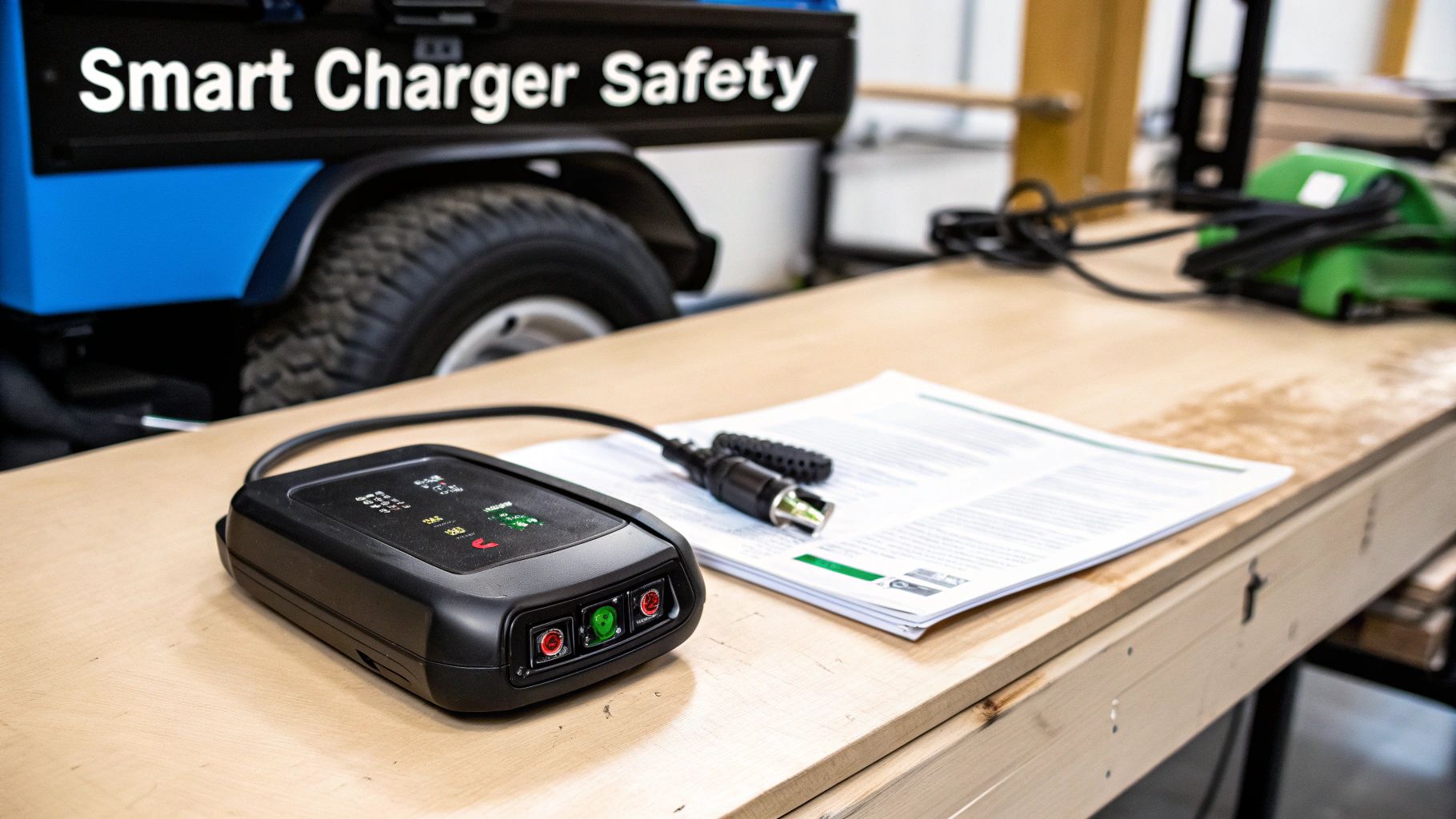
Once you've nailed down the right voltage and amperage for your cart, it's time to look past the basic numbers and focus on the technology inside the charger. A modern charger is so much more than a simple power cord—it’s a sophisticated piece of gear designed to protect and extend the life of your expensive batteries. This is where "smart charging" comes into play, and it’s a total game-changer.
Think of an old, basic charger as a blunt instrument. It just shoves power into the battery until you remember to unplug it. A smart charger, on the other hand, is like a personal trainer for your battery pack. It doesn't just blindly pump electricity; it actively monitors your battery's health and adjusts the charge in real-time.
These devices use advanced multi-stage charging algorithms to essentially "talk" to your batteries. They sense the voltage, current, and even the ambient temperature, tailoring the power delivery to exactly what the battery needs at that moment. This approach prevents the single biggest killer of golf cart batteries: overcharging.
Core Functions of a Smart Charger
A true smart charger doesn’t just stop when the battery hits full. It carefully guides it through a precise sequence to ensure every cell is optimally charged and conditioned for a long, healthy life. The magic is in its ability to automatically shift between different charging phases.
For lead-acid batteries, most high-quality models will follow these stages:
- Bulk Charge: This is the sprint. The charger delivers maximum amperage to quickly bring the battery up to about 80% capacity.
- Absorption Charge: Now it slows down. The voltage is held steady while the amperage gradually tapers off, "topping off" that final 20% without causing any heat stress.
- Float/Maintenance Mode: Once fully charged, the charger backs off to a tiny trickle charge. This is just enough power to offset the battery’s natural self-discharge, keeping it at 100% without any risk of overcharging.
This intelligent process is exactly why you can safely leave a smart charger plugged in for weeks or even months. It’s a true "set it and forget it" solution that guarantees your cart is always ready to roll when you are.
Must-Have Safety Protections
Beyond the smart algorithms, the best golf cart battery charger models are armed with a suite of safety features that act as your electrical safety net. These aren't just flashy add-ons; they are critical protections for your cart, your batteries, and your property.
When you're comparing chargers, make sure these protections are on the list—they're non-negotiable:
- Automatic Shut-Off: This is the most fundamental feature. The charger automatically ends the main charging cycle once the battery is full, preventing overheating and permanent damage.
- Short-Circuit Protection: If the charger clamps accidentally touch each other, this feature instantly cuts the power to prevent dangerous sparks and potential damage.
- Reverse Polarity Protection: We all make mistakes. This feature prevents any damage if you accidentally connect the positive clamp to the negative terminal and vice-versa.
- Temperature Compensation: More advanced chargers use a sensor to monitor the surrounding temperature and adjust the charging voltage accordingly. This is huge—it prevents overcharging in hot weather and undercharging when it’s cold.
These features offer priceless peace of mind. You can plug in your cart and walk away, knowing your equipment is protected from common user errors and electrical faults.
Investing in a charger with robust safety features is not about avoiding the unlikely; it's about protecting your valuable equipment from the very plausible. A quality smart charger is the best insurance policy you can buy for your battery pack.
The Importance of Safety Certifications
So, how can you be sure a charger is genuinely safe and not just a cheap knockoff? Look for official certification marks. These aren't just letters stamped on a label; they are proof that the charger has passed rigorous, independent testing for electrical safety and performance.
The two most important certifications to look for are:
- UL (Underwriters Laboratories): This is the gold standard for safety in North America. A UL listing means the product has been tested to meet incredibly stringent safety requirements.
- CE (Conformité Européenne): This mark indicates that the product complies with the health, safety, and environmental protection standards for anything sold within the European Economic Area.
Seeing one or both of these logos is a strong signal that you're buying a well-engineered product that won't fail dangerously. As cart owners demand better and safer tech, the global market for these devices is growing fast. The Golf Cart Battery Chargers Market was valued at USD 450 million in 2024 and is projected to hit USD 750 million by 2033—a trend fueled by people like you seeking safer, more efficient charging. You can discover more insights about this growing market on verifiedmarketreports.com.
Plugs, Portability, and Other Practical Considerations
You’ve sorted through the technical stuff—voltage, amps, and smart charging. Now it's time to focus on the details that make a real difference in your day-to-day routine. These are the practical things that separate a good charger from the best golf cart battery charger for you, covering how the charger physically fits into your life and your cart.
Let’s start with the charging plug. It might seem like a small detail, but getting it wrong is a massive headache. Think of it like trying to use a European power adapter in a U.S. outlet—without the right connection, nothing happens. Sure, you can find adapters, but they just create another weak link in the chain. It's always better to get a charger with the right native plug from the get-go.
Most golf carts use one of a few standard connector types. The easiest way to avoid any guesswork? Just snap a quick photo of your cart's charging port before you start shopping. That way, you know you’re getting a perfect match.
Common Golf Cart Plug Types
- Crowfoot Plug: This is a classic rectangular plug with two diagonal pins. You'll see it a lot on older EZ-GO and Club Car models.
- Round Plugs: Many modern brands, like Club Car and Yamaha, have moved to their own proprietary round plugs. These often have a specific notch or pin layout to guarantee a secure, model-specific connection.
- Anderson Connector: This is a tough, two-pin connector known for its solid connection, often used in more heavy-duty applications.
Getting the plug right means no frustrating returns or last-minute hunts for an adapter. It’s a simple step that guarantees you can plug in and start charging the moment you unbox it.
The Overlooked Value of Portability
Beyond the plug, the actual size and weight of the charger matter more than most people think. Older "on-board" chargers are often bulky, heavy boxes bolted right into the cart. They work, but they offer zero flexibility. Modern portable chargers, on the other hand, are a huge leap forward in convenience.
Imagine you need to store your cart for the winter in a cramped garage, or you want to bring your charger to a vacation home. A lightweight, compact charger is infinitely easier to deal with. You can disconnect it, stick it on a shelf, or toss it in your car without a second thought. This kind of flexibility is a game-changer for anyone who values a clean setup and easy mobility.
A portable charger doesn't just power your cart; it adapts to your lifestyle. The ability to easily move, store, and handle your charger adds a layer of practical convenience that heavy, fixed units simply can't match.
For many cart owners, a portable charger is also a smarter long-term buy. If you upgrade your golf cart in a few years, there’s a good chance you can take your high-quality portable charger with you, as long as the new cart has the same voltage and plug type. That’s not an option with most built-in chargers. By thinking through these practical factors—the right plug and a manageable size—you're choosing a charger that doesn't just fit your battery, but also fits perfectly into your life.
Charging Best Practices for a Longer Battery Life
Having the best golf cart battery charger is one thing, but knowing how to use it is what really protects your investment. A few smart habits can add years of reliable performance to your batteries, saving you from the headache and cost of replacing them too soon. It’s all about making sure your cart is ready to go when you are.
The golden rule? Avoid deep discharging. Consistently running your batteries down below a 20% charge puts a massive strain on them, especially the lead-acid types. Think of it like constantly driving your car with the fuel light on—it’s just not healthy for the engine.
Instead, get into the rhythm of recharging your cart after every significant use. Even if you only played nine holes, plug it in. This simple routine keeps the battery working in its sweet spot and drastically extends its life. It’s far better for a battery to get frequent, shallow charges than to suffer through infrequent, deep ones.
Create a Healthy Charging Environment
Where you charge is just as important as when. Batteries get hot when you’re driving and when you’re charging, and heat is their number one enemy. A simple but critical best practice is to let your cart cool down for at least 30 minutes after a long ride before plugging it in.
This cool-down period lets the internal temperature of the batteries stabilize, which helps them accept a charge more safely and efficiently. Charging a hot battery can cause damage and slowly chip away at its overall capacity.
Beyond that, pay attention to your charging setup:
- Ventilation is Key: Always charge your cart in a well-ventilated space. Lead-acid batteries release hydrogen gas while charging, and that gas is flammable. Good airflow is non-negotiable to prevent it from building up.
- Use the Right Extension Cord: If you have to use an extension cord, make sure it’s a heavy-duty, 12-gauge cord and keep it as short as possible. A flimsy or overly long cord causes a voltage drop, forcing your charger to work overtime and potentially undercharge your batteries.
"A battery maintainer is designed to be left on 24/7... If anything, I’d blame the battery, especially on a relatively modern car... Build quality for batteries has gone to crap."
This insight really drives home the value of a smart charger, especially for long-term storage during the off-season. A quality maintenance mode stops the battery from self-discharging without overcharging it, keeping it healthy and primed for spring. Following these practices makes you more than just a cart owner—it makes you a savvy one who gets the most out of their gear.
Frequently Asked Questions About Golf Cart Chargers
Even after you've done your homework, a few questions always pop up. Getting the details right when choosing a charger is a big deal—get them wrong, and you could be looking at a costly mistake. This section cuts straight to the chase, answering the most common questions we hear from golf cart owners.
Think of this as your final checklist. We'll tackle practical, real-world scenarios to give you the confidence you need to pick the perfect charger and keep your battery investment safe for years to come.
Can I Use a 36V Charger on a 48V Golf Cart or Vice Versa?
In a word: no. This is the single most important rule of golf cart charging—you must always use a charger with a voltage that exactly matches your cart's battery system.
Trying to use a 36V charger on a 48V battery pack is pointless; it just doesn't have enough juice to get the job done. But going the other way—using a 48V charger on a 36V system—is incredibly dangerous. It will blast the batteries with too much power, causing severe overcharging, permanent damage, and creating a serious fire risk.
Is It Safe to Leave My Golf Cart Plugged In All the Time?
That all comes down to the kind of charger you have. Modern "smart" or "automatic" chargers are built specifically for this. Once the battery is full, they automatically shut off the main charging cycle and switch into a maintenance or "float" mode, which safely keeps the battery topped off.
If you have one of these, leaving it plugged in is generally safe and often even recommended. However, if you're working with an older manual charger, leaving it connected after the battery is full is a recipe for disaster. It will keep pushing power into a full battery, which can boil the electrolyte in lead-acid batteries and completely ruin them. When in doubt, always check your charger's manual.
How Do I Know What Charging Plug My Golf Cart Needs?
The easiest and most reliable way is to simply look at the charging port on your golf cart and compare it to the plug on your old charger. The three most common styles you'll see are the rectangular Crowfoot plug, the two-pin Anderson connector, and various round plugs specific to brands like Club Car or Yamaha.
Pro Tip: Pull out your phone and take a clear, well-lit photo of your cart's receptacle. When you're shopping online, you can pull up that picture and compare it directly to the product images. It's a simple trick to guarantee you order a perfect match right from the start.
Does a Higher Amp Charger Always Charge Faster?
Yes, a charger with a higher amperage (amp) rating will definitely charge your batteries more quickly. A 25-amp charger, for instance, will fill up your batteries much faster than a 15-amp model. This is a huge plus if you use your cart daily and need a quick turnaround between trips.
But faster isn't always better. The key is to match the charger's amperage to your battery pack's total capacity, which is measured in amp-hours (Ah). Using a charger that's too powerful for your batteries can generate a lot of excess heat, which slowly degrades the internal components and can shorten your battery's overall lifespan.
Ready to experience the convenience of a lightweight, powerful electric caddie? The Caddie Wheel transforms your standard push cart into a motorized powerhouse, letting you walk 36 holes with ease.
Discover the Caddie Wheel today!
Share:
A Hands-On Guide to Golf Cart Motor Repair
Your Ultimate Guide to the Golf Cart Electric Upgrade