

If you've ever finished the first nine holes with your shoulders already tired and your mood dropping with every uphill push, you know the problem. A good walking round stops feeling enjoyable when the cart starts fighting you, and that's exactly where an electric assist conversion kit makes sense, because it lets you keep the push cart you already trust and add power only where you need it.
That matters more than most buyers expect. A big part of the conversion-kit market is still aftermarket retrofitting, not buying a whole new motorized setup, and current estimates put the global e-bike conversion kit market at USD 7.53 billion in 2025, with a projection of USD 13.51 billion by 2031 and 82.41% of sales coming from aftermarket kits (Mordor Intelligence market overview). The same broad category is no longer experimental, either, its history runs from early patents and prototypes to real commercial adoption, which is exactly why a retrofit can feel like the practical middle ground between effort and convenience (electric-bike history overview).
Why Converting Your Push Cart Changes the Game
On a wet course with a loaded bag, even a reliable push cart can become hard work. The frame may still fold neatly and track well, but every slope, rut, and soft patch adds resistance. Retrofitting gives that familiar cart assistance without forcing you to replace the setup that already fits your bag, storage space, and walking routine.
An electric assist conversion kit occupies a useful middle ground. You continue walking and stay involved in the round, while the motor reduces the effort required to move the cart between shots. That can help golfers managing joint strain, but it also suits anyone who wants to finish the back nine with more energy for the swing. The benefit is practical, not recreational transport. You are reducing the work of pushing a loaded cart, not turning the round into a ride.

Why retrofitting feels smarter than replacing
The conversion only makes sense if your existing cart is a sound starting point. Check the frame width, wheel mounting points, folding mechanism, brake clearance, and the way your bag sits under load. A kit that fits one cart may require brackets, adapters, or permanent changes on another. Confirm those details before comparing motor power or battery capacity.
Practical rule: keep the cart if it folds reliably, tracks straight, holds your bag securely, and has no cracked frame or badly worn wheels. A motor will not correct poor alignment or a failing brake. It can also add weight, charging duties, cable exposure, and another set of parts to inspect after wet rounds.
Retrofitting remains attractive because you upgrade the part that causes the most fatigue while keeping the controls and storage habits you already understand. For golfers who walk regularly, that trade-off can be easier to live with than buying a complete electric model. Check replacement-part availability and cleaning requirements as carefully as the initial fit.
What Makes an Electric Assist Conversion Kit Work
A conversion kit is a simple system built from three parts: a motor, a battery, and a controller. For a golf push cart, the motor is usually built into or attached to a powered wheel that replaces or supplements an existing wheel. The battery provides energy, while the controller regulates how much assistance reaches the motor and how quickly it responds.
A representative kit for a wheeled platform shows how these specifications fit together. One example uses a 48V brushless hub motor, with 500W nominal power, 43Nm max torque, a 48V 8.8Ah battery, 422Wh of stored energy, and an advertised range of up to 79 km (49 miles) under favorable conditions (technical kit listing). Those figures are useful for comparison, but they do not predict exactly how the retrofit will feel on your course.
How the parts work together
The motor provides forward assistance, the battery supplies the energy, and the controller determines how aggressively that assistance arrives. In practical terms, voltage indicates how the system delivers electrical power, torque affects how well the motor starts a loaded cart, and watt-hours describe how much energy the battery stores.
The same conversion kit can behave differently across a round. A flat path places a light demand on the motor, while a wet incline or a heavily loaded cart requires more effort from the system. Frequent starts and stops also use energy differently from a long, steady run. That is why battery capacity alone does not describe the full experience, particularly on hilly courses.
A battery rating is only half the story. The other half is how often the cart has to start, stop, and climb.
Control feel matters as much as peak power. A responsive controller makes the cart easier to guide beside you, while delayed or uneven assistance can turn bumps and tight turns into constant corrections. On a retrofit, also pay attention to how the controller, battery, and cables mount to the original frame. Poor routing can leave wiring exposed to wheel spray or interfere with folding and storage.
For a closer look at motor selection and the trade-offs between power and cart use, see this guide to choosing the right electric motor for a golf cart.
Key Benefits and What to Look for When Buying
A conversion kit makes sense when your current push cart fits well, folds the way you need, and only lacks assistance on hills or longer walks. Retrofitting keeps the frame, storage habits, and accessories you already know. The buying decision then comes down to two questions: will the kit fit, and will its assistance match how you play?
Compare runtime with real course use
Battery capacity provides a starting point, but duty cycle gives a more useful picture. An independent review reports roughly 225Wh powering about 18 holes of intermittent assistance, while other battery-powered carts are commonly described as reaching around 36 holes per charge (independent golf push cart review). The difference reflects more than battery size.
Starts, stops, inclines, wet ground, and a loaded bag all increase demand. Runtime also changes according to whether the motor is helping you push or moving the cart under its own power. A similar battery rating can therefore produce a different round on another course. Look for an honest runtime explanation that describes usage conditions rather than relying on a distance figure alone.
Confirm fit before comparing power
A retrofit can fail before the motor does. Check the cart's wheel diameter, axle shape, wheel width, brake arrangement, and frame clearance. The motor wheel must sit squarely, and the added hardware must leave the cart able to fold and store as intended. Compatibility guidance also warns that some carts are unsuitable, so confirm the details before ordering (compatibility FAQ overview).
A practical checklist:
- Battery behavior: Choose documentation that explains expected runtime in real use.
- Weight balance: A powered wheel can change tracking on side slopes, grass, and rough paths.
- Assist response: Test whether starting, stopping, and braking feel predictable rather than abrupt.
- Frame fit: Verify the axle, wheel, brake, and folding arrangement against the kit's requirements.
The control should also suit your routine. A remote that offers clear speed adjustment and dependable stopping is easier to manage beside you than a system requiring frequent corrections. Extra power has limited value if it makes the cart awkward to steer.
Golf-specific reviews describe conversion-style assist kits as additions to existing manual push carts, not replacements for them. They also point to stability features for uneven terrain (push cart review overview). That trade-off defines the purchase: keep a cart you already like, but accept the need to verify fit, balance, and control before expecting a smoother round.
Installing Your Kit for Seamless Use
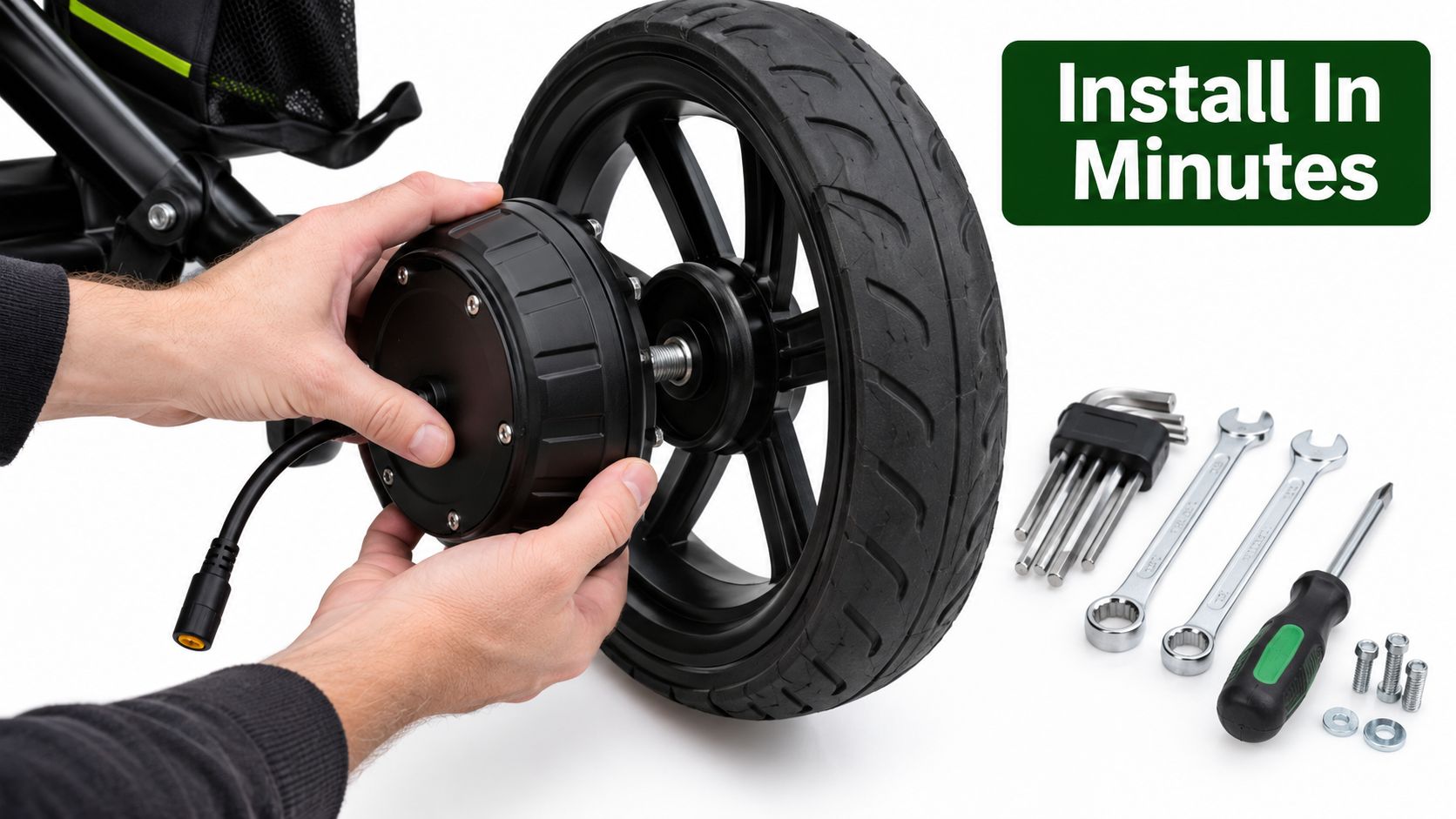
A lot of golfers assume installation means a full workshop project. In reality, the best conversion setups are built to avoid that, because the whole point of a retrofit is to make the upgrade practical for an existing cart, not to turn the owner into a mechanic.
Start with fit, not force
Before anything goes on the cart, check the axle shape, wheel width, and brake arrangement. If the motor wheel isn't seated correctly, the rest of the setup doesn't matter, because a conversion that looks secure but isn't aligned will be annoying at best and unsafe at worst.
Practical rule: if the wheel doesn't drop in cleanly, stop there. Don't “make it fit” with pressure or improvised hardware.
That's the value of a drop-on design with a bracket system, it reduces guesswork. A good kit should feel like a component swap, not a rebuild, and the fewer loose steps there are, the less likely you are to end up with wiring issues or a wheel that sits awkwardly under load.
Keep the controls simple
The control side should be equally straightforward. A variable-speed remote should let you manage forward motion, reverse, and braking without digging through menus or reaching for a complicated interface. If the cart becomes harder to operate after the upgrade, the system has missed the point.
For anyone looking at a branded solution, Caddie Wheel is one example of a drop-on motorized wheel and bracket setup designed for existing push carts, with installation centered on simplicity rather than a full cart replacement. The best installations are the ones that disappear into your routine after the first few rounds, because they just work.
Maintaining Your Electric Assist for Longevity
A conversion kit often feels effortless during the first few rounds. After wet weather, muddy paths, repeated charging, and storage between seasons, the kit's durability is tested. Small maintenance checks keep an existing push cart dependable without turning ownership into another project.
After a muddy round, wipe the motor housing and remove dirt from moving areas. Inspect battery contacts for grime or corrosion, then store the cart and battery somewhere dry. Avoid repeatedly draining the battery completely, and do not leave it in very hot, cold, or damp conditions for long periods. These habits help preserve consistent assistance over time.
Battery care is the part people skip
Battery handling deserves separate attention because it has a direct effect on range and reliability. The guide to electric trolley batteries covers charging and storage practices in more detail, including considerations for off-season use.
Keep the pack charged according to the manufacturer's instructions, rather than leaving it empty after a round. Check the contacts before connecting it, especially if the cart has been used in wet grass or stored in a garage. Dirt or moisture at the connection can cause inconsistent power and make a mechanical problem look like a battery fault.
Watch the hardware as well as the power
A retrofit adds a motorized wheel, bracket, wiring, and fasteners to a frame that was originally designed for pushing. Rough ground and vibration can loosen hardware or shift a bracket. Mud can also collect around exposed parts and affect how freely the wheel turns.
Before each round, check that the wheel and bracket remain secure, the wiring is clear of moving parts, and the controls respond normally. A short inspection catches changes before they become a failed outing.
A five-minute check before a round is cheaper than chasing a mystery fault after the cart starts acting up.
Warranty terms matter for long-term ownership. Check what the manufacturer covers, which parts are excluded, and whether the coverage suits how often you play. A conversion can cost less than replacing the cart, but that advantage lasts only if the battery and mounting hardware receive regular attention.
Common Questions About Compatibility and Rules
A push cart can look “standard” and still be a poor match for an electric assist conversion kit. Check the frame, wheel mount, axle, and balance before ordering. A motorized wheel that sits off-centre may track acceptably on a driveway but pull, wobble, or drag on uneven fairway ground.
Can you use one in competition
Competition rules address how the cart is used, not only whether it has a motor. An electric push cart may be permitted, but transporting the player any distance on the cart breaches the transportation rule and brings the general penalty (push cart policy). The distinction matters for golfers using an assist system during events.
Confirm the conditions for your format before playing. Casual rounds, practice sessions, club competitions, and larger tournaments may apply different expectations. A conversion that works well for everyday golf may still be unsuitable for a particular event, so check the local rules and any competition conditions in advance.
Compatibility checks before ordering
Measure the cart's wheel-mount width, axle diameter, and available clearance around the frame. Confirm that the mounting hardware can sit squarely and that the added wheel will not interfere with folding, braking, or storage. Check the cart's balance with a loaded bag as well. Extra weight or a high centre of gravity can make a lightweight frame harder to control on slopes.
Before ordering, run through a structured compatibility test for your push cart to confirm wheel mounting and axle fit. The broader history of electric-bike retrofits shows that conversion is an established approach (electric-bike history overview), but golf carts still require a model-by-model fit check.
A retrofit makes sense when you already like your cart and want less pushing effort without replacing the whole setup. Caddie Wheel uses that approach, providing an attachable electric assist wheel for existing carts. Review Caddie Wheel alongside your cart's measurements, folding method, and intended use before buying.
Share:
What Is Controlled Braking: A Complete Guide