
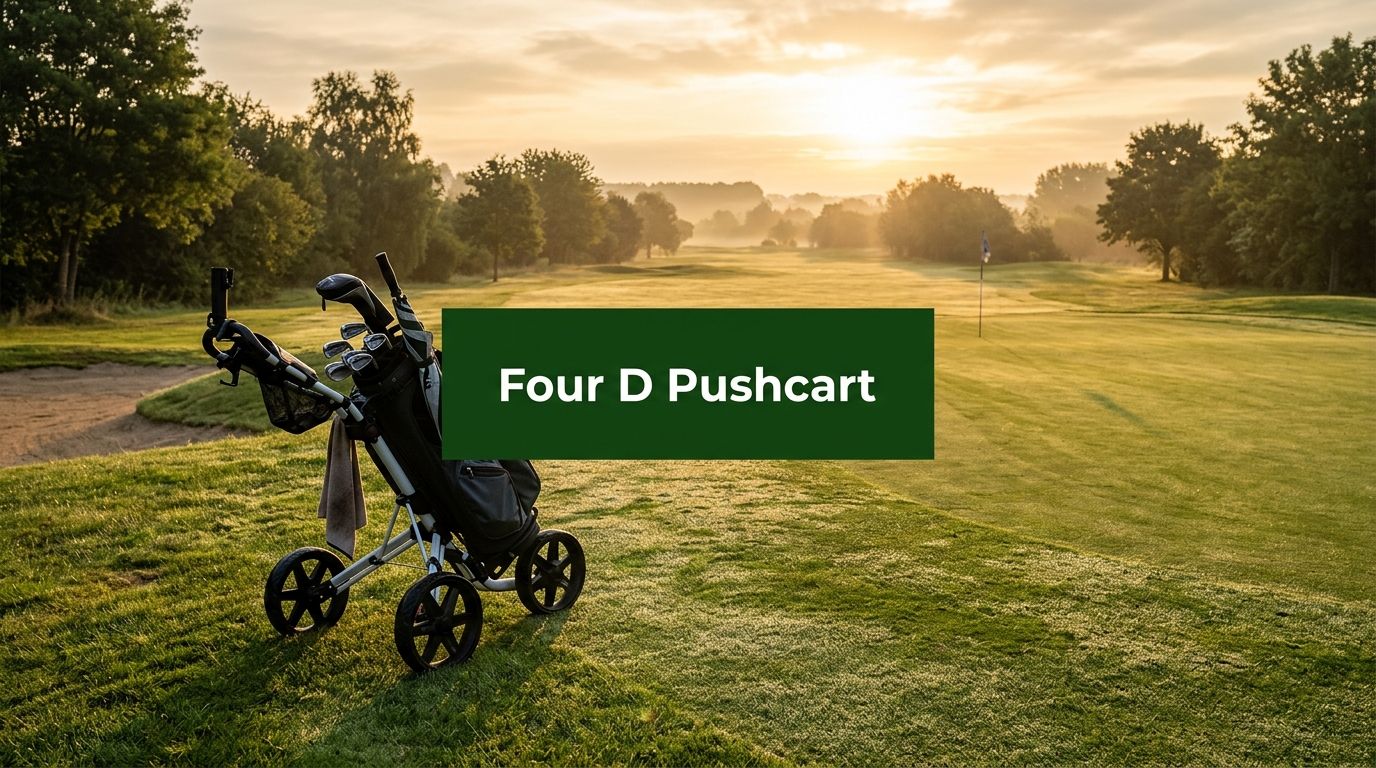
You're probably here because your current cart has given you at least one bad moment on a hill.
Maybe it leaned when you parked beside a side slope. Maybe a gust caught the bag. Maybe you looked down after setting your club on the grass and saw the cart start to wander just enough to break your concentration. That kind of instability sounds minor until it happens on the back nine, when you're trying to commit to a shot and your gear keeps demanding attention.
That's where a Four D pushcart earns its place. A good four-wheel cart gives you a lower-stress walking round because it starts with a simple advantage: it stands its ground better. For golfers who walk regularly, that matters more than flashy accessories. Stability affects how the cart tracks, how confidently you can park it, and how well it handles extra weight from rain gear, water, and accessories.
For golfers thinking beyond a basic manual setup, that same stable platform also matters when you want to add electric assist later. A cart that feels planted as a pushcart usually gives you a better foundation for powered movement too. That's the angle most buyers miss.
Your Guide to the Four D Pushcart
A walking round gets harder when your cart feels like one more thing to manage.
On a hilly course, a three-wheel cart can be perfectly usable right up until the moment it isn't. You stop on a modest sidehill, turn to judge yardage, and catch movement in the corner of your eye. Even if it doesn't fully tip, that little wobble changes how you use it for the rest of the round. You park more carefully. You reposition more often. You pay attention to the cart when your attention should stay on the shot.
A Four D pushcart fixes that problem at the source. The four-wheel layout creates a more settled feel, especially when the course isn't flat and the bag is fully loaded. Instead of asking the golfer to constantly compensate, it lets the frame do the work.
A stable cart doesn't just protect clubs. It protects rhythm.
That's why experienced walkers tend to care less about gimmicks and more about fundamentals. If the frame is solid, the cart becomes easier to live with in every phase of the round: walking off the tee, parking near bunkers, crossing uneven fairway edges, and rolling up around greens without feeling like the whole setup is one awkward angle away from a spill.
Who benefits most from a four-wheel setup
Some golfers feel the difference immediately:
- Golfers on hilly courses: Side slopes expose weaknesses fast.
- Players who carry more gear: Extra layers, drinks, and accessories raise the demand on the chassis.
- Senior golfers or mobility-conscious walkers: A calmer, more predictable cart reduces unnecessary corrections.
- Anyone considering electric assist later: A stable base handles powered movement better than a twitchy one.
The true value of a Four D pushcart isn't that it looks different. It's that it removes one of the small but persistent irritations of walking golf.
What Makes a Four Wheel Design Different
A four-wheel pushcart behaves more like a table than a tripod.
That's the easiest way to understand it. A three-wheel design can be nimble, but it also leaves broader tipping vulnerability around its open sides. A four-wheel design spreads the load over four contact points, so the cart feels more planted when the ground pushes back with uneven lies, ruts, and side slopes.

There's actual performance logic behind that feeling. Four-wheel golf push carts provide superior lateral stability compared to three-wheel designs, reducing cart roll on slopes by up to 40% due to their wider base geometry that distributes load across four contact points, according to Bighorn Golfer's comparison of 3-wheel and 4-wheel golf push carts.
Why that wider footprint matters
The issue isn't only tipping. It's the chain reaction that starts before a full tip ever happens.
A cart that rolls slightly on a slope forces you to:
- Re-park more often, especially around greens
- Keep one hand on the frame, when you'd rather be reading a putt or selecting a club
- Load the bag more carefully, because uneven weight becomes a bigger issue
- Think about cart position constantly, which gets old over 18 holes
With a stronger four-wheel base, those little corrections happen less often. That's why golfers who play rolling terrain often end up preferring a quad-style frame even if they started with a three-wheel model.
Stability also improves upgrade potential
This matters even more if you're considering an electric conversion.
A motor adds propulsion. Propulsion adds force. If the underlying frame already feels unsettled, adding power won't fix that weakness. In practice, a more stable chassis gives electric assist a safer, more predictable platform to work from. If you want a broader look at frame styles, this guide to 4-wheel push golf carts is useful for comparing what that layout changes in day-to-day use.
Practical rule: Buy the frame first. Accessories can improve a good cart, but they rarely rescue a bad foundation.
That's the key distinction. A Four D pushcart isn't better because four is automatically better than three in every situation. It's better when your priority is calm, planted movement under real course conditions.
Key Features and Buying Considerations
Wheel count gets attention, but it shouldn't be your whole buying decision. A well-designed Four D pushcart earns its keep through the details you notice every time you load, fold, park, and steer it.

Start with the folding system
If a cart is annoying to set up in the parking lot, you'll feel that friction every round. Look for a fold that feels intuitive and repeatable. It doesn't need to be flashy. It needs to be fast enough that you won't dread using it when you're tired after a round or packing up in bad weather.
Good signs include:
- Clean hinge action: No sticky halfway points
- Compact storage shape: It should fit naturally alongside your bag
- Minimal fuss: Fewer steps usually means less frustration
Check how the handle area is laid out
The console matters more than most buyers think. During a round, that handle zone becomes your dashboard. You want enough room for the items you use, without creating clutter that rattles or gets in the way.
Look for a cart that gives you sensible access to:
- Balls and tees
- A drink holder that doesn't feel flimsy
- A scorecard or phone slot
- An umbrella mount if you play in mixed weather
- Brake access that's easy to reach
Don't overlook brake design
On flat courses, brake quality can feel like a minor detail. On slopes, it becomes essential. You need a brake that holds the cart where you leave it, without requiring a stomp and a prayer.
Some golfers prefer hand-mounted control because it feels more direct. Others don't mind a foot brake if it engages positively. The key is simple: test whether the cart stays parked with a loaded bag.
Think ahead about electric compatibility
At this stage, many buyers either save money or waste it.
A frame that leaves room for accessories and future upgrades gives you options. The best carts don't lock you into a single use case. If you decide later that you want motorized help, compatibility becomes a real buying criterion. One practical benchmark is whether the frame can accept an add-on wheel system without awkward adapters or permanent modification. The verified product details for one such system note that the Caddie Wheel features a drop-on design with a snap-in bracket that allows installation in minutes without tools, specifically designed to attach to most three- and four-wheel push carts, securing with a simple velcro strap rather than requiring bolts or clamps, as shown in this YouTube demonstration of the installation setup.
That same principle applies beyond golf. If you like seeing how teams think through fit, usability, and physical specs before manufacturing, HYDAWAY's HYDAWAY product development guide is a useful example of why design details matter long before a product reaches the user.
A buyer's short list
Before you commit, ask yourself:
| What to check | Why it matters |
|---|---|
| Frame stability | It affects confidence on slopes and uneven ground |
| Folding simplicity | You'll use it before and after every round |
| Brake quality | A loaded cart has to stay put |
| Handle and console usability | Small conveniences matter over 18 holes |
| Future upgrade path | A good cart should remain useful as your needs change |
A Four D pushcart is a better buy when it solves daily friction, not when it just looks sturdy in photos.
The Stability Advantage on the Course
The difference shows up in ordinary moments.
You pull off the fairway onto a slight bank while waiting for the green to clear. With a weaker setup, you angle the wheels carefully, test the brake, glance back twice, and still don't fully trust it. With a stable four-wheel cart, you park it, take your yardage, and move on.
That's not dramatic. It's just better golf.
Where four-wheel stability pays off
A Four D pushcart helps most in the places where rounds often get messy:
- Sidehill fairway positions: The cart feels less eager to drift or lean.
- Apron and collar areas: You can leave it nearby without babysitting it.
- Cart-path edges and rough transitions: The frame deals better with uneven ground.
- Windy days with a full bag: A more planted base inspires more confidence.
Those moments reduce physical strain too. A lot of walking fatigue doesn't come from the long straight pushes. It comes from all the small corrections. Tugging a cart back into place. Catching a lean before it becomes a tip. Adjusting your route because the cart doesn't feel secure on a slope.
Less correction means better energy use
That's one reason a stable platform matters to older golfers and anyone managing stamina carefully. Verified benchmark testing for electric-assist wheels compatible with four-wheel carts found that they reduce gait fatigue in senior golfers by 35% over 18 holes, helping players walk all holes without pushing fatigue while maintaining ergonomic posture, according to Sun Mountain's PX4 product information.
Even without focusing on the powered angle yet, that tells you something important. When the cart setup supports your movement instead of fighting it, walking becomes more sustainable over a full round.
The best pushcart is the one you stop thinking about after the first tee.
That's what four-wheel stability changes on the course. It removes interruptions. You don't spend the day managing the cart. You spend the day playing golf.
Upgrading to Electric with the Caddie Wheel
A stable manual cart becomes much more interesting when you see it as a platform.
That's the strongest case for a Four D pushcart. It doesn't just work well as a pushcart. It gives you a better foundation for electric conversion because the frame already starts from a place of balance and control. When power enters the equation, that matters. A shaky base and a motor are a poor combination. A settled four-wheel frame is far better suited to powered assistance.

Why the platform matters before the motor
Electric assist doesn't just reduce effort. It changes how force moves through the cart.
On a good four-wheel frame, that added propulsion has a better chance of feeling composed. The cart tracks more confidently, especially on rolling terrain where manual carts can already feel busy. If you're trying to preserve energy on hills without moving to a fully separate electric caddie, this kind of conversion can be a smart middle ground.
That's also why compatibility and simplicity matter. If installation is awkward or permanent, the upgrade loses some of its appeal. A system that attaches cleanly to an existing pushcart respects the investment you've already made in the frame.
What practical electric assist should do
At minimum, an add-on motor should solve three problems:
- Reduce pushing strain on hills
- Keep controls simple enough for real-course use
- Support a full round without becoming another thing to manage
Those basics matter more than novelty features. Golfers don't need a gadget show. They need dependable propulsion that lets them keep walking.
Verified product details for the Caddie Wheel state that the unit uses a Lithium-ion 36V 5ah 180wh battery with a 250-watt motor output, supporting up to 36 holes per charge, a threshold engineered to allow golfers to complete full tournament rounds without recharging, according to the Caddie Wheel unit specifications.
That battery capacity tells you this isn't built only for a casual nine. It's aimed at golfers who walk full rounds and don't want range anxiety halfway through the day.
Control and real-course feel
A conversion only works if it behaves naturally on the course. You need enough control to handle starts, stops, and pace changes without overthinking the system. That includes the ability to slow down approaching greens, manage inclines, and keep the cart moving at a comfortable walking speed.
If you want a practical frame of reference on manual versus powered movement, this guide on golf cart manual options helps clarify where electric assist fits for golfers who still want to walk but don't want the strain of constant pushing.
There's also value in seeing the motion in action:
Who gets the most from this upgrade
Not every golfer needs electric assist. But certain players usually appreciate it immediately:
- Golfers on steep or long courses: Hills change the math fast.
- Players returning from fatigue or mobility issues: Walking remains possible without heavy pushing.
- Frequent walkers: Less physical drain makes repeated rounds easier to sustain.
- Golfers who already like their cart: Conversion lets you upgrade the experience without replacing everything.
The key point is this. A Four D pushcart isn't just a stable cart. It's often the better chassis for adding power safely and sensibly. If you know you may want electric help later, choosing the right four-wheel platform now is usually the smarter move.
Essential Maintenance and Care Tips
A pushcart doesn't need much maintenance, but the small things matter. Ignore them long enough and you'll feel it in rough folding action, weaker braking, noisier rolling, or extra wear around the joints and wheels.

What to do after each round
If the course was wet, muddy, or sandy, wipe the frame and wheels down before storing it. Debris around the axles and joints tends to build up slowly, and then all at once your cart starts feeling older than it is.
A simple post-round routine helps:
- Wipe the wheels: Mud and grit wear moving parts faster.
- Dry the frame: Moisture left sitting on metal parts can create long-term issues.
- Check the brake contact point: Make sure it still engages cleanly.
- Clear the wheel housings: Small stones and packed grass can affect rolling.
What to inspect every so often
You don't need a workshop checklist. You need a golfer's checklist.
Look at the folding joints, wheel attachment points, and any strap areas that hold the bag in place. If something has loosened, you'll usually notice it first as a rattle, a twist, or a slight shift in tracking. Deal with it early.
Store the cart the way you want it to behave next weekend. Clean, dry, and ready to unfold.
If your setup includes electric assist
Maintenance becomes partly about the cart and partly about the powered component. That's one reason low-complexity motor design matters. Verified information from Alphard notes that the Caddie Wheel's gearless and brushless hub motor design ensures the unit operates at extremely low noise levels while maintaining high efficiency, unlike competing buggies that use geared motors which introduce mechanical noise and require more maintenance, as described on the Alphard Golf site.
That's a useful design trait because fewer wear-prone internal complications usually means less service hassle over time.
For broader upkeep habits, this golf cart maintenance tips guide for 2025 is a practical reference for keeping both cart and accessory components in dependable shape.
Frequently Asked Questions About Four D Pushcarts
A few questions come up almost every time golfers compare a Four D pushcart to other cart styles. The answers below are the ones that matter most in real buying decisions.
Common questions from walking golfers
| Question | Answer |
|---|---|
| Is a four-wheel cart always better than a three-wheel cart? | Not always. If your top priority is maximum nimbleness, a three-wheel cart can still suit you. If your priority is stability on slopes and a calmer feel with a loaded bag, a four-wheel cart often makes more sense. |
| Does a Four D pushcart feel harder to steer? | Some golfers notice a different steering feel at first. In practice, most adjust quickly. The trade-off is usually worth it if you value a more planted frame. |
| Is a four-wheel design better for hilly courses? | Yes, that's one of its strongest use cases. A more stable footprint helps on side slopes, uneven fairway edges, and awkward parking spots. |
| Can a four-wheel pushcart work with electric assist? | Yes, many can. The important part is frame compatibility and a secure mounting method. A stable four-wheel platform is often a better candidate for electric conversion than a less settled chassis. |
| Should I buy based on wheel count alone? | No. Brake quality, folding design, bag support, console usability, and upgrade path matter just as much. |
| Is electric conversion only for senior golfers? | No. Senior and mobility-conscious golfers may benefit quickly, but frequent walkers, hilly-course players, and golfers who want to save energy for later holes can also find it useful. |
| What's the biggest mistake buyers make? | They focus on appearance or a low price and ignore how the cart behaves on real terrain. Stability and ease of use matter more over time than showroom impressions. |
Final buying advice
If you walk often, buy for the course you play. Not the flat practice area in the store parking lot, and not the idealized version of your game. If your rounds involve slopes, weather, a full bag, and the occasional long walk between greens and tees, a Four D pushcart is often the more practical choice.
And if there's even a decent chance you'll want electric help later, start with the most stable platform you can.
If you want electric assist without replacing your existing pushcart, Caddie Wheel is worth a close look. It's built for golfers who want to keep walking, reduce pushing strain, and convert a standard pushcart into a powered setup with a simple, lightweight system.
Share:
Electric Golf Trolley Accessories: A 2026 Buyer's Guide
7 Key Tips for Golfing in the Rain