
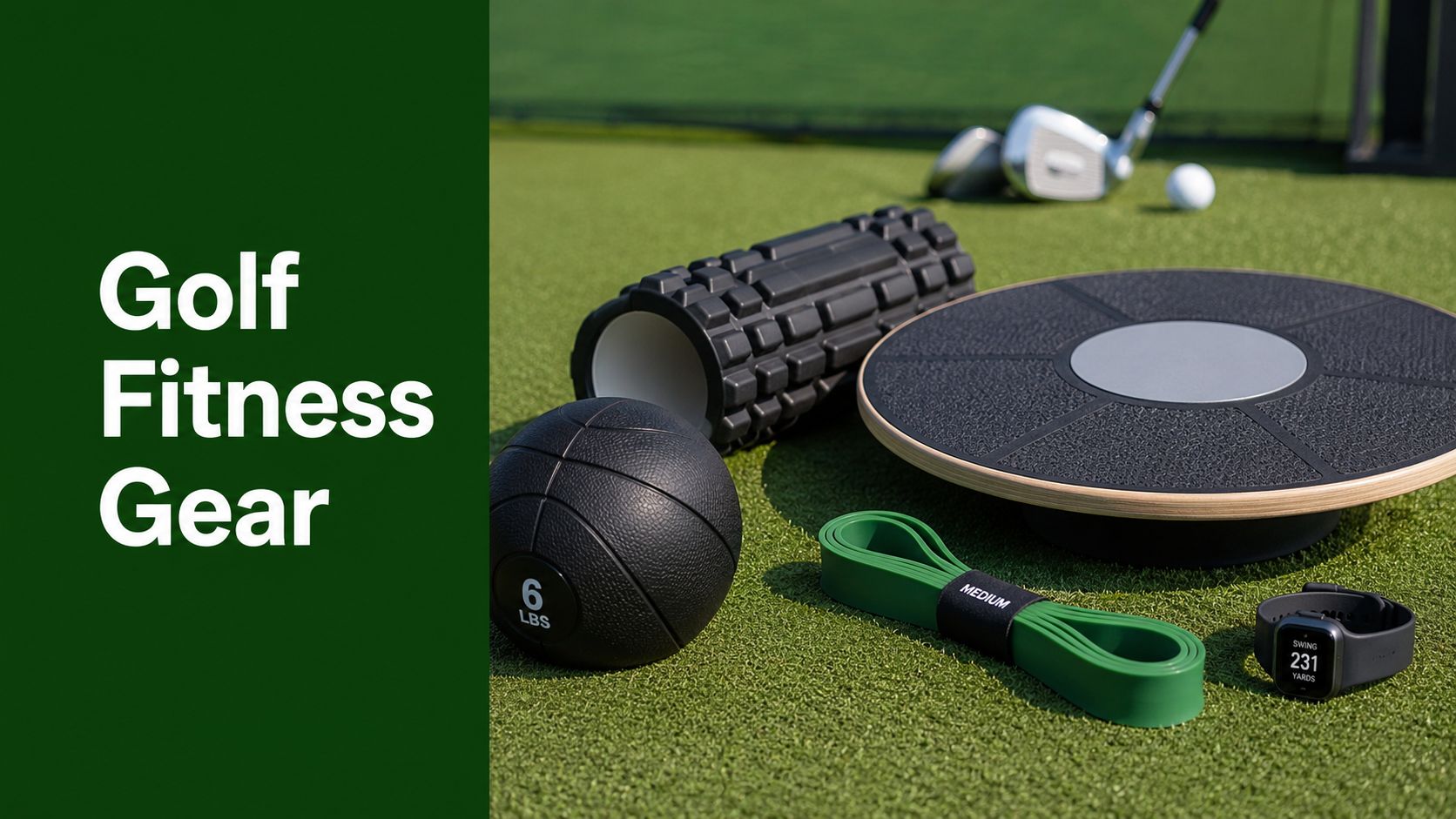
Most advice about golf fitness equipment starts in the wrong place. It chases clubhead speed first, even though many golfers lose shots because their bodies fade on the back nine, their hips stiffen, and their posture falls apart before the 18th green. If you walk golf, the equipment that matters most is the gear you'll use before, during, and after a round, not the shiny setup that looks impressive in a garage.
Why Golf Fitness Equipment Matters Beyond Clubhead Speed
Walking a round changes the conversation immediately. A controlled study found that walking 18 holes produced 17,007 ± 1,708 steps and 880 ± 279 kilocalories, while riding in a cart produced 6,274 ± 1,111 steps and 456 ± 155 kilocalories (PMC study). That's not a minor difference, it's a completely different physical demand.
A lot of golfers think of fitness as something that only helps the swing. In practice, the first benefit is often much simpler, you still have energy when the round gets hard. Golf is described in the literature as a moderate-intensity activity at about 4.8 METs, and one review cites a nine-hole round at 46% of peak MET in a healthy older population (systematic review). That means the round itself can be a real training load, not just a leisurely walk.

The best golf fitness equipment helps you handle that load without burning out. That includes tools that build mobility for the turn, strength for ground contact, and endurance for repeated walking. It also includes setup choices that are easy to use before a round, not just effective in theory. A routine that's hard to pack, hard to store, or hard to start usually loses to the schedule of most golfers.
Practical rule: if a tool doesn't help you feel better by the 14th hole, it's not solving the problem most golfers actually have.
A lot of older content still frames the issue around generic exercise habits, but golfers need something more direct. For a mobility-first approach that fits on-course preparation, these golf mobility exercises pair well with portable equipment and short warmups. That's the right lens for golf fitness gear, not chasing a random training trend.
The Main Categories of Golf Fitness Equipment
The useful categories are simpler than the market makes them look. Strength tools support force production and rotation. Mobility tools help you move better and recover faster. Balance tools sharpen control through the swing. Cardio and endurance tools support the ability to keep walking and keep your mechanics intact late in the round.

Strength training gear
Medicine balls, cable systems, and rotational trainers belong here. They matter most when a golfer wants more usable power, better sequencing, or stronger trunk control. The goal isn't bodybuilding, it's to create force that transfers into the swing without making the body feel beat up.
Mobility and flexibility tools
Stretch platforms, foam rollers, and simple floor-based mobility aids fit this category. They're the right choice for golfers who feel tight through the hips, thoracic spine, or shoulders. Build quality matters because unstable or slick surfaces can turn a simple drill into a frustrating one.
Balance and stability tools
Wobble boards, stability discs, and similar tools help with control and posture. They're especially useful for golfers whose misses show up when they lose foot pressure or sway in transition. These tools work best when they're used with intent, not as random balancing games.
Cardio and endurance gear
This category is often ignored in golf fitness coverage, but it's the one walking golfers feel most. The right cardio tool doesn't need to be fancy. It needs to support the ability to walk, recover between holes, and keep form under fatigue.
Coach's note: equipment that improves how you finish a round is often more valuable than equipment that makes your first ten swings feel flashy.
There's also a technology layer. Radar-based launch monitors and wearable systems give feedback on swing mechanics and body response, which is useful if you want to know whether a fitness change is translating. For golfers who already use a push cart, the line between equipment categories gets blurry, because on-course aids can also function as part of the training environment. This explanation of what a push cart is helps frame that side of the setup.
Choosing the Right Equipment for Your Golfer Profile
The wrong gear usually isn't bad gear. It's just mismatched gear. A senior golfer who needs less strain does not need the same setup as a tournament player chasing measurable swing changes, and a walking golfer has different priorities again. The smartest buy is the one that solves the problem you feel on the course.

Walking golfers
If you play on foot and care about energy management, portability wins. Resistance bands, a compact mobility mat, and a lightweight balance tool usually beat a crowded home-gym setup. The question to ask is simple, can you set it up quickly, store it easily, and use it consistently after a round or before tee time?
Senior golfers
For older players, joint friendliness and low-friction use matter more than ambition. Stretch platforms with traction, foam rollers, and stable balance tools are practical because they support motion without forcing aggressive loading. Heavy or awkward equipment tends to sit unused, which defeats the point.
Fitness-focused players
Players chasing measurable performance gains often benefit from a broader setup. Radar feedback, rotational strength tools, and structured mobility work give them a way to connect training to swing outcomes. The key is to avoid collecting gear that overlaps too much, since redundancy usually creates clutter rather than progress.
Most coverage of golf fitness equipment still talks about general strength and mobility, but not about whether the gear is portable, storage-friendly, or useful for golfers who walk a lot. That gap matters because many golfers live in apartments, travel for golf, or just don't want a room full of unused equipment. The more your routine fits your space, the more likely you are to keep doing it.
A real-world benchmark for on-course usability is whether the equipment supports repeatable movement without becoming a burden. TRUE Stretch Golf is a good example of that kind of engineering, with a structural tubular steel frame, polyethylene platform with non-skid rubber padding, 58 x 49 x 87 inches dimensions, 180 lb weight, and a 500 lb maximum user weight (TRUE Stretch Golf). For golf-specific mobility work, that kind of stable base matters because it's built to tolerate loaded movement instead of wobbling under it.
Sample Workouts and Drills Using Golf Fitness Equipment
A good routine should feel like it belongs to golf, not the gym. The easiest way to do that is to match the drill to the part of the round it supports. Warmup work should make the first tee feel easier. Strength work should improve control without draining your legs. Recovery work should leave you looser, not sore.
Pre-round warmup
Use a resistance band, a mobility mat, and a light balance tool. Start with banded rotations for controlled torso turns, then move into hip openers and a few single-leg balance holds. Keep the effort moderate, because the goal is to wake the body up, not fatigue it before you tee off.
A simple sequence works well:
- Band rotations, 8 to 10 controlled reps each side.
- Hip hinge reaches, 6 to 8 reps.
- Single-leg balance holds, 20 to 30 seconds each side.
- Three to five rehearsal swings, focusing on posture and rhythm.
Strength and power session
Use a medicine ball, cable system, or other rotational trainer on a day you're not playing. One session can include rotational throws, split-stance chops, and anti-rotation holds. Keep the movement quality clean, because sloppy reps teach sloppy mechanics.
If you like tracking progress, use a simple log and track results with PlateBird tracker so you can compare how the body feels across sessions instead of guessing. That's especially useful when you're adjusting volume around multiple rounds in a week.
Mobility recovery routine
After a round, go lighter. Foam rolling, stretch-platform work, and breathing-based trunk mobility help reduce that locked-up feeling golfers know too well. This is the routine that keeps the next round playable.
A weekly structure for two to three rounds usually works best when the hardest strength session sits furthest from the busiest golf day. Light mobility can happen more often, even after short rounds. The hard mistake is trying to squeeze in a demanding power workout right before a long walk, because that usually just makes the round feel heavier.
When Motorized Assist Belongs in Your Fitness Strategy
Motorized assist belongs in the conversation when walking is the goal, not when proving a point. Some golfers want every step under their own power. Others want the health and rhythm of walking without the accumulating strain that pushes them into a cart halfway through the season. That's where a power-assist cart can make sense.
The best use case is a golfer who still wants the walking stimulus but needs to protect joints, manage hills, or keep energy for the swing. In that context, Caddie Wheel is a drop-on battery-operated wheel attachment that turns an existing push cart into a remote-controlled cart with forward, reverse, and braking control. It also has a battery designed to support up to 36 holes per charge, which matters for players who don't want to think about charging midweek or mid-trip. For a deeper look at that category, motorized push carts are worth comparing against purely manual options.
The trade-off is straightforward. Motorized assist reduces the strain of pushing, but it doesn't replace fitness work that improves mobility, balance, or swing control. Used well, it can preserve the benefits of walking while lowering the cost of doing it repeatedly. That's valuable for golfers who want to play more often without getting ground down by terrain or fatigue.
There's also a broader mobility consideration. Some golfers need a full walking solution, while others just need a lower-effort way to keep pace with the group. In those cases, it's worth comparing the push-cart route with a fully enclosed electric scooter if the goal is to reduce physical demand as much as possible. The right answer depends on whether you still want a walking workout or you're prioritizing comfort first.
Maintenance and Safety Tips for Golf Fitness Gear
Gear fails in predictable ways. Bands crack, rollers get dirty, balance tools get unstable, and electronics stop behaving the way they should. A simple maintenance habit beats replacing equipment early or learning a safety lesson the hard way.

Inspect what gets used often
Check resistance bands for surface wear, cracks, or stretching that changes resistance. Look over bolts, clips, and attachment points on launch monitors and rotating trainers. If a piece starts to move differently than it did when new, don't ignore it.
Store gear where it stays stable
Heat, damp storage, and crushed equipment shorten the life of most home fitness gear. Foam pieces flatten, rubber surfaces degrade, and batteries don't love extreme conditions. Keeping gear dry and out of unnecessary compression helps it last longer.
Use the tool for its intended job
Balance boards need controlled movements, not wild reps. Rotational tools need posture and sequence, not speed for its own sake. Launch monitors need enough space and a stable setup so the data stays useful.
Keep electronic devices ready
Radar-based monitors and battery-powered aids work best when you treat charging like part of the routine. Don't let batteries sit empty for long stretches, and check device placement before a session so the readings are consistent. For broader product durability standards that translate well to travel and compact gear, HYDAWAY's manufacturing standard is a useful reference point.
If a tool feels sketchy, unstable, or inconsistent, stop using it until you know why.
That's especially true for golfers who train at home and then bring the same habits onto the course. Safety isn't a separate concern from performance. It's the reason good equipment keeps earning a place in the bag.
Building a Sustainable Golf Fitness Setup Over Time
The smartest setup usually starts small. One golfer begins with bands and a mat because he needs to move better before he can train harder. Another starts with a launch monitor because he wants feedback on swing changes. A third buys a push-cart assist because walking 18 holes is the part that's wearing him down. All three can be right, because the best setup matches the golfer's actual constraint.
The safest way to build is to prioritize the highest-friction problem first. If storage is tight, buy portable gear. If the round leaves you fatigued, invest in endurance support or walking efficiency. If your swing feels inconsistent, add tools that show whether change is real. Most wasted money goes into equipment that solves a problem you didn't have.
Over time, the setup should evolve with your game. A younger player may lean harder into strength and feedback. A senior golfer may shift toward mobility, stability, and lower-strain walking. A golfer who starts out chasing performance may later care more about preserving energy and keeping the round enjoyable.
The long game is simple. Buy gear that gets used, not gear that gets admired. Upgrade only when your current tools stop matching your body, your course schedule, or your playing goals.
If walking the course matters to you, Caddie Wheel gives you a practical way to reduce pushing strain while keeping the rhythm of a real round. It fits naturally into a golf fitness setup built around endurance, portability, and on-course usability, and you can see how it works at Caddie Wheel.
Share:
Motorcaddies Golf Cart: 2026 Guide to Choosing Your Caddy
Easy Rider Golf Carts Explained for Modern Walking Golfers