
Choosing the right portable battery charger boils down to matching capacity (Wh), output specs (voltage and amperage), and connectors to your gear’s demands. An electric golf caddie isn’t a smartphone—it needs higher capacity and faster charging to power you from tee to green. Pick the right match, and you’ll avoid long waits at the charging station and keep your round on schedule.
Keeping Your Caddie Powered Through The Back Nine
This isn’t about topping up a wearable. It’s about giving your Caddie Wheel the endurance to handle 18, 36, or more holes without eating into your playing time.
Imagine running out of juice on the 14th fairway—it throws off your rhythm and can derail your round. We’ll cut through the fluff and focus on exactly what golfers using electric assistance need to know.
What To Expect In This Guide
You’ll come away with a clear roadmap for turning battery specs into on-course performance, syncing charge times with your breaks, and choosing a charger that won’t let you down. Here’s where we’re headed:
- Decoding The Specs: What Watt-hours (Wh), milliamp-hours (mAh), voltage, and amperage mean in real-world golf terms
- Capacity Planning: How to calculate the power you need for your regular rounds, plus a buffer for those extra-long days
- Connectors And Compatibility: Ensuring your charger snaps onto your Caddie Wheel without adapters or guesswork
- Safety And Durability: Finding models with the right certifications and a build that handles dirt, grit, and the occasional drizzle
Think of your charger as essential gear—right up there with your wedge or rangefinder. It should slide into your routine, not complicate it.
For golfers who want more tee-to-green time, choosing the right power source is a genuine game-changer. You can also dive deeper in our in-depth guide to portable golf cart chargers. Let’s unpack the details.
Decoding Charger Specs for Golf Course Realities
Walking into the world of portable chargers can feel like trying to read a foreign language. When you’re trying to keep something as essential as your Caddie Wheel running for 18 holes (or more), getting the technical details right isn’t just nice to know—it’s critical.
Let’s cut through the jargon. We're going to focus on the numbers and terms that actually matter out on the golf course, so you can pick a charger that won't let you down on the back nine.
Watt-Hours Versus Milliamp-Hours
The first number you’ll see plastered on every charger box is its capacity, usually in milliamp-hours (mAh). While it’s a familiar spec, it doesn't always paint the full picture, especially when you're comparing chargers that have different internal voltages.
The real MVP for measuring a battery's total energy is Watt-hours (Wh). Think of Wh as the true size of the fuel tank. It’s a universal standard that tells you exactly how much energy a charger can store and deliver, making it the best way to compare apples to apples.
Pro Tip: For a power-hungry device like an electric caddie, always look for the Watt-hour rating. A 20,000mAh charger running at 3.7V actually holds less total energy (74Wh) than a 15,000mAh charger at 5V (75Wh), even though the mAh number looks bigger at first glance.
For a long day on the course with a Caddie Wheel, the sweet spot for a portable charger is typically between 10,000 and 20,000mAh. This range has nailed the balance between portability and power so well that it commands about 58% of the global market. A 10,000mAh unit will usually give you enough juice to top off your caddie for a 36-hole day, while the bigger 20,000mAh+ chargers are for golfers who need absolute certainty for all-day tournaments.
To really get a grip on this, it's helpful to understand the fundamental differences between lithium and lead-acid battery storage, since each type has its own charging quirks.
The Role of Voltage and Amperage
If Watt-hours tell you the size of the gas tank, then voltage and amperage tell you how fast the fuel flows. These two specs are crucial because they determine both compatibility with your caddie and how quickly it'll charge.
- Voltage (V): This is the electrical "pressure." The charger’s output voltage has to be compatible with your Caddie Wheel's input needs. A mismatch can lead to painfully slow charging or, even worse, damage your gear.
- Amperage (A): This is the electrical current, or the rate of flow. More amps mean faster charging. Simple as that. A charger with a 3A output will get your battery ready for the next round way faster than a weak 1A charger.
Picture this: you're stopping for lunch between rounds. A high-amperage charger could give you enough power for another 18 holes by the time you finish your sandwich. A low-amperage one? It would barely make a dent. For a deeper dive into the numbers, check out our guide on how to calculate power consumption the right way.
Key Charger Specifications at a Glance
To make it even clearer, here’s a quick breakdown of what these specs mean for you, the golfer, when you're trying to keep your Caddie Wheel powered up.
| Specification | What It Means | Golfer's Takeaway |
|---|---|---|
| Capacity (Wh) | The total energy stored in the charger. A more accurate measure than mAh. | The bigger the number, the more recharges you get. Essential for 36-hole days or tournaments. |
| Output Voltage (V) | The "pressure" of the electrical current. Must match your device's input. | Check your Caddie Wheel's manual. The wrong voltage can cause damage or slow charging. |
| Output Current (A) | The "flow rate" of the electrical current. Higher amps mean faster charging. | Aim for at least 2.4A, or higher for rapid top-ups between rounds. |
| Ports (USB-A, USB-C) | The physical connection types. Modern chargers feature faster USB-C ports. | A charger with USB-C Power Delivery (PD) is ideal for quickly charging larger devices. |
Once you understand these core concepts, you can see past the marketing hype and judge a charger's true potential. You'll be ready to pick a power source that not only works but works efficiently for your needs on the course.
Matching Charger Capacity to Your Golfing Habits
How much power do you really need in your bag? The answer isn’t a single number—it’s a direct reflection of how you play the game. Picking the right portable battery charger means you'll have just enough juice to get you through the round without lugging around a heavy, oversized brick for 18 holes.
Let's get specific and figure out the precise power needs for your Caddie Wheel. A casual weekend golfer has completely different needs than a competitive player grinding through a two-day tournament. Your goal is to find that sweet spot between power, portability, and peace of mind.
This decision tree breaks down the process, mapping out the key factors—capacity, speed, and portability—to help you land on the perfect charger.
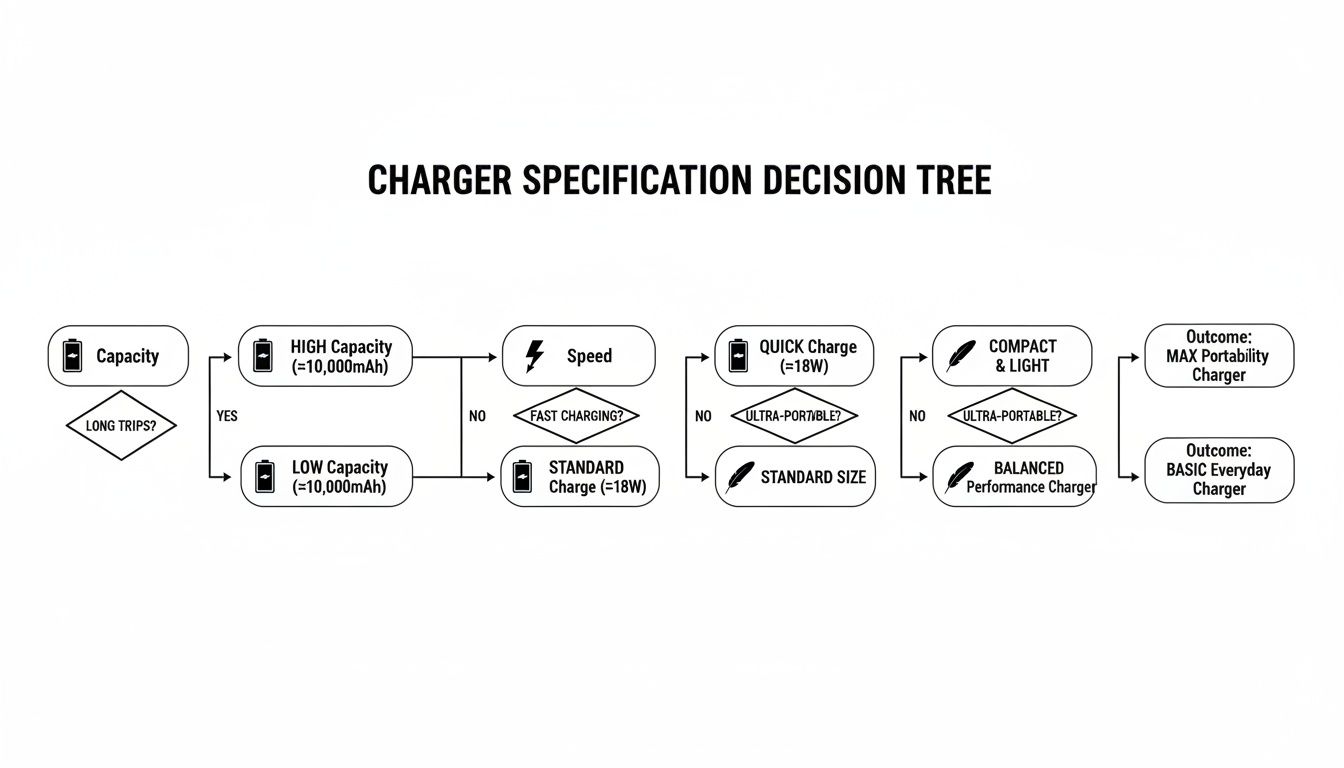
As you can see, how often you play and for how long directly points to the capacity and features you should be looking for.
Calculating Your Power Needs for the Course
First things first, you need a baseline. Your Caddie Wheel is engineered to last up to 36 holes on a single charge under normal conditions. But let's be realistic—hilly courses, a heavy tour bag, and soft, wet ground will all demand more from the battery.
A great rule of thumb is to pack enough power for at least one full recharge. If your Caddie Wheel battery is 100Wh, a portable charger with at least that much capacity is a smart move. It ensures you can finish a second round without a hint of battery anxiety.
Let's look at a few real-world scenarios:
- The Weekend Warrior (18 Holes): For a standard 18-hole round, you probably won’t need to charge your Caddie Wheel mid-game. A smaller 10,000mAh charger (roughly 37Wh) is perfect. It’s got plenty of power to top off your phone and rangefinder, with enough in reserve for an emergency caddie boost.
- The Avid Golfer (36-Hole Days): If you're the type to play from sunup to sundown, you’ll need something more substantial. A 20,000mAh charger (around 74Wh) is the ideal companion here. It has enough capacity to get your Caddie Wheel back to nearly a full charge while you grab lunch.
- The Tournament Player (Multi-Day Events): Playing back-to-back tournament days with no guarantee of a wall outlet? Maximum capacity is your best friend. A 27,000mAh charger (which slides in just under the 100Wh airline limit) provides a critical safety net, making sure you’re powered up for the long haul.
A portable charger isn’t just for recharging a dead battery; it's for strategic top-ups. Adding 30-40% charge during a 45-minute break can be the difference between finishing strong and having your caddie die on the 17th green.
Thinking through your habits will help you pick a charger that fits your routine like a glove. For a deeper dive into battery performance, check out our complete guide on understanding your golf trolley battery.
The Impact of Fast Charging Technology
Capacity is only half the story. The other, equally critical piece of the puzzle is charging speed. Modern fast-charging standards, especially USB-C Power Delivery (PD), have completely changed the game for high-capacity gear like the Caddie Wheel.
A standard USB-A port might give you 5-12 watts of power, which is more of a trickle charge. At that rate, it could take hours to make a real difference. In stark contrast, a USB-C PD port can deliver 45W, 65W, or even 100W.
That kind of wattage is a round-saver. Picture this: you just finished your morning 18 and your Caddie Wheel is at 30%. Plugging it into a portable charger with 45W USB-C PD output while you eat could boost it back to 70-80%—more than enough power to confidently tackle the back nine.
Here’s a practical look at how output wattage translates to time on the course:
| Output Power | Charger Type | On-Course Scenario |
|---|---|---|
| 12W | Standard USB-A | Best for an overnight charge or a very slow top-up. Not practical for quick recharges between rounds. |
| 45W | USB-C PD | Excellent for getting a significant power boost during a 45-60 minute lunch break. |
| 65W+ | High-Power USB-C PD | The fastest you can get. This can add substantial range in as little as 30 minutes. |
When you’re shopping, make it a priority to find a charger with a high-wattage USB-C PD port. It’s the only way to ensure the power in your battery pack gets into your Caddie Wheel quickly and efficiently, minimizing downtime. For any serious golfer, this feature is a non-negotiable.
Choosing a Charger Built for the Golf Course
All the tech specs in the world don’t matter if your charger is a hassle to lug around or can't even connect to your gear. Beyond the internal details like capacity and voltage, the physical design is what makes or breaks a portable charger out on the course. Golfers scrutinize every ounce in their bag, so getting the form factor right is just as critical as the power it delivers.
A charger that’s too bulky gets left in the car. One without the right ports is just an expensive paperweight. Let's dig into the tangible stuff—ports, weight, and durability—to make sure your charger fits right into your game.
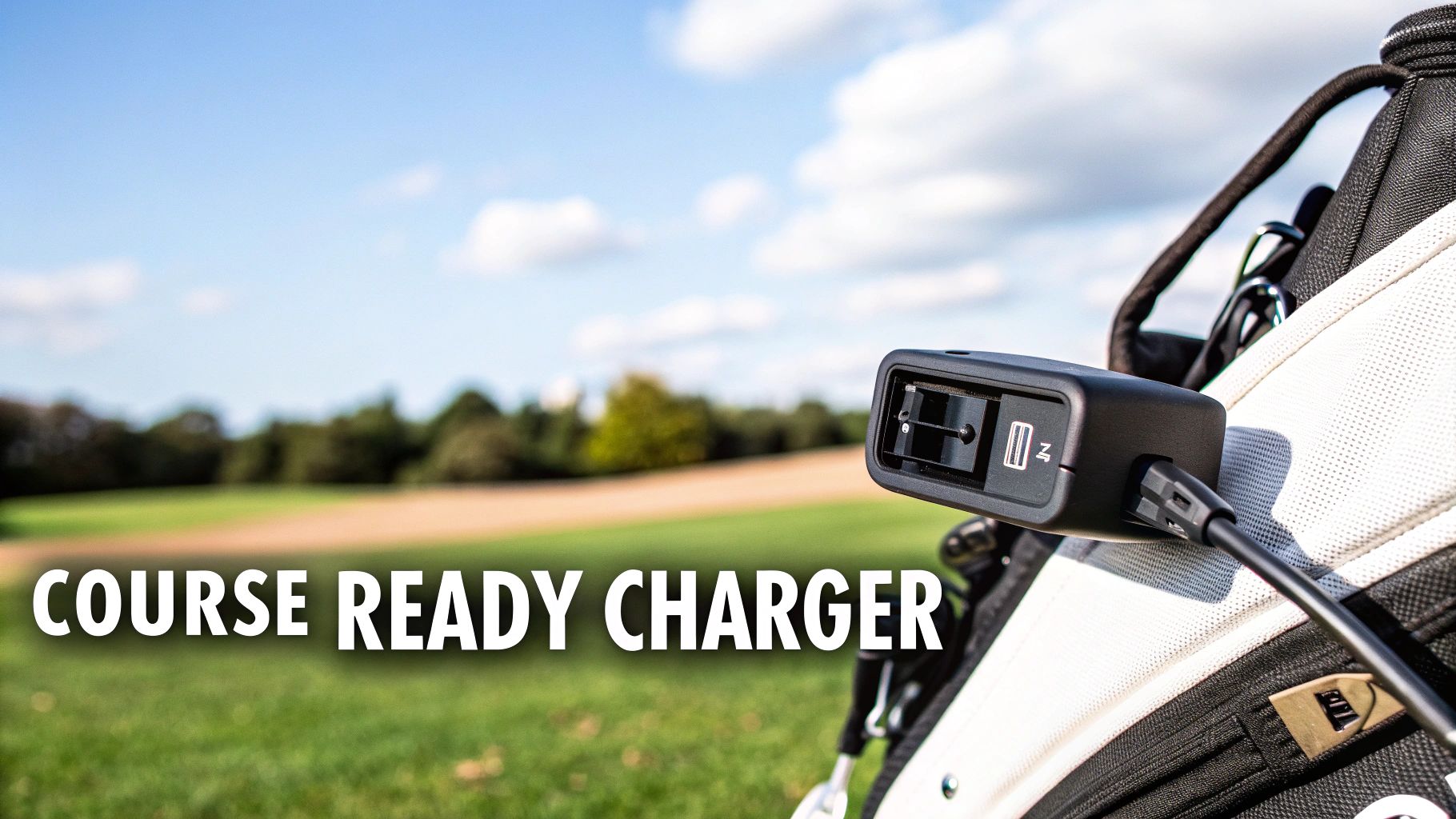
Connecting Your Gear: The Right Ports
First up is the compatibility check. You absolutely need to confirm the charger has the right output ports for your Caddie Wheel and anything else you carry. Most modern chargers offer a mix of options, but they aren't all created equal.
- USB-A: The classic rectangular port we all know. It’s fine for older accessories, phones, or maybe a rangefinder, but it's typically the slow lane for charging.
- USB-C: This is the current standard and a non-negotiable for charging bigger batteries like the one on your Caddie Wheel. Specifically, look for a charger that supports USB-C Power Delivery (PD). This is the key to getting the fastest, most efficient charge possible.
- DC Output: Some heavy-duty power banks come with a dedicated DC barrel port. While powerful, this option requires you to have the exact right cable and voltage setting for your device, which can be a bit tricky.
Before you click "buy," grab the charging cable that came with your Caddie Wheel. Check its connector type and ensure the portable charger you’re looking at has a matching, high-output port. This one simple step will save you from that sinking feeling of needing a charge and realizing you can't connect.
The Balance Between Weight and Power
For anyone who walks the course, weight is always on the mind. A heavy charger can add a surprising amount of strain by the back nine. Here, you'll face a direct trade-off: more power almost always means more weight and a bigger footprint.
A slim 10,000mAh charger might only weigh around 8 ounces (225g), making it easy enough to forget it's in a pocket of your golf bag. On the other hand, a beefy 27,000mAh unit that can fully recharge your caddie will likely weigh 1.5 pounds (680g) or even more.
Your decision here should tie directly back to your golfing habits. If you just need an emergency top-off for your phone, a lighter, lower-capacity model is perfect. But if you're a 36-hole-a-day warrior playing demanding courses, that extra weight is a worthwhile trade for complete peace of mind.
If you can, try to handle a few different chargers in a store. Imagine adding that weight to your fully loaded bag. Finding that sweet spot is personal, but don't underestimate how much an extra pound feels on the 16th hole.
Built to Survive the Course
A golf course isn’t a pristine office environment. Your gear gets exposed to dirt, dust, morning dew, and the occasional pop-up shower. A standard power bank designed for a briefcase might not last long getting tossed around in a golf bag.
When you're trying to figure out how to choose a portable battery charger for golf, keep an eye out for durability features. Some models are built specifically for the great outdoors and include:
- Rugged Casings: Look for chargers with reinforced corners or rubberized shells that can handle being dropped or bumped around.
- IP Ratings: An Ingress Protection (IP) rating tells you how well a device is sealed against dust and water. A rating like IP65 means it’s completely dust-tight and can handle jets of water—more than enough to survive a sudden downpour.
- Port Covers: Simple rubber or silicone flaps that seal the charging ports are a huge plus. They keep sand, dirt, and moisture from getting inside and causing serious damage.
Opting for a charger built to take a beating ensures it won’t fail you because of a little bad weather or rough handling. It’s a small detail that makes a massive difference in its long-term reliability.
Prioritizing Safety and Travel-Ready Power
Having a powerful charger is one thing, but having a safe one is non-negotiable. When you've invested in quality equipment like a Caddie Wheel, the last thing you want is to risk damaging it with a cheap, unreliable power source. This is where safety certifications and built-in protections really earn their keep.
And for many of us, golf isn't just a local game. We travel for tournaments, vacations, and new courses. Trying to navigate airport security with a high-capacity battery can be a headache if you don't know the rules. Get it wrong, and you could be leaving an expensive charger behind at the TSA checkpoint.
Understanding Essential Safety Certifications
When you're looking at a portable charger, take a moment to hunt for the small symbols printed on the device or its packaging. These aren't just for show; they're your guarantee that the product has passed rigorous, independent testing for safety and reliability. If a charger doesn't have these, walk away.
Here are the key certifications to look for:
- UL (Underwriter Laboratories): This is a big one, especially in North America. A UL mark means the product has been tested against fire, electrical shock, and other potential hazards.
- CE (Conformité Européenne): The CE symbol indicates that the charger meets the health, safety, and environmental standards for products sold within Europe.
- FCC (Federal Communications Commission): This certification ensures the device's electromagnetic interference is within approved limits, preventing your charger from messing with other nearby electronics.
Choosing a charger with these certifications is the single best way to protect your Caddie Wheel from electrical mishaps. Uncertified chargers often use substandard components that can fail unpredictably, posing a risk to both your gear and your safety.
These marks are a clear signal that the manufacturer has invested in quality control and follows established safety protocols.
Built-In Protections That Safeguard Your Gear
Beyond the official stamps of approval, a high-quality portable charger will have a multi-protection system built right into its circuitry. These features are constantly monitoring the charging process to prevent the kind of issues that can degrade or even destroy your Caddie Wheel’s battery over time.
Think of it as an intelligent bodyguard for your equipment. Key protective features include:
- Overcharge Protection: This is probably the most critical feature. It automatically cuts the power flow once your caddie’s battery is full, preventing damage from too much voltage.
- Short-Circuit Protection: If the charger detects a short circuit, it immediately shuts off the power to prevent a dangerous current surge that could cause a fire.
- Temperature Control: Charging high-capacity batteries generates heat. This system monitors the charger's internal temperature and will slow down or shut off if things get too hot, protecting both itself and your gear.
These safety nets work in the background, giving you peace of mind every time you plug in. They are a true hallmark of a well-engineered product.
Flying with Your Portable Charger
For any golfer who travels, knowing the airline regulations for lithium-ion batteries is absolutely essential. The rules are set by agencies like the Federal Aviation Administration (FAA) and are strictly enforced for safety.
The most important number you need to remember is 100 Watt-hours (Wh). The vast majority of airlines let you bring lithium-ion batteries under 100Wh in your carry-on luggage only. They are strictly forbidden in checked bags because of the fire risk in the cargo hold.
To make sure your charger is ready for takeoff:
- Check the Wh Rating: The Watt-hour rating should be clearly printed on the charger's case. If it’s not, you can calculate it yourself: (mAh / 1000) x Voltage = Wh.
- Confirm the Limit: A charger rated at 27,000mAh with a standard 3.7V internal battery works out to 99.9Wh—safely under the limit.
- Pack it in Your Carry-On: Always, always keep your portable charger in your handbag, backpack, or golf bag carry-on.
By choosing a flight-compliant charger that’s loaded with the right safety features, you can confidently power your Caddie Wheel wherever your love for the game takes you.
Alright, before you pull the trigger on a new charger, let's run through one last mental checklist. This isn't just about picking a power bank; it's about finding a reliable partner for your Caddie Wheel that actually makes your life easier on the course. Think of this as the final once-over to make sure you've covered all your bases.
This quick list boils down everything we've talked about into a few simple, actionable points. Use it to double-check that the charger you’re eyeing can truly handle the demands of a long day of golf.
The Non-Negotiables
These are the core specs you absolutely have to get right. Nail these, and you’ll have a charger that’s safe, compatible, and ready to perform for years to come.
- Capacity Confirmed: Does it pack enough juice in Watt-hours (Wh) to get you through your longest day? For you 36-hole grinders, a 20,000mAh (74Wh) charger is a great place to start.
- Voltage and Amperage Verified: Does the charger’s output match what your Caddie Wheel needs? You’ll want a high-amperage output (2.4A or more) to get a decent charge in a reasonable amount of time.
- The Right Ports Onboard: Does it have a USB-C Power Delivery (PD) port? This is the secret sauce for getting a meaningful charge during that short break between rounds.
- Safety Certifications Present: Look for UL, CE, or FCC marks on the device or its packaging. Don't ever compromise on safety—certified chargers protect your expensive gear from getting fried.
A great charger isn’t just about having power. It’s about delivering that power safely, quickly, and through the right connection. If a charger misses any of these key points, it’s not the right one for your Caddie Wheel, period.
Finally, give it a quick physical reality check. Is it light enough that you won't mind it in your golf bag? Does it feel sturdy enough to survive being tossed in the car trunk? By ticking off these last few boxes, you can feel confident you’re buying a charger that will keep you rolling, hole after hole.
Still Have Questions? Let's Clear Things Up
Even with the best game plan, a few questions always come up when you’re hunting for the right portable charger for your Caddie Wheel. Let’s tackle some of the most common ones I hear from golfers to make sure you can buy with total confidence.
Can I Just Use a Regular Phone Power Bank for My Caddie Wheel?
It's a tempting shortcut, but using a standard power bank meant for your phone is a bad idea for a high-capacity device like an electric caddie. Most of those little chargers are built with low amperage outputs, usually somewhere between 1A and 2.4A. Trying to charge a big caddie battery with one would be painfully slow.
On top of that, they just don't have the right voltage or wattage to give your battery a healthy, efficient charge. To protect your battery’s lifespan and get back on the course without waiting all day, you absolutely need a high-output portable charger—ideally one with USB-C PD or a DC output that matches your caddie's specs.
What's the Deal with Watt-Hours (Wh) and Why Does It Matter So Much?
Watt-hours (Wh) are the single most reliable way to understand a battery's true energy capacity. It's a simple calculation: Voltage (V) multiplied by Amp-hours (Ah). This gives you a universal number to compare different chargers, no matter what their internal voltage is. It's a much more accurate gauge of power than the mAh number alone.
For any golfer who travels, the Wh rating is non-negotiable. Most airlines cap lithium-ion batteries in carry-on luggage at 100Wh without needing any special approval. A quick look at this spec will tell you if your charger is good to fly or if it's going to get flagged by security.
How Can I Tell If a Charger Is Actually Safe to Use?
The fastest way to check a charger’s safety is by looking for certification marks, either on the device itself or on the packaging. The big ones to look for are UL (Underwriter Laboratories), CE (Conformité Européenne), and FCC. These symbols mean the product has been through the wringer with testing to meet strict safety standards.
Any reputable charger will also proudly list its built-in safety features, like:
- Overcharge protection to keep from frying your battery.
- Short-circuit protection to stop dangerous power surges in their tracks.
- Overheating protection to keep things cool while charging.
Do yourself a favor and steer clear of those cheap, unbranded chargers. The few bucks you might save just aren't worth the risk to your expensive gear.
Ready to power your round without compromise? The Caddie Wheel is engineered for endurance, easily lasting up to 36 holes on a single charge. When paired with the right portable charger, you'll have limitless freedom on the course. Learn more and get yours today at caddiewheel.com.
Share:
The Definitive Guide to Electric Golf Bag Carts
A Golfer's Guide to Electric Hand Golf Carts