
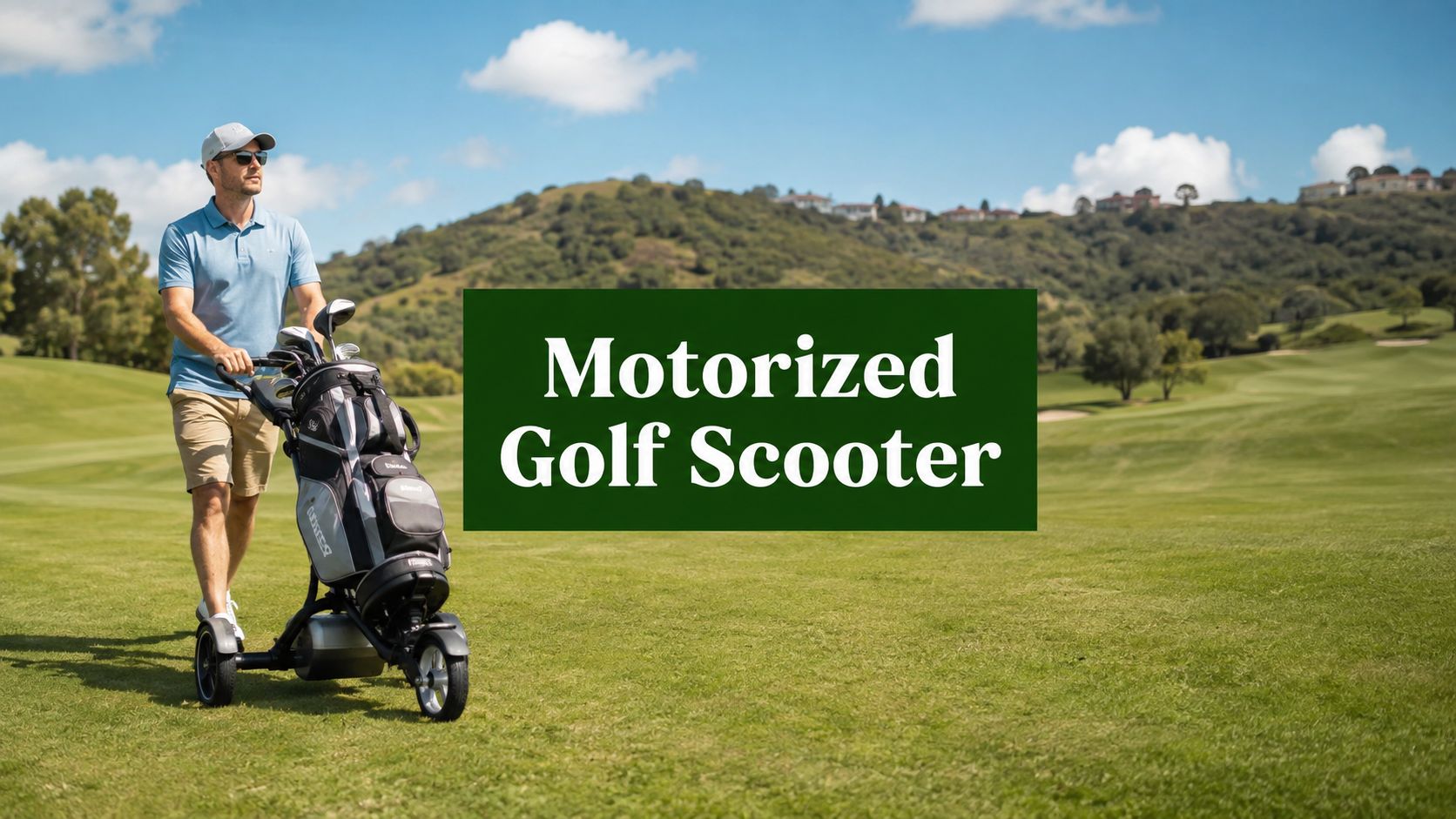
A motorized golf scooter is a power-assist system that attaches to your existing push cart, giving you forward, reverse, and braking control at the push of a button while you keep walking. For golfers who are tired of muscling a bag up every hill, it's the middle ground between doing everything by hand and buying a full electric cart.
If you've ever started a round feeling fresh and finished it with a sore back, burning shoulders, or dead legs on the last few holes, you already know the problem. The question isn't whether powered golf transport exists, it's which option fits your course, your body, and the way you like to play.
What Is a Motorized Golf Scooter
A walking golfer feels the difference most on the sixth uphill hole, not the first tee. The cart still follows, the bag still rides, but the push effort disappears when the wheel unit takes over. That's the basic appeal of a motorized golf scooter, a compact electric assist that mounts to a push cart and helps move it with less strain.

What it really is on the course
The modern powered golf transport idea goes back to the early 1930s, when J.K. Wadley's 1932 attempt followed an electric cart he saw in Los Angeles. That early prototype didn't work well on the course, but it pointed toward the same goal golfers still want today, less strain without giving up the walk. Golf carts were widely accepted by the mid-1950s, then gas-powered carts arrived in 1971, which shows how quickly the category moved from novelty to standard gear. Historical overview
A motorized golf scooter sits in a different place than a full cart. It doesn't replace your whole setup, it attaches to your existing push cart and turns that cart into a powered carrier. That matters for golfers who like the rhythm of walking, reading lies on foot, and staying close to the round instead of riding past it.
The best way to think about it is as electric assistance for your push cart, not a substitute for golf itself.
The practical result is simple. You still walk the course, but the motor handles the part that wears you down, especially on hills, wet turf, and long transitions between holes. For many seniors and mobility-conscious golfers, that difference is what keeps the round comfortable enough to finish well.
How Motorized Golf Scooters Work
The mechanics are straightforward once you strip away the marketing. A motorized golf scooter combines a motor, a battery pack, a remote, and a mounting bracket so your push cart can move under power instead of pure muscle. The user stays in control, but the machine does the hauling.
The pieces that matter
The useful benchmark here is the relationship between motor output, voltage, and battery size. Product examples in the 2000 to 2400 W class with 48 to 60 V lithium packs and roughly 20 to 25 Ah capacity are commonly aimed at 25 to 45 km of range and 4 to 6 hour recharge times, which tells you the bottleneck is not just raw power, it's how efficiently you use it on course. Technical benchmark
That's why two golfers can get different results from the same unit. One plays a flat course on a calm pace setting and finishes a round with battery to spare. Another runs the same setup on a hilly track, on thicker grass, and with a heavier bag, then wonders why the range drops faster than expected. The answer is usually the duty cycle, not the sticker wattage.
The remote is what makes the whole thing feel natural. Forward, reverse, and braking happen from your hand, so you're not constantly bending, pushing, or fighting the cart. That's also what separates a drop-on assist from a full electric push cart, because you keep your current frame and add propulsion.
What the power rating doesn't tell you
Peak motor rating can be misleading if you treat it like an all-purpose performance score. Course use depends just as much on terrain, speed setting, and rider mass as it does on the motor label. In practical terms, a golf scooter that feels effortless on level ground can feel ordinary on steep fairways if the battery is small or the load is heavy.
If you want a plain analogy, imagine it as adding electric pedal assist to a bicycle. You're still doing the activity, but the assist smooths the hard parts instead of replacing the ride entirely. For a clear breakdown of how the moving parts connect, this overview of how a golf cart works gives useful background in simple terms.
Motorized Golf Scooter vs Electric Push Carts and Alternatives
The buying decision usually comes down to compatibility and convenience. If you already own a push cart you like, a drop-on motorized wheel assist keeps that cart in play. If you want an integrated ride with a single frame and fewer add-ons, a full electric push cart may make more sense.
Golf transport options compared
| Option | Best For | Upfront Cost | Installation | Battery Life |
|---|---|---|---|---|
| Motorized golf scooter assist | Golfers who want to upgrade an existing push cart | Usually lower than a full electric cart | Adds to your current cart | Varies by model and course use |
| Full electric push cart | Buyers who want an all-in-one powered cart | Higher | No retrofit, but you buy a new cart | Built into the unit |
| Electric caddie | Golfers who want a dedicated powered carrier | Varies | Depends on the model | Depends on the model |
| Towing device | Niche users with specific transport needs | Varies | Often more involved | Depends on the setup |
A drop-on assist is attractive because it avoids replacing equipment you already trust. That's a real advantage for golfers who have a cart that folds well, fits the trunk, and handles their regular course terrain without issue. A full electric cart can be simpler in operation, but it also locks you into one system and usually asks for a bigger commitment.
Who should choose what
If the goal is walking comfort without giving up your current push cart, the assist path is usually the cleaner fit. If the goal is all-in convenience and you don't mind carrying a dedicated powered frame, a full electric push cart may be easier to live with. If your primary concern is portability, or you're on a tighter budget, the retrofit approach tends to make more sense.
Choose the tool that matches your current cart and your actual course, not the one with the flashiest spec sheet.
The broader market suggests this category isn't going away. The global golf cart market is projected at USD 2.12 billion in 2025 and USD 3.70 billion by 2034, while a separate forecast places the global electric golf cart market at USD 1,194.57 million in 2025 and USD 2,029.44 million by 2034. Market outlook
Core Features and Buying Criteria for Walking Golfers
A motorized golf scooter only works well if it fits your body, your cart, and your course. The smartest buyers ignore hype and start with the basics, because a great assist on paper can still be annoying if it's too heavy, slow to recharge, or awkward to mount.

Start with fit and control
Compatibility comes first. Not every powered wheel fits every cart, so verify whether the unit is built for three-wheel and four-wheel push carts before you buy. If the mount is unstable or the bracket sits poorly on your frame, the rest of the features don't matter much.
Control is next, especially for seniors or anyone with hand, wrist, or shoulder limitations. A remote that's easy to read and simple to operate reduces fumbling before every shot. If you've ever wrestled with a stiff handle on a cold morning, you already know why control design matters more than glossy specs.
Check power, weight, and support
Motor power should match the hardest part of your course, not the easiest. Hills, rough fairways, and soft ground need more than casual assist, so look for a system that's meant for real course duty rather than flat-path cruising. Battery capacity matters too, but it should be judged against your normal round length and your terrain, not against an optimistic label.
A light setup is easier to store and easier to live with after the round. That's where a drop-on design can beat a bigger integrated cart, because you can remove it when you don't need powered support. Warranty coverage is also worth checking, and a 12-month warranty is a sensible baseline for a product that includes electronics, a battery, and a moving bracket.
If you can't lift it, fit it, and pair it without a tutorial, it's probably not the right unit for everyday use.
The Caddie Wheel is one example of this kind of setup, with a lightweight drop-on format, broad cart compatibility, quick recharge, and a free extra remote. The details matter less than the lesson, choose a system that solves your round, not one that creates new chores.
Installation and Compatibility for Push Cart Users
Most push cart owners want one answer before anything else, can the assist attach to what they already own? If the answer is yes, the upgrade becomes much easier to justify because you're improving a cart you already know instead of relearning a whole new setup.

What installation actually looks like
The usual process is uncomplicated. The motor bracket aligns with the frame, the mount locks into place, the battery connects, and the remote pairs with the unit. For golfers who don't want special tools or a shop visit, that simplicity is the whole point.
A useful installation checklist looks like this:
- Inspect the frame first: Make sure the axle and cart tubing give the bracket a stable landing point.
- Mount the bracket securely: A solid lock matters more than speed of installation.
- Check the motor position: The drive wheel should sit straight enough to track cleanly.
- Connect power carefully: Battery placement should be secure, not dangling.
- Test remote response: Verify forward, reverse, and brake before the first hole.
Where compatibility gets tricky
Uneven terrain exposes sloppy mounting fast. If the bracket has play in it, the unit can feel fine in a driveway and sloppy on a sloped fairway. That's why a universal-looking fit isn't enough, the attachment has to hold under the motion of a real round.
If your cart has unusual dimensions or a non-standard wheel arrangement, measure before you commit. The easier the retrofit, the more often you'll use it. For more detail on the attachment side, this guide to golf cart bracket compatibility is a practical place to start.
Storage matters too. A unit that's simple to remove between rounds is easier to live with in a car trunk, garage, or locker. The less friction between rounds, the more likely you are to keep walking.
Benefits and Limitations of Motorized Golf Scooters
The upside is real, and so are the trade-offs. A motorized golf scooter reduces the grind of pushing, helps protect joints and backs, and makes it easier to keep walking when the course turns uphill or the round runs long. For golfers who want more movement without the punishment, that balance is the whole value proposition.

Why golfers keep choosing assist
The strongest benefit is energy conservation. You still walk, but you stop burning effort on the least enjoyable part of the round, the push. That leaves more in the tank for the back nine, and it keeps the walking experience intact in a way a ride cart never quite does.
There's also a fairness and access angle that doesn't get discussed enough. A 2025 systematic review of on-course transportation found recurring themes around inclusion and accessibility, legal and ethical issues, competitive fairness, safety, and injury risk, and it also noted knowledge gaps and research priorities in the area. Systematic review
Where the downsides show up
The limitations are practical, not theoretical. You need to manage charging, you add some weight to the setup, and the initial spend is higher than sticking with pure manual pushing. Very steep terrain can also push any assist system harder than a normal round does, so buyers should be honest about where they play.
For golfers who want gentle movement rather than full exertion, powered assist can still support an active lifestyle. A useful companion read is staying active with gentle cardio, especially for readers thinking about how to keep movement in the game without overdoing strain.
The right assist system doesn't replace walking, it makes walking possible for more rounds, on more courses, with less wear and tear.
For many players, that's the sweet spot. You keep the golf habit, you keep the exercise, and you stop treating every hill like a chore.
Maintenance, Safety, and Cost Expectations
A powered golf setup stays useful only if you treat the battery well and inspect the hardware regularly. Lithium packs like to be stored sensibly, charged with the correct charger, and kept out of full depletion when possible, because careless battery habits shorten the useful life of any electric assist.
Keep the system ready
A quick pre-round check goes a long way. Look at the bracket, make sure the brake responds, and confirm the remote connects cleanly before you head out. That habit is boring until it saves you from a dead remote halfway through the front nine.
Safety is mostly about judgment. Slow down on slopes, avoid operating in poor visibility, and skip use in inclement weather. A Minnesota city ordinance for motorized golf carts allows operation only on city streets, only from sunrise to sunset, and prohibits use in inclement weather or when visibility is too poor to see people and vehicles at 500 feet. Local ordinance example
Don't ignore battery handling
The same caution applies off the course. If you want a practical primer on battery safety, the discussion of Knight Tek battery fire solutions is worth reading before you store or charge any lithium-powered product. Good battery habits are part of owning electric gear, not an optional extra.
Cost-wise, a motorized push-cart assist usually lands in a more accessible range than a full electric push cart, which is why so many walking golfers treat it as a value play rather than a luxury purchase. If you're trying to keep the walking habit alive over the long term, the cheapest option up front usually isn't the cheapest option over many seasons.
For battery care specifics, this guide on golf cart battery maintenance is worth bookmarking. Keep the battery healthy, keep the bracket tight, and the system will stay far less annoying over time.
Frequently Asked Questions for Walking Golfers
Is a motorized golf scooter allowed at my local course?
That depends on the course and any local rules. Some places treat powered mobility equipment differently from standard carts, while tournament committees may have stricter standards around fairness and pace, so it's always smart to ask before you show up.
Do I still get exercise if the cart is powered?
Yes, because you're still walking the holes. The assist reduces pushing strain, but it doesn't turn the round into a ride, so you still get the movement that makes walking golf appealing.
Can it handle big hills?
It can help a lot on hills, but no system changes physics. Stronger motors, good battery health, and sensible speed settings matter most when the course starts climbing, and terrain always affects real-world results.
What about trunks, stairs, and storage?
That's where a drop-on system can be easier to manage than a fully integrated powered cart. If you can remove the assist between rounds, you're usually dealing with less bulk in the car and less frustration at home.
How long does one charge last?
That depends on terrain, speed, bag weight, and how hard you ask the motor to work. The most honest answer is that a full round is a function of use, not just a battery label, which is why course conditions matter so much.
If you're weighing your options and want a simple powered add-on that keeps your current push cart in play, take a look at Caddie Wheel. It's built for golfers who want forward, reverse, and braking control without giving up the walking round. If that sounds like the right balance for your game, it's worth exploring the fit for your cart and course.
Share:
Golf Divot Repairer Guide: Types, Technique, and Best Picks
Club Brush Golf: Clean Grooves for Better Spin