The email lands in your inbox and your stomach drops. “Annual performance review cycle begins next week.” If you're a new manager, you're probably wondering how to summarize a full year without sounding vague, unfair, or unprepared. If you're the employee on the receiving end, you may already be bracing for a conversation dominated by whatever happened most recently.
That reaction makes sense. A one year performance review can feel like a bureaucratic ritual, especially when the discussion turns into a recap of the last few months instead of a fair assessment of the full year. The good news is that the process gets much easier when you stop treating the review as a year-end writing exercise and start treating it as a year-long evidence habit.
The managers who handle annual reviews well rarely have better memories. They have better notes, clearer expectations, and a more disciplined way of separating patterns from isolated moments. That's what makes the review useful.
Why the Annual Review Still Matters
The annual review has earned a bad reputation. Employees often see it as high-stakes and backward-looking. Managers often see it as a time-consuming form that forces nuance into rigid boxes. Both complaints are real.
Yet the annual process still shapes compensation decisions, promotion discussions, development plans, and formal documentation in many workplaces. A 2026 HR roundup reports that 71% of companies still conduct performance reviews on an annual basis, while 95% of HR managers are dissatisfied with their current system, according to SelectSoftware Reviews' performance management statistics. That combination tells you two things at once. The one year performance review is still standard, and many organizations still run it poorly.
Why managers still need to learn it
Even in companies that have added quarterly check-ins or ongoing feedback, the annual review often remains the official record. It's the moment when scattered observations get consolidated into a written judgment. That written judgment matters.
A weak review usually fails in one of two ways:
- It becomes vague praise: “Great attitude,” “solid contributor,” “needs to be more strategic.”
- It becomes a recent-events summary: one late project, one strong presentation, one difficult month.
Neither version helps the employee improve. Neither version protects the manager from bias.
A good annual review isn't a memory test. It's a record of patterns, contribution, growth, and next steps.
What the annual review does well
Used properly, the annual review gives both sides something valuable that day-to-day conversations sometimes miss.
| What the process can do | Why it still matters |
|---|---|
| Create a formal record | Important for promotions, compensation, and role changes |
| Recognize sustained work | Helpful when quiet, consistent performers get overlooked |
| Clarify expectations | Useful when goals drifted during the year |
| Reset priorities | Gives manager and employee a shared plan for the next cycle |
The mistake isn't holding a one year performance review. The mistake is waiting until the end of the year to think about it. When managers do that, the process becomes subjective, rushed, and overly influenced by recent events. When they build the review across the year, it becomes one of the clearest management tools they have.
Laying the Groundwork for a Fair Review
Fairness starts long before review season. If you want the final conversation to reflect the whole year, you need a simple system that captures the year while it's happening.
MIT Human Resources recommends using clear, concise, observable, and measurable evidence in performance reviews, along with documented expectations and SMART goals, in its guidance on writing effective performance reviews. That advice sounds straightforward. In practice, it means you need evidence that answers basic questions: What happened? When did it happen? What was the employee responsible for? What changed because of their work?

Build a lightweight note system
Don't create a complicated HR side project for yourself. Create one private document per employee and keep it simple. A running note works well in Google Docs, Notion, OneNote, or whatever your team already uses reliably.
A practical format is a Kudos and Coaching file with dated bullets under two headings:
-
Kudos
- Delivered the Q1 client rollout with minimal escalation
- Stepped in to onboard new teammate during a busy sprint
- Improved meeting prep by sending decisions in advance
-
Coaching
- Missed handoff details twice in April
- Needed follow-up on status visibility during product launch
- Good technical solution, but stakeholder alignment came late
This works because it captures specifics close to the event. It also keeps positive and developmental notes in the same place, which prevents the review from becoming either a complaint file or a praise file.
Use your calendar as evidence
Managers often think documentation has to mean formal write-ups. It doesn't. Your calendar already tells part of the story.
After a major meeting, project closeout, conflict, customer escalation, or stretch assignment, add a quick note while the details are fresh. Tie the note to a month, project, or business cycle. That helps you later when you're trying to avoid recency bias.
A fair one year performance review usually includes evidence from across the year, such as:
- Early-cycle expectations tied to job responsibilities
- Mid-year course corrections from check-ins or one-on-ones
- Peak workload examples that show how the person handled pressure
- Collaboration patterns across teams, not just deliverables
- End-of-year outcomes placed in context, not overweighted
Ask employees to keep a success journal
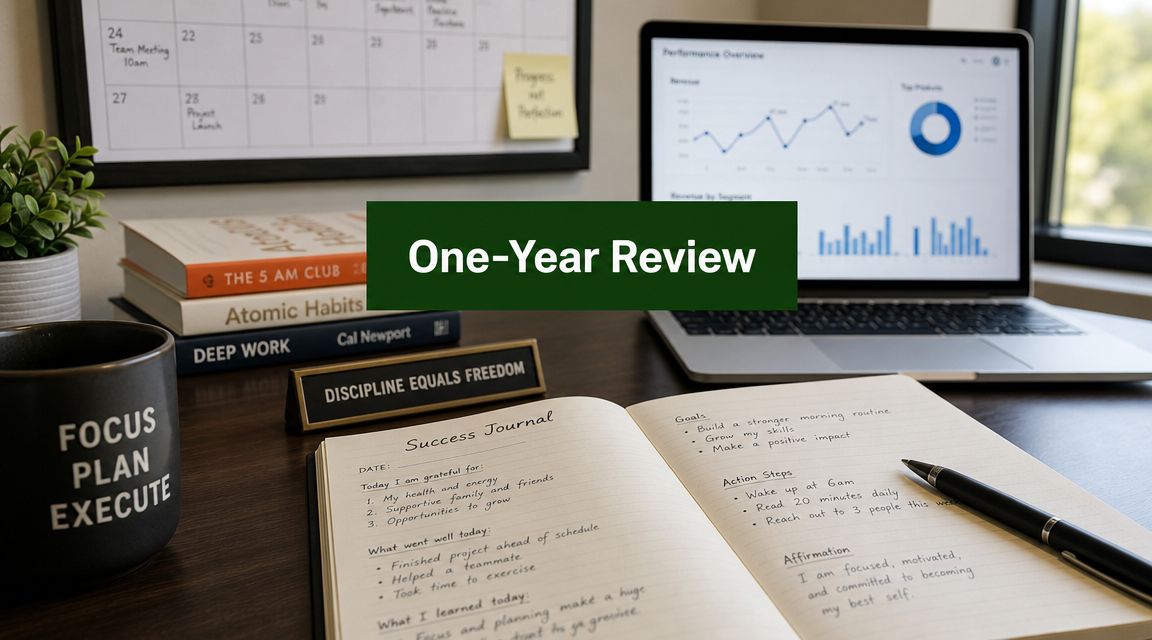
Employees shouldn't rely on memory either. I advise people to keep a personal success journal all year. It can be a private note on their laptop. It doesn't need polished sentences.
What belongs in it:
- Completed work: projects, launches, fixes, process improvements
- Scope changes: extra responsibilities, backfills, cross-functional work
- Learning moments: new systems, certifications, stretch assignments
- Obstacles handled: difficult stakeholders, unclear requirements, tight deadlines
- Recognition received: client praise, peer feedback, thank-you messages
The best self-assessments come from journals like this because they contain real examples instead of general claims.
Practical rule: If you can't point to a specific moment, month, or example, the feedback probably isn't review-ready yet.
Use AI carefully, not as a substitute for judgment
AI can help organize notes, tighten wording, and spot repetition. It can also flatten nuance if you feed it poor inputs. If you're trying to optimize performance reviews with AI, use it after you've gathered your own dated examples, not before. A cleaner sentence isn't the same thing as a fair assessment.
The process that works is human first, tool second. Collect the facts throughout the year. Then use tools to improve clarity, not to invent substance.
Crafting a Compelling Self-Assessment
When employees sit down to write a self-assessment, many default to one of two weak versions. The first is a task list. The second is a modest shrug. Neither helps.
A strong self-assessment doesn't say, “I attended meetings, supported the team, and worked hard.” It tells a coherent story about contribution, judgment, growth, and impact. The employee's job is not to sound impressive. It's to make their work legible.

Turn activity into contribution
Here's the difference.
A weak sentence says: “Managed onboarding for new hires and helped with team coordination.”
A stronger sentence says: “Supported onboarding for new hires by documenting recurring questions, updating training materials, and becoming a go-to contact during their first weeks. That reduced confusion and gave the team a more consistent start.”
The second version works because it connects actions to value. It also shows initiative instead of simple participation.
A useful structure for self-assessments is:
| Prompt | Better way to answer |
|---|---|
| What did you do? | Name the project or responsibility clearly |
| Why did it matter? | Connect it to team priorities, customers, or operations |
| What changed? | Describe the outcome qualitatively if exact metrics aren't available |
| What did you learn? | Show growth, not just execution |
Write with confident humility
Many employees understate strong work because they don't want to sound arrogant. Others overcompensate and write in inflated corporate language. Both create problems for the manager.
Use plain language. Be specific. Own your work. A few examples:
- “I took on more stakeholder communication during the second half of the year when project dependencies increased.”
- “One area I improved was escalation timing. Earlier in the year I waited too long to surface risk. By year end, I was flagging blockers earlier and with clearer options.”
- “I'd like to strengthen prioritization in the next cycle, especially when several urgent requests compete at once.”
Those statements show maturity because they combine evidence, self-awareness, and forward movement.
What managers should look for when reading it
A self-assessment is not a final verdict. It's one input. Managers should compare it against their notes, peer feedback, previous goals, and observed patterns.
Read for these signals:
- Clarity: Does the employee describe work performed, or mostly intentions?
- Ownership: Do they take credit appropriately without claiming every team success?
- Reflection: Can they name a development area without becoming defensive or vague?
- Alignment: Do their examples connect to the role for which they were hired?
When a self-assessment feels either too thin or too polished, ask follow-up questions before drafting conclusions.
“I want to separate one-off moments from real patterns. Let's look at what you handled consistently across the year, where you grew, and where stronger habits would raise your impact next year.”
That framing helps developmental feedback land without sounding punitive. It tells the employee that the manager is evaluating the whole body of work, not building a case against them.
Navigating the Performance Review Conversation
The meeting itself should feel like a discussion with structure, not a courtroom and not a monologue. Too many managers make the mistake of reading the review aloud as if they're presenting a final sentence. That shuts people down fast.
Start with enough context that the employee knows this is a full-year conversation. Then move through strengths, growth areas, and future priorities in that order. The sequence matters because people listen better once they feel seen accurately.

A simple agenda that works
A practical review conversation usually follows this flow:
-
Open with the purpose
- “I want this to reflect your full year, not just the last few months.”
-
Reinforce strengths with examples
- Name specific work, not personality labels
-
Discuss development areas with context
- Focus on patterns, trade-offs, and missed opportunities
-
Invite the employee's perspective
- Ask where they agree, disagree, or want to add nuance
-
Shift to next-year goals
- End with direction and support, not just judgment
If you need prompts to prepare for that discussion, these key questions for performance evaluations can help managers avoid generic conversations and ask for better reflection.
How to address a difficult point without flattening motivation
Suppose the employee missed a target. Don't soften it into meaninglessness, but don't turn it into a character statement either.
Say this instead:
“You didn't hit this target, and we need to talk about why. I don't see it as a lack of effort. I do see a pattern where risks stayed too implicit for too long. The improvement I'm looking for is earlier visibility and clearer escalation.”
That script works because it separates the issue from the person. It names the concern, identifies the pattern, and points toward a behavior change.
A poor version sounds like this: “You need to be more proactive.” That's too vague to act on.
A better version sounds like this:
- Weak feedback: “Be more proactive.”
- Usable feedback: “When project timelines start slipping, I need you to flag the issue before the deadline is at risk and come with at least one proposed path forward.”
How employees can disagree professionally
Employees don't need to accept every point without offering feedback. They do need to respond in a way that keeps the conversation productive.
Useful language includes:
- “I'd like to add context to that example.”
- “I see the situation a bit differently and want to explain what I was balancing.”
- “I agree with the outcome, though I think the cause was partly role clarity, not just execution.”
- “That feedback is helpful. Can we identify what good looks like in practice next year?”
That last question is especially effective because it moves the discussion toward standards and support.
A short reset can help if the conversation gets tense.
Keep the meeting human
Managers often overprepare the document and underprepare the tone. The employee is listening for more than words. They're deciding whether the process feels fair, whether their work received genuine notice, and whether the path forward is believable.
A few practices help:
- Pause after key points: Give the employee time to react
- Check understanding: Ask, “How does that land for you?”
- Stay with examples: If disagreement appears, return to dates, situations, and observed behavior
- End with support: Clarify what you will do as the manager, not only what they need to do
The best one year performance review conversations feel candid, calm, and specific. People can handle hard feedback. What they struggle with is fuzzy feedback delivered as if it were objective truth.
Setting Meaningful SMART Goals for Next Year
A review that ends with “keep it up” or “improve communication” wastes the hardest part of the process. Once you've reflected thoughtfully, you need to translate that discussion into actionable goals for the employee.
MIT's review guidance recommends SMART goals for the coming year as part of a stronger performance process, which is why this framework remains useful when managers apply it seriously rather than mechanically. The test is simple. Could two people read the goal and picture the same behavior?
The difference between vague and usable goals
“Get better at project management” sounds reasonable. It's also too broad to guide action.
A stronger goal identifies the kind of improvement, the context where it matters, and the time frame for showing it. That doesn't mean every goal has to be packed with complicated metrics. It means the goal must be observable.
Here is a practical comparison.
Example of Transforming a Vague Goal into a SMART Goal
| SMART Criteria | Vague Goal: 'Get Better at Project Management' | SMART Goal |
|---|---|---|
| Specific | Unclear about what should improve | Lead project kickoffs with documented scope, owners, milestones, and risk log |
| Measurable | No visible standard | Demonstrate consistent use of status updates, decision logs, and risk escalation in active projects |
| Achievable | Hard to judge | Fits the employee's current role and responsibilities |
| Relevant | May not connect to business needs | Supports cross-functional execution and reduces confusion during delivery |
| Time-bound | No deadline | Apply this approach in the next review cycle and discuss progress during scheduled check-ins |
Before and after examples
Use these conversions as a template.
-
Before: Improve communication
After: Send stakeholders a concise weekly update for active projects that covers status, risks, decisions needed, and next steps. -
Before: Be more strategic
After: In planning discussions, bring at least one recommendation that weighs trade-offs, dependencies, and likely impact on team priorities. -
Before: Develop leadership skills
After: Mentor a newer teammate on a defined workflow, document common issues, and take responsibility for helping them reach steady execution.
Not every role needs the same kind of goal. A coordinator, engineer, sales manager, and department lead should leave with different priorities. For leaders in particular, communication goals often need sharper wording around executive presence, alignment, and message discipline. This roundup of goals for senior leadership communication is useful if you're trying to make those expectations less abstract.
Keep the number of goals manageable
The best goals survive contact with real work. The worst ones read well in December and disappear by February.
A practical set of goals usually includes a mix like this:
- One performance goal tied to core role delivery
- One collaboration or communication goal tied to working style
- One development goal tied to growth, stretch, or readiness for more scope
Strong goals answer three questions. What should change, how will we recognize it, and when will we revisit it?
That last question matters most. A SMART goal without follow-up is just cleaner paperwork.
Avoiding Common Traps and Ensuring Follow-Through
The review fails when everyone treats the signed document like the end of the process. It isn't. It's the start of the next cycle.
One reason follow-through matters so much is that year-end ratings are vulnerable to bias. Josh Bersin notes that nearly 50% of the variation in performance ratings can be explained by the manager rather than the employee in his discussion of what organizations learned about performance ratings and their limits. That should make every manager more humble about their own certainty.
Three traps that damage review quality
The most common failures look different on the surface, but they often come from the same problem. The manager relies on impressions instead of a repeatable process.
- Halo or horn effect: One strong trait or one frustrating trait colors everything else.
- Manager-centric judgment: The review reflects the manager's preferences more than the employee's actual performance pattern.
- Set-it-and-forget-it goals: The document is filed away and not reopened until the next annual cycle.

What better follow-through looks like
You don't need a heavy process to avoid these traps. You need a consistent one.
Try this rhythm:
| Follow-up point | Manager action |
|---|---|
| Soon after the review | Confirm the key priorities in writing |
| During regular one-on-ones | Ask what progress, friction, or support is needed |
| At quarterly checkpoints | Revisit goals, examples, and shifting priorities |
| Before the next cycle | Review notes for patterns instead of relying on memory |
The one year performance review becomes useful instead of ceremonial. The employee knows what matters. The manager keeps watching the work in real time. Small corrections happen before they become annual surprises.
Reviews get fairer when managers document patterns, revisit commitments, and treat goals like active agreements instead of archived statements.
A strong annual review is never just a recap. It's a checkpoint in an ongoing management habit.
If you like practical gear that removes friction from your routine, Caddie Wheel is worth a look. It adds lightweight electric power assist to many standard golf push carts, helping you walk the course with less strain and more energy left for the shots that matter.
Share:
Cold Weather Battery Performance: A Golfer's Guide
One Year Performance Review: A Manager's Action Plan