
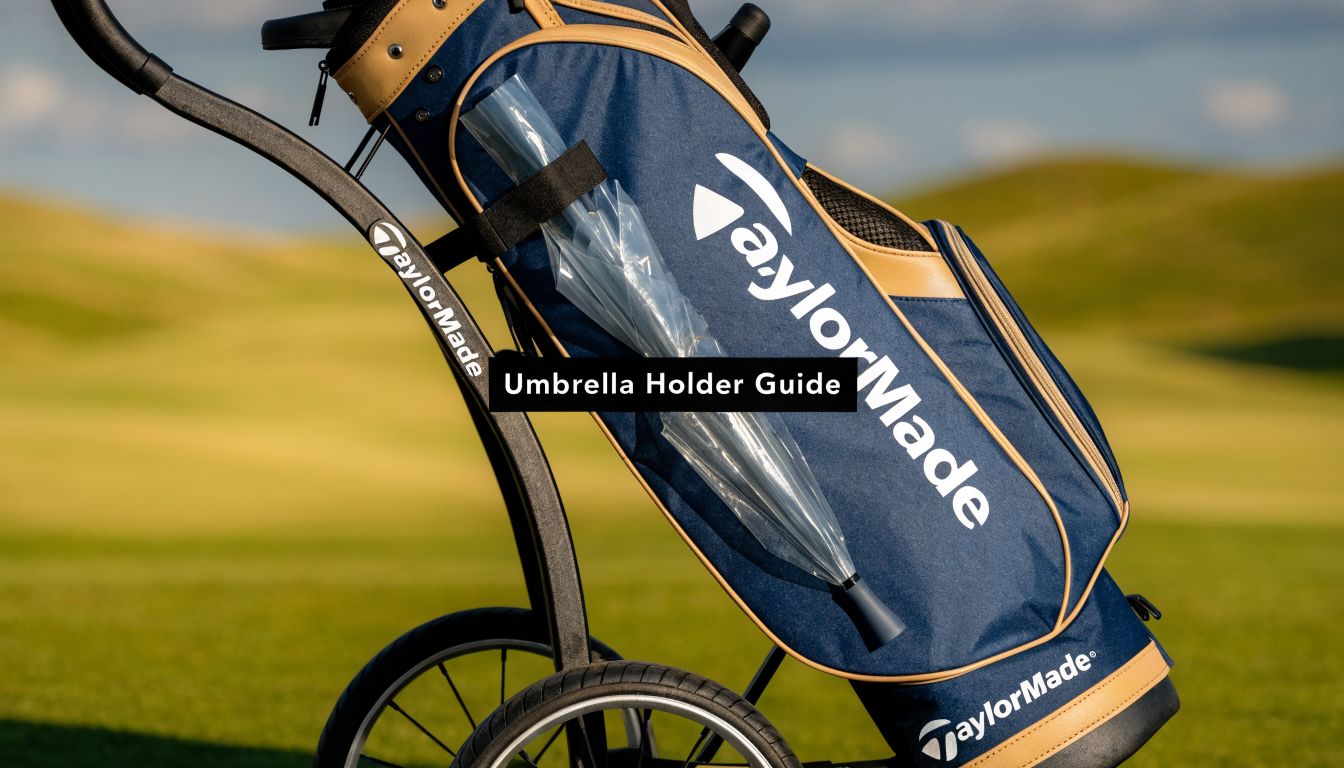
You’re usually looking for an umbrella holder for golf bag after a round that went sideways. Rain starts on the 3rd hole, you jam the umbrella into a club divider, it leans at a bad angle, your grips still get damp, and every bump of the cart turns the handle into a rattle. If you use a push cart with an electric assist, the annoyance gets worse. Vibration, braking, and tight turns expose every weak clamp and every lazy install.
That’s why I don’t treat an umbrella holder as a throw-in accessory. It’s part of a walking setup that protects your clubs, keeps your hands free, and lets you focus on yardage and shot shape instead of wrestling gear. A good holder feels invisible when it’s installed well. A bad one becomes the thing you keep fixing all day.
Why a Dedicated Holder Beats Tucking It in Your Bag
Stuffing an umbrella into the bag sounds fine in the parking lot. On the course, it usually fails in three ways. It shifts, it rubs, and it never sits where you need coverage.
The first problem is distraction. An umbrella wedged into a divider or side pocket moves every time the cart rolls over rough ground. That wobble transfers into the bag, the clubs, and your attention. If you’re trying to walk at a steady pace and keep your pre-shot routine clean, that constant movement gets old fast.
The second problem is wear. Club dividers, top cuffs, and pocket seams aren’t meant to act like a clamp. Repeated rubbing from an umbrella handle can chew up fabric, stress stitching, and make access to clubs more awkward than it should be. You also end up fighting your own setup when you need to pull a wedge or put the umbrella away in a hurry.
Coverage matters more than people think
A proper umbrella holder for golf bag use isn’t just about staying drier. It’s about usable coverage. The umbrella needs to sit high enough and far enough off the bag to shield your grips, your gloves, and the top of the bag without blocking access to clubs.
A makeshift setup usually protects the wrong thing. You stay half covered while your grips and scorecard still take the weather.
That’s why dedicated holders earn their keep. They place the shaft in a repeatable spot, hold angle under load, and let you deploy or collapse the umbrella quickly when conditions change.
It also improves the whole walking setup
A lot of golfers spend time choosing a cart and a bag, then treat the umbrella holder like an afterthought. That’s backwards. The holder has to work with the frame shape, bag width, and where your clubs sit. If you’re still dialing in the rest of your walking setup, it helps to look at push cart golf bags that pair cleanly with accessories and cart frames.
A dedicated holder won’t fix bad weather. It will stop your gear from becoming one more problem.
Selecting the Perfect Umbrella Holder for Your Cart
Most golfers buy the first universal clamp they see and hope it fits. That works sometimes. It also explains why so many holders end up twisted, loose, or mounted in the wrong place.
The right choice starts with your cart, not the umbrella. Look at the frame tubing first. Some holders love round tubes and hate oval ones. Some sit fine on a simple three-wheel frame but become awkward on carts with molded handles, brake cables, accessory tabs, or power-assist brackets.
The three holder styles that matter
There are really three categories worth comparing.
| Umbrella Holder Type | Best For | Pros | Cons |
|---|---|---|---|
| Clamp-on universal holder | Golfers switching between carts or using standard push-cart frames | Flexible, easy to move, widely available | Can wobble on odd tube shapes, depends heavily on correct fit and installation |
| Screw-on or bracket-mounted holder | Carts with a dedicated accessory point or clean frame geometry | More secure feel, cleaner placement, less likely to rotate | Less transferable, may need specific hardware, not always friendly to mixed brands |
| Integrated cart-specific holder | Golfers using a cart brand with matching accessories | Best fit when matched correctly, tidy look, fewer setup guesses | Limited compatibility, harder to reuse if you change carts |
What to inspect before you buy
A holder can look solid online and still be wrong for your cart in practice. I’d check these details before buying:
- Tube shape: Round and oval tubing are common trouble spots. A holder that grips one well might never fully seat on the other.
- Clamp padding: Rubber or soft inserts help, but they can also compress too much if the design is weak.
- Pivot control: You want angle adjustment that locks firmly, not a loose hinge that drifts during the round.
- Height and offset: The umbrella needs enough clearance to cover you without crowding the bag opening.
- Fold clearance: Some holders work until you collapse the cart. Then they hit a wheel, strut, or handle joint.
Material trade-offs are real
Plastic gets dismissed too quickly. Good reinforced plastic can work well and keep weight down. Cheap plastic with rough edges and weak screw threads is where the complaints start.
Metal sounds like the safe choice, but it isn’t automatically better. A rigid metal clamp on a poorly matched frame can mark tubing, create pressure points, and still slip if the contact area is wrong. I’d rather have a well-designed composite clamp with decent padding than a heavy metal one that fits badly.
Practical rule: Buy for frame compatibility first, lock-up second, and material third.
For standard carts and upgraded carts
If you’re using a plain manual push cart, a quality clamp-on holder is often enough. If your cart has extra hardware, a non-standard upright, or a motorized upgrade, the margin for error gets smaller. In that case, it helps to review push cart accessories that play nicely with real walking setups before you commit.
One more buying tip. Don’t confuse a holder that “fits most carts” with one that fits your cart well. Universal usually means adaptable, not perfect. That difference shows up fast in wind, rough terrain, and repeated use.
Flawless Installation for Maximum Stability
A decent holder installed well will outperform a premium holder installed badly. Most failures come from two mistakes. The clamp is mounted on the wrong part of the cart, or the golfer tightens by feel until something flexes.

Proper setup starts before the first screw turns. Look at the cart folded and unfolded. Find a mounting zone that stays clear of the bag, wheels, and any folding joints in both positions. On most push carts, the rear upright is the safest starting point because it usually gives better clearance and a steadier base.
Start with fit, not force
Expert testing on clamp-type golf cart umbrella holders found that properly torqued clamp mechanisms at 2.5 to 3 N·m on round tubing can achieve up to 99% securing integrity in static load trials. The same testing notes a 12% to 15% failure rate per 100 rounds when golfers overtighten or use the clamp on improperly sized handles, which leads to slippage in wind gusts above 30 km/h (19 mph), according to Golfio’s Bag Boy umbrella holder product reference.
That tells you two important things. First, clamp performance can be excellent. Second, brute force is not the answer.
A reliable install sequence
Use this order and you’ll avoid most headaches:
- Measure the mounting tube Don’t eyeball it. Check whether the tube is round or oval and make sure the holder’s clamp range matches it.
-
Choose a mid-upright position
Mid-height on the rear upright is usually the cleanest spot. It reduces interference with wheels and keeps the umbrella from crowding the bag opening. -
Tighten to the right feel, then stop
If you have a small torque wrench or calibrated hand screwdriver, use it. The target is 2.5 to 3 N·m, not “as tight as possible.” -
Set handle clearance carefully
The umbrella handle should sit snug, not jammed. Too loose and it chatters. Too tight and you deform the grip area or stress the holder. -
Test before the round
Do a short shake-and-twist check. If the clamp rotates, the install isn’t finished.
What golfers usually get wrong
The common mistake is over-tightening until the rubber pad mushrooms out. That feels secure in the garage. On the course, the compressed pad creeps, preload drops, and the whole thing starts to rotate.
Under-tightening causes a different problem. The holder may look fine at rest, then pivot when the cart changes direction or bounces across a path seam. Once that starts, the umbrella angle becomes inconsistent and coverage suffers.
If the clamp needs hero-level force to stay put, the fit is wrong, the mount point is wrong, or both.
A quick visual walkthrough helps
If you want to see the mounting idea in action before you start, this walkthrough gives a helpful visual reference:
My preferred final check
Before taking it onto the course, I’d do a simple dry run:
- Push the cart over uneven ground: A driveway edge or rough patch will tell you more than a flat garage floor.
- Open and close the umbrella once: Make sure deployment doesn’t force the holder to rotate.
- Turn the cart sharply: Watch for contact with the bag, brake lines, or wheel housings.
- Fold the cart: Confirm the holder doesn’t create a new storage problem.
This part matters because umbrella holders rarely fail all at once. They fail in stages. A little rotation becomes a lot. A small clearance issue becomes constant rubbing. A clamp that “mostly holds” becomes the thing you’re fixing on the 11th hole.
Adapting Your Setup for Electric Assists like Caddie Wheel
A motorized push setup changes the umbrella holder equation. Generic guides usually assume a standard manual cart rolling at a steady walking pace. Electric assist adds vibration, braking input, reverse movement, and more hardware competing for the same space.
That’s why a holder that seems acceptable on a normal push cart can become annoying or unstable once power assist enters the picture.

Why power-assist setups expose weak mounts
The overlooked issue isn’t just wind. It’s repeated micro-movement. A holder can survive a hand-pushed pace but slowly loosen when the cart sees powered starts, stops, and directional changes across a full round.
That blind spot shows up in user complaints. A 2025 Golf Digest forum thread showed 68% of 200+ power cart users report umbrella slippage, and the same background notes that content hasn’t kept pace with the rise of electric caddy assists, with sales up 40% in major markets, as summarized in MyGolfSpy’s discussion of universal umbrella holder issues.
Placement matters more on an assisted cart
On an electric-assist setup, don’t just look for a tube that accepts the clamp. Look for a tube that keeps the umbrella clear of the moving parts and your controls.
Here’s what I’d prioritize:
- Motor clearance: Keep the holder away from any area where the umbrella shaft or canopy could drift into the powered wheel or its support bracket.
- Remote access: Don’t mount the holder where it blocks easy reach to your remote or forces you to steer around the umbrella handle.
- Bag access: Electric setups already add complexity. You don’t want the umbrella crossing over your putter well or top dividers.
- Reverse and braking room: When the cart slows or backs up, a loose umbrella can swing in ways a manual cart never sees.
One setup detail most golfers miss
If you’re using a drop-on power assist such as Caddie Wheel, treat the umbrella holder and the power unit as a shared system, not separate accessories. That means checking the cart folded, unfolded, under power, and while turning. The holder can’t interfere with the wheel attachment point, and the umbrella can’t create extra snag points during reverse or braking. If you need a refresher on how those powered setups are configured, Caddie Wheel’s golf cart manual is the right reference point.
On a power-assist cart, “good enough” mounting usually becomes “why is this loose again?” by the back nine.
What works in practice
For most assisted carts, the safest approach is a conservative one. Mount the holder on a stable rear upright, keep the umbrella centered enough to avoid sail effect, and recheck clamp tightness after the first few holes. If the holder needs constant correction, don’t keep blaming the weather. Revisit fit, placement, and how the umbrella sits when the cart accelerates and slows.
On-Course Adjustments for Wind, Rain, and Sun
Installation gets the holder secure. Angle management is what makes it useful. A lot of golfers put the umbrella up once and never touch it again. That’s fine in calm weather. It’s a mistake when the wind shifts, the rain changes direction, or the sun drops lower.

Wind needs a different mindset
The umbrella shouldn’t fight the wind head-on. It should shed it. Mechanical testing of pivoting and rotating holders shows that holders rated for 30 mph winds maintain an 85% to 90% retention rate when the umbrella is feathered at a 30° rearward angle. Without that adjustment, wind-induced release rates can jump to 35% to 40% in the same conditions, according to Golf Galaxy’s Bag Boy umbrella holder reference.
That’s the practical lesson. Don’t point the canopy straight into the weather and expect the clamp to save you.
Three smart adjustments during the round
- For steady rain: Keep the canopy covering the grips and upper bag opening first. Your jacket can handle a little mist better than your glove can handle a soaked grip.
- For crosswinds: Rotate the umbrella slightly so the wind flows past it instead of shoving broadside into it.
- For sun: Lower the angle as the sun moves. Good shade at the 2nd tee can become useless by the 11th.
Small angle changes on the course do more than extra clamp tension ever will.
A simple routine that works
When conditions are mixed, I’d use a quick check at every tee:
- Look at wind direction.
- Check whether the canopy still protects the grips.
- Nudge the angle only as much as needed.
- Collapse the umbrella if the gusts become erratic or you’re moving through exposed ground.
Know when to put it away
Not every hole is an umbrella hole. Open ridges, strong quartering gusts, and fast downhill sections can all create enough strain to make storage the smarter choice. A holder is there to help you manage conditions, not to prove a point about toughness.
Common Questions About Golf Umbrella Holders
Can I use a regular umbrella instead of a golf umbrella
Usually, yes, if the handle fits the holder securely and the canopy doesn’t throw off the cart’s balance. The issue isn’t whether it opens. The issue is whether it sits cleanly in the holder without wobble and gives useful coverage. Many standard umbrellas are shorter, narrower, or shaped in ways that make them less stable on a cart.
Will an umbrella holder fit directly on a golf bag
Some bags have loops or sleeves for umbrella storage, but that’s different from a true holder. Storage keeps the umbrella with the bag. A holder is meant to support an open umbrella while you walk. If you want hands-free use, the mount almost always needs to attach to the cart frame, not just the bag fabric.
What if my cart has an odd frame shape or accessories already mounted
Start by checking for a clear mounting section that stays accessible when the cart folds. If the frame is heavily ovalized, molded, or crowded by accessory brackets, look for a cart-specific holder or a bracket-mounted option instead of forcing a universal clamp. If the holder rotates unless you overtighten it, stop there. That’s usually a compatibility issue, not a tightening issue.
A good umbrella holder for golf bag use should disappear into your round. If you’d like a cleaner walking setup with power assist added to the cart you already own, Caddie Wheel offers a lightweight electric assist system designed for standard push carts, with remote control for forward, reverse, and braking. It’s a practical option for golfers who want to keep walking without fighting the cart.
Share:
Automatic Greasing System: A Complete 2026 Guide
Electra Caddy Parts: Your Complete Repair Guide