

You're standing on the first tee, feeling fresh, with a full day of golf ahead. By the time you reach the final holes, though, the challenge won't be just your swing. Your legs will feel heavier, your walking pace may slow, and decisions that seemed automatic in the morning can require real concentration. Thirty-six holes of golf isn't two 18-hole rounds. It's an endurance day with a second-half fatigue problem.
For walking golfers, the difference matters. Course routing adds distance that the scorecard doesn't show, hills increase pushing effort, and fatigue becomes more noticeable late in the afternoon. With a sensible plan, the format can be rewarding rather than punishing.
What a 36 Hole Golf Day Really Looks Like
A 36-hole day usually starts with an early tee time, a complete 18-hole round, a short transition for food and recovery, and another full round. The break might feel generous when you're walking off the 18th green, but it disappears quickly once you've parked the cart or push trolley, found food, refilled water, and prepared for the afternoon.
Golfers take on the format for different reasons. A golf trip might include two rounds because the course is the main attraction. A club event or qualifying day may require players to complete more holes than usual. Others enjoy the personal challenge of testing their game and stamina in one long day.

Treat the day like a long hike with golf in the middle
The best mental model is a long hike broken into repeated skill tasks. You're not only walking from tee to green. You're stopping, swinging, searching for balls, reading greens, making choices, and managing your emotions after poor shots.
That combination explains why a second round can feel different even if the course is familiar. Your body accumulates walking and pushing load, while your mind must keep making decisions under less comfortable conditions.
Practical rule: Plan for the final six holes before you play the first six.
Your clothing and accessories can also make the day feel more organized, especially during tournaments or group outings. If you're arranging a club event, bulk golf hats for tournaments and shops can help create a consistent look without making players carry extra branded gear.
Start with modest expectations. The morning round is for building rhythm, not spending every reserve of energy. A controlled first 18 gives you a better chance of enjoying the afternoon and finishing with sound decisions.
Understanding What 36 Holes Means in Modern Golf
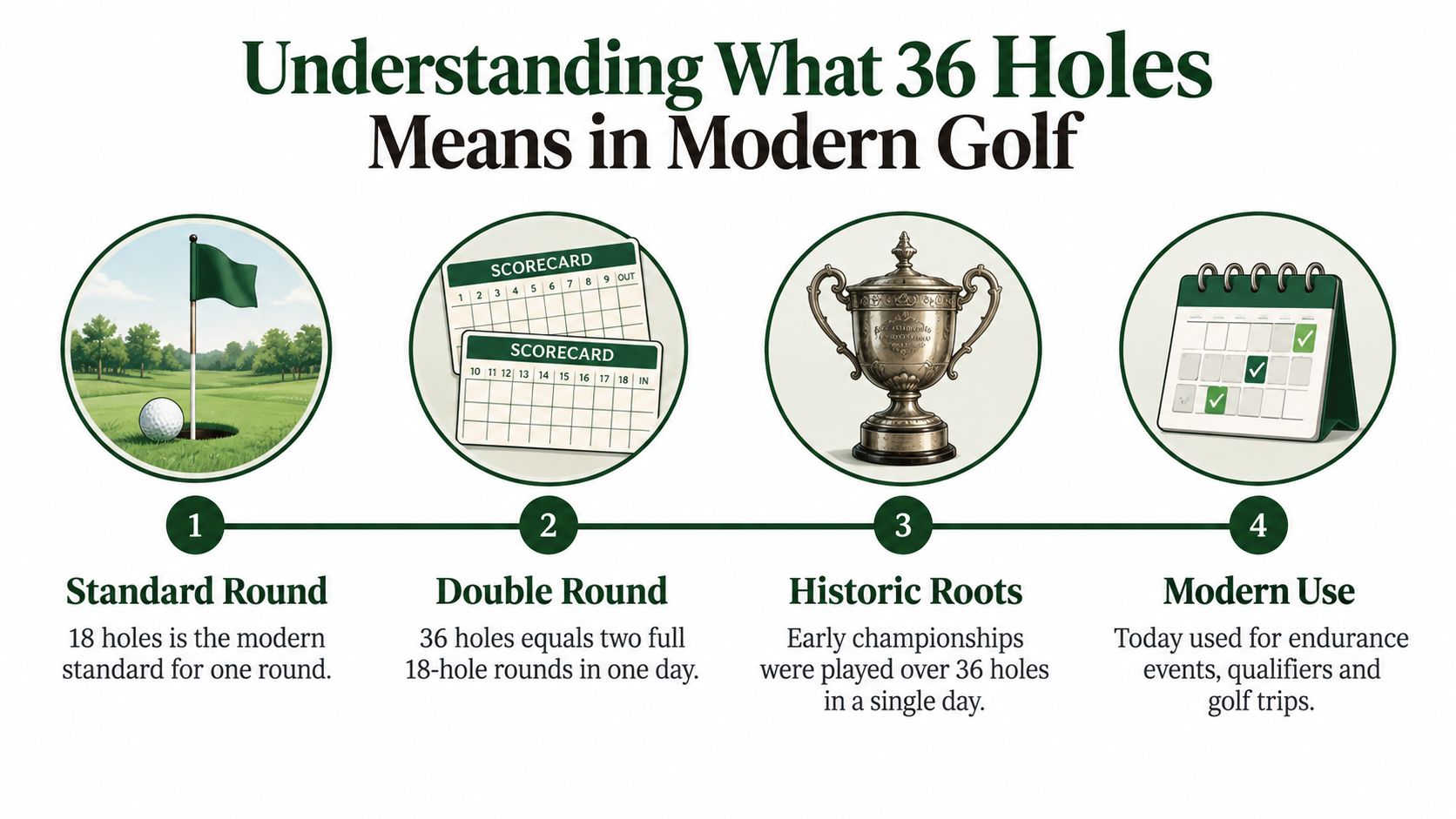
The simplest definition is two complete 18-hole rounds played in one day. An 18-hole round is the familiar unit of golf, while 36 holes doubles the number of tee shots, approaches, chips, putts, transitions, and walking demands.
That format can happen in two ways. You might play the same 18-hole course twice, or you might use a golf facility with 36 holes and complete one round on each layout. Baltusrol Golf Club and Plutaluang Navy Golf Course are examples of facilities listed as having 36 total holes, showing that this isn't only a theoretical tournament format. The facility examples are documented here.
Why the number has historical weight
Thirty-six holes also has a meaningful place in championship golf. The first British Open Championship, held at Prestwick in 1860, used 12-hole rounds and ran for three rounds, creating a total of 36 holes. The U.S. Open later used 36 holes in one day before expanding to 72 holes over two days in 1892. This history of championship formats shows why 36 holes became one of the game's early full-test formats.
The modern 72-hole championship is now the familiar elite standard, but 36 holes still works as a concentrated test. Players must maintain a repeatable swing, manage their attention, and adapt their strategy as conditions and energy change.
A useful way to think about the format
Use the first round to establish a sustainable baseline. The second round reveals whether that baseline was realistic.
A golfer who attacks every hole early may produce a strong opening score but lose control later. A player who manages effort, eats consistently, and accepts conservative targets can stay competitive when the day becomes difficult. That's why 36 holes measures more than shot-making. It measures how well you can repeat good habits under pressure.
How Far You Walk and How Long 36 Holes Takes
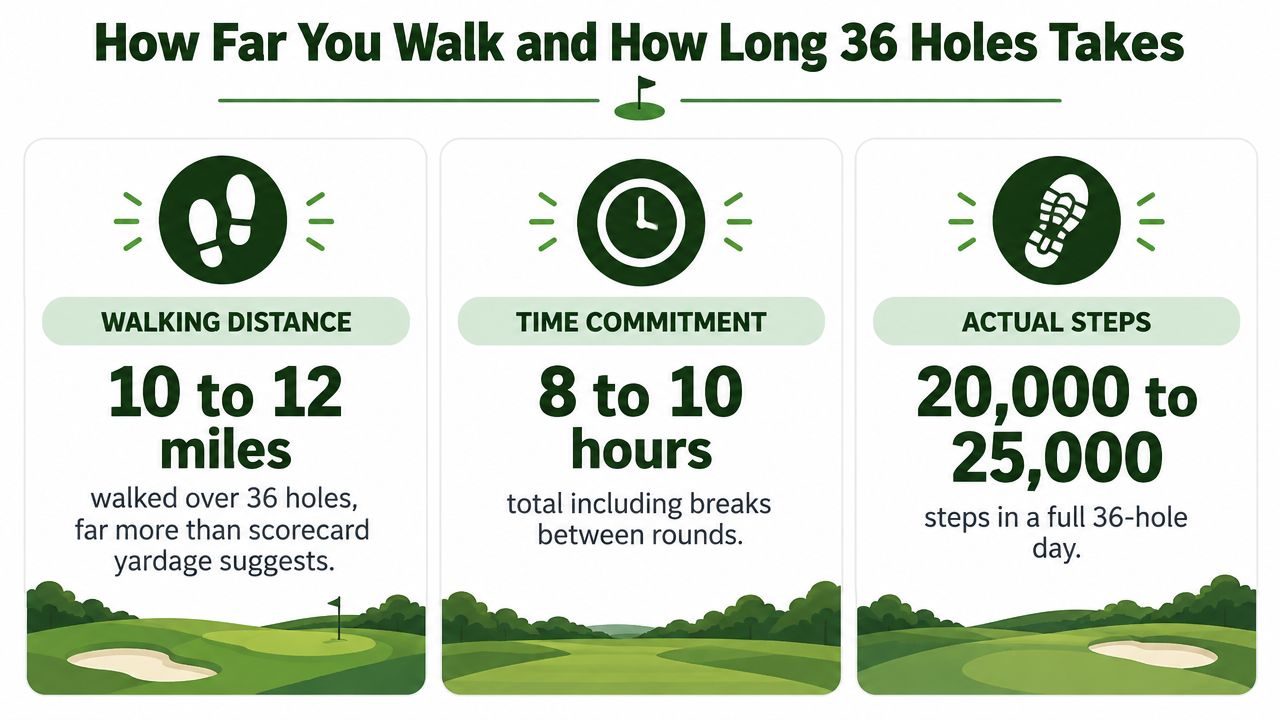
Scorecard yardage is only the start of the walking calculation. One GPS-based analysis of 891 courses found an average tee-to-green round length of 6,466 yards, but the total increased to 8,098 yards, or 4.6 miles, after walks between greens and the next tees were included. That routing adds roughly 25% beyond the scorecard distance. The course-walking analysis explains this gap.
A separate research review found that an 18-hole round typically involved 4.4 to 11.3 kilometers of walking, depending on the course and study conditions. Across 36 holes, that implies roughly 8.8 to 22.6 kilometers, or approximately 5.5 to 14 miles, before considering unusual routing or extra searching. Another survey of more than 1,000 rounds reported an average 18-hole walking distance of 6.6 miles, with an average extra walking load of 77% beyond scorecard yardage. These walking-distance findings are summarized by Golf Monthly.
Why the scorecard can mislead you
The ball rarely travels in a straight line from tee to green. You walk around hazards, cross from one side of a green to the next tee, move to different landing areas, and sometimes retrace steps after an errant shot.
That's why the practical estimate should come from your own course history rather than its printed yardage. If your watch records a typical 18-hole distance, double that figure as a starting point, then allow for the extra time needed for a meal and reset between rounds.
Time depends on more than walking speed
A 36-hole day can occupy most of the daylight hours. The total depends on group size, pace of play, course congestion, terrain, ball searches, and the length of the break.
Riding usually reduces walking distance and can shorten transitions, but it doesn't remove waiting between shots. Walking can feel efficient on a clear course because you move directly from one position to the next, while hills and a heavy push cart can make the same layout much more demanding.
Use the guide to walking a golf course like a pro to assess your course routing, equipment setup, and walking habits before committing to the full day.
Why the Second 18 Feels Harder Than the First
The second round becomes difficult because several types of fatigue arrive together. Your legs have already completed a substantial walking workload, your hands and shoulders have spent hours handling clubs and equipment, and your attention has been active through dozens of decisions.
The late-round effect isn't only physical. A systematic review reported significant increases in mental fatigue between holes 25 to 30 and holes 31 to 36, alongside declines in scoring as play progressed. The review of fatigue during 36-hole golf formats is especially useful because it focuses on what happens after the familiar 18-hole distance has already passed.
Fatigue changes your decisions before it changes your swing
Many golfers notice a concentration problem before they notice a dramatic swing problem. You may rush club selection, stop checking wind direction, aim at a pin that isn't worth the risk, or lose track of a simple pre-shot routine.
Those small lapses can create a chain reaction. A poor decision places the ball in trouble, the recovery requires extra effort, and the next shot demands even more concentration. By the closing holes, the golfer is spending energy correcting earlier choices instead of playing the course in front of them.
A measured study cited in golf-walking guidance recorded about 1,442 calories burned while walking 18 holes with clubs, based on 721 calories for nine holes. The guidance and cited measurement are available from Tonal. The figure illustrates why a full walking day deserves the same preparation you'd give any long endurance activity.
Walking is exercise, but more exercise isn't always better
Recent full-round data found that walking produced 17,007 steps and 880 kilocalories, compared with 6,274 steps and 456 kilocalories when using a cart during a competitive 18-hole round. The walking condition also brought greater physical demand and perceived performance strain. The comparison of walking and cart use helps separate two questions that golfers often combine: whether walking is healthy, and whether maximum walking load is sensible on a 36-hole day.
Walking can support fitness, but a golfer may still need to manage recovery, joint stress, and accumulated effort. Seniors, players returning from injury, and golfers on hilly courses should watch for shortened strides, persistent soreness, declining posture, and a pace that falls sharply. Those signs suggest that the goal should shift from proving toughness to protecting a controlled finish.
How to Pace and Plan a Successful 36 Hole Day
A good 36-hole plan begins before the first tee. Check the course map, identify steep sections, and decide whether you'll walk both rounds, ride one, or use an assistive setup. Pack water, practical food, spare gloves, weather protection, and any medication or recovery items you normally need.
Build energy instead of chasing it
Eat before hunger becomes urgent. Choose familiar foods that provide steady fuel, and keep portions manageable so you don't begin the second round feeling heavy. Drink regularly rather than waiting until you're thirsty, particularly in warm or exposed conditions.
The break between rounds should have a purpose. Sit down long enough to let your feet and lower legs settle, eat a proper meal, refill bottles, and change a damp shirt or socks if necessary. Avoid turning the break into a long inactive spell if that makes you stiff. A gentle walk and easy mobility work can help you feel ready to move again.
Between-round rule: Recover your legs without switching them completely off.
Pace your effort on the course
Your walking rhythm should feel sustainable from the opening tee. Don't sprint to a distant ball, push aggressively uphill, or spend excessive energy carrying out a shot that has little chance of improving your position.
Use course management to reduce unnecessary work:
- Choose a reliable club: Favor predictable carry and control over a low-percentage attempt that may create a long recovery.
- Limit avoidable detours: Keep your equipment positioned where it won't require repeated trips across the fairway.
- Accept conservative targets: A safe part of the green can be better than a flag that brings a difficult miss into play.
- Reset after mistakes: One poor hole shouldn't cause an emotional response that drains concentration for the next several holes.
The final stretch deserves its own strategy. If your swing feels less stable, widen your targets, take an extra club when appropriate, and protect your balance. The golf pace-of-play guidelines for a faster round can also help your group reduce delays without making the day feel rushed.
Walking Smarter With Electric Assist for 36 Holes
Unaided walking gives you the highest level of physical demand, especially when you push a loaded cart up repeated slopes. Electric assist changes the pushing task without requiring you to give up walking between shots.
That distinction matters. You can continue walking the course, keep moving through the routing, and retain much of the activity that makes walking attractive, while reducing the force required from your arms, shoulders, and legs. The aim isn't to remove every challenge. It's to avoid spending your limited energy on the trolley rather than your golf.
Compare the two setups
| Walking without assist | Walking with electric assist |
|---|---|
| You supply all pushing force on flats and hills | The motor supplies propulsion while you continue walking |
| Uphill sections can raise effort quickly | Slopes become easier to manage |
| Pace depends on your physical output | Controls help maintain a steady rhythm |
| Fatigue may arrive earlier in the second round | More energy can remain for swings and decisions |
An assistive wheel is particularly relevant for seniors, golfers managing mobility limitations, and players who want to walk a hilly course without accepting the full pushing penalty. It can also suit push-cart owners who already like walking but find a complete 36-hole day too demanding with a conventional setup.
What to check before choosing one
Compatibility comes first. Confirm that the system fits your three- or four-wheel push cart, attaches securely, and has controls you can operate without interrupting your routine. Battery capacity matters because a full day requires support beyond a single round, and simple forward, reverse, and braking functions are easier to manage when you're tired.
Caddie Wheel's electric assist wheel is designed as a drop-on motorized wheel for standard golf push carts, with a snap-in bracket, variable-speed remote, and a battery advertised to support up to 36 holes on a charge. Used correctly, that setup can reduce pushing effort while preserving the act of walking, which is the central tradeoff for a long walking day.
Is Playing 36 Holes Right for You
The right choice depends on more than whether you can finish 18 holes comfortably. Consider your course, your recovery, your available daylight, and the reason you're playing the extra round.
Walk all 36 if you already handle long walking days well, the course is manageable, and you can prepare food, water, and equipment in advance. Use electric assist if pushing effort is the main problem, particularly on hills or during the afternoon round. Ride one round or split the golf across two days if fatigue, injury history, or recovery makes a full walking day likely to compromise your swing and enjoyment.
The practical workload can range from roughly 8.8 to 22.6 kilometers across 36 holes depending on course conditions, based on the walking-distance review cited earlier. The late-day mental challenge is just as important, with fatigue becoming especially significant after hole 25. Your best plan is the one that lets you keep making calm decisions when the scorecard reaches the closing stretch.
If elbow soreness has already started to affect your push or swing, review appropriate rehab exercises for elbow pain before scheduling a demanding day. A little preparation can prevent a personal challenge from becoming a recovery project.
Caddie Wheel offers a motorized assist wheel for standard three- and four-wheel golf push carts, with remote control and battery support advertised for up to 36 holes on a charge. Visit Caddie Wheel to see whether electric assistance can help you walk more of your next full golf day with less pushing fatigue.
Share:
Quick Charge Battery Life Explained for Golfers
36 Holes of Golf in One Day How to Walk It Well