
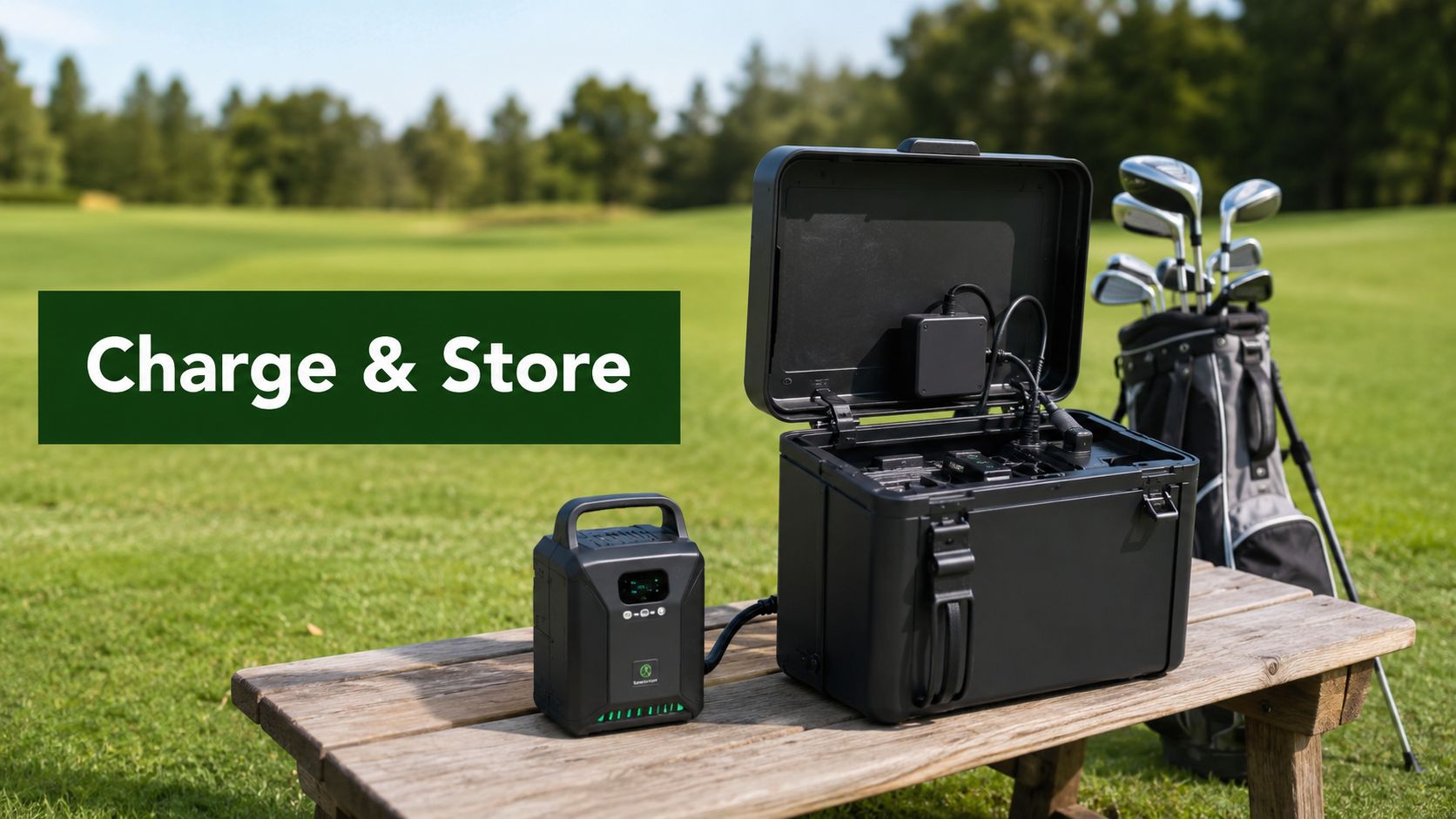
You're standing on the 14th tee, the round's still in reach, and the little battery light on your Caddie Wheel starts blinking. That's the moment most walking golfers realize the charger isn't an afterthought. It's part of the whole system, the same way clean grips, fresh gloves, and a charged rangefinder keep a round smooth.
A battery charging box sounds like a technical product, but for golf it's usually a simple idea. It gives your battery and charger a safe, tidy place to live between rounds, so you're not hunting for cords, dragging connectors across the garage floor, or wondering whether heat and clutter are shortening battery life. The best part is less drama on golf day and fewer charging mistakes at home.
What a Battery Charging Box Actually Does for Your Golf Setup
On a walking round, the battery box question usually starts with a warning light, not a shopping list. You get home, set the cart in the garage, and you want one place where the charger, battery, and cable all make sense together. That's where the idea of a battery charging box fits a golf setup, it's a compact home base, not a giant industrial rack.
The phrase gets used loosely, so it helps to separate the pieces. A wall charger pushes electricity into the battery. A power bank stores electricity for later. A battery charging box is the enclosure or organized housing that keeps charging safer and cleaner, especially when you want the battery and charger stored together between rounds. In the broader history of rechargeable systems, that enclosure idea is old, not new, since battery charging has long been about controlling how electricity enters the cell and how the hardware is protected around it, from the first lead-acid battery in 1859 to later enclosed charging facilities history of the battery.
For a walking golfer, that distinction matters because the box itself doesn't make charging smarter. The charger, the battery chemistry, and the storage conditions do the actual work. A helpful way to think about it is simple, the box supports the routine, while the charger manages the battery.

Practical rule: if the setup only makes your garage look cleaner but doesn't improve ventilation, connector access, or battery handling, it's just storage, not a better charging system.
If you're comparing golf-specific charger advice with broader electric-cart guidance, Solana EV charger advice is a useful cross-check because it keeps the focus on matching hardware to the battery, not just buying a box and hoping for the best.
Matching the Charger and Box to Your Caddie Wheel Battery
Before you buy anything, match the charger to the battery first and the box second. That order saves more frustration than any glossy product page. A high-capacity lithium-ion battery needs the right charging protocol, which means the charger's voltage, connector, and current behavior have to fit the pack you're using.
That's especially important because modern lithium-ion packs behave very differently from older chemistries. Industry data shows lithium-ion pack energy density at about 450 Wh/L versus roughly 70 Wh/L for lead-acid, and pack costs have fallen from about $1,000/kWh in 2011 to about $150/kWh in 2022 Zapi Group. Those shifts help explain why portable golf gear moved toward lighter, denser batteries and smarter chargers. They also explain why the old habit of using “whatever charger is around” is a bad fit for a modern golf setup.
The quickest compatibility check is practical, not fancy. Look at the battery label, confirm the charger matches the required voltage, make sure the connector type is the same, and verify that the charger is designed for that battery chemistry. If you're using a portable charger with a compact box, the box should fit the charger and battery without pinching the cable or trapping heat. The safest setup is always the one that matches the battery, not the one that looks neat on a shelf.
For a golfer comparing product behavior and charging flow, the internal guide best golf cart battery charger is worth reading because it keeps the focus on charger fit instead of guesswork.
A lot of readers also ask whether charging from the course, a car outlet, a generator, or a household extension cord changes the equation. The short answer is that the power source still needs to supply a stable charge to the correct charger. The charger does the battery-specific work, while the outlet or generator just feeds it. If the source is inconsistent, the charger can't fix that.
When the charger and battery don't agree, the box can't save you. The enclosure protects the routine, but the battery still needs the right electrical match.
A Safe Step-by-Step Charging Routine on the Course and at Home

The safest routine starts before the plug ever touches the battery. Check the case for cracks, look at the connector pins, and make sure the battery isn't hot from just coming off the course. Battery University notes that lithium-ion batteries should not rise more than 10°C (18°F) above ambient temperature when reaching full charge, and they also shouldn't be charged below freezing Battery University. That gives you a clean rule, if the battery feels overheated or is sitting in a cold shed, wait.
Next comes placement. Put the charger and battery on a hard, nonflammable surface with open air around them. Don't tuck the whole setup into a sealed trunk or a hot vehicle while charging. For golf gear, that's the same kind of common sense you'd use with wet grips or a muddy trolley, airflow matters because heat has nowhere to go if you trap it.
Once the charger is connected, watch the indicator lights and let the charger manage the cycle. Battery charging gets less efficient as the state of charge rises, and Battery University notes that charge acceptance drops at about 70% state of charge and higher Battery charger. In plain language, the last stretch takes longer than the early part, so don't assume the battery should climb at the same pace all the way to full.
If you want a general reminder that the charging source matters as much as the battery, how to charge a golf cart is a useful companion read because it reinforces the habit of checking the whole system, not just the plug.
The charger itself should tell you when it's done. Once the light changes to full or green, unplug it rather than leaving it connected for no reason. That's a simple habit, but it keeps the routine clean and avoids unnecessary heat.
For people who charge away from home, the same mindset helps in other small routines too. If you're camping and trying to keep a morning ritual simple, for campers needing easy coffee methods is a good example of the same principle, use the simplest method that still respects your equipment.
There's also a charger performance reality worth keeping in mind. A four-bay automatic station can charge up to four 6V/12V batteries simultaneously, and a published charger-box sizing example puts SMBus chargers at 100W, AA chargers at 36W, and USB charging at 10W, for roughly 150W of power-supply capacity when all three run at once Schumacher station. That kind of sizing logic is what keeps a setup from sagging under load.
Storage and Installation Tips That Extend Battery Life
Storage is where many golfers shorten battery life without meaning to. A battery charging box belongs in a cool, dry, shaded place, not beside a sunbaked window or next to a heater. Heat works against lithium-ion packs because they stay happier in controlled conditions, and the box's job is to support that kind of care.
A clean garage setup works well if the charger has room to breathe. Mount it where the cord does not hang under tension, keep the connector easy to reach, and avoid sharp bends that fatigue the cable. If you use a trunk or club locker, treat it as a temporary transport spot, not a charging space. The battery needs space and airflow, while the box keeps the routine organized.
For longer storage, keep the battery ready for the next round without letting it sit ignored for months. A good habit is to top it up before a golf day, then check it periodically during the off-season so it does not get forgotten. For fire-resistant options, see our guide to a fireproof lithium battery container. Lithium-ion storage guidance also points toward a cool, dry, controlled environment rather than a cramped or damp one battery charging cabinet guidance.
If you are comparing box styles for a push-cart setup, the key question is fit and access. The battery should drop in and out without yanking cables or forcing the connector into awkward angles. A simple layout reduces wear, and that matters every time you remove the pack after a round.
The storage habits you build now also help if your setup changes later. Industrial forklift guidance emphasizes spacing chargers for ventilation, controlling temperature and humidity, and keeping spill and fire response gear nearby because charging areas can create electrical, thermal, and chemical risks forklift charging station guidance. Golfers do not need a forklift bay, but the same idea applies, good layout beats improvisation. For a broader look at rugged rolling hardware and why durable contact points matter in mobile equipment, you can browse rugged wheels for off-road wagons and see that durability mindset applied to a different kind of travel gear.
Troubleshooting Common Charging Problems
Most charging complaints start with the connector, not the battery. If the pack only charges at a certain angle, think loose port, bent pin, dust, cable wear, or a connection that's getting interrupted under light pressure. That's the kind of failure pattern that shows up in real life far more often than a dead battery.
Start with the cheapest fix. Look into the port, clear out debris, inspect the cable jacket, and gently test whether the connector feels snug. If the charger works only when the cable is twisted or lifted, the problem is mechanical. A battery can be perfectly fine and still refuse to charge because the contact path is unreliable.
For golfers who haul gear over rough ground, connector stress is a real concern. If you want a broader look at rugged rolling hardware and why durable contact points matter in mobile equipment, you can browse rugged wheels for off-road wagons and see the same durability mindset applied to a different kind of travel gear.
A simple decision path helps. Clean first. Test the cable next. Confirm the outlet is live. Then look at the charger itself. If the battery still won't respond after those checks, that's when warranty support becomes the sensible move instead of random part swapping.
Practical rule: if the charger fails only when the plug is nudged, the battery is usually not the first suspect.
Caddie Wheel's troubleshooting guidance follows that same logic, starting with the power source, then the charger, then the cable and port. That sequence saves time because it keeps you focused on the most likely failure point before you assume the battery has reached the end of the road.
Building a Long-Term Charging Habit That Just Works

A charging habit works best when it fits the way you already prepare for golf. If your battery charging box lives in the same spot every time you walk back in from the course, it becomes part of the reset, like cleaning mud off your wheels or hanging up your glove. Before each round, give the battery and connector a quick visual check, then top up the battery the night before golf day so you are not rushing in the morning. A deeper look once a month helps you catch loose cables, dirty contacts, or wear before they turn into a missed tee time.
Small routines keep the whole setup predictable. Label the charging cable so it does not disappear into the rest of your gear, keep a spare fuse in the garage if your setup uses one, and leave room around the box for airflow. Those habits do not change how the charger works, but they make it much easier to use it correctly without hunting for parts or crowding the equipment shelf.
The best routine also matches how battery technology and charging hardware keep changing. A well-ventilated box that is easy to reach and suited to the battery chemistry you already use gives you a setup that is simple to repeat, even if you upgrade hardware later. For walking golfers, that means fewer last-minute checks, fewer surprises before a round, and a charging setup that feels as automatic as packing tees and balls. A battery charging box earns its place when it supports that kind of repeatable habit, round after round.
If you are setting up your own walk-and-charge routine, start with the battery fit, then make the storage and inspection habit easy to repeat. Visit Caddie Wheel to check the current battery and charger setup, then keep your garage routine as simple as your next tee time.
Share:
Single Seater Golf Buggies: Your 2026 Buyer's Guide
Electric Golf Cart UTV: Which One Do You Need in 2026?