
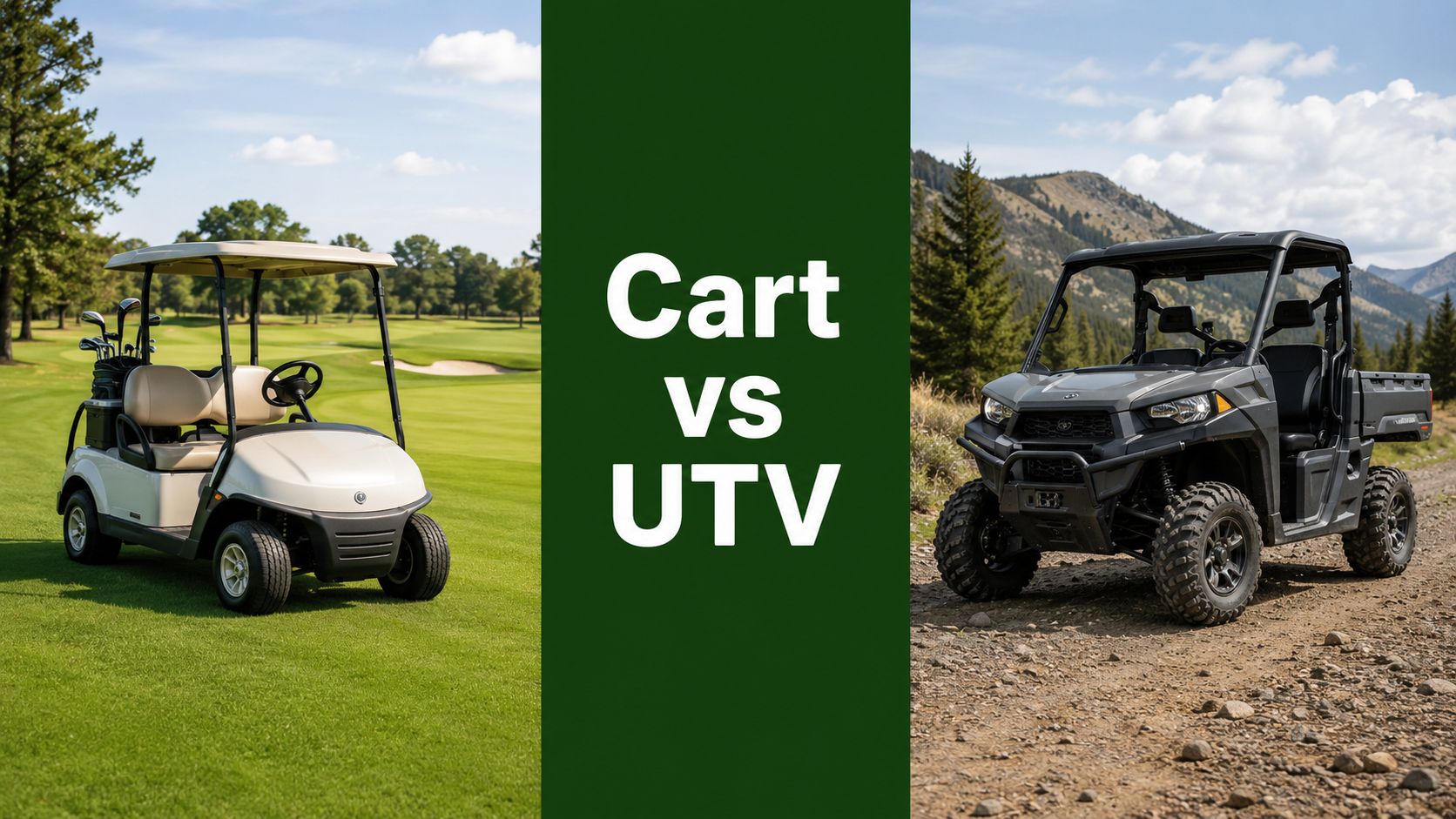
You're standing in the wrong aisle if you're trying to solve a terrain problem with a brand label. The question isn't whether an electric golf cart UTV sounds tougher or more modern, it's whether your route is flat, your load is light, and your speed needs are short enough to justify the cheapest vehicle that won't underperform.
| Need | Electric Golf Cart | Electric UTV |
|---|---|---|
| Best surface | Paved, manicured, gently rolling ground | Rough ground, uneven paths, heavier-duty routes |
| Typical role | Golf, resort transport, short community trips | Property work, hauling, mixed-use utility |
| Seating and build | Compact, low-speed, lighter-duty | 2 to 6 seats, cargo bed of about 4 feet |
| Cost posture | Lower-cost option | Higher-cost option |
| Main mistake buyers make | Buying one for terrain it can't handle | Buying one when a cart or push-cart assist would do |
A lot of buyers only realize they compared the wrong things after they've already spent money. A golfer sees a cart struggle on a steep fairway and assumes the answer is a UTV. A ranch owner buys a UTV for a tight path and discovers it's more machine than the job needs.
That's the trap. The right match is usually simpler than the category debate suggests.
The Moment Most Buyers Realize They Compared the Wrong Things
A golfer rolls up to the first steep fairway and watches a cart lose its confidence halfway there. The passengers stop talking, the motor strains, and the whole round turns into a reminder that terrain matters more than shiny features. On the other side, a property owner buys a UTV for one narrow route to a mailbox and then spends the next month dealing with a vehicle that's wider, heavier, and more complex than the job asked for.
That mismatch is the whole problem. People keep asking, “Which is better?” when the smarter question is, “What's the cheapest thing that won't underperform on my actual route?” A vehicle that's overbuilt for hauling can add cost and complexity without solving a golfer's core issue, while a lighter cart may be perfect for short trips and useless once the ground turns rough.
Think in terms of use case, not identity
A resort operator doesn't need the same answer as a ranch owner. A neighborhood commuter doesn't need the same answer as a player trying to save energy on a hilly course. The useful comparison is not cart versus UTV in the abstract, it's route length, slope, cargo, and whether the vehicle needs to leave manicured surfaces.
Practical rule: If your day is mostly paved or turf paths, start with the lighter option. If your day includes rough ground, hauling, or steep grades, the utility build earns its keep.
That's why the rest of the decision should feel like a matching exercise. Once you accept that, the answer gets a lot clearer. Sometimes the answer is a cart. Sometimes it's a UTV. And sometimes neither is the right tool at all.
What Counts as an Electric Golf Cart and What Counts as a UTV

A buyer standing between an electric golf cart and an electric UTV should start with one question, what is the machine expected to do on the route in front of it? If the answer is smooth paths, light passengers, and short trips, a golf cart is the cheaper fit that will do the job without extra bulk. If the route includes rough ground, hauling, or work sites, the UTV earns its place because the cart will underperform fast.
An electric golf cart is built for low-speed movement on smooth ground. That means paved paths, resort lanes, neighborhood streets where local rules allow them, and manicured golf-course routes. The job is simple transport, not hauling or rough-service work. If a product page talks more about seat count than suspension, you are usually looking at a golf cart, not a utility machine.
An electric UTV is built for work first. United Rentals describes a UTV as seating between two and six passengers and carrying a cargo bed of about 4 feet long, which is the kind of detail buyers should watch instead of marketing language (United Rentals). Bigger tires, stronger suspension, and a cargo-first layout point to a machine meant for rougher conditions and hauling, not just moving people around a course.
Watch the gray zone
Some listings blur the line with heavier utility carts and lifted 4x4-style models. Buyers get pulled in there because the names sound mild while the hardware does not. If the machine has the stance of a work vehicle, the cargo bed of a hauler, and the suspension to match, it belongs much closer to the UTV side, even if the seller uses softer language.
For a second check on how these labels get used in the real world, Caddie Wheel's golf cart mule guide keeps the comparison grounded in actual use instead of brochure talk. If you want a broader look at electric off-road options, browse our 2026 e-dirt bike guide.
The cleanest way to classify any model is to ask three questions. What surface is it meant for, what does it carry, and how far is it supposed to go before recharging? If the answers point to short, smooth, light-duty movement, it is a golf cart. If they point to work, rough ground, and real cargo, it is a UTV.
Speed, Range, and Terrain Put to the Test
A buyer usually notices the difference first on a long driveway, a service road, or a stretched-out property where the vehicle has to keep moving. An electric golf cart sits in the 12 to 15 mph zone, and some higher-performance models reach up to 25 mph. Electric UTVs operate in a different speed class, with some models reaching 40 to 45 mph (Kandi America). That gap matters when you are covering distance between stops. It means very little on a short, smooth route where slower travel never becomes the bottleneck.
Where speed is worth paying for
Speed is worth paying for when the route itself wastes time. A resort shuttle that keeps making short trips between buildings, a private property with long connectors, or a work path where people are waiting on transport all give a UTV a clear job to do. On a golf course, a gated neighborhood path, or any route where the trip is short and controlled, extra speed is usually just extra cost.
Range follows the same pattern. Electric golf carts are built around shorter trips, while electric UTVs can cover a wider span depending on battery capacity and configuration. The practical difference shows up only when the day is long enough to use it. If your route is stop-and-go and close together, you do not need a machine sized for marathon duty.
Terrain is where the choice gets obvious. Golf carts are made for flat or gently rolling ground. UTVs are built for rougher work, with stronger suspension and larger tires. If the route includes ruts, mud, steep grades, or regular hauling, a cart is the wrong compromise. If the terrain is smooth and the load stays light, a UTV is overkill.
Bottom line: pay for speed only when the route makes slow travel a problem. Pay for terrain only when the ground actually punishes lighter equipment.
For buyers who keep wondering how far a cart can be pushed, this off-road golf cart guide spells out the limits clearly. The point is simple. Match the machine to the route, not to the badge on the side.
Matching the Vehicle to the Buyer

A residential golfer on a regulation course usually wants help on hills, not a work rig. The route is short, the terrain is often controlled, and the load is just a person, clubs, and maybe a drink cooler. A full UTV is overkill here, and even a cart can be too much if the golfer still prefers walking most of the round.
A ranch or property owner is the opposite. The job often includes tools, feed, guests, and uneven ground. That's where the electric UTV earns its place because the vehicle needs cargo handling and rough-surface stability more than golf-course manners. If the path is rocky or the haul is real, don't pretend a light cart is enough.
A resort or community operator lives in the middle. Short shuttle routes on paved or groomed paths favor a golf cart, especially when the priority is calm transport and easy maneuvering. If the route starts to look like service work, the UTV starts to make sense.
A neighborhood commuter usually needs the cheapest vehicle that won't underperform on short errands. If the route is flat and local rules permit it, a golf cart is the cleaner fit. If the commute includes rough shoulders, cargo, or longer mixed-use travel, step up to a UTV only if the extra capability is being used.
My blunt verdict
- Walking golfer: Don't buy a cart or a UTV unless you want to ride.
- Property worker: Buy the UTV only if hauling and rough ground are part of the job.
- Shuttle operator: Pick the golf cart unless the route turns rugged.
- Short-trip neighbor: Stay with the smaller machine unless your route demands more.
The right vehicle is the one that fits the route with the least wasted capability.
The Real Cost of Owning Each One
The sticker price tells only part of the story. Electric golf carts are generally priced around $5,000 to $10,000, while electric UTVs commonly fall in the $10,000 to $25,000 range (Golf Cart Search). That gap matters before you even factor in what happens after purchase.
Charging is cheap in both cases, so don't overthink the electric bill. The bigger difference shows up in the parts that wear out. UTVs tend to take more abuse because they're used on tougher ground, so suspension and tires usually face harsher duty than a golf cart on smooth paths.
The costs buyers forget
- Purchase price: The UTV starts higher, and that gap is hard to ignore.
- Repairs and wear: Rough terrain punishes a work vehicle faster than a course cart.
- Registration and insurance: These vary by place, and the gap can become meaningful fast.
- Street-legal conversion: If you think road use is automatic, it isn't.
For buyers comparing ownership costs in more detail, this electric golf cart cost guide is worth a look because it reinforces the part people skip, total spend, not just the tag on the seat.
A cheap vehicle that fits the route beats a pricier one that sits underused. Overbuying is its own kind of waste.
If you need a simple mental spreadsheet, use this rule. Pay for a UTV when the work justifies the machine. Pay for a golf cart when the route is smooth and the payload stays light. Don't pay UTV money for golf-cart chores unless you enjoy subsidizing unused capability.
Street Legality, Permits, and the Retrofit Buyers Forget
A clean-looking electric vehicle is not automatically road-ready. That's where a lot of buyers get blindsided, because horns, turn signals, reflectors, speedometers, parking brakes, windshields, and a VIN can be part of the street-legal package, but they still don't guarantee you're allowed to drive on public roads in your area (Icon EV street-legal guide).
Local rules decide the answer. A city ordinance in the eCode360 source allows golf carts, UTVs, and ROVs on roads and streets only when the posted speed limit is not more than 35 miles per hour, and it prohibits them on state highways within city boundaries except as otherwise stated (eCode360 ordinance). It also allows crossing a higher-speed road only at an intersection and only if the crossing is perpendicular.
Don't skip transport compliance
Off-road use has its own rules too. The U.S. Fish and Wildlife Service requires four load-securement assemblies when transporting an off-road utility vehicle, with an Aggregate Working Load Limit of at least 50% of the ORUV's weight, and it says not to exceed the manufacturer's load limits or modify the vehicle except according to the manufacturer's specifications (U.S. Fish and Wildlife Service policy).
That's the part buyers forget. They assume buying the vehicle solves the legal problem. It doesn't. You still need to check jurisdiction, road class, and transport requirements before you call anything “street legal.”
The cleanest move is to verify your zip code first, then decide whether the retrofit cost and paperwork make sense for your daily route. If they don't, keep the vehicle off the road and buy for off-road use only.
When the Right Answer Is Neither a Cart Nor a UTV
A walking golfer on a regulation course often doesn't need either machine. If the problem is fatigue on hills, a full cart is overbuilt and a UTV is even more so. You want the workout, you want the walk, and you just don't want to spend your round pushing dead weight uphill.
That's where a power-assist wheel on an existing push cart becomes the smarter answer. Caddie Wheel is a rugged motorized wheel with a snap-in bracket, a variable-speed remote with forward, reverse, and braking, a battery rated for up to 36 holes per charge, and a portable charger that fits in a golf bag. It motorizes a standard push cart without turning the golfer into a driver.
Why this option matters
- Keeps the walk: You still walk the course instead of riding.
- Fits course rules better: It behaves like a golf accessory, not a road vehicle.
- Solves the actual pain point: Hills and fatigue, not cargo hauling.
- Avoids the legal mess: No street-legal conversion, no road-use guessing game.
A lot of golfers don't need a transportation solution. They need less strain. That's a different job, and it deserves a different tool. If your only real complaint is that the round wears you down, buying a cart or UTV is a roundabout way to solve it.
Choosing the Right Electric Option for Your Round
Start with three questions. How rough is the terrain. How much payload and how many passengers are you carrying. How far do you typically drive on a normal day.
If the ground is flat, the loads are light, and the route stays on a regulation course, a power-assist push cart is the right call. If the route is mixed, the payload is moderate, and the vehicle is mostly moving people short distances, an electric golf cart fits. If the ground is rough, the loads are heavy, and the route stretches across property or utility work, an electric UTV earns the upgrade.
Measure the steepest fairway before you buy. Check whether your local road rules allow anything near you. And if you're still deciding between a cart and a utility machine, price the conversion and the legal hassle before you spend on the vehicle itself.
If you want a practical next step, compare your current route against your fatigue, cargo, and road-use needs, then see whether a lighter assist solution is enough or whether you need a full vehicle. If you're ready to keep walking without pushing hard on hills, take a look at Caddie Wheel and decide whether a motorized push-cart setup fits the round you play.
Share:
Battery Charging Box: Choose, Charge, and Store It Safely
iPad Mount for Golf Cart: The Complete Buyer's Guide