

Deciding on the best electric golf push cart that follows you really boils down to two options: a fully integrated, all-in-one autonomous caddy or a power-assist conversion kit you add to your current cart. While both get you that hands-free experience, they are worlds apart in performance, cost, and convenience. The right choice truly depends on what you, the golfer, really need.
Your Guide to Hands-Free Golf Caddies
Walking the course is supposed to be relaxing, not a workout hauling your clubs around. An electric golf push cart that follows you is the perfect fix, letting you focus on your next shot instead of fighting with your gear. This technology completely removes the physical strain of pushing or pulling a heavy bag for 18 holes. You'll feel less tired, which can seriously improve your game, especially on the back nine.
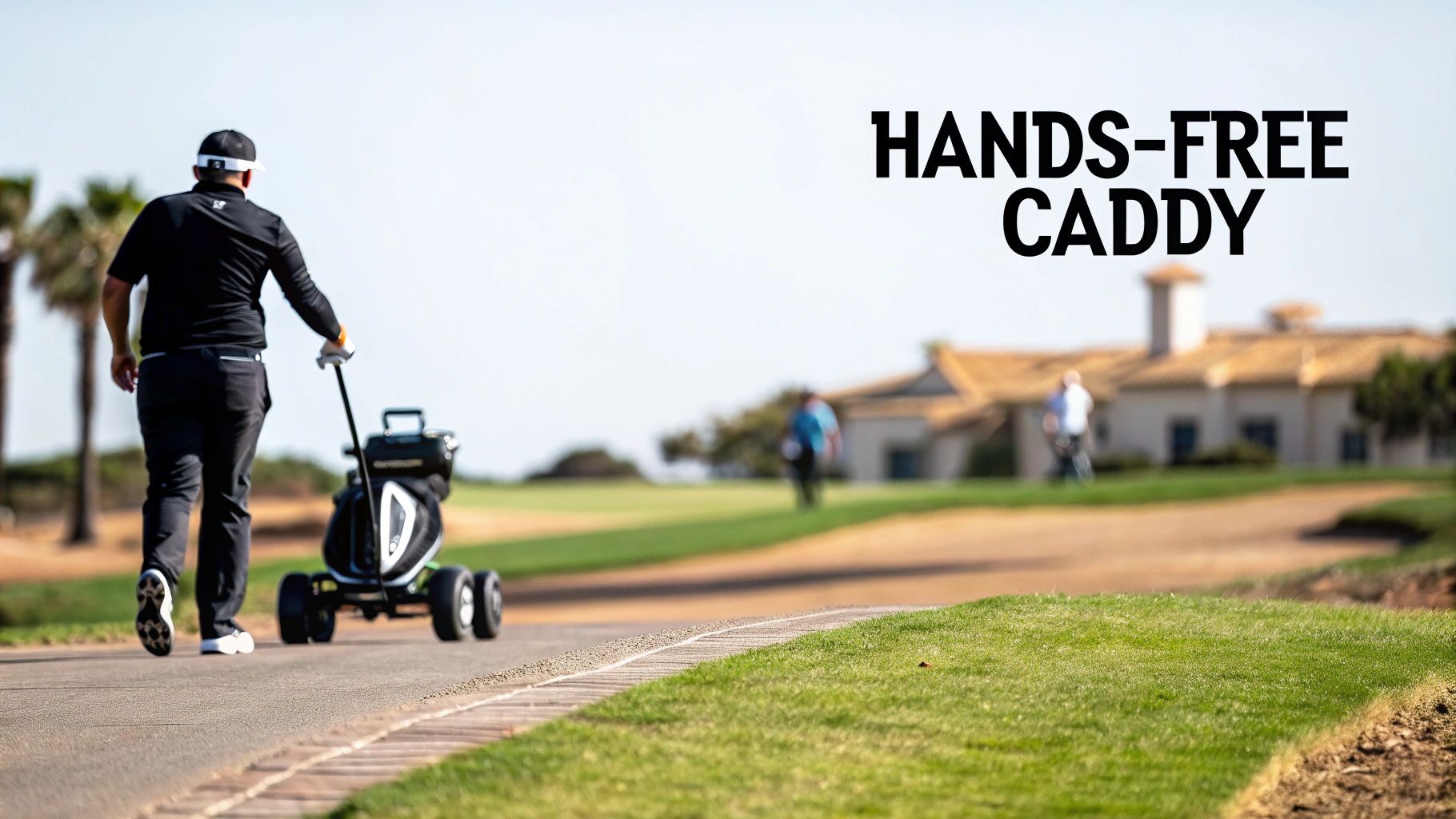
Autonomous Carts vs Power-Assist Kits
The market for these smart caddies is blowing up, signaling a major shift in how golfers are hitting the links. In fact, the global electric golf push cart market is on track to hit $500 million in 2025 and is growing at a CAGR of 8% through 2033. This growth is being fueled by tech-savvy players and huge leaps in battery life. You can find more stats on this trend over at archivemarketresearch.com.
This boom means you have two clear paths to a hands-free round:
- Fully Autonomous 'Follow-Me' Carts: These are complete, all-in-one units built from the ground up with motors, sensors, and follow technology already integrated. They're designed to give you the most stable and feature-packed experience right out of the box.
- Power-Assist 'Follow-Me' Add-Ons: These are kits designed to convert your trusty manual push cart into a motorized caddy with follow features. It’s a much more affordable way to get into the game.
To give you a better sense of how they stack up, here’s a quick rundown of the main differences.
Quick Look: Autonomous vs Power-Assist Caddies
This table breaks down the core distinctions at a glance, helping you see where each option shines.
| Feature | Fully Autonomous 'Follow-Me' Cart | Power-Assist 'Follow-Me' Add-On |
|---|---|---|
| Initial Cost | High ($1,500+) | Moderate ($500 - $1,000) |
| Integration | Seamless, factory-built design | Retrofitted onto an existing cart |
| Stability | Optimized with a low center of gravity | Dependent on the original push cart |
| Setup | Ready to use out of the box | Requires installation and compatibility checks |
As you can see, the choice isn't just about price. It's about how much you value a purpose-built system versus the flexibility of upgrading gear you already own. We'll dive deeper into what these differences mean for you on the course.
How Follow-Me Golf Cart Technology Works
That "magic" feeling of an electric golf cart following you down the fairway isn't magic at all. It’s a clever blend of sensors, wireless signals, and smart programming that creates a kind of "digital tether" between you and your gear. The whole system is designed to let the cart trail you autonomously, so you can forget about it and focus on your next shot.
At the core of this tech is a simple tracking concept. Most follow-me carts use a small remote that you clip onto your belt or slip into your back pocket. This remote continuously sends out a signal—usually via Bluetooth or Radio Frequency (RF)—that sensors on the cart lock onto. The cart’s onboard computer then interprets this signal to maintain a steady following distance, speeding up or slowing down to match your pace.
The Brains of the Operation
Of course, the remote is only one part of the equation. The cart itself is packed with tech that turns that simple signal into smooth, reliable motion. Here’s what’s typically working behind the scenes:
- Dual Motors: Nearly all follow-me carts have two independent motors, one for each of the main wheels. This setup is crucial for precise steering, tight turns, and better stability, especially when you’re navigating bumpy or uneven ground.
- Sensors and Gyroscopes: These little components are constantly working to keep the cart balanced and aware of its orientation. They're what stop it from tipping over on a hillside and what enable features like automatic downhill braking, which keeps your cart from running away from you on steep slopes.
- AI and Visual Tracking: The newest, most advanced models are starting to move beyond just the remote. Some now use AI-powered cameras and visual sensors to physically "see" and lock onto you, following your form without needing a remote at all.
Key Takeaway: The reliability of any follow-me system comes down to how well its sensors, motors, and software communicate. The simpler systems use a remote-based "leash," while the more sophisticated models use AI vision to deliver a truly hands-free experience.
Manual Control and Failsafes
You’re not always walking in a straight line on the course, and the designers know that. The remote also doubles as your manual steering wheel when you need it. You can use it to guide the cart around a bunker, send it ahead to the next tee box while you walk to the green, or just park it perfectly next to your ball.
More importantly, these carts are built with safety in mind. If the connection between the remote and the cart ever drops—maybe you walked too far ahead or the remote’s battery died—the cart is programmed to stop in its tracks. This feature alone prevents your expensive clubs from taking a solo joyride across the course.
If you want to go deeper into how these systems work, our detailed guide to golf carts that follow you offers a comprehensive breakdown. Ultimately, this technology is all about being a dependable partner on the course, freeing you up to focus completely on your game.
Comparing Autonomous Carts and Power-Assist Kits
Deciding between a fully autonomous cart and a power-assist kit isn't a simple choice. It's a classic trade-off: do you want the seamless, integrated performance of a purpose-built machine, or the cost-effective convenience of upgrading what you already own? Both get you a hands-free golfing experience, but how they get you there is worlds apart. The right answer really depends on your game, your home course, and your budget.
An autonomous cart is designed from the ground up to be one thing. Every part—from its low-slung frame to the dual-motor drivetrain—is engineered to work in perfect harmony. That integration is its biggest advantage, giving it a level of stability and performance that a retrofitted kit often can't quite replicate. On the flip side, a power-assist kit is a clever way to leverage the push cart you've already invested in, making it a much more accessible entry point into motorized golf.
Performance on Hills and Rough Terrain
The real test for any electric caddy isn't the flat fairway; it's how it handles hills, sidehills, and bumpy rough. This is where the dedicated design of an autonomous cart truly shines. For anyone playing a course with serious elevation, a purpose-built cart with a low center of gravity is a game-changer. Models like the Robera AI even have anti-tipping systems designed to tackle inclines up to 25 degrees, keeping your bag upright on tricky terrain. Their wider wheelbases and balanced weight distribution prevent the top-heavy wobbles that can sometimes plague add-on kits.
A power-assist kit's performance is completely dependent on the push cart it's attached to. A unit like the Caddie Wheel delivers plenty of power, but the cart's underlying stability is still based on its original design. If you've got a lightweight push cart that's already a bit tippy, adding a motor won't solve that—it might even make it more noticeable on steep ground.
For golfers who regularly play courses with significant elevation changes, the purpose-built stability of an integrated autonomous cart offers a clear and decisive advantage in both performance and safety.
Battery Life and Real-World Range
This is an area where both options have made huge leaps. A top-tier autonomous cart usually packs a high-capacity lithium-ion battery that can easily last 36 holes on a single charge. Because the battery and motors are factory-matched, these systems are incredibly efficient and deliver consistent power from the first tee to the 18th green without any fade.
Power-assist kits also come with impressive battery specs, often promising 27 to 36 holes. However, your actual mileage may vary. The real-world range depends on factors like how heavy your golf bag is and the rolling resistance of your push cart's wheels. The harder the motor has to work, the faster the battery will drain. You can check out a variety of electric golf cart conversion kit options to see how different models balance power with battery life.
This image breaks down the three main technologies that enable these carts to follow you around the course.

It shows how the best electric golf push cart that follows you might use a simple remote, advanced GPS, or cutting-edge AI vision to stay by your side.
Ease of Setup and Daily Operation
Here, the tables turn. Autonomous carts are pretty much plug-and-play. You charge it, unfold it, and you're good to go. The folding mechanisms are often engineered to be quick and simple, making setup a total breeze.
A power-assist kit, on the other hand, needs a one-time installation. While modern designs have made this process much simpler, you’ll still need to spend a little time making sure the brackets are fitted securely to your specific cart. Getting this right is key to safe operation. Once it's installed, though, daily use is incredibly easy—it’s usually just a matter of attaching the motorized wheel and battery before you head out.
Portability for Transport and Storage
Finally, you have to think about getting your caddy to and from the course. Autonomous carts, for all their features, are almost always heavier and bulkier than a standard push cart. Even with efficient folding systems, the folded unit can still take up a good chunk of your trunk space.
This is where a power-assist kit has a clear edge. You can detach the motor and battery, breaking the whole system down into smaller, lighter pieces. This modular design makes it far easier to pack into a crowded car or store in a tight space at home. It's no surprise that the convenience of these portable solutions is a major reason the market was valued at $340 million in 2025 and is projected to hit $570 million by 2034.
Analyzing the True Cost of Ownership
When you're deciding between an electric caddy that follows you and a power-assist kit, the initial price tag is only the first chapter of the story. A fully autonomous, integrated follow cart can easily set you back $1,500 or more. On the other hand, a high-quality power-assist conversion kit usually lands somewhere between $500 to $1,000.
That initial gap is pretty significant, but a smart buyer always looks beyond the sticker price. You have to consider the total cost of ownership over the cart's entire life. This bigger picture includes maintenance, future battery replacements, and any other hidden fees that might pop up. By digging into these numbers, you can figure out which option truly offers the best value for your game.
Upfront Investment vs. Long-Term Value
A power-assist kit like the Caddie Wheel gives you immediate value by motorizing the push cart you already have. You’re building on an investment you've already made, which makes it a really budget-friendly way to get into automated golf. Down the road, your main cost will be replacing the battery, but with modern lithium-ion units, that’s usually several years away.
An integrated autonomous cart is a different beast entirely—it’s a premium, all-in-one purchase. Yes, the upfront cost is higher, but you're paying for a perfectly optimized system where every single part was designed to work in harmony. This can often mean better durability and fewer headaches over time since you're not dealing with aftermarket parts. For a closer look at the numbers, you can explore a detailed breakdown of the cost of electric golf carts to see how different models stack up.
Key Financial Insight: The real value isn't just about the initial price. It's about weighing that upfront cost against future expenses, like a new battery, and the undeniable benefit of a purpose-built, integrated system.
Uncovering Hidden and Future Costs
Beyond what you pay on day one, other expenses can sneak up on you. It's really important to check if there are any subscription-based features. Some high-end models might require ongoing payments for things like advanced GPS mapping or critical software updates.
The most predictable future cost for either option is the battery. It’s not a matter of if, but when. Here’s a quick rundown of what you should expect:
- Battery Lifespan: Most quality lithium-ion batteries are built to last for 1,500 to 2,000 charge cycles. For the average golfer, that translates to several solid seasons of regular play.
- Replacement Cost: When the time comes, a new battery will likely cost between $200 and $500, depending on the brand and its capacity. Factoring this in from the start helps you create a much more realistic long-term budget.
In the end, it really comes down to your financial comfort zone. For the budget-conscious golfer looking for an immediate and effective upgrade, the power-assist kit is the clear winner. The integrated autonomous cart, however, represents a long-term investment in peak convenience and seamless performance.
Choosing the Right Caddy for Your Game
All the tech specs in the world don't mean much until you translate them to the course. To make things simple, let's figure out which option is right for you by looking at a few common golfer profiles. Finding your category will help you zero in on the best electric golf push cart that follows you based on what you actually need.
This isn't about finding a one-size-fits-all winner. It’s about matching the right technology to your game, your home course, and your budget so you can make a choice you feel great about.
The Tech-Savvy Golfer on Hilly Terrain
If you love having the latest gear and your home course is full of tough hills and elevation changes, a fully integrated autonomous caddy is where you should be looking. These units are built from the ground up with stability in mind, often featuring a low center of gravity and smart anti-tip systems that a retrofitted cart just can't match.
Their purpose-built design gives them far better balance and traction on steep inclines and tricky sidehill lies, keeping your bag secure when it matters most. For a tech-focused golfer who appreciates a smooth, reliable experience, the seamless integration of hardware and software is a huge plus.
Situational Recommendation: For golfers who won't compromise on stability and want the most advanced hands-free features, an integrated autonomous cart is the clear choice. The performance benefits on tough terrain easily justify the higher price tag.
The Budget-Conscious Golfer with a Trusted Push Cart
Already own a high-quality push cart that you absolutely love? If that sounds like you, then a power-assist add-on kit is the smartest, most cost-effective route. This approach lets you build on your existing investment, adding powerful follow technology for a fraction of what a brand-new autonomous unit costs.
It’s the perfect solution for the practical golfer who wants the perks of a motorized caddy without ditching their favorite gear. The best modern kits offer fantastic battery life and dependable remote control, giving you a taste of that premium, hands-free experience at a much more accessible price.
The Frequent Traveler and Storage-Savvy Player
For golfers who are constantly on the road or dealing with limited storage space at home, portability is everything. This is where a power-assist conversion kit really shines. You can detach the motor and battery with ease, breaking the entire system down into smaller, more manageable pieces.
That modular design makes it so much easier to squeeze into a packed car trunk or tuck away in a closet. While integrated autonomous carts are getting more compact, they are still almost always a single, heavier, and bulkier unit compared to a disassembled kit.
- Integrated Cart: A heavier, single unit that can be a real challenge to fit in smaller vehicles.
- Add-On Kit: Detachable parts give you way more flexibility for both transport and storage.
The demand for electric options is exploding across the board. The broader golf cart market was valued at $1.86 billion in 2024, with electric models capturing a huge 52% market share thanks to their quiet operation and easy upkeep. If you want to take your time on the course to the next level, you might also look into pairing your new caddy with one of the many golf experience days available.
A Few More Things You’re Probably Wondering About
Even after breaking down all the tech, you probably still have a few questions rattling around. Deciding on the right electric caddie is a big investment, and it’s smart to get every last detail ironed out before you pull the trigger.
We’ve pulled together the most common questions golfers have about both fully autonomous caddies and power-assist kits. The goal here is to give you straight, clear answers so you can feel totally confident in your choice.
How Do They Handle Hills And Obstacles?
This is a huge one, and honestly, the performance can vary a lot between different models. The high-end autonomous carts are engineered from the ground up for stability, using features like automatic downhill braking and anti-tip wheels to tackle steep ground safely. Some of the more advanced units, like the Robera AI, can handle inclines up to a respectable 25 degrees.
Obstacle avoidance is where things get interesting. Basic models will need you to step in with the remote to steer around a bunker or a stray tree root. The more sophisticated systems, however, use AI-powered sensors to navigate around smaller stuff all on their own.
With a power-assist kit, its stability is really only as good as the push cart it’s attached to. If your cart is already a bit wobbly on its own, the kit isn't going to magically fix that underlying issue.
What Happens If The Remote Or Connection Fails?
Losing control of your clubs is a nightmare scenario, but good brands have built-in failsafe measures for this exact reason. If the remote loses its connection to the cart for any reason—dead battery, interference, you name it—the unit is programmed to stop in its tracks. This keeps it from running away or taking a swim in the nearest water hazard.
And if the main battery dies mid-round? No problem. Most units can be pushed manually just like a regular old push cart, so you'll never be left stranded. The easiest way to avoid this is to just get in the habit of charging both the cart and the remote before you head out.
The most crucial safety feature is the automatic stop function. It ensures that a lost signal or dead remote battery results in a stopped cart, not a runaway disaster with your expensive gear.
Are Power-Assist Kits Universally Compatible?
Nope, and this is one of the most important things to check before you buy. While some conversion kits are designed with universal brackets meant to fit a wide range of models, many are built specifically for certain brands or cart designs.
Before you even think about buying a power-assist kit, you must confirm it’s compatible with your exact push cart. Manufacturers always provide a detailed compatibility list on their product pages. Slapping on a kit that doesn’t fit properly is a recipe for poor stability and unsafe operation.
Is An Autonomous Cart Worth The Higher Price?
This really comes down to what you value and what your budget looks like. A fully integrated autonomous cart gives you that premium, seamless experience right out of the box. You’re paying for optimized balance, better performance on hills, and generally more advanced features. It’s the top-shelf choice for golfers who want the absolute best.
A conversion kit, on the other hand, is a fantastic entry point into follow-me tech at a much lower cost. It's the perfect solution if you already have a push cart you love and just want to give it a major upgrade without buying a completely new system.
Ready to make walking the course effortless without breaking the bank? The Caddie Wheel adds powerful, remote-controlled assistance to the push cart you already own. Learn more and get yours today at caddiewheel.com.
Share:
Your Guide to a Golf Cart Sand Bottle
Your Guide to Battery Power Golf Cart Performance