You've probably seen a golfer roll past in a strange stand-on machine and thought, that looks fun, but would it help me on a real round? Maybe you're tired of hauling a bag up the back nine, maybe your regular push cart still leaves you sweaty and rushed, or maybe you're just trying to figure out whether the electric golf board is a smart mobility tool or a novelty with a cooler logo. The short answer is that it can be both, depending on your body, your course, and how much control you want over the round.
Walking the Course Without the Burn
The tiring part usually hits when the round already feels half-finished. Your shoulders have settled into the strap, the fairway has tilted uphill again, and the walk to the next tee suddenly looks longer than it did on the scorecard. That's the moment many golfers start looking at powered mobility options, not because they want to stop walking entirely, but because they want to keep walking without turning the back nine into a grind.
An electric golf board exists for that exact tension. It tries to preserve the rhythm of a walking round while cutting some of the strain out of the day. That puts it in the same conversation as other powered golf mobility tools, but it's also different in one important way, you ride it rather than push or pull it.
What golfers are really deciding
The choice isn't just board versus no board. It's ride-on board versus cart-assist motor, portability versus convenience, and novelty versus everyday practicality. A board can feel more playful and more immersive, but it also asks more from the rider. A motorized add-on for a push cart keeps your usual setup and changes less about how you already play.
If you like the walk itself, the right question isn't “Do I want to stop moving?” It's “How do I stay fresh long enough to enjoy the whole round?”
That distinction matters because a board changes the whole motion of the game. You aren't just lightening the load, you're changing how you travel from shot to shot. Some golfers love that. Others want the least possible disruption to the routine they already trust.
What an Electric Golf Board Is
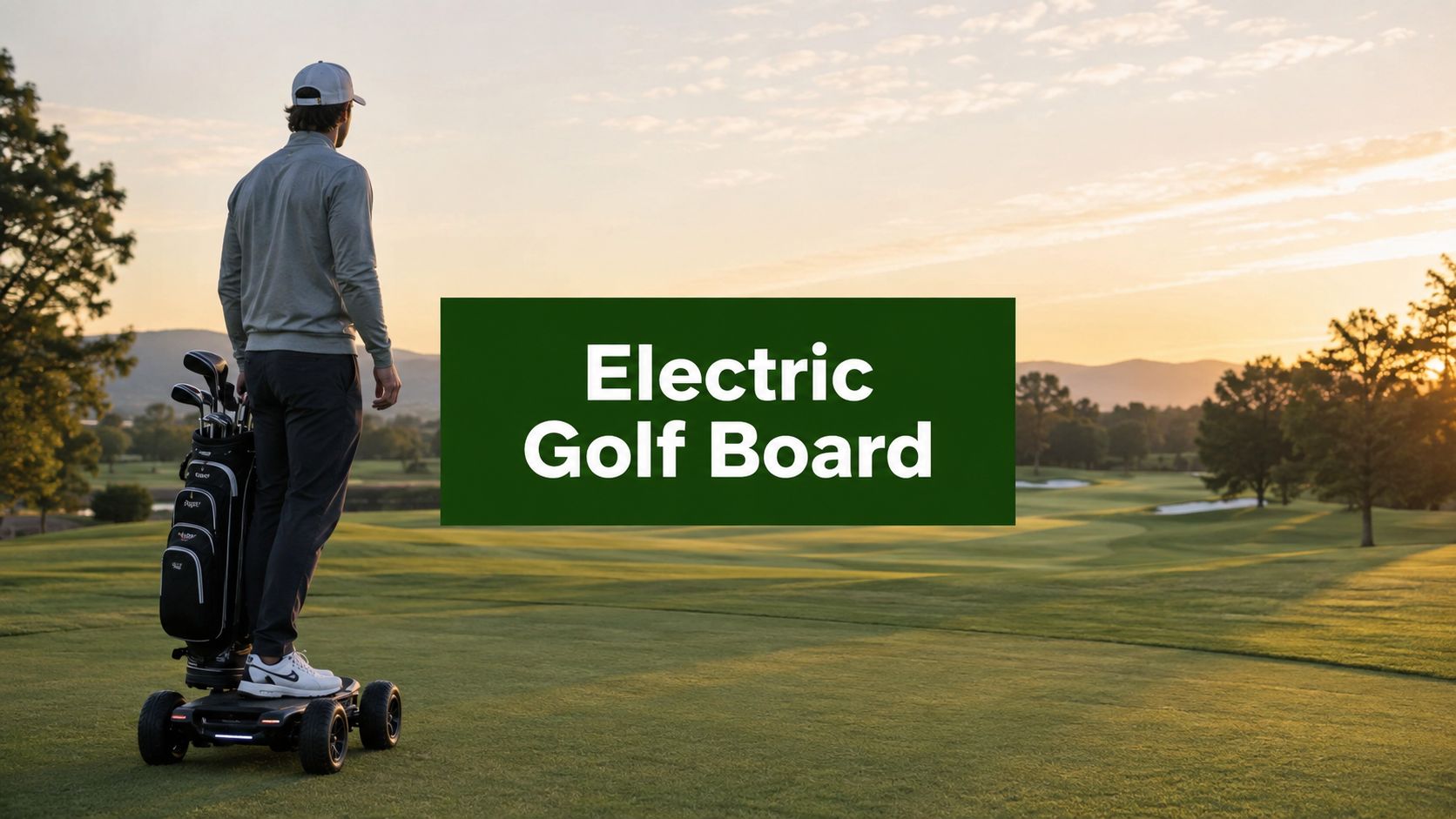
An electric golf board is a rider-on device that turns the golf course into a standing ride. You stand on the deck, steer with body weight, and use built-in power to move between shots. It behaves more like a small vehicle than a wheeled accessory, which is why it feels so different from a standard push cart or a motorized wheel add-on.

The main parts you need to picture
The board has a stand-on deck, which is the platform your feet stay on during the ride. Under that deck sits the battery pack, usually a lithium unit built into the base, along with one or more hub motors that drive the board forward. Control usually comes from a handheld throttle or remote, and braking is part of the ride experience rather than an afterthought.
GolfBoard's own product documentation describes how the platform is built around speed between shots and course turnaround, not just leisure riding. Its pace-of-play claim says an average 18-hole round takes 2:37, and that makes 36 holes possible in roughly 5 hours. The same documentation says its V1.3 boards can provide 27 holes of usage on one charge on most courses, with a just-under-1-hour recharge that can support a second 18-hole round for operators, plus practical range context of about 15 miles on street and 12.5 miles off-road (GolfBoard).
That makes the product easier to understand as a mobility platform, not a novelty toy. The battery, the drive system, and the recharge cycle all shape how the round works in practice. If you are comparing it with a lighter powered option, the differences become clearer. A motorized golf scooter overview shows a related category that still keeps the golfer on the move, but with a different riding setup and different trade-offs.
How a normal round unfolds
You power it on, settle your stance, and roll to the first shot. After you hit, you move the board toward the ball, park it near your next lie, and repeat the process. The rhythm is simple once you have learned it, but it still takes adjustment because balance and steering are part of the experience.
For golfers who are trying to place this category in the bigger picture, the board concept sits in the same family as other ride-style golf mobility tools. The important point is that these devices are active equipment. The golfer has to participate in the ride, not just ride along with it.
Real Pros and Cons Worth Knowing Before You Try One
A board can look like a shortcut to a more enjoyable round, but the test is simpler. Does it help you walk the course with less strain, or does it add a layer of hassle you will notice every time you tee it up? For some golfers, the answer is clear the first time they ride. For others, the fit depends on their balance, the ground underfoot, and whether their home course welcomes the format.
Where the upside is real
The main benefit is easier movement around the course. Golfers who want to keep walking but feel worn down by long rounds can see the appeal right away, because the board reduces the physical grind without moving them into a full cart setup. It also changes the feel of the round in a way some players like, since standing and riding can make the experience feel more active than sitting and more relaxed than carrying every step.
There is a practical course-flow angle too. GolfBoard's own documentation has tied the platform to quicker rounds and fast battery turnaround, which shows how the category has been framed around getting groups through the course efficiently, not just around the novelty of riding one (GolfBoard). On properties where pace matters, that can be a real advantage if the staff is comfortable with the equipment and the layout gives riders room to move.
Where the trade-offs show up
The limits show up just as quickly. A board asks for balance, steady footing, and comfort on uneven ground. That is a different ask from a push cart, where the golfer mostly manages direction and speed while staying planted behind the handle.
Course fit matters here more than many first-time buyers expect. Wet grass, slopes, tight landing areas, and local policy can all change whether the board feels usable or frustrating. Independent coverage has treated these devices as a separate transport category rather than a simple bag carrier, and the current GolfBoard page promotes a battery that offers 48.8% more power than the original model and 12.2% more than the second generation, which is another reminder that the equipment has kept evolving (NBC Sports Golf).
The budget side also deserves a sober look. A board adds a purchase decision, storage needs, and maintenance expectations that many golfers do not face with a basic walking setup. If you are comparing options, a guide to charging golf carts can help frame the broader battery and charging side of powered golf mobility without assuming every rider wants the same tool.
The better question is not whether the board looks fun. It is whether it makes your round easier without making your day harder.

Battery Life, Charging, and Basic Maintenance
Battery behavior is where the ownership experience becomes either easy or annoying. The good news is that modern golf boards are built around sealed lithium packs, not the kind of maintenance-heavy setup many golfers picture when they hear “electric.” The practical question is less about constant tinkering and more about whether the recharge pattern fits how often you play.
What the specs suggest in everyday use
GolfBoard's FAQ says its boards use a compact 50.4-volt lithium battery pack built into the base, take about 2.2 hours to charge, cost around $0.10 for a full recharge, and can be cycled well over 1,000 times, with battery life of up to 3,500 rounds of golf (GolfBoard live-to-ride FAQ). Independent coverage from Chicago Golf Report says GolfBoards can reach up to 14 mph, use rechargeable lithium-ion batteries built into the board, charge in approximately two hours, and have battery-pack life of about 3,500 rounds (Chicago Golf Report).
That gives you a realistic picture. You're not dealing with a long overnight ritual, and you're not looking at a battery system that needs attention after every outing. The useful mental model is closer to charging a high-use personal device than maintaining a gas-powered machine.
| Spec | GolfBoard (GolfBoard.com) | Independent Coverage |
|---|---|---|
| Battery type | 50.4-volt lithium battery pack | Rechargeable lithium-ion battery built into the board |
| Charge time | About 2.2 hours | Approximately two hours |
| Recharge cost | Around $0.10 | Not stated |
| Battery life | Up to 3,500 rounds of golf, over 1,000 cycles | About 3,500 rounds |
| Range context | About 15 miles on street, 12.5 miles off-road | Not stated |
Maintenance habits that keep it simple
The basics are straightforward. Keep the charging port clean, check the tires and braking surfaces, and make sure the board is stored in a moderate environment rather than a hot trunk or damp shed. If the throttle or response feels off, treat it like a vehicle problem, not a bag accessory problem.
For general charging habits on golf equipment, this charging guide for golf carts is a useful mindset reset even though the hardware is different. The principle is the same, battery health lasts longer when you treat charging as a routine, not an emergency.
Who Actually Benefits From Riding a Board
The right rider usually shares two traits. They like a little pace, and they don't mind learning a new feel under their feet. If that sounds like you, the board can feel liberating. If balance already feels like work, the experience can turn annoying fast.
Good fit profiles
Younger golfers and athletic players often adapt fastest because the riding stance feels intuitive once they've tried it a few times. Golfers who care about speed, novelty, and a more dynamic way to move around the course can also enjoy it, especially if their home course is open to that kind of transport.
Courses with more open routing and fewer restrictions make the fit even better. Hilly layouts can benefit from powered mobility in general, but that doesn't automatically mean a board is the safest or easiest choice for everyone. Terrain and rider confidence still matter more than the marketing image.
When another option may suit you better
Older golfers and players with mobility limits may prefer a device that asks less of their balance and stepping confidence. A stand-on format can be tiring in a different way than walking, because your legs and core stay engaged the whole time. That's a good thing for some players and a bad trade for others.
Budget-conscious golfers and current push-cart owners often look elsewhere first. If you already own a cart you like, changing the propulsion may make more sense than replacing the entire setup. That's especially true if you only want to reduce pushing effort, not reinvent the ride.
If you're happiest when the gear disappears into the background, a board may be more device than you need.
The cleanest self-check is simple. If you want to ride, you can practice the stance, and your course allows it, the board deserves a look. If you mainly want to walk more comfortably, a lighter assist solution may fit your game better.
Electric Golf Board vs Push-Cart Motor Assist
An electric board and a push-cart motor assist are both powered mobility tools, but they solve different problems. One changes the way you travel. The other changes how hard it is to keep your existing routine.
Design and learning curve
A board is a stand-on ride-on platform. You shift weight, manage balance, and steer from the deck. A push-cart assist setup, by contrast, keeps you walking behind the cart while a motorized wheel does the pulling work for you.
That difference changes the whole entry experience. A board takes practice because your body becomes part of the steering system. A motorized wheel add-on is usually much easier to adopt because the cart still feels like a cart, just with less effort attached to it. For golfers comparing the two, this surf golf cart discussion is a helpful way to think about the riding side of the category.
Portability, compatibility, and use case
Boards are a separate machine, so they bring their own storage and charging needs. A drop-on motor wheel, such as the Caddie Wheel motorized wheel add-on for compatible push carts, keeps your existing frame and adds propulsion without forcing a whole new riding style. That makes it a more conservative choice for golfers who want electric assist without changing how they walk the course.
There's also a compatibility question. Boards are course-dependent by nature, while a motor assist wheel depends on whether your push cart is supported. That means the decision often comes down to which part of the setup you want to change, the entire ride experience or just the pushing effort.
| Factor | Ride-On Electric Golf Board | Push-Cart Motor Assist |
|---|---|---|
| Core idea | Stand and ride | Walk behind your cart with powered assist |
| Learning curve | Higher | Lower |
| Changes to your routine | Major | Moderate |
| Best for | Riders who want a new mobility experience | Walkers who want less strain |
If you want a full change in how golf feels between shots, a board fits that job. If you want to keep your walking pattern and remove the push, a motor assist usually makes more sense.
Safety, Terrain, and Course Rules That Matter
A board is not just a fancier walking aid. It has enough speed, torque, and rider involvement that it belongs in the same general mental bucket as other small transport devices. That's why the safety conversation matters more here than it does with a standard push cart.
The first-round risks
The biggest risk is simple in theory and real in practice, a new rider can lose balance while learning the throttle and braking feel. That is especially true when starting, stopping, or shifting weight on uneven ground. Practicing in a controlled space before a first round is the smart move, not optional prep.
Terrain changes the equation fast. Wet grass, side slopes, and uneven lies make any stand-on device less forgiving. A golfer who is comfortable on flat paths may feel much less stable once the surface changes underfoot.
Course policy is part of the product
Many courses restrict or ban board-style devices outright, and that's not just a formality. Operators have to think about turf protection, pace control, insurance, and safety around other players. So the answer to “can I bring one?” is always local, not universal.
Footwear matters too. Shoes with decent grip and a stable sole are a better match than slick casual footwear, because the whole device depends on your footing. Etiquette matters as well, since faster movement doesn't excuse cutting across lines or crowding other groups.
Test the throttle and braking before the first tee, not during a crowded round.
Choosing the Right Solution for Your Game
The easiest way to choose is to ask three direct questions. Do you want to ride or walk? Does your course allow the device you want? And do you want to replace your setup or keep it and add assist?
A simple decision path
If your answer to the first question is ride, and you're comfortable learning a new stance, an electric board belongs on your shortlist. If your answer is walk, but you want less strain, a motor assist for a push cart is probably the cleaner fit. If your answer is “I'm not sure,” start with the option that changes the least about how you already play.
Budget comes next. A board asks you to buy an entirely new mobility platform, while a cart-assist setup works with a push cart you may already own. That's often the deciding factor for golfers who like the idea of powered help but don't want a complete reset.
A quick FAQ
Are electric golf boards legal at most courses? No single answer covers every course. Local rules decide, and many properties set their own restrictions.
Can they handle steep hills? They can handle course terrain differently depending on rider skill, board design, and conditions. The safest answer is to check the specific model and the terrain you play.
Are they loud? They're generally associated with electric mobility rather than engine noise, so they fit a quieter on-course experience than gas-powered transport.
Are they worth it compared with a motorized push-cart wheel? If you want a new ride experience, a board may be worth the trade. If you want to keep walking and just reduce strain, a drop-on motor wheel usually lines up better with that goal.

If you're leaning toward powered help but don't want to replace your whole walking routine, take a look at what Caddie Wheel does with a motorized wheel add-on for compatible push carts. It's a practical reference point for golfers who want electric assist without moving all the way into a stand-on board. Compare that path against your home course rules, your balance comfort, and how you like to move during a round.
Share:
Electric Golf Cart for Hunting: The Complete Buyer's Guide
How to Reduce Energy Consumption: A Practical Home Guide