Updated October 2026. Prices are US list prices checked on brand sites and in MyGolfSpy's 2026 buyer's guide.
Quick answer
An electric golf push cart is a walking cart with a battery-powered motor that does the pushing for you. There are three types: power assist ($599–$949, you guide the handle while the motor drives), remote control ($850–$2,100, you steer with a handheld remote) and follow mode ($2,800 and up, the cart tracks you). If you already own a push cart you like, a conversion kit such as the Caddie Wheel ($749, bracket included) is the lowest-cost way to go electric without buying a new cart.
Walking 18 holes is one of the best parts of golf until the back nine turns uphill. That is the moment an electric push cart earns its keep. The motor carries the load, you keep walking, and you reach the 16th tee with your legs and your swing still intact.
The category has grown fast, and the choices are not obvious. Some carts follow you around the course. Some you drive with a remote like a toy car. Some are kits that bolt onto the cart you already own. Prices run from about $600 to well over $2,800, and the right pick depends less on features than on how you play, where you play and what you already have in the garage.
This guide walks through the three types of electric push carts, what each costs in 2026, the features that actually matter on the course, and a six-question checklist to help you choose. Where we mention the Caddie Wheel, we will be upfront: it is our product. We will also tell you when something else is the better fit.
What is an electric golf push cart?
An electric golf push cart, sometimes called an electric caddy, electric trolley or motorized push cart, is a three- or four-wheeled walking cart with a motor and a rechargeable lithium battery. The motor drives one or more wheels so you no longer push the weight of your bag yourself. You still walk the course, which keeps the exercise, the pace and the feel of a walking round, but the effort of moving 25 to 35 pounds of cart and clubs up and down hills goes away.
That is different from a riding golf cart, which you sit in, and from a manual push cart, which has no motor at all. An electric push cart sits in between: you walk, the cart works.
The 3 types of electric golf push carts
The biggest decision is how much control you want to hand to the cart. More control means more convenience, but also more cost, more weight and more to learn.
1. Power assist: you guide, it pushes
A power-assist cart has a motor that drives the cart forward while you walk beside it with a light hand on the handle. You set the speed, the motor does the pushing, and you steer by nudging the handle the way you would steer any push cart. The cart never runs off without you, so there is nothing to crash into a bunker or roll into a pond.
This group includes complete power-assist carts such as the MGI E-Boost ($599), and conversion kits that add a motor to a cart you already own, such as the Caddie Wheel ($749 with a bracket kit included). Power assist is usually the lightest and simplest way to go electric, which matters when you are lifting the cart in and out of a car twice a round.
Best for: golfers who want the work taken out of hills without giving up the feel of walking with their cart, and anyone who already owns a push cart they like.

A Caddie Wheel mounted between the rear wheels of a Clicgear push cart. The cart keeps its own frame, fold and brake.
2. Remote control: you steer it remotely
Remote-control carts have two motors, one per rear wheel, so a handheld remote can drive them forward, turn them left and right, and in many cases reverse. You can send the cart ahead to the next tee while you walk to the green, or park it on the far side of a hazard.
Popular models include the Alphard Cybercart ($1,450 list, often on sale for less), which MyGolfSpy named its best overall electric cart two years running, and the Motocaddy M7 Remote ($1,699), with a GPS version at $2,099. The trade-off is weight and price. Twin motors and a larger frame make these heavier to load, and remote driving takes a few rounds to learn on slopes.
Best for: golfers who want the cart to travel on its own and are happy to pay and lift more for that freedom.
3. Follow mode: it tracks you
Follow carts use sensors to track a small transmitter you carry, so the cart trails a few steps behind you with no hands at all. The Stewart Q Follow ($2,800) is the best-known example and MyGolfSpy's pick for best follow cart. It is the most hands-free option, and also the most expensive. Follow mode works best on open, well-kept courses; most follow carts also include a remote for tight spots, tee boxes and car parks.
Best for: golfers who want a completely hands-free walk and have the budget for it.
For a model-by-model comparison, see our roundup of the 7 best walking electric golf carts for 2026, or MyGolfSpy's independent testing in its best electric golf push carts of 2026 guide.
How much does an electric golf push cart cost?
In 2026, most electric golf push carts cost between $599 and $2,100, with follow carts starting around $2,800. Here is where the best-known options sit on list price.
| Model | Type | List price (USD) |
|---|---|---|
| MGI E-Boost | Power-assist cart | $599 |
| Caddie Wheel | Power-assist conversion kit, bracket included | $749 |
| Clicgear 4.5 + Caddie Wheel | Push cart + conversion bundle | $949 |
| Alphard Club Booster V2Pro | Twin-motor conversion kit | $950 |
| Alphard Cybercart | Remote cart | $1,450 |
| Motocaddy M7 Remote | Remote cart | $1,699 |
| Motocaddy M7 GPS Remote | Remote cart with GPS | $2,099 |
| Stewart Q Follow | Follow-me cart | $2,800 |
Two things are worth knowing about these numbers. First, sale prices move around: Alphard in particular often runs discounts below list, so check the brand site before you buy. Second, the conversion kits on this list assume you already own a push cart. If you do, the kit price is your total cost. If you do not, add the price of a compatible cart, or look at a bundle that includes one.
Buy a new electric cart or convert the one you own?
This is the question most buyers skip, and it is often the one that saves the most money. A good manual push cart already has the things that are hardest to get right: a frame that folds the way you like, a brake, a console, bag straps that fit your bag and wheels that roll true. Throwing that away to buy a whole new electric cart means paying again for parts you already own.
A conversion kit adds only the missing piece, the motor and battery. Kits come in two styles. A single drive wheel, like the Caddie Wheel, mounts between the rear wheels with a cart-specific bracket and pushes the cart forward while you guide the handle. A twin-motor kit, like the Alphard Club Booster V2Pro, replaces your rear wheels with motorized ones and lets you steer by remote. We compare the two head to head in Caddie Wheel vs Alphard Club Booster V2Pro.
Buying a complete electric cart makes more sense if your current cart is worn out, if it is not on any kit's compatibility list, or if you want remote steering or follow mode built in from the factory. If you like to tinker, it is possible to build your own; our DIY build vs conversion kit guide covers what a home build really involves. For the full picture on kits, read our push cart electric conversion kit guide.
Already own a push cart? Power it for $749.
The Caddie Wheel clips onto the cart you already use, with the bracket kit for your model included. It weighs 15 lb, runs 36+ holes per charge and comes with a 12-month warranty. Check if your cart is compatible.
Shop the Caddie Wheel Or get the Clicgear 4.5 bundle ($949) →
7 features that matter on the course
Spec sheets list dozens of numbers. These are the ones that change how a round feels.
1. Weight, especially the heaviest piece
You will lift your cart into a car boot or truck bed at least twice every round. Total weight matters, but the heaviest single piece matters more. A cart that splits into a light frame and a separate battery is easier to load than one solid unit of the same total weight. For reference, the Caddie Wheel weighs 15 lb (6.8 kg) and comes off the cart separately, while the Alphard Club Booster V2Pro weighs about 21 lb plus a 4 lb battery. Many complete remote carts weigh more than either once the battery is in.
2. Battery range and real-world conditions
Most lithium batteries are rated for 18 to 36 holes. Treat the rating as a best case. Hills, wet grass, a heavy bag and higher speed settings all drain a battery faster. If you play 36 holes or walk a hilly course, look for a rating comfortably above what you need. The Caddie Wheel is rated for 36+ holes per charge and roughly 400 charge cycles. Our guide to the most hilly golf courses in North America shows the kind of terrain that tests a battery.
3. Control style and speed settings
Power-assist carts give you a speed control and leave the steering to your hand on the handle. Remote carts add steering, and sometimes reverse, on a handheld remote. Whichever you choose, look for several speed settings so you can match a flat fairway, a steep climb and a slower walk at the end of the day. The Caddie Wheel has a 4-speed remote. One honest limitation: as a single drive wheel, it drives straight and relies on you to guide the handle, so it will not steer around a corner on its own.

The Caddie Wheel remote sits in a holder on the handle, within thumb reach while you walk.
4. Hills and braking
Climbing is where any motor earns its price, but descending matters too. Check how the cart behaves going downhill: whether it has a parking brake, whether the motor holds speed on a slope, and how you stop it in a hurry. Conversion kits keep your cart's existing brake, which is one less thing to learn. If your home course is steep, read user reviews from golfers on similar terrain rather than relying on the spec sheet.
5. Folding and transport
MyGolfSpy scores carts partly on folded size, and for good reason. A cart that will not fit your trunk with your clubs is a cart you stop using. Time the fold, measure your boot, and check whether the battery has to come out first. With a conversion kit, you keep the fold you already know.
6. Weather resistance
Golfers play in damp conditions, so look for a water-resistant battery and sealed electronics. Be realistic about ratings, though: most push cart batteries handle light rain, not a downpour or standing water. The Caddie Wheel's battery is water resistant and fine in light rain.
7. Warranty, compatibility and support
An electric cart is a motor, a battery and electronics that bounce around a golf course for years. Look for at least a 12-month warranty, a clear compatibility list if you are buying a kit, and a real person to call if setup goes wrong. The Caddie Wheel carries a 12-month warranty, publishes its compatible carts list, and includes free first-installation support; if you get stuck, a technician can be sent to help. Installing it on a cart that is not on the list voids the warranty, so check first.
The electric push cart buyer's checklist
Before you buy, answer these six questions. They will narrow the field faster than any spec comparison.
- Do you already own a push cart you like? If yes, start with conversion kits. You keep the cart and pay only for the motor.
- Power assist, remote or follow? Decide how much control you want to hand over. Each step up adds cost and usually weight.
- Can you lift it into your car? Check the heaviest piece you will carry, not just the total weight.
- Will the battery last 36 holes? Allow extra range for hills, wet grass and higher speeds.
- How does it fold and travel? Time the fold and measure your trunk before you buy.
- What warranty and support come with it? Look for at least 12 months and help with setup.
Which electric push cart is right for you?
Here is how the choice usually plays out for different golfers.
You walk most rounds and already own a good push cart. A power-assist conversion kit is the obvious starting point. You keep everything you like about your cart and add the motor for the hills. Check your model on the compatibility list, and if you own two carts, note that one Caddie Wheel can move between them with a second bracket kit (except Sun Mountain and Pathfinder/Micro carts).
You want to start walking but do not own a push cart yet. Compare a complete power-assist cart against a cart-plus-kit bundle. The Clicgear 4.5 + Caddie Wheel bundle ($949) pairs a Caddie Wheel with the Clicgear 4.5, MyGolfSpy's 2026 push cart runner-up in its best push carts guide.

Photo: Samuel Girven on Unsplash
You want the cart to travel on its own. Look at remote-control carts such as the Alphard Cybercart or Motocaddy M7, or a twin-motor kit like the Alphard Club Booster V2Pro. Budget for the extra weight as well as the price.
You want completely hands-free golf. A follow cart like the Stewart Q Follow is the category leader. Expect to pay $2,800 or more.
You have back, shoulder or knee concerns. Lifting is often the harder part than pushing, so put weight at the top of your list. A light, two-piece setup is easier to manage than a heavy one-piece cart. If you want to hear from someone who has been there, you can talk to a Caddie Wheel user before you buy.

Common mistakes to avoid
- Buying on top speed. You walk at walking pace. Speed settings matter for matching your stride, not for going fast.
- Ignoring the lift. A cart that is a pain to load stays in the garage. Weigh the heaviest piece.
- Trusting the battery rating on a hilly course. Ratings assume ideal conditions. Leave headroom.
- Replacing a cart you love. If your current push cart fits your bag, your car and your habits, convert it instead.
- Skipping the compatibility check. Kits are cart-specific. Confirm your exact model before you order.
- Forgetting course rules. Most courses welcome electric push carts, but a few restrict remote or follow carts on certain areas. Ask your pro shop.
Frequently asked questions
Are electric golf push carts worth it?
For golfers who walk regularly, especially on hilly courses, yes. An electric push cart removes the effort of moving 25 to 35 pounds of cart and clubs, so you finish the round with more energy for your swing. If you already own a push cart, a conversion kit makes the upgrade cheaper than a new electric cart.
How much does an electric golf push cart cost?
In 2026, power-assist carts and conversion kits cost about $599 to $949, remote-control carts about $850 to $2,100, and follow carts start around $2,800. The Caddie Wheel conversion kit is $749 with a bracket kit included.
Can I make my push cart electric?
Yes. A conversion kit adds a motor and battery to a manual push cart. The Caddie Wheel mounts with a cart-specific bracket and works on the carts on its compatibility list, including popular Clicgear, Bag Boy, CaddyTek, Big Max and Axglo models.
How far will an electric push cart go on one charge?
Most are rated for 18 to 36 holes. Hills, wet grass, a heavy bag and higher speeds reduce range. The Caddie Wheel is rated for 36+ holes per charge.
What is the difference between a power-assist and a remote-control push cart?
With power assist, the motor drives the cart forward while you guide the handle. With remote control, two motors let a handheld remote drive and steer the cart on its own. Remote carts cost and weigh more; power-assist carts are lighter and simpler.
Can I use an electric push cart in the rain?
Most handle light rain if the battery and electronics are water resistant, but avoid downpours and standing water. The Caddie Wheel's battery is water resistant and fine in light rain.
Walk every round with the hills taken care of
The Caddie Wheel turns the push cart you already own into an electric caddy for $749, bracket kit included. Rated 4.8/5 by 500+ golfers in our customer reviews. New to push carts? Get the Clicgear 4.5 and a Caddie Wheel together.
Shop the Caddie Wheel Or get the Clicgear 4.5 bundle ($949) →
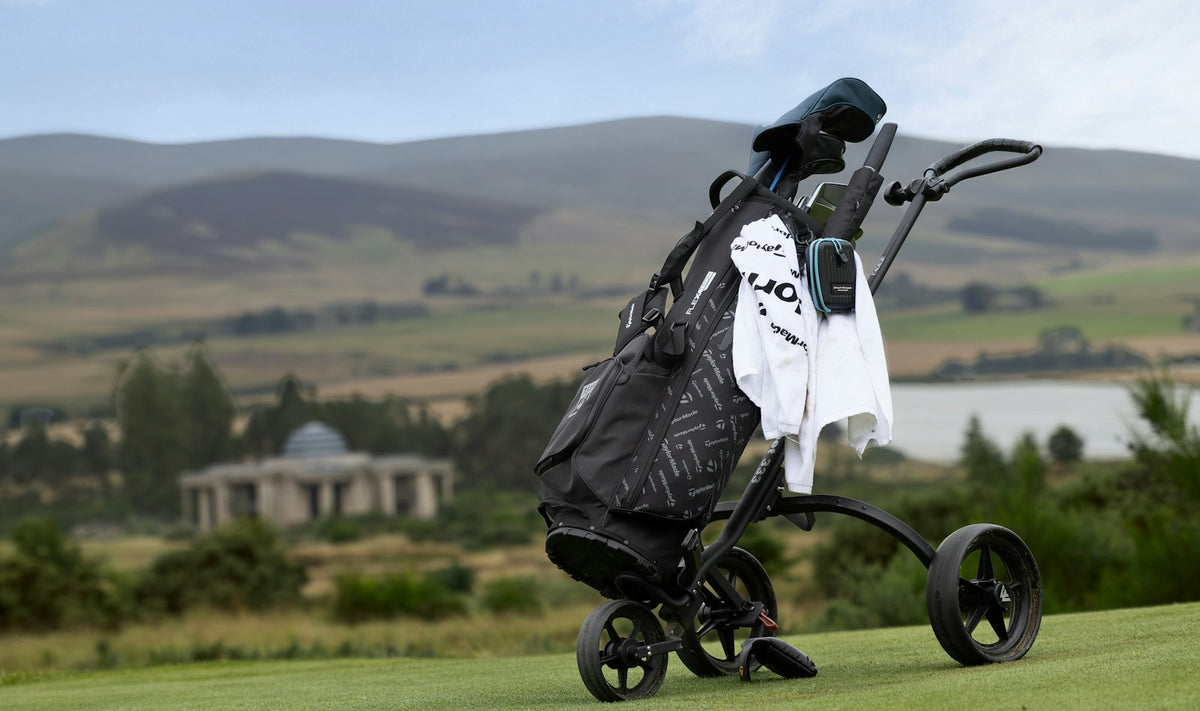
Cover photo: nicola dowie on Unsplash. Prices are US list prices checked in October 2026 and may change; sale prices may be lower.
Share:
Electric Assist Conversion Kit: The Complete Golfer's Guide
Which Golf Push Carts Can Be Motorized? A Brand-by-Brand Guide (2026)