
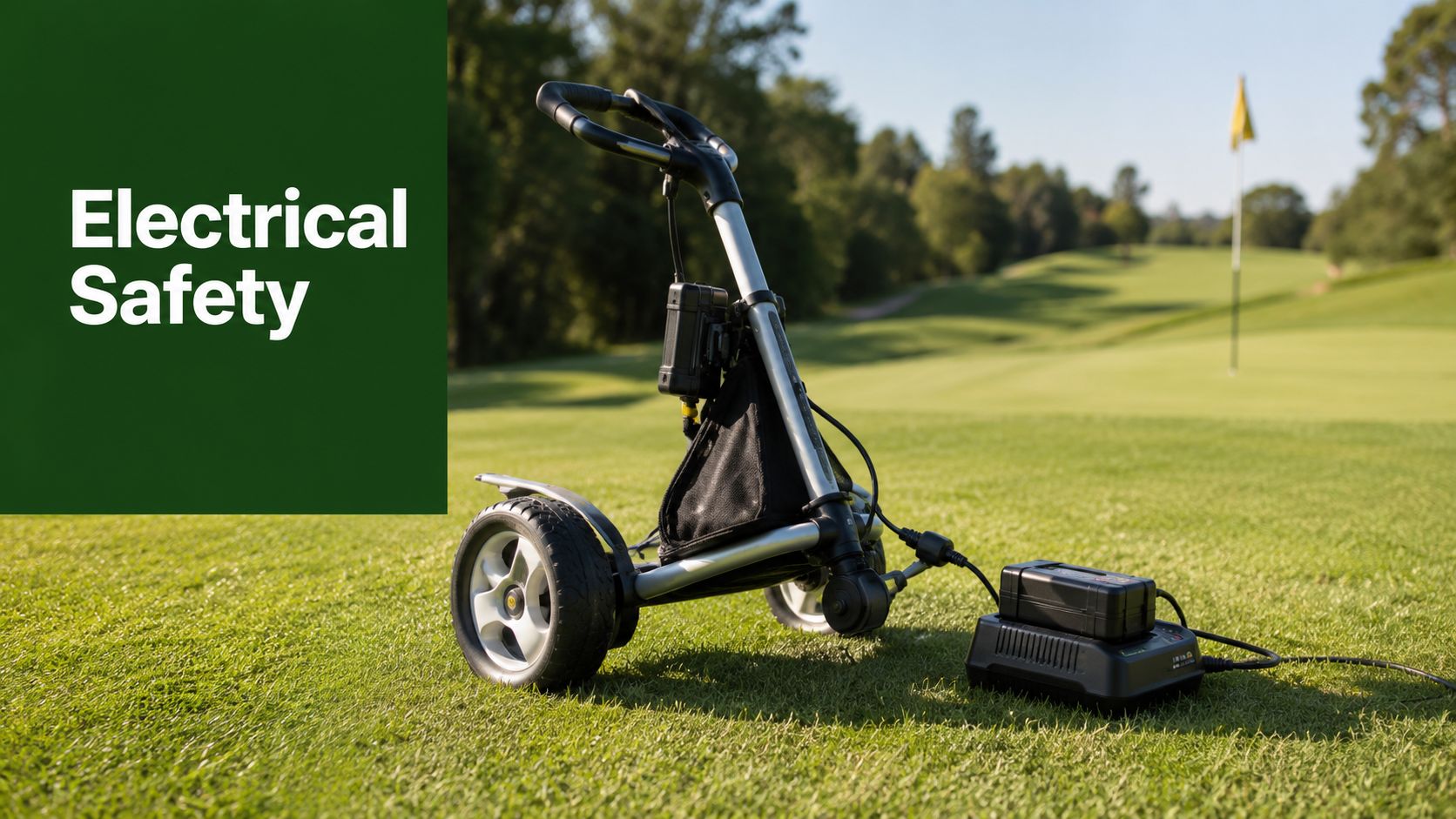
You're probably doing what a lot of walkers do. You charge your electric assist, clip it onto the push cart, toss the charger back in the trunk, and head to the course thinking about tee shots, not wiring.
That's normal. Portable golf caddie systems are built to make the round easier, not to turn every user into an electrician.
Still, outdoor battery-powered gear deserves a little respect. Golf courses add dew, puddles, cart path vibration, trunk transport, and rushed setup in parking lots. Those conditions are exactly where good electrical safety guidelines matter most. Not because these devices are unsafe on their own, but because a few small habits can prevent damaged batteries, overheated cords, failed connectors, and a ruined round.
The good news is that safe use isn't complicated. If you can check your tire pressure, clean your grooves, and keep your grips dry, you can handle the electrical side of a portable caddie too.
Why Electrical Safety Matters on the Golf Course
You step out of the car before sunrise, unzip the bag, and set your electric caddie on damp pavement. The battery was charged the night before. The wheels look fine. Everything feels ready. Yet this is one of the most common moments for trouble to begin, because portable golf equipment meets moisture, bumps, folding joints, and hurried setup all at once.
That mix is what makes electrical safety on the golf course different from electrical safety in a garage or spare room. An outdoor battery-powered caddie gets carried, folded, loaded into a trunk, rolled across wet turf, and parked beside puddles and sprinklers. Generic safety advice often misses those details, but they matter because small faults in a portable device can grow after repeated exposure to water, dirt, vibration, and impact.
Small problems start quietly
A caddie rarely fails in a dramatic way first. It usually starts with something ordinary. A charging cable gets caught under other gear in the trunk. Grit works into a connector after a muddy walk from the 9th green. A battery case takes a hard knock when the frame shifts during transport. A damp port gets closed up before it fully dries.
That pattern is a lot like a hairline crack in a graphite shaft. You may not notice it on the practice swing, but stress keeps finding the weak spot until performance drops or the part gives way. Electrical parts behave the same way. Wear at a connector, cable, or battery housing can lead to heat, poor contact, corrosion, or sudden loss of power when you are halfway up a slope.
Portable mobility aids also sit in an awkward middle ground. They are less powerful than industrial equipment, but they face harsher day-to-day conditions than many indoor electronics. That is why casual habits can cause outsized problems.
The broader risk is real. The U.S. Bureau of Labor Statistics reports that fatal work injuries involving exposure to electricity continued to occur in 2023 across many settings, showing that electricity remains hazardous when equipment is damaged, wet, or used carelessly, as summarized by the U.S. Bureau of Labor Statistics Census of Fatal Occupational Injuries news release.
Golfers are not working around power lines or heavy industrial panels. Still, the lesson carries over cleanly. Electricity is safest when the equipment is intact, dry where it should be dry, and used the way the manufacturer intended.
Small checks protect both you and the equipment
A good comparison is your pre-round look at grips, spikes, or tire pressure. You are not performing a repair. You are catching obvious trouble before it costs you a hole, a round, or a piece of equipment.
For a portable electric caddie, three areas deserve that same habit:
- Battery housing: Check for cracks, swelling, dents, or signs that the case took an impact during transport.
- Cable routing: Check that no wire is pinched, stretched, or rubbing against a wheel, frame edge, or folding point.
- Connectors and ports: Check for dirt, corrosion, moisture, bent pins, or a loose fit.
A simple rule helps here. If a part carries power or connects to the battery, treat visible damage the way you would treat a cracked clubhead. Stop using it until it is inspected or replaced.
That one-minute check protects more than the electronics. It also protects the rhythm of the round. A caddie that cuts out on a hill, overheats after a poor connection, or refuses to start on the first tee is often showing signs that were visible earlier.
Understanding Core Electrical Safety Principles
A battery-powered golf caddie works a lot like a push cart with one big difference. Stored energy is doing the work for you, and that energy has to travel through wires, connectors, switches, and control boards in a controlled way. When that path stays clean, dry, and undamaged, the caddie behaves predictably. When that path is interrupted, pinched, wet, or overheated, small faults can turn into shutdowns, melted parts, or shock risk.

Voltage, current, and resistance in plain English
Voltage is the push. Current is the flow. Resistance is anything that makes that flow harder.
On the course, a simple hose comparison helps. Voltage works like water pressure at the tap. Current works like the amount of water moving through the hose. Resistance works like a kink, a clog, or a narrowed section that makes the water struggle to pass through. In an electric caddie, dirt in a connector, corrosion after moisture exposure, or a partially damaged wire can all raise resistance.
That matters because extra resistance often creates heat in exactly the wrong place. A loose battery connection may still power the unit, just as a damaged club grip may still let you swing, but both are warning signs, not proof that everything is fine.
A short circuit is different. It means electricity finds an unintended path. Instead of passing through the parts designed to manage it, the current bypasses part of the system. That can cause a sudden cutoff, visible sparking, damaged electronics, or rapid heating.
Why portable outdoor equipment behaves differently
Portable golf caddies live a harder life than many battery devices used indoors. They are folded into trunks, bounced over curbs, rolled through wet grass, and parked beside damp bags and muddy wheels. Generic home-electronics advice misses that combination of moisture, vibration, impact, and repeated transport.
That is why a caddie can seem perfectly normal on a garage floor and then show trouble halfway up a slope or after a wet morning round. Variable terrain shifts load on the motor. Repeated folding stresses cable routes and connectors. Water does not have to flood a component to cause trouble. A thin film of moisture, trapped grit, or corrosion inside a port is enough to change how electricity moves.
Protection devices and correct charging gear also matter. If you want a broader look at how battery systems are handled in golf equipment, this guide to charging golf carts and battery-powered golf vehicles gives useful background on matching chargers and battery setups. The same basic lesson applies to portable caddies. Use the correct charger, keep connections clean, and do not treat electrical parts as interchangeable just because the plug seems to fit.
For battery buyers comparing replacement packs across light electric mobility products, Batteries for Canadian e-riders is one example of why voltage, capacity, connector style, and intended device all need to match the system they are powering.
A note on fault protection and shock risk
Portable outdoor equipment deserves more caution around wet conditions because the body, the ground, and damp surfaces can all make fault current more dangerous. Georgia Tech's electrical safety guidelines PDF explains that ground fault protection is used to interrupt dangerous leakage current quickly, which is exactly the kind of protection that matters around garages, sheds, outdoor outlets, and charging areas.
The practical takeaway is simple. Keep your charging setup dry, use protected outlets where required, and do not ignore tingling, intermittent cutouts, or tripped protection devices. Those are fault warnings, not quirks.
Electricity does not need a dramatic failure to become dangerous. Moisture, dirt, corrosion, and damaged insulation are enough.
A note on battery heat
Golfers often hear terms like thermal runaway and assume every warm battery is about to fail. That is not the right way to read normal operation. Some warmth during use or charging can be expected. Abnormal heat is the concern.
A battery or charger that becomes much hotter than usual, smells strange, swells, leaks, or changes shape should be taken out of service right away. Batteries store a large amount of energy in a compact case, so heat is often the earliest clear sign that something inside the system is no longer under control.
The home side of this matters too. Electrical problems in homes and garages cause fires and serious injuries every year, as noted earlier. For caddie owners, the lesson is straightforward. Safety on the fairway starts with safety in the places where the battery is charged, stored, transported, and inspected.
Safe Charging and Storage Practices
Charging is where most avoidable mistakes happen. Not out on the fairway. At home, in the garage, near a bench, or off an overloaded extension cord because it seemed convenient.

Set up a charging spot that stays boring
That's the goal. A boring charging setup is a safe one.
Choose a dry, ventilated area on a non-flammable surface. Keep the charger and battery away from clutter, paper, solvents, or anything that traps heat. Don't charge in a puddle-prone garage corner, and don't leave the unit where a car tire, lawn tool, or closing door can crush the cord.
Extension cords deserve special caution. If you need one, treat it as temporary. The Canadian Centre for Occupational Health and Safety says extension cords should never be used as permanent wiring and must be kept away from heat, water, oil, and vehicles.
Avoid the charger mistakes golfers make most often
Some errors look harmless because the device still powers up.
- Using a substitute charger: Match the charger to the battery and device. “Close enough” isn't good enough with battery systems.
- Ignoring certification marks: Use chargers and cords certified by recognized testing labs, not bargain replacements with vague labeling.
- Charging damaged equipment: If the plug is loose, the cable jacket is split, or the battery case is compromised, stop there.
- Leaving everything coiled tight: Tightly wound cords can trap heat and hide damage.
If you're comparing replacement battery options for another personal electric mobility setup, use reputable sources with clear product specifications, such as Batteries for Canadian e-riders. The important habit isn't brand loyalty. It's verifying compatibility, build quality, and intended use before plugging anything in.
Respect cord capacity
This is one of the clearest electrical safety guidelines because the math is straightforward. When connecting a charger to an extension cord or power strip, the total power requirement must not exceed 80 percent of the rated capacity of that cord. For a standard 15-amp cord, the load should not exceed 12 amps to prevent overheating and fire hazards, according to the Texas office electrical safety guidance.
A simple way to think about that on golf gear days is this. If the charger is sharing a strip with heaters, fans, refrigerators, or workshop tools, you're asking for trouble. A charger should have breathing room, electrically and physically.
For golfers who want a separate walkthrough on charging-related habits around course equipment, this guide on charging golf carts safely is a useful companion read.
A visual reminder helps here:
Store for the off-season like you store a good putter
Don't toss the battery into a freezing shed and forget it until spring.
Use a clean, dry location where the battery won't be knocked around by other gear. Before storage, inspect the case and terminals, wipe off dirt and moisture, and keep the charger cable loosely arranged instead of kinked or crushed under heavier items.
Store the battery where you'd be comfortable storing quality electronics, not where you'd leave muddy shoes and fertilizer.
Long periods of neglect are hard on portable power systems. A little organization in November usually means fewer surprises in April.
Your Pre-Round Safety Inspection Checklist
The best inspection is the one you'll do. For most golfers, that means a routine that takes less than a minute in the parking lot.

The 60-second walk-around
Start with your eyes, not the power button.
-
Look at the battery shell
Check for cracks, swelling, dents, or any area that looks distorted after transport. -
Follow every visible cable
Look for fraying, cuts, flattening, or spots where the insulation has rubbed thin. -
Inspect the connectors
Dirt, grass, corrosion, and bent contact points can all interfere with safe power transfer. -
Confirm proper seating
Make sure plugs are fully inserted, battery mounts are secure, and nothing feels sloppy. -
Test controls before moving off
If your system uses a remote or control interface, confirm it responds normally before heading toward the first fairway.
Why wire condition matters more than people think
A damaged wire doesn't just risk a shutdown. It can become a heat source.
If a wire's cross-sectional area is too small for the current it carries, resistive heating follows the relationship P = I²R, which can make temperature rise rapidly enough to melt insulation or ignite nearby material. That's a specific concern for motorized wheels drawing sustained current, as explained in the electrical installation specification covering conductor sizing.
Here's the practical side of that technical point. If insulation is nicked, crushed, or worn, don't assume “it still works” means “it's still safe.” Golfers often confuse function with safety. A cable can power the unit and still be one round away from failure.
What to check by touch and by feel
Not every issue is obvious visually. Some show up in the way parts fit.
| Check area | What you want | What should stop play |
|---|---|---|
| Battery fit | Firm, stable seating | Rocking, looseness, poor latch |
| Plug connection | Snug insertion | Wobble, partial connection, exposed metal |
| Cable routing | Clear of wheels and hinges | Pinch points, rubbing, sharp bends |
| Housing condition | Smooth, intact case | Cracks, bulges, impact damage |
If a connector feels wrong in your hand, trust that instinct. Clean fit and stable seating matter with outdoor electronics.
A habit worth repeating every round
Make the inspection part of your first-club routine. Many golfers automatically check tee, glove, rangefinder, and ball marker before they head to the starter. Add the electrical check to that same sequence.
That way safety becomes ordinary. Ordinary is what you want.
Navigating Weather and Water Exposure
Outdoor electric gear doesn't need a thunderstorm to get into trouble. Morning dew, wet rough, a dripping bag, and a charger set down near a wash area can be enough.
Portable electric assist devices fall into a gap that many generic safety articles miss. Existing electrical safety content heavily focuses on workplaces, yet it doesn't do enough for homeowner-style outdoor use with portable electric assist devices, even though over 60% of electrical injuries occur in residential settings and rise during outdoor activity seasons, as noted in the electrical safety booklet discussing residential and outdoor risks.

What IP ratings actually tell you
An IP rating describes how well a device resists intrusion such as dust or water. Golfers often see a number or label and assume it means “waterproof.” That's where confusion starts.
Use this simple rule of thumb:
- IPX0 means no water protection
- IPX4 generally means splash resistance
- IPX7 indicates a much higher level of water protection, including temporary submersion under defined conditions
The key is that water-resistant doesn't mean rainproof in every situation, and rainproof doesn't mean charger-safe, connector-safe, or mud-proof. The device might survive splashes while a port, cable end, or accessory remains vulnerable.
Course decisions that reduce risk
Wet conditions call for judgment, not guesswork.
- On damp morning grass: Use the device normally only if the manufacturer allows that environment and all connections are clean and sealed.
- In light rain: Reduce exposure time. Avoid setting the battery or charger on the ground.
- In a sudden downpour: Power down, cover what you can, and stop using the device if water is reaching open connections or non-sealed areas.
If you want a deeper look at sealing vulnerable spots, this article on waterproofing electrical connections is a practical next read.
Water and protection devices
Water changes the risk because it can create an unintended path for current. That's why wet-area protection matters so much. The Electrical Safety Foundation International states that GFCIs must be installed anywhere electricity and water are within six feet of each other, including places like kitchens, bathrooms, laundry areas, and near outdoor hoses, in its indoor electrical safety booklet.
For golfers, the lesson is easy to apply at home. If you charge or rinse equipment near a sink, hose, garage wash zone, or any damp utility area, use a location with proper wet-area protection and keep the charger itself dry.
Splash resistance helps. It doesn't cancel out common sense.
After any wet round, dry the device before storage, inspect connectors for moisture and debris, and don't plug in the charger until everything is clean and fully dry.
Emergency Response and Product Compliance
If something goes wrong, the right response is calm and simple. Don't troubleshoot a hot, smoking, or sparking device while standing there with a golf towel in one hand and a battery in the other.
What to do if you notice heat, smoke, or sparks
Follow a clear sequence.
- Stop using the device immediately: Don't try to finish the hole first.
- Power it down if you can do so safely: If controls respond normally and there's no immediate hazard, shut the system off.
- Move away from flammable material: Keep it clear of dry grass, towels, paper scorecards, or trunk clutter.
- Do not handle a visibly damaged battery more than necessary: Heat, swelling, smoke, or odor means the unit needs professional evaluation.
- Do not plug it back in to “test it”: A second attempt can make a bad situation worse.
If the problem happens at home after a round, isolate the area and follow the product maker's service guidance. If the battery has been overheating, many golfers also choose to store it in a more protective setup. A guide to a fireproof lithium battery container can help you think through safer storage options.
Buy equipment that has passed real testing
This step matters before the first charge ever happens.
All electrical equipment, including battery chargers and extension cords, must be certified by a nationally recognized testing lab such as UL or CSA to show it meets safety standards for protection against shock and short circuits, according to Constellation's electrical safety guidance on certified equipment.
Look for certification marks on:
- Chargers
- Battery packs
- Extension cords
- Surge suppressors
- Replacement accessories that carry power
If the labeling is missing, vague, or suspicious, skip it. The cheapest replacement charger on a marketplace site can become the most expensive piece of gear in your garage.
The mindset that keeps you safe
Good electrical safety guidelines aren't about fear. They're about discipline. Keep components dry, use the right charger, inspect before each round, and avoid improvised fixes.
That's the same mindset good golfers bring to equipment in general. Clean gear performs better. Well-kept gear is safer too.
If you want an easier walking round without the bulk and complexity that often make electric gear harder to live with, take a look at Caddie Wheel. Its lightweight power-assist approach is designed for golfers who want simple setup, less strain on hills, and a smoother push-cart experience.
Share:
Golf Hand Warmer Pouch: A Guide for Walking Golfers
Short Circuit Prevention for Your Caddie Wheel