
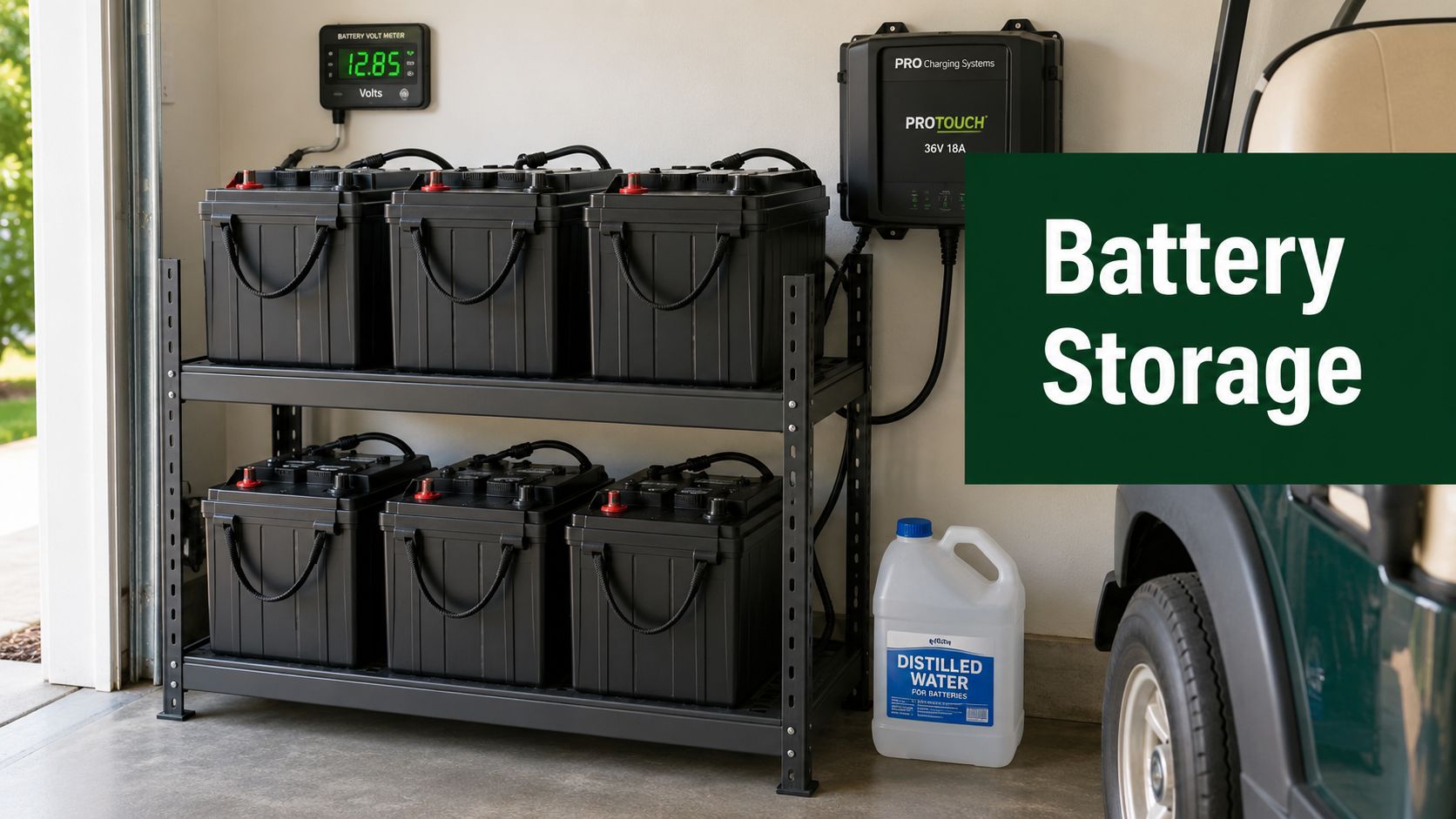
The last round of the season has a way of sneaking up on you. One week you're loading the cart for a quick nine, and the next you're tucking clubs into the garage and telling yourself you'll deal with the battery later.
That “later” is where a lot of expensive mistakes start.
A golf cart battery can come through the off-season just fine, or it can spend months slowly discharging, corroding, freezing, or drifting into a condition that shortens its life before spring even arrives. Most of the trouble isn't dramatic. It's neglect. A cart gets parked, a charger gets unplugged, a cold snap rolls through, and by the time the weather turns, the battery has paid the price.
Protecting Your Investment Through the Off-Season
If you've ever opened the battery compartment in March and found a cart that won't wake up, you already know why golf cart battery storage matters. Batteries don't like being ignored. They like the right charge level, the right environment, and a little attention while the cart sits.

The stakes are getting higher because the battery side of the golf world is changing. One market projection says the golf cart battery market will grow from $1.49 billion in 2024 to $2.21 billion by 2030, with a shift toward lithium-ion because of its lighter weight, faster charging, and longer cycle life according to Strategic Market Research's golf cart battery market outlook. That means more owners now have to think beyond the old habit of parking the cart and hoping for the best.
What goes wrong when a cart sits
Lead-acid and lithium fail in different ways, but the root problem is the same. Storage changes battery condition even when the cart isn't moving.
A lead-acid pack that goes into winter undercharged can come out weak or damaged. A lithium pack left connected to accessories can drain lower than expected. In both cases, the cart looks fine from the outside while the battery deteriorates inside.
Practical rule: Off-season battery care is cheaper than springtime troubleshooting.
Treat storage like equipment protection
Most golfers are careful with clubs, rangefinders, and travel gear. The same mindset helps here. If you already keep a home inventory for valuable gear, these tips for organizing your household can make it easier to track chargers, maintenance items, spare parts, and purchase records before winter starts.
That small bit of organization helps more than people think. When the charger, distilled water, safety glasses, and service notes all have a place, you use them.
The simple payoff
Proper golf cart battery storage gives you three things:
- A cart that starts when the season does
- Less avoidable battery wear
- Fewer spring surprises
That applies whether you're running a traditional lead-acid setup or a newer lithium system. The prep is different, but the goal is the same. Protect the battery now so it isn't the first thing that disappoints you when the course calls again.
Pre-Storage Prep For Lead-Acid Versus Lithium Batteries
You park the cart in late fall, shut the garage door, and expect everything to be fine until spring. That is where expensive battery mistakes usually start. The prep for lead-acid and lithium is different enough that borrowed advice from a neighbor or a Facebook group can cost you a season.

Lead-acid batteries need a full-prep routine
For a traditional lead-acid pack, the playbook is straightforward. GolfCarts.com's off-season battery storage guidance recommends cleaning terminals, fully charging the pack, checking and replenishing water with distilled water, and disconnecting cables or putting the cart in tow/storage mode to stop small electrical draws.
Lead-acid batteries punish neglect in storage. Let one sit undercharged for months and sulfation can build fast enough to shorten battery life or leave the cart sluggish when you bring it back out.
A lead-acid shutdown routine that works
- Clean the terminals Corrosion holds moisture and adds resistance. Put the cart away clean, not with a problem already forming.
- Check electrolyte levels Add distilled water only if needed. Flooded batteries do not forgive guesswork, and tap water creates its own trouble.
- Charge the pack fully For lead-acid, full charge before storage is the safe move. This is one area where partial charge is asking for trouble.
- Disconnect the battery or use storage mode A tiny parasitic draw over several weeks can leave a pack far lower than expected.
- Inspect cables and hold-downs Loose connections and damaged insulation are easier to catch now than in the first week of spring use.
If your cart uses flooded batteries, this golf cart battery watering system guide is a useful refresher before winter, especially on carts that saw heavy summer use.
Lead-acid owners usually make one of three mistakes. They skip the water check, they skip the final full charge, or they do both and leave the cart connected.
Lithium prep is easier, but the storage charge question deserves a real answer
Lithium owners get conflicting advice for a reason. One manufacturer may say store the pack around 50% to 80%. Another may want the battery charged to 100% before storage. Both recommendations can be correct for the battery they were written for.
The difference usually comes back to how that specific pack and its Battery Management System handle balancing, self-discharge, and low-voltage protection. Some lithium systems balance cells most effectively near full charge. Others are better stored below full because holding lithium at maximum voltage for long periods can add stress, especially if the battery sits in a warm space.
That is why the answer is not "lithium should always be stored at 100%" or "lithium should always be stored at 60%." The right answer is the one your battery maker specifies.
If the battery manufacturer gives a storage state-of-charge range, use that range instead of generic internet advice.
A practical default looks like this:
| Battery type | Best storage approach |
|---|---|
| Lead-acid | Fully charge before storage |
| Lithium with manufacturer instructions | Follow the stated storage charge level and shutdown steps |
| Lithium without clear instructions | Contact the battery maker before storing for months, especially in freezing climates |
Cold-weather golfers need to be more careful here than many guides suggest. A lithium pack may survive low temperatures better than many owners think, but charging a lithium battery when the cells are too cold can cause real damage. If your cart spends winter in an unheated garage, do not assume spring charging is as simple as plugging it in on the first warm-looking morning. Let the battery warm into a safe temperature range first if the manufacturer requires it.
Lead-acid has its own winter weakness. A discharged lead-acid battery is more vulnerable to freezing than a fully charged one. That is another reason a full charge matters before long storage in northern climates.
What I tell cart owners to avoid
These are the habits that lead to springtime battery problems:
- Parking a lead-acid cart partly charged
- Leaving a lithium pack connected to accessories, lights, trackers, or other small loads
- Mixing storage advice from different brands
- Assuming cold storage and cold charging are the same thing for lithium
- Skipping a visual safety check before closing the battery compartment
If you store the cart where chargers, heaters, or other electrical equipment are nearby, keep a fire plan that matches the battery type. Standard extinguishers are not always enough for battery incidents. Products designed to effectively extinguish battery fires are worth knowing about before you need one.
Here is a helpful visual reference before you put anything away.
Creating a Safe and Optimal Storage Environment
Good battery prep can still be undone by a bad storage spot. A damp shed, an unheated outbuilding with sharp temperature swings, or a cluttered garage corner near fuel cans can undo careful work in a hurry.
The battery doesn't need luxury. It needs stable conditions.

Temperature and dryness matter most
For storage, I always prefer an indoor space that stays cool, dry, and reasonably stable. Moisture invites corrosion. Temperature swings add stress. A battery stored in a controlled garage or utility space is usually in a much better position than one left in a drafty outbuilding.
For lithium packs, one storage workflow advises a temperature-controlled space between 32°F and 77°F. That gives owners a useful target range for indoor storage without guessing.
Ventilation and fire awareness
Lead-acid batteries deserve special respect when charging because they can vent gas. That means the area should be ventilated and free of careless hazards. Don't crowd the battery next to open flames, spark sources, or a pile of solvents and oily rags.
Lithium storage calls for a different kind of caution. Keep the area uncluttered, protect the pack from impact, and avoid burying chargers and batteries under seasonal gear. If you want a more secure setup, a purpose-built fireproof lithium battery container can help keep your storage area more organized and better protected.
Store the battery where you'll actually inspect it. Out of sight often becomes out of mind.
If you're thinking about emergency planning for the garage or workshop, it's worth learning what tools are meant to effectively extinguish battery fires and where those tools should be kept.
A practical storage setup
You don't need a custom workshop. A simple arrangement is enough:
- Use sturdy shelving so chargers and maintenance items aren't on the floor
- Keep the battery area clear of golf bags, paint cans, and loose metal items
- Label the charger that belongs to that battery system
- Store safety gear nearby so you're not hunting for glasses or gloves later
That last point matters more than it sounds. When the right gear is already within reach, routine checks indeed get done.
In-Storage Maintenance and Charging Schedule
Storage isn't one task. It's a rhythm. The owners who get through winter cleanly usually follow a simple calendar instead of relying on memory.
That's especially true if the cart sits through real winter, not just a few idle weekends.

Lithium needs fewer check-ins
One lithium storage workflow from Bolt Energy USA's guide to storing a golf cart lithium battery recommends charging to 100%, disconnecting the battery from the cart, storing it in a cool, dry, temperature-controlled space (32°F to 77°F / 0°C to 25°C), and checking state of charge every 2 to 3 months, topping up if it falls below 50%.
That schedule is one reason lithium appeals to seasonal owners. The battery usually asks for less hands-on attention while the cart is parked.
A simple lithium calendar
-
At storage time
Charge according to the battery maker's guidance, disconnect the battery, and park it in a controlled indoor space. -
During storage
Put a reminder on your phone to check it every 2 to 3 months. -
If charge drops too far
Top it up before it slips into deep discharge territory.
That doesn't mean lithium is maintenance-free. It means the maintenance is cleaner and less frequent.
Lead-acid asks for more discipline
Lead-acid owners need a tighter routine. A battery supplier also advises checking lead-acid batteries about every 30 days during storage, and another winter-storage FAQ suggests checking stored golf cart batteries every four to six weeks. The exact cadence can vary, but the main point is the same. Don't park a lead-acid cart in November and ignore it until spring.
What to keep on the schedule
| Battery chemistry | Mid-storage check focus | Common miss |
|---|---|---|
| Lead-acid | Charge condition, water level, cable condition | Letting the pack sit discharged too long |
| Lithium | State of charge, connection status, storage temperature | Forgetting accessory drain or skipping periodic checks |
If you're using a maintainer or evaluating whether one makes sense for your cart, this guide to a trickle charger for golf cart batteries helps frame when continuous support is useful and when simple periodic checks may be enough.
Cold-weather owners should be stricter, not looser
In northern climates, winter storage problems usually come from delay. Owners wait too long to do the first check because the cart isn't being used. Then they wait again because it's cold, the garage is cramped, or the holidays get busy.
Don't rely on memory. Put the battery on the calendar the same way you'd schedule furnace service or snowblower prep. If you like templates for recurring upkeep, you can create your electrical maintenance plan around the same idea and adapt it to your cart.
The best storage schedule is the one you'll actually follow in January, not the perfect one you forget in December.
Essential Tools and Pre-Launch Checklist
When spring arrives, don't rush straight to the first tee. Bring the battery back methodically. Most startup mistakes happen because owners are excited the weather broke and skip the basics.
Keep these tools on hand
A small kit covers almost everything needed for golf cart battery storage and recommissioning:
- Safety glasses for any cleaning, reconnecting, or water checks
- Gloves to keep hands protected during battery handling
- Terminal cleaning brush or a battery terminal cleaner
- Voltmeter or multimeter for a quick status check
- Distilled water if you're running flooded lead-acid batteries
- Correct charger matched to the battery chemistry
- Clean rags for wiping terminals and tray areas
One practical option for walkers using an electric assist setup is Caddie Wheel, which uses a battery built into the wheel rather than a separate pack strapped onto the cart frame. The same storage mindset still applies. Keep the charging gear together, protect the battery during long idle periods, and verify condition before the first round back.
A good spring wake-up routine
Before you reconnect anything, inspect the battery compartment. Look for corrosion, moisture, dirt, or anything that doesn't belong there.
Then run through this short list:
-
Check the battery visually
If something looks swollen, cracked, leaking, or badly corroded, stop there and address that first. -
Reconnect carefully
Tight, clean connections matter. Loose hardware causes a lot of avoidable trouble. -
For lead-acid, verify water level
Make this part of the restart routine, not an afterthought. -
Charge before use
Give the battery a proper charge before the first outing instead of assuming the stored charge is enough. -
Test the cart close to home
A short local run beats discovering a problem halfway through a round.
What not to do on opening day
- Don't reconnect dirty terminals and hope driving will “work it out”
- Don't mix chargers between battery types
- Don't ignore weak startup behavior
- Don't head straight for a long round without a quick test drive
A calm fifteen-minute check is worth more than a rushed spring launch.
Troubleshooting Common Storage Problems
The first warm weekend of spring is when storage mistakes usually show up. You reconnect the cart, turn the key, and get a weak click, a fault light, or nothing at all. In most cases, the battery is not automatically ruined, but the next step matters.
My battery is dead after winter. Is it ruined
A dead battery after storage can mean anything from normal self-discharge to real damage.
Start with three questions. Was the battery stored at the charge level the manufacturer calls for. Was it left connected to the cart. Was anything still drawing power over the winter.
Lead-acid batteries suffer when they sit discharged. Sulfation starts building, and recovery gets harder the longer they stay that way. Lithium packs have a different problem. If voltage falls too low, the Battery Management System may shut the pack down to protect it, and some packs will not wake back up without a specific recovery process.
Use the correct charger first. If the battery does not respond normally, stop there and get model-specific guidance before forcing more charge into it.
Can I just leave the battery in the cart all winter
You can, provided the cart and battery setup supports it.
The trouble is that many owners assume "off" means fully off. It often does not. Clocks, accessories, controllers, and other onboard electronics can keep pulling small amounts of power for months. That slow drain is a common reason a battery that looked fine in November is flat by March.
If the battery stays installed, confirm whether the cart has a real storage mode or a known parasitic draw. If you cannot verify that, disconnecting the battery is usually the safer bet.
Why do lithium storage recommendations conflict so much
Because different lithium systems are built and managed differently.
The 50 to 80 percent advice is aimed at long-term battery health. Storing a lithium pack at a moderate state of charge reduces stress during a long idle period, especially in warm conditions. The 100 percent advice usually comes from a specific manufacturer, charger logic, or BMS design that expects the pack to be topped off before storage, then isolated or monitored in a certain way.
So the advice sounds contradictory, but it usually reflects different hardware and different assumptions.
Cold weather adds another layer. In a northern garage, a full lithium pack may be better protected against dropping too low during storage, but charging a frozen lithium battery can cause expensive damage. That is why golfers in cold climates need to separate two questions that often get lumped together. What charge level should the pack sit at, and what battery temperature is safe for charging. Those are not the same thing.
If the battery label, manual, and charger instructions do not match, trust the battery manufacturer first. They know how that pack and BMS are meant to be stored.
My charger behaves differently in storage mode. Should I worry
Usually no.
Some chargers cycle on briefly, some stay quiet until voltage drops, and some show a light pattern that looks wrong until you read the manual. That does not automatically mean a problem. It means the charger is following its own maintenance logic.
A primary concern is mismatch. A charger meant for lead-acid should not be used on lithium, and one lithium charger may not be right for another pack if the voltage, communication setup, or charging profile is different. Strange charger behavior is worth checking. Randomly swapping chargers is how people turn a small issue into a replacement bill.
If I made a mistake this winter, what matters most now
Work methodically.
Inspect the case, cables, and terminals. Verify the battery chemistry and charger. Clean corrosion or dirt before reconnecting anything. If the pack looks swollen, cracked, or wet, do not try to bring it back with one more charge cycle.
Most spring battery losses happen after storage, not during it. They happen when an owner guesses, bypasses the right charger, or ignores a warning sign because the first tee time is booked.
If you want a simpler way to walk the course with less strain while keeping your setup compact, Caddie Wheel offers an electric power-assist option for standard push carts with a built-in battery and straightforward charging routine.
Share:
Mastering Golf Cart Wheel Offset for Perfect Fit
Caddie Wheel Quad Remote Control: Master Your Game