
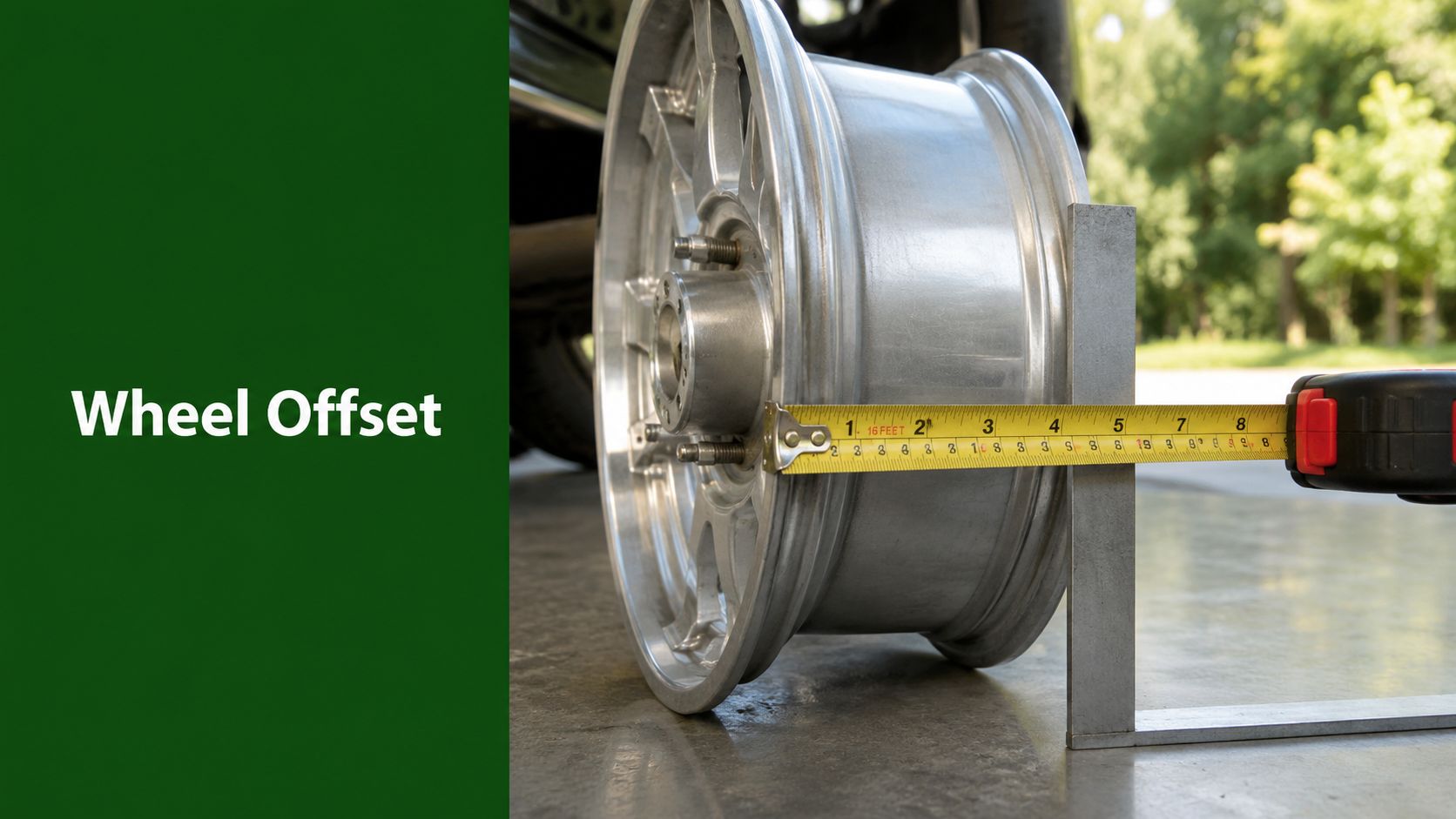
You're probably staring at a wheel listing that looks perfect, right up until you hit the fitment details. The finish is right. The size looks right. Then you see 3+4, 2+5, or negative offset, and suddenly it feels like you need a machine shop degree just to buy wheels.
That confusion is normal. I've seen plenty of golfers pick a wheel based on looks, only to find out the tire sits too far in, sticks too far out, or rubs when they turn. Offset is the spec that decides where the wheel and tire sit on the cart, and that changes more than appearance. It affects clearance, stance, steering feel, and whether your upgrade plays nicely with lifts, brakes, and suspension parts.
Why Your Golf Cart Wheel Offset Matters
A common situation goes like this. A golfer wants to replace factory wheels with a custom set, maybe to freshen up the cart or make room for a more aggressive tire. The new wheels bolt on, but the cart doesn't drive the way they expected. At full turn, the tires touch inside the wheel well. Or the cart suddenly has a wider stance than planned. Or the steering feels different.
That usually comes back to golf cart wheel offset.
What offset changes in the real world
Offset tells you where the wheel mounts in relation to its width. In plain language, it decides whether the tire sits more inboard, more centered, or more outboard from the hub. That one detail influences several practical outcomes:
- Tire clearance: A different offset can move the tire away from suspension parts or closer to them.
- Cart stance: The wheels may sit tucked under the body or push outward for a wider look.
- Handling feel: The cart can feel more settled or more awkward depending on how far the tire is moved from the hub.
- Upgrade compatibility: Lifted carts and carts with brake changes often need more careful offset choices than stock carts.
Practical rule: If you don't know the offset, you don't yet know if the wheel really fits.
A lot of people think offset is just a style detail. It isn't. It's one of the first fitment checks I'd make before buying any wheel and tire combo.
Why golfers get tripped up
The tricky part is that offset often shows up in a format that looks unfamiliar. Instead of a simple label, you'll see wheel descriptions written in a code-like way. That can make buyers assume they're looking at some niche racing spec when it's a basic measurement system.
Once you understand what those numbers mean, wheel shopping gets much easier. You stop guessing and start comparing your current setup to the one you want.
Understanding the Three Types of Wheel Offset
A cart can look perfect in a product photo and still rub a brake caliper on the first turn. That usually comes down to offset.

The easiest way to sort offset is by where the wheel's mounting pad sits across the wheel's width. If that pad sits in the middle, the wheel is centered. If it sits closer to the outside face, the tire tucks inward. If it sits closer to the inside face, the tire sticks farther outward.
That sounds abstract at first, so tie it to what you see on the cart. Offset changes where the tire ends up relative to the hub, suspension, brakes, and fender edge. On a modern lifted cart, that can be the difference between smooth clearance and a tire that clips plastic or a wheel that will not clear an upgraded brake setup.
Zero offset or centered offset
A zero offset, also called a centered offset, puts the mounting surface right at the wheel's centerline. The inner half and outer half are balanced evenly from the hub.
This is the neutral starting point. Factory-style setups often use it because the cart's original steering and body clearance were designed around that middle position. If you are comparing wheel specs and also want to separate wheel width from overall size, this guide to measuring wheel diameter accurately helps clear up a common mix-up.
Centered wheels usually give predictable fitment on stock carts. On heavily modified carts, though, neutral does not always mean problem-free. Bigger tires, lift kits, and brake conversions can all change how much room you really have on the inside and outside.
Negative offset
A negative offset wheel places the mounting surface closer to the inside of the wheel. That pushes more of the wheel and tire outward.
This is the setup you see on many custom golf carts because it creates more inside clearance. If a lifted cart has a larger tire or aftermarket brakes with a bulkier caliper, moving the wheel outward can create the breathing room those parts need. It also widens the stance, which can help the cart feel more settled, especially with taller tire-and-lift combinations.
The common shorthand can look odd until you know what it means. A wheel listed as 3+4 means one side measures 3 inches from the mounting pad and the other side measures 4 inches. On many golf cart wheels, that larger outer number means the wheel sits farther outboard, which is why 3+4 is commonly treated as a negative-offset style. A 2+5 wheel pushes outward even more.
A simple workshop way to picture it is this. Negative offset works like wearing boots with a wider footprint. You gain room near the inside hardware, but you also move load farther away from the hub. That outward move can help clearance, yet too much of it can create fitment headaches at the fender line.
Positive offset
A positive offset wheel places the mounting surface closer to the outer face of the wheel. That pulls the tire farther inward under the cart.
Positive offset is less common on golf carts because the inside area gets crowded fast. Steering arms, leaf springs, shock mounts, and brake parts all compete for that space. On a lifted cart with upgraded brakes, a positive-offset wheel can be the one that looks fine on paper but contacts the caliper or inner sidewall area once everything is bolted up.
There are cases where a tucked-in wheel is useful. Some builders want to keep the tire under the body for a cleaner look or to avoid pushing the tread outside the fender. The tradeoff is reduced inner clearance, so this style needs extra care before you buy.
The same stability idea shows up on advanced push cart setups too. A wheel position that sits too far inboard can make the platform feel narrower and less planted, while a wider effective stance often feels steadier. The hardware is different, but the principle is the same whether you are setting up a lifted golf cart or refining a push cart that uses a Caddie Wheel.
A quick way to remember it
- Negative offset: pushes the wheel outward
- Zero offset: keeps the wheel centered
- Positive offset: pulls the wheel inward
If you remember where the tire moves, the terminology gets much easier.
How to Measure Your Current Wheel Offset
Before you shop, measure what's already on your cart. That gives you a baseline. Then you can compare a new wheel instead of guessing from product photos.

What you need
You don't need a shop full of tools. A few basics will do:
- A straightedge: A level, ruler, or any flat bar long enough to span the wheel
- A tape measure: A regular household tape is fine
- A flat surface: Measuring on the floor or a sturdy bench helps
- A removed wheel: It's much easier to get an accurate reading with the wheel off the cart
If you're also checking overall sizing, this wheel diameter measuring guide helps you separate wheel size from tire size, which people mix up all the time.
Step by step at home
Start with the wheel laid face down, so the mounting pad is facing up.
-
Measure the wheel width
Measure the full wheel width from inner edge to outer edge. If the wheel is described in the common golf cart format, that width is often discussed as a 7-inch-wide wheel in offset examples. -
Measure the backspacing
Lay the straightedge across the back lip of the wheel. Then measure from the mounting pad up to the straightedge. That gives you backspacing. -
Compare inner and outer distances
Once you know the full width and where the mounting pad sits, you can describe the wheel in the same style used by wheel sellers. If the distances are equal, it's centered. If the inner side is shorter and the outer side is longer, you're looking at negative offset. If the reverse is true, it's positive.
Don't measure in a hurry. Even a small mistake in where you place the straightedge can send you shopping for the wrong wheel.
A visual walkthrough can help if you're more hands-on than diagram-oriented:
What the numbers are telling you
When you see a wheel listed as 3+4, read it as a map of where the hub face sits within the wheel. It's not random. It's a quick fitment shorthand.
Here's the simple read:
| Wheel notation | What it suggests |
|---|---|
| Equal split | Centered wheel |
| 3+4 | Common negative offset example |
| 2+5 | More pronounced negative offset look |
That's why measuring your current wheel matters. You can compare your stock setup to a custom one and decide whether you want the tire to stay close to stock, move slightly outward, or move farther outward for extra inner clearance.
The Impact of Offset on Performance and Stability
Wheel offset isn't just about fit. It changes how the cart behaves once you're driving it.
Industry guidance notes that standard golf cart suspensions are commonly described as handling tires up to about 18 inches, which is one reason wheel diameter is usually kept below 12 inches on stock carts to preserve clearance. Those same guides also describe stock golf cart wheels as typically 8x7, with 18x8.50-8 as the most common stock tire size. They also note that moving to wider, more negative-offset wheels increases outward scrub radius, reduces inner clearance, and changes the side loads transmitted to bearings, as explained in this wheel dimensions and fitment guide.
Why negative offset can feel better on rough ground
When a wheel sits farther outward, the cart often gains a wider stance. On uneven paths, side slopes, or rougher terrain, that can make the cart feel more planted. Many owners like that extra stability, especially on lifted carts that already sit higher.
But that wider stance doesn't come free.
Moving the contact patch outward alters the mechanical effect on the steering and hub area. The cart may feel different when you turn at low speed. Some setups feel heavier at the wheel. Others feel more reactive over bumps.
The trade-off most buyers miss
The same change that helps inner clearance can increase load on parts that support the wheel. That's why I tell golfers to think of offset as a packaging decision first. You solve rubbing and clearance issues, then make sure the cart still drives the way you want.
A few practical outcomes to expect:
- More inner room: Helpful when a larger tire would otherwise get too close to suspension parts.
- Less tucked-in appearance: The cart may look wider from the front and rear.
- Different steering feel: The farther the tire moves from the hub, the more likely you are to notice the change.
- More stress on components: Bearings and front-end parts may see higher side loads over time.
If your cart already feels vague or pulls slightly, it's smart to sort that out before changing wheels. A wheel swap can make an alignment issue more obvious, so it's worth reviewing the basics of golf cart front end alignment before blaming offset alone.
A wheel that clears everything in the garage can still behave differently on the course, especially under load and at full lock.
Clearance beats appearance
Buyers often get sidetracked by style. Deep-looking wheels are popular, and a wider stance can look great. But if the offset doesn't match your suspension and tire combo, the cart won't care how good the wheel looked online.
Get the fitment right first. The clean look follows from that.
Choosing the Right Offset for Custom Carts
There isn't one perfect offset for every golf cart. The right choice depends on whether the cart is stock, lifted, running larger tires, or carrying brake and suspension upgrades that change space around the hub.

Stock carts need restraint
Factory carts usually do best when you stay close to the intent of the original setup. If the cart has stock suspension and stock-size tires, a dramatic offset change can create more problems than it solves.
That doesn't mean you can't upgrade. It means you should be cautious about chasing a wider stance when the cart doesn't need it. Mild changes are easier to live with than extreme ones.
Lifted carts and modified carts need measurement
At this point, offset decisions get more serious. Neutral educational sources point out a major gap in wheel buying advice for modern brake and suspension kits. A lot of articles explain offset in basic terms but stop short of answering the buyer's real question: Will this offset work with my lifted cart, brake kit, and tire size? They also note that the wrong offset can cause rubbing or create a wider track width than expected, as described in this fitment discussion around golf cart wheels.
That's exactly the issue I see in the shop. A brake kit may take up space near the mounting area. An independent rear suspension setup may alter where the safe clearance zone sits. A lift can solve one rub point while exposing another during turning or suspension movement.
Here's the practical approach:
- For stock body and stock suspension: Stay conservative. Don't assume a negative offset wheel is automatically an upgrade.
- For larger tires: Negative offset often helps by moving the tire outward and away from inside interference.
- For brake kits: Check wheel-to-caliper clearance before you buy. The wheel can bolt on and still not be usable.
- For lifted carts: Turn the steering through full lock and think about suspension movement, not just static clearance.
Same as stock isn't always the safest answer on a modified cart. Sometimes the modification itself changes what “safe” means.
The same stability principle shows up in push cart design
Push carts don't use wheel offset the same way a powered golf cart does, but the balance principle is similar. A cart with a broader, more stable wheelbase tends to track better and resist tipping on uneven ground. That matters even more when a golfer adds a powered assist system and expects the cart to stay composed on sidehills and transitions.
That's one reason wheel fitment concepts carry over surprisingly well between cart types. The hardware differs, but stability still starts with where the wheels support the load.
If you like comparing fitment ideas across vehicle categories, this guide to buying 16 chrome wheels is a useful outside example of how finish, sizing, and fitment decisions often need to be considered together rather than one at a time.
A simple buying filter
Before you click buy, ask these questions in order:
| Question | Why it matters |
|---|---|
| Will it clear the inside? | Suspension and brake parts come first |
| Will it fit at full turn? | Static clearance isn't enough |
| Will the stance be too wide? | Outward movement changes appearance and behavior |
| Does it suit the cart's use? | Course cruising and rough property use aren't the same |
That order keeps you from buying based on looks alone.
Troubleshooting Common Offset and Fitment Issues
You bolt on the new wheels, set the cart down, turn the steering wheel, and hear the tire kiss a suspension part. That moment usually points back to offset.
Why are my new tires rubbing on the inside
Inside rubbing means the wheel and tire package is sitting too far toward the chassis. The cause is often an offset that places the mounting pad too close to the outside face of the wheel, which pulls the tire inward, or a tire width the cart cannot carry with the current wheel.
Start your check at the closest hard parts first. Look at the leaf spring, shock, inner fender, and brake components. On many lifted carts with aftermarket brake kits, the brake hardware takes up space that a factory setup did not, so a wheel that fit before may now contact the caliper or bracket. The fix is not always "more wheel" or "more lift." It is choosing an offset that creates clearance on the inside without pushing the tire so far outward that it hits the body at full turn.
Do I need a lift kit for negative offset wheels
A lift kit and wheel offset solve different clearance problems. Offset changes side-to-side position. A lift kit creates more room above the tire and often changes steering and suspension geometry.
That is why a lifted cart can still rub. If the wheel sits too far inward, extra ride height will not help the inside sidewall clear a brake bracket. If the wheel sits too far outward, the cart may clear the inside but catch the fender lip or body edge when the suspension moves.
Can I use different offsets front and rear
You can, but do it for a reason.
A casual mix often creates a cart that looks odd from behind, tracks differently than expected, or clears in the rear but rubs in the front at full lock. Front wheels do the steering work, so offset mistakes usually show up there first. Rear offset changes stance and load support. If you want a staggered setup, measure both ends and confirm how the cart will be used, especially on lifted carts that see rough paths, yard work, or sharper turns around garages and sheds.
The same balance logic also shows up on advanced push cart setups. A powered push cart using a Caddie Wheel benefits from a stable wheel position under load for the same reason a golf cart does. The farther the support point moves from where the load wants to sit, the more the system can feel awkward on side slopes and transitions.
Will the wrong offset hurt bearings or hubs
It can over time. Moving the tire farther away from the hub changes how the load acts on the parts that support the wheel, similar to holding a bag close to your body versus with your arm stretched out. The weight may be the same, but the strain on the support point increases.
If you already hear bearing noise, feel looseness, or see wobble, inspect the hub before blaming the wheel alone. This golf cart wheel hub assembly guide shows the parts to check and what wear usually looks like.
If a wheel setup only works when the cart is parked straight and unloaded, it does not fit correctly.
My cart looks wider than expected
That usually means the new wheel places more of the wheel and tire outward than the old one did. Many owners notice this right after switching from factory wheels to an aftermarket style with a more aggressive stance.
A wider look is not automatically a problem. Sometimes it improves inner clearance and gives a lifted cart a more planted feel. But it should be intentional. If the cart now sticks out farther than expected, recheck full-turn clearance, trailer fit, garage width, and whether the tires throw more debris along the body side.
Offset is a fitment control, not a styling footnote. When you troubleshoot it methodically, the right answer becomes much easier to spot.
Share:
Best Battery Operated Fan for Golf Cart: 2026 Buyer's Guide
Golf Cart Battery Storage: A Pro's Guide for 2026