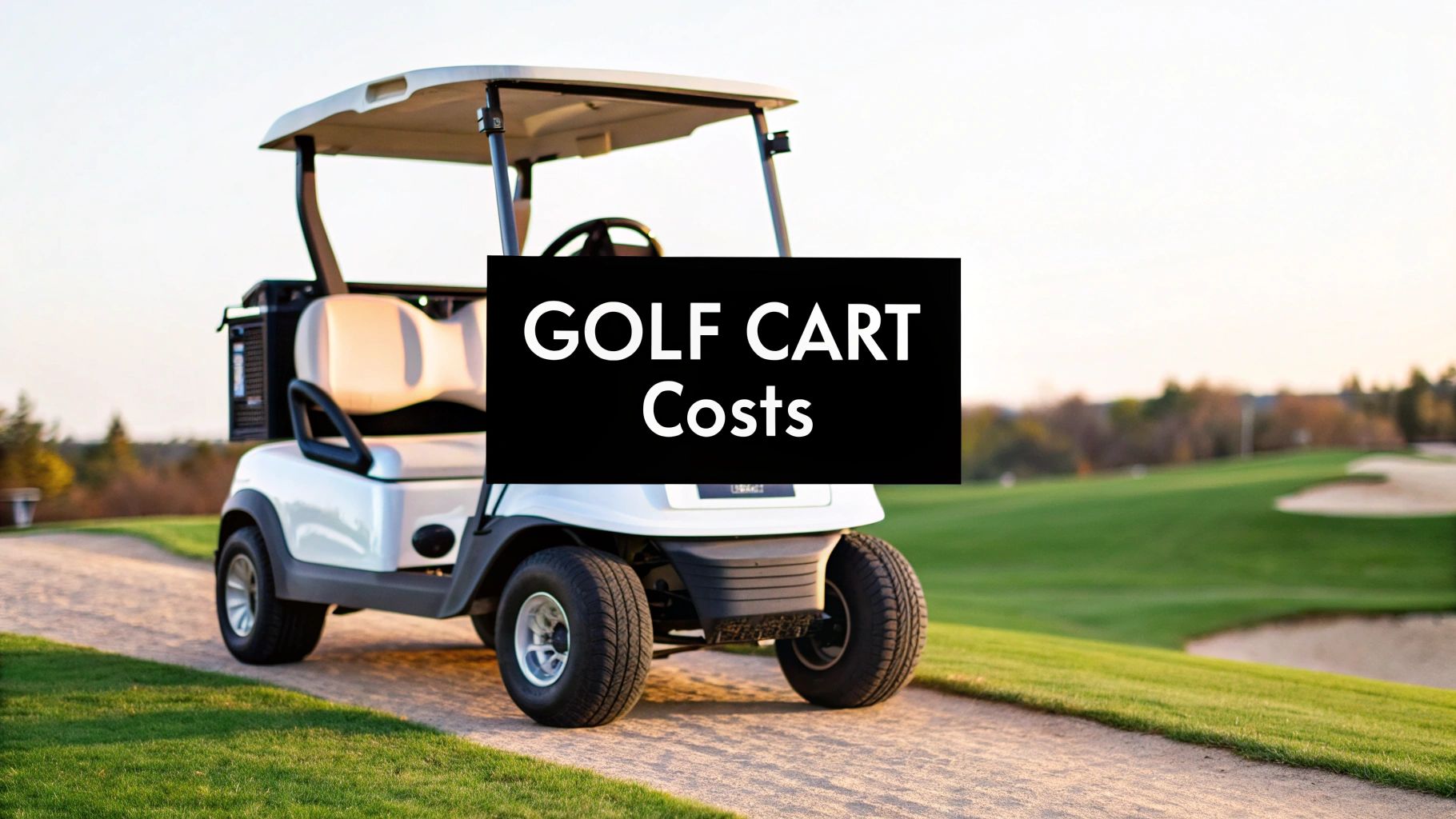
When you're in the market for a golf cart, the first question on your mind is probably, "How much is this going to cost me?" The short answer is, it depends. A brand-new golf cart will typically set you back somewhere between $8,000 and $12,000, while you can find a solid used model in the $2,500 to $7,000 range.
Of course, the final price tag is influenced by a lot more than just its condition. The powertrain, brand reputation, and any special features all play a huge role in what you'll end up paying.
Your Quick Guide to Golf Cart Costs
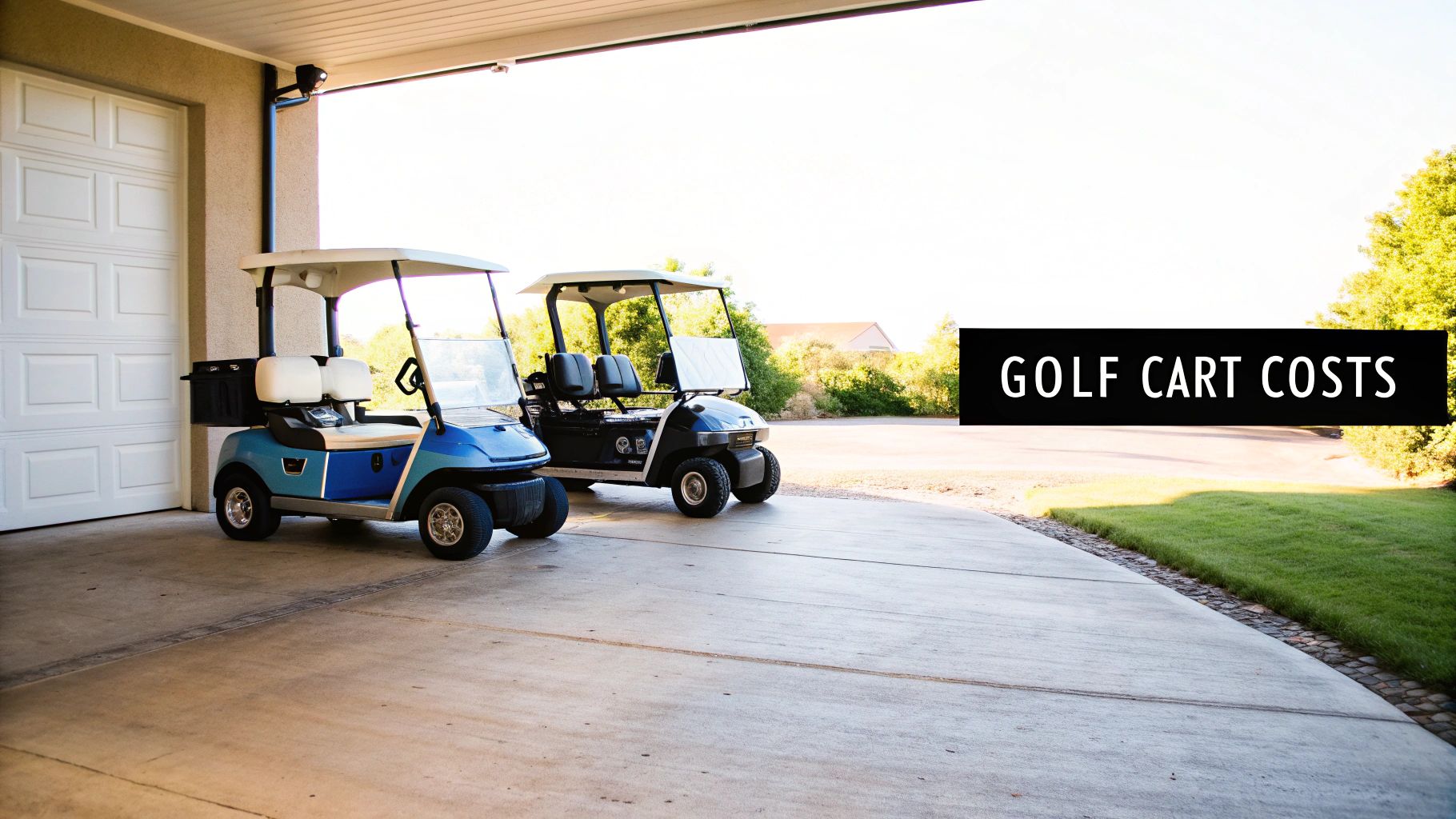
Before we get into the nitty-gritty of what drives the price up or down, it helps to have a general idea of the market. Think of it like buying a car—there's a whole spectrum of options. You can go for a basic, no-frills model for simple tasks, or you can get a fully customized, street-legal vehicle loaded with all the bells and whistles.
This overview is designed to give you a quick financial snapshot. Whether you’re eyeing a new electric cart for quiet cruises around the neighborhood or a budget-friendly used gas model for the course, knowing the typical price brackets is the first step to making a smart choice.
Typical Golf Cart Price Ranges at a Glance
To make things easier, here’s a quick breakdown of what you can expect to pay for new and used golf carts, separated by their power source. This table should give you a clear starting point for aligning your budget with the right type of cart.
| Cart Type | Condition | Average Price Range |
|---|---|---|
| Electric | New | $9,000 - $12,000 |
| Gas | New | $8,000 - $11,000 |
| Electric | Used | $3,000 - $7,000 |
| Gas | Used | $2,500 - $6,000 |
As you can see, there’s a noticeable difference not just between new and used, but also between gas and electric models. This gives you plenty of room to find something that fits both your needs and your wallet.
Understanding the Market Demand
Golf carts aren't just for the links anymore. They've become a go-to mode of transport in planned communities, on large properties, and even for commercial uses. This explosion in popularity is a major factor shaping market prices.
The global golf cart market is booming. It was valued at around US$2.85 billion in 2025 and is on track to hit US$4.18 billion by 2032. In 2024, the U.S. alone accounted for nearly 95% of the North American revenue share, showing just how much American golf culture drives demand.
For many players, especially those on a budget or seniors, the cost of a new cart can feel a bit steep. This is where options like power-assist units for push carts become a smart, cost-effective alternative. You can dig deeper into these trends in this comprehensive golf cart market report.
Decoding the Price of a New Golf Cart
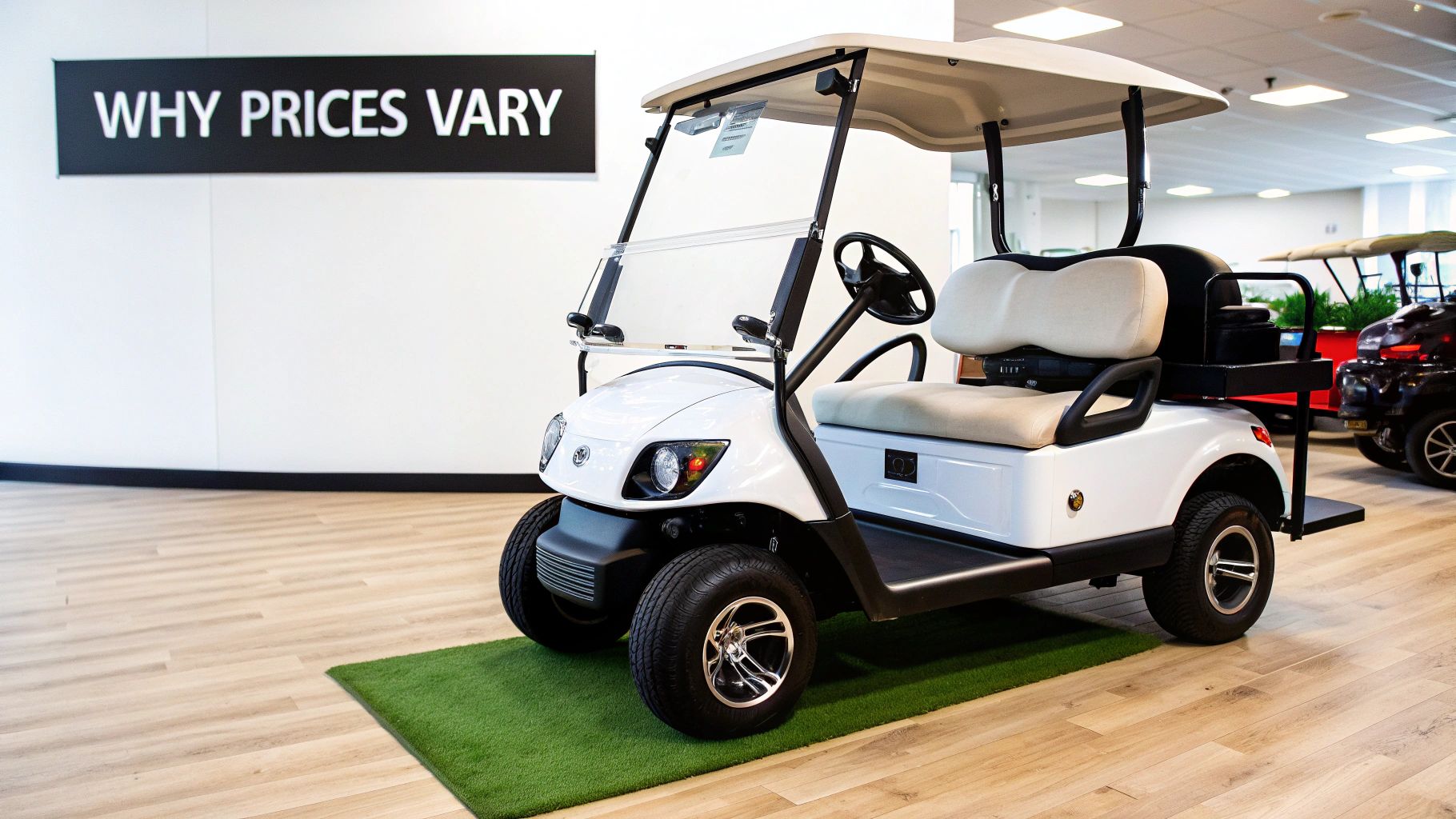
Walking into a golf cart dealership can feel a lot like stepping onto a car lot. You might see two carts that look nearly identical, but their price tags are thousands of dollars apart. What gives?
Just like buying a car, the final cost of a new golf cart is rarely the number you see on the sticker. Think of the manufacturer's suggested retail price (MSRP) as the starting line. A basic, no-frills, two-seater might start around $8,000, but that figure is just the beginning of the journey. The price climbs as you add features and choose premium options, so understanding what drives these costs is key to building a cart that fits your needs without destroying your budget.
The Powertrain: Electric vs. Gas
Your first big decision is choosing between an electric and a gas-powered cart. This choice really sets the financial baseline for everything that follows.
Generally, new electric carts tend to have a slightly higher upfront cost. This is mostly due to the price of their advanced battery systems, especially if you spring for modern, high-performance lithium-ion batteries over the old-school lead-acid ones.
On the flip side, new gas-powered carts often have a lower initial sticker price. But don't forget they come with their own set of long-term expenses, like filling up the tank and dealing with more complex engine maintenance. If you're weighing the pros and cons, our guide to buying a power golf cart can help you sort it out.
The initial price gap between electric and gas models is usually the first thing buyers notice. An electric model might run you $500 to $1,500 more than its gas-powered twin, and that difference almost always comes down to the battery technology.
Brand Reputation and Build Quality
Ever wonder why some car brands cost more than others? The same logic applies to golf carts. Established names like Club Car, E-Z-GO, and Yamaha have spent decades building a reputation for reliability, innovation, and top-notch materials. That trust and quality come with a higher price tag.
These top-tier manufacturers don't cut corners. They use superior components, from more durable frames to advanced suspension systems, which all add up to a smoother ride and a cart that lasts longer.
Of course, newer or budget-friendly brands can offer a much more attractive entry price. They can be a fantastic value, but it's always smart to do a little homework on their build quality and parts availability to make sure you’re making a solid long-term investment.
How Customizations Inflate the Final Cost
This is where the price can really start to take off. Customizations are how you turn a standard factory cart into your cart, one that perfectly matches your lifestyle. But every cool addition, from custom seats to a killer sound system, adds to the final bill.
Let's break down some common upgrades and what they typically cost:
- Seating: Swapping a standard two-seater for a four- or six-seater with a rear-facing flip seat can add $600 to $1,500 or more.
- Wheels and Tires: Ditching the standard wheels for custom alloy rims and rugged all-terrain tires will usually set you back $500 to $1,200.
- Performance Upgrades: Want more speed and torque? A high-performance motor or controller can cost an extra $400 to $2,000.
- Tech Packages: Adding goodies like a Bluetooth sound system, a GPS unit, or a digital dashboard can range anywhere from $300 to $1,500.
- Lithium Batteries: This is a big one. Choosing a lithium battery over standard lead-acid batteries is a major upgrade, often adding $1,500 to $3,000 to the price. The trade-off? A much longer lifespan, zero maintenance, and better performance.
Ultimately, the answer to "how much is a new golf cart?" is deeply personal. It starts with a base model and grows with every decision you make, from the engine under the seat to the speakers playing your favorite songs. By understanding these cost drivers, you can prioritize what really matters to you and build the perfect cart for your budget.
Finding Value in the Used Golf Cart Market
For a lot of buyers, the smartest way to get a golf cart isn't by heading to a shiny new showroom. It’s by exploring the bustling used market. Going with a pre-owned model can slash your initial cost by 50% or more, which is a massive draw. A well-maintained used cart gives you just about all the same perks as a new one, but for a fraction of the price, usually somewhere between $2,500 and $7,000.
Think of it just like buying a used car. You can find some incredible deals on reliable rides if you know what to look for. But if you’re not careful, you can just as easily end up with a lemon. This section is your playbook for navigating the second-hand market with confidence, so you can find a dependable cart that fits your budget perfectly.
Your Used Cart Inspection Checklist
Before you even start talking numbers, you need to put on your detective hat. A thorough inspection is the single most important thing you can do when buying a used golf cart. It reveals the true story of how the cart was treated and what surprise expenses might be hiding around the corner.
Here’s what you absolutely need to focus on:
- Battery Health is Paramount: For electric carts, the batteries are the heart of the machine—and the most expensive single part to replace. Check the date codes on them. Most lead-acid batteries will last you about 4-6 years. Ask the owner how they charged them and look for any crusty corrosion on the terminals.
- Frame and Chassis Integrity: Get down and look underneath the cart. You're searching for rust, cracks, or any weird bends in the frame. A little surface rust might just be cosmetic, but deep corrosion is a huge red flag. It’s a sign the cart was stored poorly or abused in harsh weather.
- Motor Hours and Performance: If there's an hour meter, check the reading. For a gas cart, listen to the engine. Does it start up easily? Does it run smoothly without puffing out a bunch of smoke? For an electric cart, take it for a spin. You want to feel smooth acceleration, not a jerky ride or any strange noises.
- Tires and Suspension: Check the tire treads and look for uneven wear, which could signal an alignment problem. Give each corner of the cart a good push down to test the suspension. It should feel firm, not like a bouncy castle.
Private Seller vs. Certified Dealer
Once you know what to look for, the next big question is where to look. You’ve basically got two main paths: buying from a private seller or going through a certified dealer. Each route has its own pros and cons that can really shape your buying experience and peace of mind.
A private sale will almost always get you the lowest price. You’re cutting out the middleman and the dealership overhead that gets baked into the cost. But this path comes with more risk. These sales are nearly always "as-is," meaning you get no warranty and no support after you drive off.
Buying from a certified dealer usually costs more upfront, but what you're really paying for is confidence. Dealers often inspect, refurbish, and sometimes even offer a limited warranty on their used carts, giving you a safety net against any immediate problems.
To help you figure out what's best for you, here’s a quick rundown:
| Feature | Private Seller | Certified Dealer |
|---|---|---|
| Price | Generally lower | Higher due to overhead and reconditioning |
| Warranty | Almost never offered | Often includes a limited warranty (e.g., 30-90 days) |
| Condition | Varies widely; "as-is" | Inspected and often refurbished |
| Selection | Limited to one vehicle | Multiple models and brands to compare |
| Paperwork | You handle the title transfer and registration | Dealer handles all paperwork for you |
In the end, choosing between a private seller and a dealer comes down to your comfort level with risk and how much legwork you’re willing to do. If you trust your inspection skills, a private sale can land you a fantastic deal. If you’d rather have a smoother, more secure transaction, a dealer is often the wiser choice.
The Hidden Costs of Golf Cart Ownership
When you’re eyeing a shiny new (or new-to-you) golf cart, it’s easy to get fixated on the price tag. But that initial number is just the first chapter in the full story of what it costs to own one. Think of it like buying a car or a house—the purchase price is only where the spending starts.
The real cost of ownership reveals itself over time. We're talking about maintenance, fuel or electricity, insurance, and the eventual need to replace major parts. A lot of first-time buyers get so caught up in the excitement of the purchase that they completely overlook these long-term expenses, which can seriously inflate the total investment.
Let's pull back the curtain on these ongoing costs so you can go in with a clear, complete financial picture before you commit.
The Big Ticket Item: Battery Replacement
For electric golf carts, the battery pack is the single most expensive part you'll have to replace. It's the heart and soul of your cart, acting as both the engine and the fuel tank. While they’re incredibly efficient, these batteries have a finite lifespan, and swapping them out is a major expense you absolutely have to plan for.
A standard set of lead-acid batteries will generally give you 4 to 6 years of service. When it’s time for a new set, you can expect to pay anywhere from $800 to $1,500. If you spring for a cart with a higher-end lithium-ion battery, you’ll get a much longer run—often 8 years or more. The trade-off? The replacement cost is steeper, typically falling between $2,000 and over $4,000.
Planning for battery replacement isn't optional for electric cart owners. A smart move is to set aside $20 to $30 a month in a dedicated "battery fund." That way, the big expense won't be a shock when it finally arrives.
Routine Maintenance and Upkeep
Just like your car, your golf cart needs regular TLC to keep it running safely and smoothly. These routine costs might seem small compared to a new battery pack, but they definitely add up over a year. Staying on top of maintenance doesn't just prevent bigger, pricier problems from cropping up—it also extends the life of your cart. For a deeper dive, check out our guide on golf cart maintenance costs.
Here are a few common jobs to budget for:
- Tire Replacement: You'll likely need new tires every 3-5 years. A full set will run you between $200 and $400.
- Brake Servicing: Regular brake checks and adjustments are a must for safety. A complete brake service can cost from $100 to $300.
- Annual Tune-Ups: For gas carts, this means oil changes, new spark plugs, and clean filters, which typically costs $100 to $250. Electric carts need less attention, but the connections and motor should still get a yearly once-over.
Long-Term Ownership Costs: Electric vs. Gas Golf Carts
The choice between an electric or gas powertrain will have a huge say in your long-term budget. While a gas cart can sometimes be a bit cheaper upfront, an electric model often works out to be more economical over its lifetime.
This table gives a clearer picture of what you can expect to spend each year.
| Cost Category | Electric Cart (Estimated Annual Cost) | Gas Cart (Estimated Annual Cost) |
|---|---|---|
| Fuel / Energy | $50 - $150 (Electricity) | $200 - $400+ (Gasoline) |
| Routine Maintenance | $75 - $150 | $150 - $300 |
| Major Replacements | Battery Pack (amortized) | Engine Parts (less frequent) |
| Total Estimated Annual Cost | $300 - $600 | $400 - $750+ |
As you can see, the lower fuel and maintenance needs of an electric cart usually lead to significant savings year after year.
Insurance and Customizations
Don't forget about the other odds and ends. If you plan on driving your cart on public roads (where permitted), you’ll most likely need insurance, which can run $100 to $300 per year. And while customizations are optional, they’re a very common expense—owners love adding personal touches like enclosures, sound systems, or lift kits to make their ride their own.
It's a booming market. The golf cart industry hit a market size of USD 2.6 billion in 2024 and is expected to grow at an 8% CAGR through 2034. Electric carts are leading the charge, holding a 63% market share thanks to their quiet, zero-emission operation. With new carts averaging $8,000-$12,000, it's no surprise many golfers are turning to power-assist units as a much more affordable way to motorize their walk without the full expense of a cart.
If you decide a used cart is the right move, make sure you know what you’re looking for. This checklist highlights the critical checks to perform so you don't end up inheriting someone else's expensive headaches.
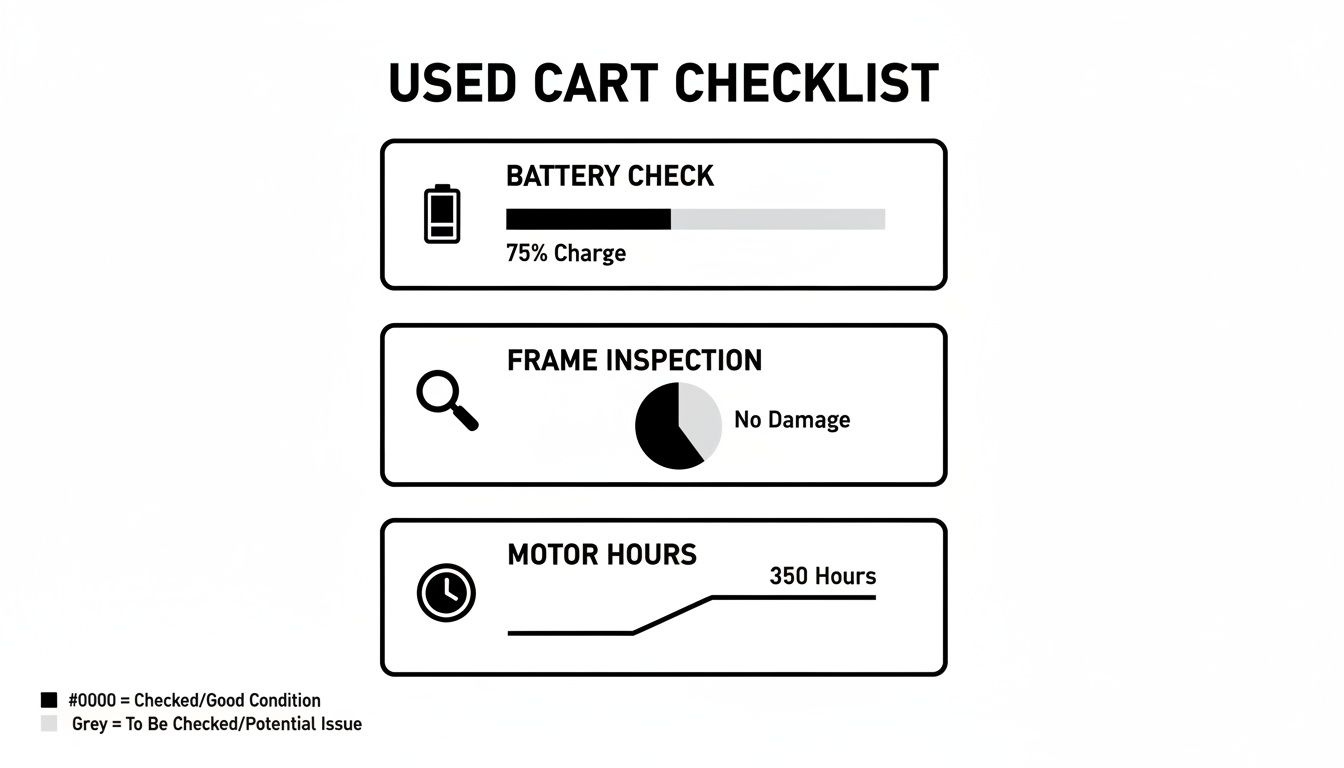
A thorough inspection of the battery system, frame integrity, and motor hours is non-negotiable. It's the only way to get a real sense of a used cart's value and what it might cost you down the road.
Exploring Smarter Golf Cart Alternatives
Before you sink thousands of dollars into a full-sized golf cart, it’s worth asking a simple question: is it actually what you need for the course? For many golfers who love to walk, the answer is a clear no. A traditional cart can feel like total overkill when your main goals are just to save a little energy and cruise up those tough hills.
This is where smarter, more practical alternatives come into the picture. Instead of a massive investment, you can get the core benefit of a cart—motorized assistance to reduce fatigue—without the high price tag, storage headaches, and constant upkeep.
Rethinking Your Needs on the Course
Let’s be honest about the real problem a cart solves during a round. It’s not about having a roof or extra seats. It’s about not having to shove 30+ pounds of clubs up a steep fairway on the 16th hole when your legs are already tired.
Motorized power-assist units are engineered to solve this exact problem for a fraction of the cost. An option like the Caddie Wheel attaches right to your existing push cart, turning it into a remote-controlled caddie that does all the heavy lifting. It gives you the power to glide over any terrain, letting you save your stamina for what really matters: your game.
By focusing on the one thing you truly need—motorized help—you get to sidestep all the complexities that come with owning a full cart. You get the function without the financial gut punch, which is a huge win for any golfer.
Comparing Costs: A Direct Look
Let's break down the numbers. A brand-new golf cart can easily run you $8,000 to $12,000. Even a decent used model will set you back several thousand dollars. That's a serious expense, especially when you start adding in the long-term maintenance costs.
In sharp contrast, a power-assist unit is a much smaller, one-time investment. You get the crucial advantage of motorized power without the extra costs of insurance, battery replacements, and potential repairs that a full-sized vehicle demands. For most players, it's just a far more sensible financial move. You can learn more about transforming your current setup in our guide on golf push cart electric conversion kits.
Understanding the Market Shift
There's no denying the demand for golf carts. The North American market hit USD 920.8 million in 2024 and is expected to climb to USD 1.356 billion by 2033. Electric models are leading the charge, capturing over 63% of the global share.
But this growth doesn't mean a massive cart is your only choice. In fact, this shift toward electric power highlights a key point for walkers: why spend thousands on a vehicle when a simple, elegant electric assist can achieve the same on-course goal? It’s all about matching the solution to the actual problem.
It’s helpful to look at similar markets for perspective. For instance, the cost-benefit analysis of electric bikes offers great insights into the ownership experience and long-term value of smaller personal electric vehicles.
For walkers, seniors, and anyone who wants the health benefits of walking without the strain, a power-assist unit offers a compelling blend of performance, convenience, and massive savings. It’s not just a cheaper option; for many, it's a smarter one.
Answering Your Top Golf Cart Cost Questions
Alright, so you're getting close to making a decision. This is usually when a few final, nagging questions pop up. Getting these sorted out is often the last step to feeling truly confident in your choice. Let's tackle the most common ones we hear from buyers.
We'll cover everything from how long those pricey batteries actually last to whether paying extra for street-legal features is a smart move.
How Long Do Golf Cart Batteries Really Last?
This is a big one, especially if you're leaning toward an electric cart. The lifespan of your batteries has a huge impact on your long-term ownership costs. With standard lead-acid batteries, you can realistically expect four to six years of solid performance, assuming you take good care of them.
Lithium-ion batteries are a whole different ballgame. Yes, they cost more upfront, but they often last eight years or more and are virtually maintenance-free. The real takeaway here is to think about that future replacement cost when you're comparing a cart with lead-acid batteries to one with lithium.
Is It Worth Paying Extra for a Street-Legal Cart?
Making a golf cart street-legal means adding safety gear like headlights, tail lights, turn signals, mirrors, and a proper windshield. This process can tack on anywhere from $500 to over $2,000 to the price tag. The million-dollar question is: do you need it?
The answer comes down to how you plan to use it. If you're in a community where you'll be driving on public roads (usually those with speed limits of 35 mph or less), then going street-legal isn't just "worth it"—it's required by law. But if your cart is going to live its entire life on the golf course or your own property, you can save a good chunk of cash by skipping the upgrades.
Before you spend a dime on street-legal features, do a quick check on your local and state laws. Regulations can be surprisingly different from one town to the next. A little homework upfront ensures your investment is both legal and useful.
When Is the Best Time of Year to Buy a Golf Cart?
Just like buying a car, timing your purchase can save you some serious money. The best deals are almost always found during the off-season, which generally runs from late fall through the winter months.
- End of Golf Season: As the weather gets colder, demand plummets. Dealerships get motivated to clear out the previous year's models to make space for the new ones.
- Holiday Sales: Keep an eye out for promotions around Black Friday or year-end clearance events. You can often snag some pretty decent discounts.
Shopping when things are slow gives you more leverage to negotiate and a better shot at finding a great price on both new and used carts. A little strategic planning can go a long way.
Ready to skip the high costs and maintenance of a traditional cart? The Caddie Wheel gives you the motorized power you need to conquer any course without the hassle. Transform your push cart and enjoy the walk.
Learn more at https://caddiewheel.com.
Share:
A Golfer's Guide to Electric Remote Golf Carts
A Golfer's Guide to the Golf Cart Battery Gauge