
If you're looking to make your electric golf cart faster, the secret lies in upgrading its core power components. The most direct routes to more speed are boosting the battery voltage, swapping in a high-performance speed controller and motor, or even just reprogramming your existing controller to unleash its hidden potential. Any of these changes will have a big impact on the power and RPMs getting to your wheels.
Understanding What Controls Your Golf Cart's Speed
Before you start breaking out the tools or clicking "add to cart" on new parts, it's really important to get a handle on what actually makes your golf cart go. Think of it like a team—if you upgrade one player, the others need to be able to keep up. Most stock electric carts are intentionally capped at a leisurely 12-15 mph for safety reasons on the course.
That speed limit isn't an accident. It's a carefully engineered balance between the motor, the speed controller, and the battery system. Figuring out how these pieces work together is the first step to making smart, effective upgrades that won't just burn out your system.
The Core Components of Speed
Your cart’s top speed isn’t down to just one part; it’s a team effort between several key systems. Here’s a quick rundown of the main players:
- The Motor: This is the muscle of your cart. It’s responsible for converting electrical energy from the batteries into the spinning force that turns the wheels. Its specific design dictates the maximum RPM and torque it can handle.
- The Speed Controller: If the motor is the muscle, the controller is the brain. It acts as a gatekeeper, regulating how much electricity flows from the batteries to the motor. This is what manages your acceleration and top speed, and most factory controllers are programmed to be very conservative.
- Battery Voltage: Think of your battery pack as the fuel tank. Bumping up the voltage—say, from a 36V system to a 48V one—is like increasing the electrical pressure. It lets the motor spin faster and kick out more power.
- Tire Size: This one gets overlooked a lot, but the diameter of your tires can act like a final gear change. Bigger tires cover more ground with every single rotation, giving you a small but noticeable boost in top speed.
Understanding how these parts interact is everything. For instance, dropping a powerful new motor into your cart without upgrading the controller is like putting a race car engine into a go-kart with a governor—you’ll never tap into its real power. For a much deeper dive, check out our detailed guide on electric golf cart speed control.
To give you a clearer picture, here's a quick look at how each major part affects your cart’s speed and the performance jump you can expect from an upgrade.
How Key Components Impact Your Cart's Speed
| Component | Stock Performance (Avg. MPH) | Upgraded Potential (Avg. MPH) | Primary Role in Speed |
|---|---|---|---|
| Motor | 12-15 | 18-22 | Converts electrical energy into rotational force (RPM). |
| Controller | 12-15 | 20-24 | Regulates power flow from the battery to the motor. |
| Battery Voltage | 12-15 (36V) | 18-22 (48V+) | Provides the electrical pressure needed to spin the motor faster. |
| Tires (Size) | 12-15 (Standard) | 14-17 (Oversized) | Increases the distance covered per wheel rotation. |
Upgrading any one of these can give you a boost, but upgrading them together is where you'll see the most dramatic results.
Why Your Stock Cart Is Slow
Did you know that the average electric golf cart straight from the factory tops out at a modest 12-15 miles per hour? It's true. But what's also true is that a straightforward motor and controller upgrade can easily push that number up to an exciting 20-24 mph. Savvy owners have been doing this for years, ever since aftermarket parts became widely available.
The key takeaway is that your cart is almost certainly capable of more. Manufacturers build them with safety and battery life as the top priorities, not raw speed. That leaves a lot of performance on the table for you to unlock with the right tweaks.
Interestingly, many of the core ideas for speeding up electric vehicles are universal. If you want a broader perspective, this guide on how to make an electric bike faster shares some surprisingly similar principles. A little foundational knowledge goes a long way in making sure you spend your money wisely.
If you're really serious about getting more speed out of your electric golf cart, the power system is where the magic happens. The biggest performance jump comes from two key components: the battery pack and the speed controller. These two work in tandem to deliver—and manage—the raw power your motor craves.
I like to think of it this way: your batteries are the gas tank, and the controller is the throttle. A bigger tank (higher voltage) and a more aggressive throttle (higher amperage) are the surefire ways to unlock some serious speed and torque.
The Lithium Battery Advantage
For years, the golf cart world ran on heavy, clunky lead-acid batteries. They get the job done, but they’re saddled with some major drawbacks when it comes to weight and consistent power delivery. Switching to a modern lithium-ion battery pack is one of the single most effective upgrades you can make.
The difference is night and day. Right away, you'll notice:
- Massive Weight Reduction: Lithium batteries are often 50-75% lighter than their lead-acid cousins. Dropping that much weight instantly makes your cart feel more nimble and improves acceleration.
- Consistent Voltage: Lead-acid batteries sag. As they drain, their voltage drops, making your cart feel sluggish. Lithium packs, on the other hand, maintain a steady voltage until they're nearly empty, giving you full power for longer.
- Faster Charging and Longer Lifespan: Not only do lithium batteries charge way faster, but they can also last up to 10 times longer than traditional batteries. It's a smart investment that pays for itself over time.
The data backs it up. We’ve seen electric golf carts gain 25-40% more speed just from swapping out lead-acid for high-capacity lithium-ion packs. That’s enough to take a cart from a leisurely 12 mph to a zippy 18-20 mph. This kind of performance boost has helped drive a 300% surge in lithium battery adoption in the U.S. golf cart market since 2015. For a closer look at the numbers, our guide to golf cart lithium conversions breaks it all down.
https://caddiewheel.com/blogs/golf-content/golf-cart-lithium
Unleash Potential with a Performance Controller
If the batteries are the fuel, the speed controller is the brains of the operation. The controller that came with your cart was programmed at the factory with one goal in mind: safety and longevity. It limits the amperage to protect the motor and stretch the battery life, not to win any races. An aftermarket performance controller, however, is built for one thing: go-fast.
A high-amperage controller opens the floodgates, allowing more current to flow from the batteries to the motor. You'll feel it most during acceleration and when climbing hills. It translates directly to quicker take-offs, more hill-climbing torque, and a higher top speed.
This flowchart pretty much sums up the decision-making process for getting more speed.
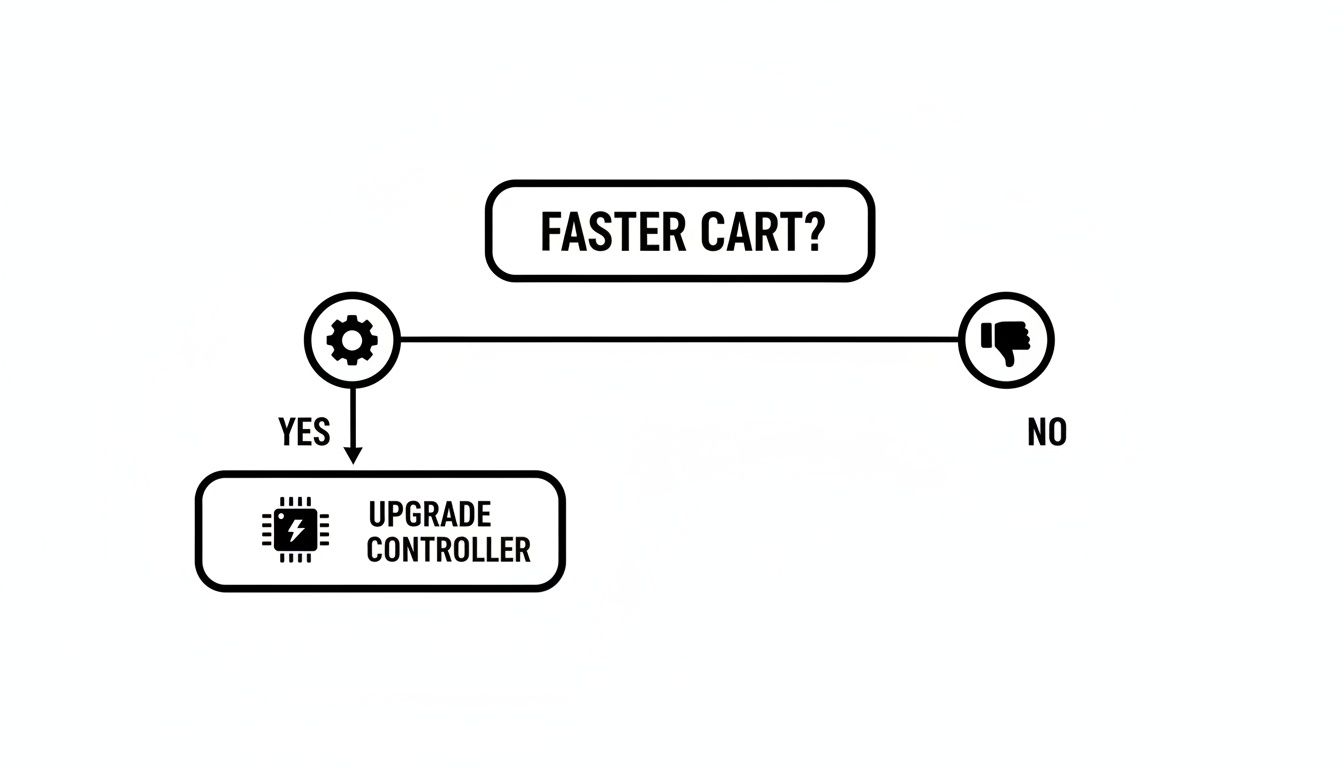
As the chart shows, if you want your cart to be faster, upgrading the controller is one of the most direct routes you can take. It’s the central hub for all your speed modifications.
When you start looking at these critical parts, it’s really important to weigh your options. Taking the time and understanding OEM vs. aftermarket options is crucial for getting the performance you want without sacrificing long-term reliability. A quality controller paired with a powerful battery setup is the absolute foundation for a fast, responsive, and fun-to-drive electric cart.
Choosing the Right Motor for Your Speed Goals
Okay, so you've upgraded the batteries and the controller. Your cart now has the juice it needs to really perform. The next piece of the puzzle is the electric motor itself—this is what will actually translate all that newfound power into speed and acceleration on the ground.
Don't just go out and buy the biggest, most expensive motor you can find. This is about making a strategic choice. Swapping the motor is all about matching its performance characteristics to what you actually do with your cart.
This is where you have to be honest with yourself about what kind of speed you really want. Are you looking to hit the highest possible top speed while cruising down paved community roads? Or do you need raw, stump-pulling muscle for tackling steep, muddy hills on your farm or hunting lease? Your answer will point you toward either a high-speed motor or a high-torque motor.
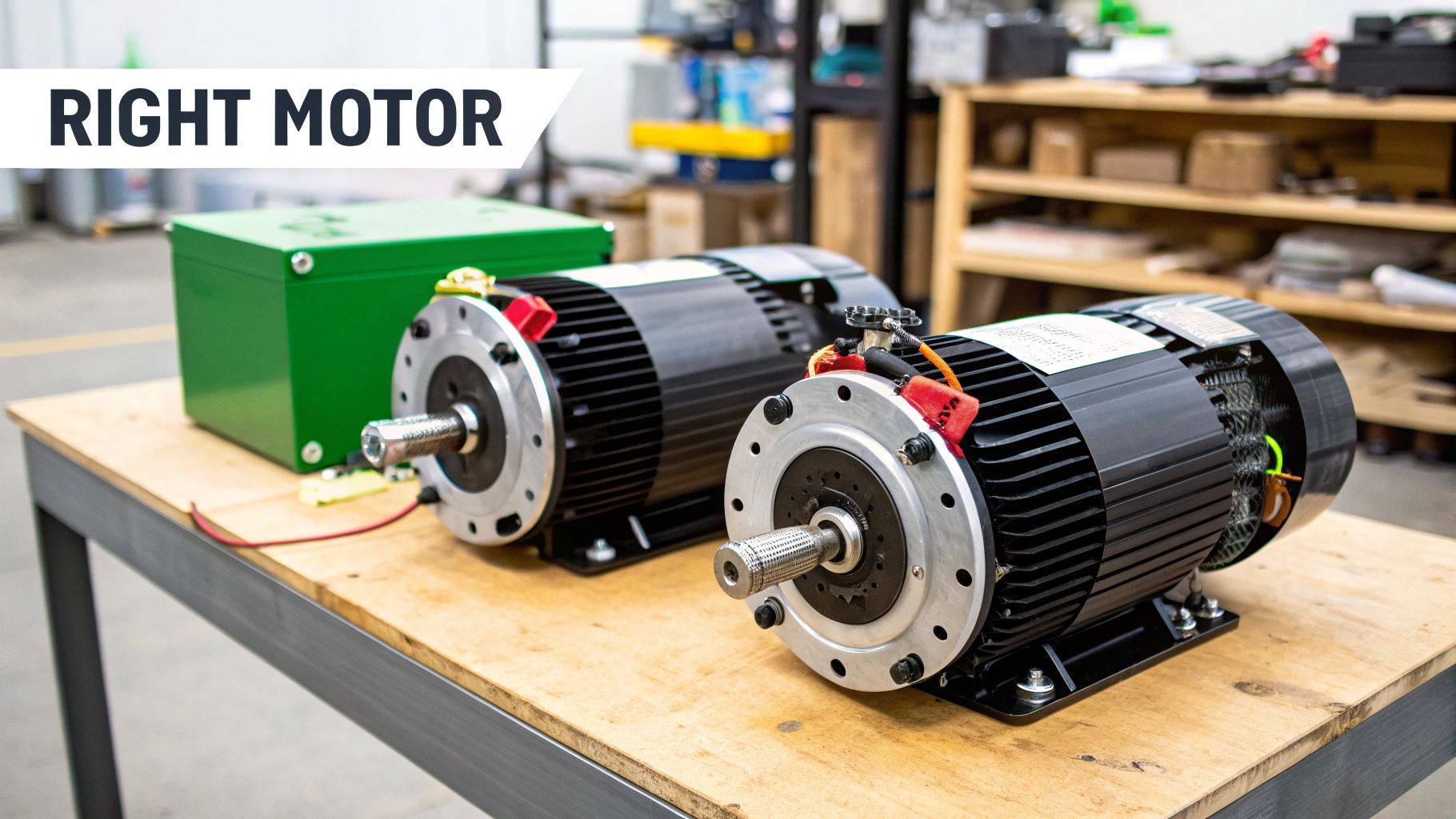
High Speed vs High Torque Motors
When people start thinking about how to make an electric golf cart faster, the conversation almost always boils down to these two types of aftermarket motors. Getting this choice right is crucial, so let's break down the trade-offs.
-
High-Speed Motors: These are built for one thing: RPMs. They are designed to spin incredibly fast, which directly translates to a higher top-end speed on flat surfaces. If your cart spends most of its life on asphalt and you want to keep up with neighborhood traffic, this is your ticket. The downside? They often feel a bit weak on takeoff and can struggle with hills.
-
High-Torque Motors: Think of these as the workhorses. They generate immense twisting force (torque) right from a dead stop. This gives you that satisfying, throw-you-back-in-your-seat acceleration and the grunt to climb steep inclines without breaking a sweat. They won't set any land speed records on a long straightaway, but they make the cart feel incredibly responsive and powerful under load.
The decision here is critical. A high-speed motor will feel sluggish and disappointing on a hilly golf course. On the other hand, a high-torque motor will get you up that incline with ease but might not have the top-end speed you're craving for those long, flat stretches.
If you want to get into the technical nitty-gritty, our guide on how to choose the best electric motor for a golf cart offers a complete breakdown of the specs you should be looking at.
Pairing Your Motor with Gearing
For the real performance junkies out there, the final frontier is matching your motor choice with your cart's differential gearing. This is definitely a more advanced modification, but it gives you precision control over that balance between speed and acceleration. It's a lot like changing the gears on a bicycle.
You can install higher-speed gears (which have a numerically lower ratio, like 8:1) to truly maximize your top speed. This pairs perfectly with a high-speed motor.
Conversely, you can install lower-speed, high-torque gears (a numerically higher ratio, like 15:1). This multiplies the motor's torque, giving a high-torque motor even more hill-climbing power.
Choosing the right motor isn't just an upgrade; it's about turning your cart into a purpose-built machine. When a well-chosen motor is powered by an upgraded battery bank and a matched controller, you transform your ride from a generic utility vehicle into a cart that's perfectly dialed in for your environment and driving style.
Boosting Speed with Smarter Efficiency Mods
Big, expensive power upgrades are definitely exciting, but they aren't the only way to get more speed out of your electric golf cart. Honestly, some of the smartest gains come from improving efficiency—just making the absolute most of the power you already have.
This whole approach is about hunting down and eliminating anything that causes unnecessary drag or friction. You'd be surprised how these small, often-overlooked tweaks can add up to a noticeable difference in top speed and how responsive the cart feels off the line. It's all about working smarter, not just harder.
Upgrade Your Tires for a Mechanical Advantage
One of the easiest efficiency mods you can make is swapping to larger-diameter tires. Think of it like a simple gear change, but without ever having to crack open the differential.
A larger tire covers more ground with each rotation, which can bump your top speed by 2-4 mph without any other changes. For example, jumping from a standard 18-inch tire to a 20-inch or even a 22-inch tire effectively changes your final drive ratio. This lets the motor spin in its happy place (its optimal RPM range) while pushing the cart faster down the path. Just make sure your cart has enough fender clearance to avoid rubbing!
Shed Unnecessary Weight
Every single extra pound your motor has to lug around requires energy that could be going toward speed. Dropping your cart’s overall weight is a completely free and effective way to boost both acceleration and top-end performance. A lighter cart is just plain easier to move.
Start by looking for the low-hanging fruit:
- Remove Heavy Accessories: Do you really need that heavy-duty cargo box or rear-facing seat every single time you go out? Taking them off can shed a surprising amount of weight.
- Ditch the Roof: If you only use your cart in fair weather, taking off the roof and its supports can reduce weight and cut down on aerodynamic drag.
- Upgrade to Lithium Batteries: As we touched on earlier, this is a big one. Switching from old-school lead-acid to modern lithium batteries can instantly slash hundreds of pounds off your cart, giving you a massive efficiency gain.
Fine-Tune Your Cart with Basic Maintenance
Sometimes, the secret to more speed isn't a flashy upgrade at all—it's just good, old-fashioned maintenance. A cart that's fighting against itself will always feel sluggish because neglect creates friction that quietly steals your power and speed.
A well-maintained cart is an efficient cart. Drag from underinflated tires or misaligned brakes can rob you of several miles per hour without you even realizing it. These small fixes ensure all your motor's power is dedicated to moving you forward.
To minimize that resistance, focus on these key maintenance points:
- Check Tire Pressure: This one is non-negotiable. Underinflated tires create a bigger contact patch with the ground, which drastically increases rolling resistance. Inflate them to the manufacturer’s recommended PSI—it’s the easiest speed boost you'll ever get.
- Inspect Wheel Bearings: Worn-out or poorly greased wheel bearings create a ton of friction. If you hear a grinding noise coming from the wheels or they just don't spin freely when you jack up the cart, it's time for a replacement.
- Adjust the Brakes: Make sure your brakes aren't dragging. A misaligned brake shoe can constantly rub against the drum, acting like a permanent handbrake that slows you down, kills your range, and prematurely wears out your parts.
Staying Safe and Street Legal with a Faster Cart
Adding more power and speed is a blast, but it also comes with some serious new responsibilities. The moment you push your cart past its factory-set limits, you’re stepping into a new world of safety and legal rules. To really enjoy that newfound speed, you have to take the right precautions to protect yourself, your passengers, and your investment.
The first and most critical upgrade you need to make is to your braking system. Stock golf cart brakes are only designed to stop a vehicle cruising at around 15 mph. They were never meant to handle a cart flying down the road at 25 mph or more. Relying on them at higher speeds is just asking for trouble.
Upgrading Your Brakes Is Non-Negotiable
When you significantly crank up your cart's top speed, you absolutely must upgrade your brakes to match. Standard mechanical drum brakes just don't have the stopping power to handle the extra momentum safely. This isn’t a friendly suggestion; it's a necessity.
The best solution, hands down, is to install a hydraulic disc brake system. This upgrade provides vastly superior stopping power and reliability, giving you the confidence to control your souped-up cart in any situation. Think of it as an essential part of the speed upgrade package, not some optional add-on.
A faster cart that can't stop is just a faster accident waiting to happen. Make your braking system upgrade the top priority before you even think about pushing your cart to its new limits.
Navigating Local Laws and Regulations
Just as crucial as safety is making sure you’re street legal. Many towns, homeowner associations, and municipalities have strict rules for golf carts on public roads. In many places, a vehicle that can go faster than 20-25 mph is no longer considered a "golf cart." It gets reclassified as a Low-Speed Vehicle (LSV).
This reclassification brings a whole new set of requirements you have to meet:
- Safety Equipment: LSVs are typically required to have headlights, taillights, turn signals, mirrors, seatbelts, and a windshield.
- Registration and Insurance: You'll likely need to get a vehicle identification number (VIN), a license plate, and proper insurance coverage, just like a car.
- Speed Limits: You have to follow all posted speed limits, and LSVs are often restricted from roads where the speed limit is over 35 mph.
Before you finish your upgrades, do yourself a favor and check your local and state regulations. Getting pulled over because your modified cart is technically an unregistered motor vehicle is a surefire way to ruin a fun day.
Finally, keep in mind that most of these modifications will almost certainly void your cart's factory warranty. Manufacturers can't be expected to cover parts that are being pushed far beyond their original design specs. Be ready to take full ownership of any future repairs and maintenance.
Your Top Questions About Golf Cart Speed Answered
Even after mapping out all the upgrades, you've probably still got a few questions rattling around. That's completely normal. Let's tackle some of the most common things people ask when they start looking into making their electric golf cart faster.
We'll give you clear, straight-up answers to help you make good decisions, sidestep common mistakes, and really understand what these upgrades mean in the real world.
What Is the Easiest Way to Make My Golf Cart Faster?
The simplest, and often cheapest, first move is to upgrade or reprogram your speed controller. Most modern carts from the big names—Club Car, EZ-GO, and Yamaha—come with conservative speed limits programmed right at the factory, mainly for safety and managing fleets.
A professional can plug in and apply a "speed code," or you can grab a plug-and-play aftermarket controller yourself. Just that one change can often take you from a standard 14 mph up to around 19 mph without touching a single wrench on the motor. It’s easily the best bang for your buck to get started.
Will Making My Golf Cart Faster Drain the Battery Quicker?
Yes, absolutely. Running at higher speeds asks more from your battery pack, which means you won’t get as much range on a single charge. It's simple physics: a more powerful motor and a high-amperage controller need to pull more electricity to generate that extra speed and torque, especially when you punch the accelerator.
But you can often cancel out this extra power draw by switching to a lithium-ion battery pack.
Lithium batteries are way lighter and much more efficient than the old-school lead-acid ones. So while your motor is using more juice to go faster, the battery system itself is wasting less energy. The end result is often a similar, and sometimes even better, range than you had before any of the speed upgrades.
How Much Does It Cost to Get a Golf Cart to 25 Mph?
The price tag can swing pretty wildly depending on what cart you're starting with and the quality of parts you choose. To safely and reliably hit 25 mph, you’re not just looking at one part; you’re looking at a whole package of upgrades working together.
Here’s a rough breakdown of what you might be spending:
- High-Speed Motor: $500 - $800
- High-Amperage Controller: $400 - $700
- Lithium Battery Conversion: $1,500 - $3,000
- Brake Upgrade (Highly Recommended): $300 - $600
All in, you should probably budget somewhere between $2,500 and $4,500 for a complete, professional-grade setup that can consistently and safely top 25 mph.
Are There Any Major Risks When Making a Golf Cart Faster?
You bet. The two biggest things you need to think about are safety and legality. The stock brakes, steering, and suspension on a golf cart were designed for cruising around at 15 mph, not flying at 25 mph. Upgrading your brakes to a disc or hydraulic system isn't just a suggestion—it's critical for being able to stop safely from those higher speeds.
On the legal side, many states and local communities reclassify vehicles that can go over 20 or 25 mph as Low-Speed Vehicles (LSVs). That means they need specific safety gear like seatbelts, lights, a horn, and even a VIN to be street legal. Do yourself a favor and check your local laws before you take your newly souped-up cart out on the road.
Ready to transform your walk on the course? The Caddie Wheel makes any round easier by adding powerful, remote-controlled electric assist to your existing push cart. Learn more and get yours today at CaddieWheel.com.
Share:
Your Guide to Golf Cart Lithium Battery Upgrades
8 Actionable Tips for Senior Golfers to Play Smarter in 2025